Central (polyhedral) model of the cube inversion
The Central Model of the Cube Inversion
December 31, 2001
You have all seen, endlessly, a strange object rotating on the left side of the home page of the site. What is it about?
One day, when I have time, I will install on the site a description of the sphere inversion, as I had illustrated in the January 1979 issue of Pour la science, that is ... 22 years ago. Obviously, this would require many details and an introduction. What does it mean to turn a sphere? A sphere does not have the same meaning for the average person and the mathematician-geometer. For the average person, it is defined as the set of points located at a distance R from a fixed point O in a three-dimensional space. A geometer would continue to call "sphere" an object that would correspond to a "deformed sphere", a sort of "potato". To better grasp all these concepts, get the Lanturlu CD containing the comic strip "Le Topologicon". But the mathematician goes even further. When a surface is called "regular", a tangent plane can be defined at each of its points. This already allows considering an infinite number of deformations of the "original sphere" into an infinite number of "potatoes", when the area of the said surface can be arbitrary. However, in a "physical universe", the person deforming this sphere would face the impossibility of making it intersect itself. If these intersections or even these contacts are forbidden, one would then speak of "embeddings" of the sphere S2. But a mathematician gives himself all rights. A sphere is, for him, a "virtual" object where the intersections of surfaces become possible. The following drawings show a sphere that has "self-intersected". This representation of the sphere is then called an "immersion".
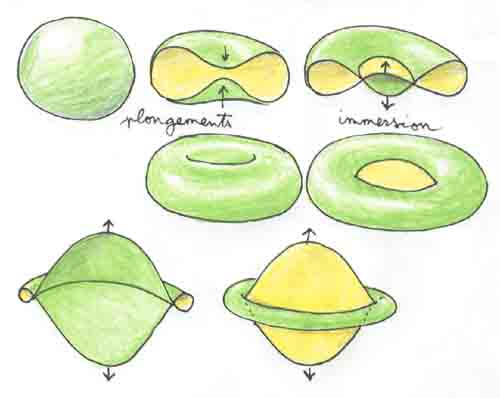
An immersion has a set of self-intersections (here a simple circular curve). The tangent plane must vary continuously. However, when looking at the drawings above, one can see that the operation turns a part (represented in green) of the inside of the sphere to the outside. To complete such an inversion, one would have to flatten this kind of equatorial tube. This seems, at first glance, problematic. This flattening would break the continuity of the tangent plane. The operation would therefore include a step that is not an immersion.
One day, an American mathematician, Stephen Smale, proved that "the sphere S2 has only one class of immersion". The corollary of this cryptic sentence was that one should be able to chain a sequence of immersions of the sphere to go from the "standard sphere" to its "antipodal" representation, that is, where all points have been replaced by their antipode. In short ... a sphere turned inside out. Raoul Bott was Smale's advisor. While Smale's purely formal proof seemed flawless, no one could see how to perform the operation. Bott constantly told Smale "show me how you would proceed", to which Smale, with his famous tongue-in-cheek reply, answered "I have no idea". Smale later received the Field Medal, equivalent to the Nobel Prize, but for mathematics. By the way, you may wonder why Nobel never wanted to create a Nobel Prize for mathematics. The answer is simple: his wife left him with a mathematician.
Things remained in that state for many years until an American mathematician named Anthony Phillips published in 1967 in Scientific American a first version of this inversion, extremely complicated. The second was invented in the early 1970s by the French mathematician (blind) Bernard Morin. I was the first to draw this sequence of transformations, which, as I have already said, will be the subject of a forthcoming paper on the site, quite lengthy, by the way. In any case, this leads us to an additional conclusion. Surfaces can be represented in polyhedral form. A cube or a tetrahedron can be considered as polyhedral representations of the sphere, as these objects have the same topology. For this point, consult my comic strip "Le Topologicon". Moreover, it becomes clear that if it is possible to turn a sphere, it is also possible to turn a cube. The transformation invented by Bernard Morin (which I illustrated in the January 1979 issue of Pour la science) goes through a central model. There is a symmetry in this sequence. This is called "the four-ear central model". Again, I am anticipating. But just as a sphere can be represented in polyhedral form, so can the successive steps of these transformations. The object you see rotating on my home page is thus the polyhedral version of the central model of the sphere inversion, a model I invented about ten years ago. The interest of these polyhedral models is that they can be constructed with flat surfaces. You can even arrange them according to cutouts. Take a look at the drawing below (I would like to thank my friend Christophe Tardy, who produced the correctly dimensioned elements).
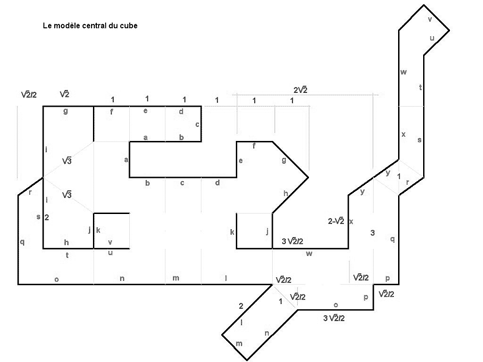
**This is a drawing that would come out on your printer in small format, not usable. **
To print this figure on an A4 sheet
You need to make four copies on thick A4 paper, two sheets of one color, two sheets of another
This is a general view of the cutout. But for printing, it is better that you go to the cutout page. Print it. Then, with this printed copy on the normal paper of your printer, go to a photocopier and make four identical copies of this drawing, two on green cardboard sheets and two on yellow ones. With this cutout, you will be able to build the central model of the cube inversion.
On these cut-out elements, you have pairs of letters: a, b, c, d, e, f, etc. You just need to fold them by bringing the same letters into coincidence, then assemble these facets with transparent tape. The following drawings show how to assemble one of the four elements. Here is how you should start folding one of the four elements first:
Here are two of these four elements, viewed from different angles.
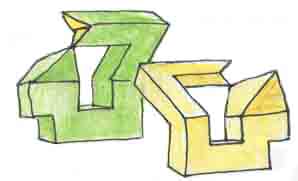
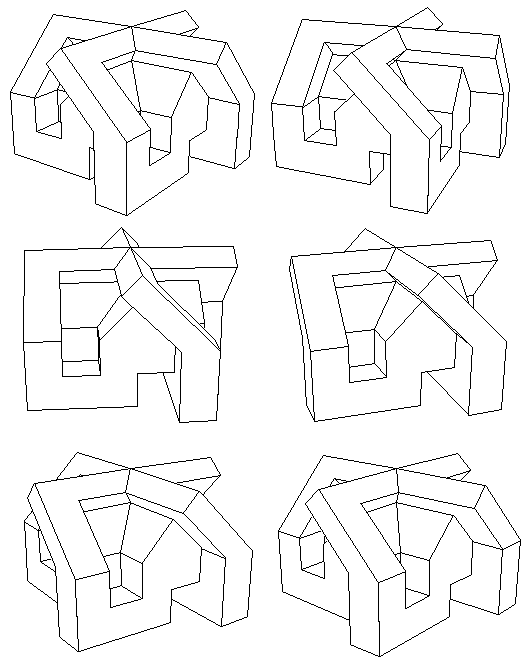
These then fit together to form an object with four-fold symmetry or alternating green and yellow elements. To see this in 3D, take a look at Tardy's "virtual reality" realizations. The fully assembled central model is also available in "vrml" in this section. Here is this object, viewed from different angles:
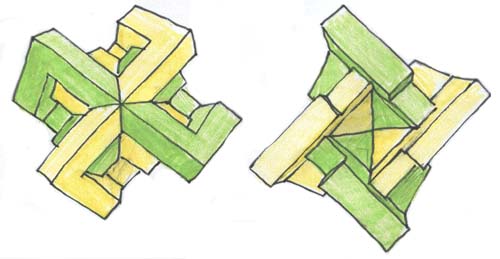
It cannot be said that one view corresponds to the "top" and the other to the "bottom" since these denominations would be completely arbitrary. On the left view, the "central" point corresponds to the "double point" (where...)