Untitled Document
The Icelandic Revolution
A Reality or a Myth?
Posted online on August 31, 2012
I found this text on a website. I no longer remember which one. It doesn't matter. For quite some time now, my readers have been asking me to put online a presentation of the economic, monetary and financial problems our planet is facing. I could do it. But I can't be on all fronts. The nuclear issue, well handled, is already quite a lot.
Of course, I am perfectly aware of the submission of our governments to the power of banks. Who doesn't remember the complicity of two successive presidents, Pompidou and Giscard d'Estaing, that accordion player. How can one be so foolish as to pay a fortune for a "d'Estaing" with a proletarian name? With his initials intertwined on the shaded property of his house.
These people are amazing, who give furious kicks to climb to the top. Isn't it said that Pompidou used to go to pee at the same time as de Gaulle? All this to end up "by the way of everyone", as King David said to his son Solomon, sensing his end is near. There is something pitiful and grotesque in all these men's lives.
This did not prevent Giscard from actively contributing to the drafting of the European Constitution. This brings us back to the movie "Matrix", when "Agent Smith" talks to a crew member of the rebel ship who has decided to abandon the fight and return to a virtual, comfortable life. A man that Smith calls "Mr. Reagan".
Back to Iceland. In France, many thinkers suggest similar things, a "peaceful revolution". This makes me remember what was heard in May 68. For a country like France, things would not be so simple. Iceland has a different landscape. Its population: 300,000 inhabitants. That of the city of Nice. Of which 118,000 in the city of Reykjavik alone, and 60% of the island's population in its immediate surroundings.
Its economy is also much simpler than ours. Living on an Eldorado of geothermal, wind and hydro energy, it could not fear a future energy crisis. It could instead export electricity to European countries, thanks to a 1,400 km underwater high voltage line connecting it to northern England.
Already, during my visit in the 1970s, I had seen bananas growing in greenhouses heated by steam. One thing strikes you when you look at the city of Reykjavik: you don't see any chimneys on the roofs. The open-air pool is heated, summer and winter. The city lives on a steam geyser.
There is also the fish. There, the fishing banks are rich. I walked these lands of fire and ice in the 1970s, one year after the eruption of Helgafell on the island of Vastmannaeyjar. Below, the village of Heimaey, which had part of its villas buried under the ash emitted by the volcano in 1973. At that time, the islanders had the second highest income per capita, after the Kuwaitis. They were furiously walking the 4 km of their only road, in their Ford Mustangs.
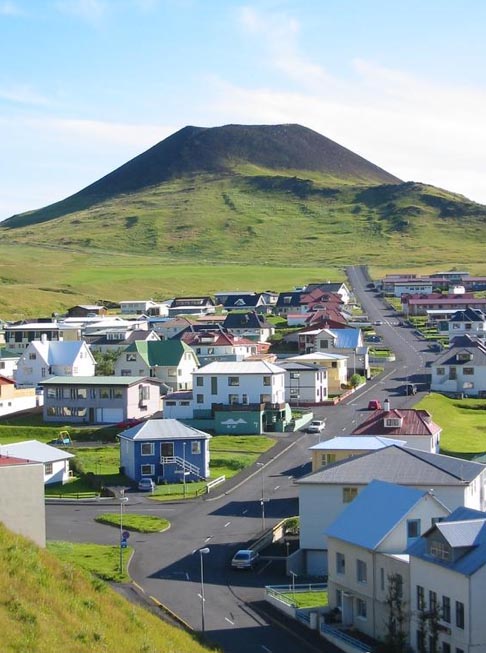
The volcano Helgafell, which awoke in 1973, when everyone thought it was extinct.
In the foreground, the only settlement on the island, the port of Heimaey
Not all Icelanders have these incomes. But it is not a poor country. It took the entire dishonesty of their "banksters" to bring a country to bankruptcy. It seems, as seen below, that the Icelanders have decided to take their future into their own hands. Not being in Europe, they could strongly devalue their currency, which reactivated their exports and reduced their imports. Classic scheme. But then, why would they want to join Europe and the Eurozone? To be clarified.
Mystery.
**
Note: This text differs significantly from what can be found on Iceland on Wikipedia.
| No news from Iceland: why? | (April 22, 2012) | If someone believes there is no censorship currently, let them tell us why we know everything about what is happening in Egypt, Syria or Libya, and why the newspapers have absolutely said nothing about what is happening in Iceland? | In Iceland, | - the people forced a whole government to resign, | - the main banks were nationalized and it was decided not to pay the debt incurred by these banks with British and Dutch banks, debt generated by their bad financial policy; | - a popular assembly has just been created to rewrite the Constitution. | And all of this peacefully. | A whole revolution against the power that led to this crisis. | That is why nothing has been published for two years. | What would happen if European citizens took this example? | Briefly, here is the story of the facts: | - 2008: The main bank of the country was nationalized. The currency collapsed, the stock exchange suspended its activity. The country was bankrupt. | - 2009: Public protests against the Parliament led to early elections. They caused the resignation of the Prime Minister and, in block, of the entire government. | The country's economic situation remains disastrous. By means of a law, it is proposed to Britain and the Netherlands to repay the debt by paying 3.5 billion euros, an amount that will be paid monthly by all Icelandic families for the next 15 years at an interest rate of 5%. | - 2010: The people again took to the streets and demanded that the law be put to a referendum. | In January 2010, the President refused to ratify this law and announced that there would be a popular consultation. | In March, the referendum took place and the NO to paying the debt won 93% of the votes. | Meanwhile, the government started an investigation to legally settle the responsibilities for the crisis. | Several bankers and senior executives are detained. | Interpol launched an investigation and all the involved bankers left the country. | In this context of crisis, an assembly was elected to draft a new Constitution that takes into account the lessons learned from the crisis and replaces the current one, which is a copy of the Danish constitution. | To do this, we directly resort to the sovereign people. | We elected 25 citizens without political affiliation among the 522 who had applied for candidacy. To do this, one must be an adult and receive the support of 30 people. | - The constituent assembly began its work in February 2011 in order to present, based on the opinions collected in the various assemblies that took place throughout the country, a draft of the Great Charter. | It must be approved by the current parliament as well as by the one that will be formed after the next legislative elections. | Here is, briefly, the story of the Icelandic Revolution: | - Resignation of an entire government | - Nationalization of the bank | - Referendum so that the people can express their opinion on fundamental economic decisions | - Imprisonment of the crisis responsible | - Rewrite of the constitution by the citizens | Have we heard about this in European media? Has it been discussed in political radio debates? Have we seen images of these events on TV? | Of course not! | J ...