Open Letter to Kovacs, Project Manager of Megajoule
Open Letter to the Project Manager of Megajoule, Mr. Francis Kovacs
September 10, 2002
After returning from a trip abroad, I set up a beginning of a dossier on a question that is not yet closed and concerns French nuclear weapons policy. Indeed, it is known that France conducted its last underground nuclear tests (officially) at Mururoa in 1996. We were told at the time that nuclear weapons research would continue in France through "computer calculations" and "simulations" to be carried out using a "Megajoule" test bench, which should be installed in Bordeaux. When I learned this, I was immediately extremely skeptical. Indeed, laser fusion is a subject not foreign to me, since 1976, the year I was the first non-American to approach a terawatt laser at neodymium, equipping the "Janus" bench in Livermore, California.
Laser fusion has proven to be a disappointing attempt. It is relatively easy to understand why. In the Livermore experiments, for example, the target, a millimeter-sized sphere filled with a deuterium-tritium mixture, is itself covered by a thin layer of a product called "pusher." The sphere is illuminated by directing the beams of several lasers onto it. The pusher evaporates and expands. Its expansion causes the compression of the fusion mixture inside the sphere. The Janus experiment (1976) had two lasers. It was to be completed by a "Shiva" experiment with 24 lasers. It is possible to "tile" a sphere with 12 pentagons, the whole having the geometry of a dodecahedron (dodeca means twelve in Greek). Twenty-four is a multiple of twelve. This number 24 is therefore not chosen at random and represents an effort to deposit this laser energy on the surface of the sphere, via the "pusher" in the most regular way possible. Unfortunately, the experiment did not give the expected results. By analogy, imagine that you want to compress pancake batter in one of your hands by squeezing it between your fingers. Obviously, it will escape between them. In laser fusion, the same problem, related to the impossibility of achieving a spherical energy deposition on a sphere (in space and in time). However, to achieve this fusion, it is essential to perform a compression by a factor of ten in radius, therefore a thousand in volume, by compressing a medium in a liquid or solid state (depending on the refrigeration temperature of the heavy hydrogen, below minus two hundred degrees Celsius). Then the temperature and density increases are such that the "Lawson conditions" (conditions under which fusion can occur) can be achieved in such a "inertial confinement" system. It was never possible to control this spherical compression.
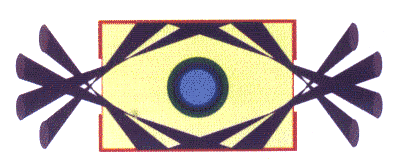
Now, surprisingly, the French are entering the race, decades after the Americans have washed their hands of it. Do they have super-lasers? No. At the CESTA (Centre Scientifique et Technique d'Aquitaine), two (old) neodymium lasers of a unit power of a terawatt have been installed in the "LIL" (Ligne d'intégration laser)... donated by the United States, a relic of an experiment that had eight ("Nova") and which also did not give results. The Megajoule bench exists only in the form of beautiful computer images. It is supposed to have 240 beams of a terawatt each. But, as will be seen in an illustration in the attached letter, the target has a spherical symmetry. The heating system, very "artisanal," consists of injecting energy laser into a one-centimeter diameter cylinder, 120 beams through each of the two orifices on the two disk-shaped faces. The inside of the cylinder being covered with a thin layer of gold, it is hoped that this device will behave like an axisymmetric oven. Pious wish.
The reader can obtain this information by requesting from the CESTA in Bordeaux, Department of Power Lasers, 15 avenue des Salières, BP2, 33114 Le Barp (tel: 05 57 04 41 45) a color brochure titled "Le Laser Mégajoule," published by them and describing the essential elements of the project.
Furthermore, the target is to achieve fusion of a mixture of two isotopes of hydrogen, deuterium and tritium, a mixture that must necessarily be cooled to very low temperature (-200°). However, no hydrogen bomb works with such a fusion mixture. All are "dry bombs," built around a Li7 H1 (lithium-hydrogen) mixture, solid at ordinary temperature. Therefore, if these experiments of fusion of hydrogen isotope mixtures worked, which is far from obvious, it is not at all clear how scientists could extract any useful information regarding the mechanisms at work in a "real" hydrogen bomb.
I will develop elements in the coming days to form an opinion on this "Megajoule project," which, in my opinion, would be a "screen project" intended to hide an extremely worrying reality: that the French continue their underground experiments on ... their own territory. We will explain how such experiments could be carried out with sufficient attenuation of the seismic signal of the explosions.
Officially, for ten years, the United States, Russia, and England have ceased to conduct underground nuclear explosions (in Nevada for the USA, in this summer and in Australia for the English, in similar sites for the Russians). Who would be naive enough to believe such a thing? All these countries are simply today practicing "stealth nuclear explosions" whose technique will be described. The Americans and the Russians have the luck of possessing desert regions on their territory. The English can also take advantage of sites located in Australia. But where can the French, expelled from their Pacific sites, continue their tests?
Good question....
Some might say, "Is it necessary to continue nuclear tests? Don't we already have all the information needed to develop these weapons according to all possible powers, using simply a computer?" The answer is no. Indeed, low-yield bombs are key elements in the development of EMP bombs, for example. Not developing this type of weapon would mean losing all strategic credibility. France cannot abandon these underground tests. In July 2002, I sent the following letter to Francis KOVACS, project manager of Megajoule. This registered letter with acknowledgment of receipt followed a "simple letter" addressed to the same person a month earlier. It, like the previous one, remained unanswered, and I doubt that the recipient could in fact answer such embarrassing questions. It is regrettable that no French journalist has asked them. Is it due to lack of competence because of subtle pressures exerted on the editorial offices of newspapers and television channels?
**
**
Jean-Pierre Petit
Research Director at CNRS
Villa Cardinale 1
6 allée du Parc 13770 Venelles
July 10, 2002
Mr. Francis KOVAC
Head of the Department of Power Lasers
Centre d'Etudes Scientifiques et Techniques d'Aquitaine
Department of Power Lasers
15 Avenue des Salières BP 2 33114 le Barp
Registered with acknowledgment of receipt.
Sir,
Without a response to my simple letter of June 6, 2002, I am sending you this letter by registered mail with acknowledgment of receipt.
I thank you for kindly sending me your presentation brochure, published by the Department of Military Applications of the "Laser Mégajoule" project, under the CESTA, the Centre d'Etudes Scientifiques et Techniques d'Aquitaine.
I must first tell you that the question of power lasers is not foreign to me, since I was one of the first Europeans to have seen closely, in the spring of 1976, the "Janus" installation of the Lawrence Livermore Laboratory, equipped at the time with two lasers, each with a unit power of a terawatt, powered by a bank of ten thousand joules capacitors. This was possible thanks to the fact that the then director, Alström, co-responsible with Nucholls of the project, was one of my colleagues and friends. At that time, the American installation "Shiva," also located in Livermore, which was to be equipped with a set of twenty-four terawatt lasers was under construction (at least the buildings), which would bring the power to twenty-four terawatts. With the same type of lasers, neodymium-doped glass units, the energy was then expected to reach 0.24 megajoules. The goal pursued by the Americans at that time, which goes back twenty-six years, was to cause the fusion of a deuterium-tritium mixture, infiltrated into small glass spheres coated with a "pusher" designed to absorb the energy and cause the compression of the mixture. As you recall on page 7, it was an inertial confinement fusion process.
As the French project is twenty-six years after, and is supposed to mature in 2008, that is thirty-two years after the efforts carried out across the Atlantic, would it be possible to know if the American effort, whose responsible (like Nucholls) did not hide it at the time, was the simulation of phenomena occurring in nuclear explosions, provided concrete results? Were fusion reactions obtained and if so, when? Have these experiments proven fruitful in this view of simulating nuclear explosions?
I have noted, in your brochure, page 3, that after the stop in 1996 of experiments allowing to validate the functioning of nuclear weapons in real size, and after the signing of the Comprehensive Nuclear-Test-Ban Treaty (CTBT), the government had now entrusted the CEA with the implementation of a Simulation program, which will now rest, in the absence of nuclear tests, on the guarantee and reliability of the deterrent weapons.
Regarding this, I have several questions to ask you. In your brochure, there is a diagram of the energy input on a target designated by a spherical capsule, a few millimeters in diameter. I quote your brochure:
"The cavity has two 1.5 mm diameter holes for the passage of the 240 beams. The deuterium-tritium mixture is in the form of a thin solidified layer at minus 250°, on the inner face of the capsule. The center of the capsule will contain the mixture in gaseous form."
In the Shiva experiment (24 terawatt lasers each) carried out in Livermore, which I do not know if it led to positive results, the energy of the lasers was supposed to be distributed as regularly as possible on the surface of the spherical target by being absorbed by a "pusher." The goal was to cause the compression and heating of the mixture and an inertial confinement. Spherical symmetry seemed to be sought at that time. In the diagram above, it would only be an axial symmetry.
Do you think that the compression could then be carried out in a satisfactory way? What do you estimate the probability of success of this experiment? Does it have a random component?
In the Quid of 1999, page 1798, it reads:
Note: Equivalent American program: NIF (National Ignition Facility), Lawrence Livermore Laboratory, California. Many estimate its chances of successfully achieving hydrogen fusion at 10%.
Your comment on this estimate?
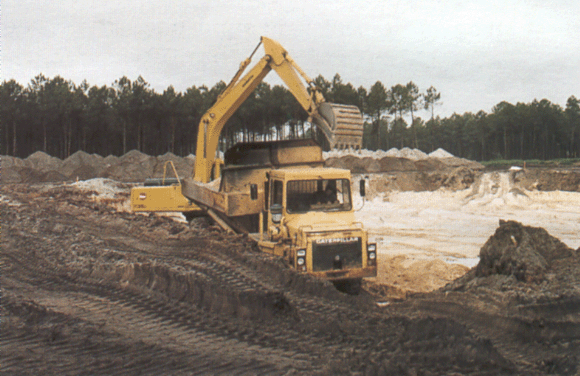
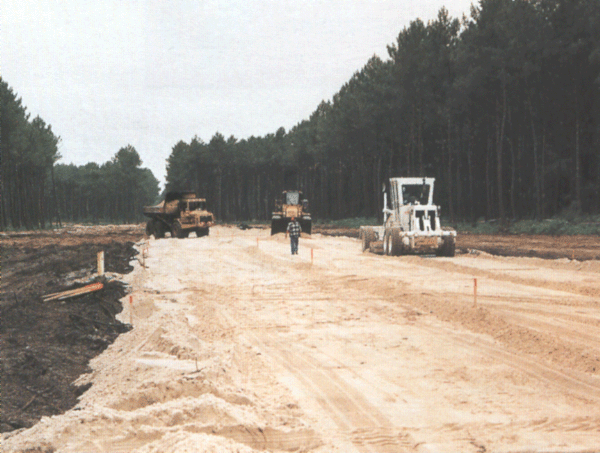
The brochure was published in 2001. The photographs that illustrate it are supposed to show the progress of the work.
We can therefore judge that at the dawn of this second millennium, they are in the stage of earthworks. Do you think we can count on fusion experiments of deuterium-tritium mixtures in 2008?
In your brochure it is written that
"An equipment similar to the Megajoule laser is currently being built in the United States, the "NIF" or National Ignition Facility, whose deadline is close to that of the LMJ (Megajoule Laser). The collaboration between France and the United States in the field of power lasers began thirty years ago. Today it concerns laser technology and the development of components. This agreement is accompanied by a reduction of costs, risks and delays by continuing joint research and development actions. This collaboration leads to exchanges of specific components realized by one or the other of the partners of this agreement. It is within the framework of these balanced exchanges that the Lawrence Livermore National Laboratory (LLNL) has made available to the DAM the experimental chamber of its Nova laser installation after its dismantling. This chamber, designed for experiments at the level of several tens of kilojoules, will be installed in the experimental hall of the LIL. It arrived at CESTA in December 1999."
Here, American experiences (installation Nova) are mentioned. Did these lead, before dismantling, to real successful experiments in laser fusion, and if so, when?
The first American experiments date back to the mid-1970s, that is more than a quarter of a century. I also quote this passage from the Quid 1999, page 1798. Referring to the development of the "new nuclear head," the article specifies that
The tests, studies and development of weapons focus on "hardening" and "stealth."
"Hardening" consists of making nuclear heads insensitive to the action of electromagnetic waves (electromagnetic pulse). But what does "stealth" mean? How could a nuclear weapon in development be "stealthy"? Enlighten my lantern, please.
Assuming everything goes well, that the Megajoule experiment is a success (although the chances of success according to the Quid are one in ten). As far as I know, hydrogen bombs are not based on a deuterium-tritium mixture, which requires cooling to very low temperature (minus two hundred and fifty degrees), but on the fusion of a Li-H (lithium hydride, solid at ordinary temperature: the "dry bomb"). In these conditions, even in case of success, how could results based on the fusion of the D-T mixture be applied to a Li-H mixture? I confess I don't understand. If you allow me this kind of analogy, it seems to me that there is as much resemblance between D-T fusion and Li-H fusion as between the operation of a diesel and an internal combustion engine, the latter being difficult to serve as a "simulator" for the first. Or else there is something I have not understood, which you can then explain to me.
Unless, after this first success in 2008-2010 on the D-T mixture, experiments on laser fusion based on a Li-H mixture are to be carried out (by the way, why not aim directly at fusion on this type of mixture. Would the experiment be more random? Or what is the problem if enough energy is focused on the target?).
Subsidiary question, in case the Americans have already succeeded in D-T laser fusion experiments: would they then have successfully moved on to laser fusion experiments on a lithium-hydrogen mixture? According to the Quid, the answer to the first question would be negative and a fortiori to the second.
In case of success of the French laser fusion experiment on the D-T mixture in 2008, how many years, in your opinion, would pass before experiments closer to real thermonuclear explosions, based on lithium hydride, could be carried out?
Where are the Americans and the Russians in this field? I have difficulty thinking that they are at the same stage as us. Unless I am mistaken, these two countries have officially ceased to conduct underground nuclear and thermonuclear experiments several years ago (1996 in our case). When did the official stops of such tests occur in these two countries? Do you believe that these stops correspond to reality?
Personally, I doubt it very much. Like many others, I think that Russians and Americans have simply found a system that allows them to continue these experiments by masking the seismic signal of the explosions (SNE or stealth nuclear experiments: stealth nuclear testing). This could be achieved, for example, by detonating the devices in old lignite mines, at a depth of a thousand meters, this inhomogeneous material being very suitable for absorbing sound waves over a wide frequency range.
By opting for these Megajoule simulations, is France not risking to fall far behind these powers? Especially since the result of these experiments seems not only problematic but also seems far from real explosions. Would it not be more realistic to find a way (and a location outside of French territory, if possible) to carry out this type of "stealth" experiments, as the Russians and Americans have certainly been doing for many years?
The idea that the Americans, who have always had a significant advantage over Europeans in terms of arms, could simply join this "Megajoule adventure" seems unlikely. Do you really believe that it is?
Thank you in advance for your response and clarifications.
Jean-Pierre Petit
Research Director at CNRS
We are planning actions jointly with different organizations such as Greenpeace or the CRIIRAD. The light must be shed on this file, which is at least explosive. Which journalist will take the initiative to question Mr. KOVACS in his office? If one is found, I would be ready to accompany him in his endeavor.
September 24, 2003. One year has passed since I put this dossier on my website. No journalist has appeared. Greenpeace and the CRIIRAD have not moved. No action has been taken.
On the other hand, Jean-François Augereau has been the advocate of this project in an article published on the same day in the newspaper Le Monde, reproduced with my comment.
December 12, 2003:
The time of "dancers" of technical and scientific
Nothing will stop this expensive Megajoule project. It "will create jobs" (one thousand jobs for technicians and researchers by 2010) and will be an opportunity for the creation of some positions at the CNRS in astrophysics, researchers finding the opportunity to study "a Sun in the laboratory," which will never ... work.
But one cannot stop there. At a time when physics is terribly short of new ideas, in all areas the decision has been made, at the European level, to install on the site of Cadarache, between Aix en Provence and Sisteron, the successor of "Tore-Supra," that is to say a Tokamak even larger than this one. But what is a Tokamak? It is a "magnetic bottle" of toroidal shape, consisting of a solenoid closed on itself. This setup, imagined after the war by the Russian Arsimovitch, is supposed to confine a fusion plasma. It is a different reactor from the classic nuclear reactors, based on fission. A fusion reactor is essentially a mixture of two isotopes of hydrogen, heated to a temperature of hundreds of millions of degrees, where exo-energetic fusion reactions are supposed to occur.
June 14, 2004: The months have passed. Occasionally, readers write to me, evoking some big question. Do you know that .... What do you think of ....
Yeah. I see one thing: I was the only one to my trial on appeal, in Nîmes, and as there was no one to demonstrate, nor journalists to be moved, I was quietly condemned. Fortunately, after that, there were people who helped me financially. Thank you to them. I only informed, made people think. This is what a reader-thésard does, whose email I reproduce below.
The fact that the Army wastes mountains of money is not new. And no one can do anything about it, neither you nor me. I think that in the end, they don't even know what they are doing. There are projects that grow, grow, like that. Look at the International Space Station. It serves to ... nothing. It's extraordinary.
I am retired and I repeat that during the 25 last years of my career I have not had a centime of credits, not a penny. Remember that letter to Malina, my director, where I asked if I could not have a laser printer "as a gift for early retirement." Mine had just died.
Isn't it funny in the end? The only person in France who could have started an MHD activity was deprived of everything for a quarter of a century. And now that the "officials" are beginning to vaguely see the delay compared to the Americans, there is not a single person who touches his "cold plasmas."
People must wonder how long I have devoted to my Egyptology work. I will give you the answer: Two trips (tourist) there, in 2000 and 2004. Some readings, including the book by Goyon. Add two months to make models in cardboard, drawings and put everything in shape. Let's say three months in total. I think I would have been a fairly good researcher, finally. But, as in Candide, I think it's time ... to cultivate one's garden. Mine is superb, since they no longer cut the grass. I like this wild, exuberant side. What a hassle I had with these well-trimmed lawns....
Hello,
In fact there are two ways to achieve inertial confinement fusion: - direct drive: all the laser beams must hit the target uniformly, with the well-known symmetry problems - indirect drive: corresponds to the schema of the cavity with two orifices on your page. The laser beams will induce an X-ray radiation inside the cavity in gold, isotropic emission which will make the cavity a kind of oven. Simulations (and some successful experiments, I believe) show that it is possible to obtain a sufficiently uniform X-ray illumination of a spherical target in its center. The "only" problem is the low energy efficiency of this method. Because it is indeed the civilian facade of the LMJ: being a major step to progress towards laser fusion (to replace nuclear power plants). But even from the point of view of realistic laserists, lasers have no chance of competing with heavy ion beams for fusion (just the total efficiency of the lasers makes one think...). The Tokamak is very elegant, but it seems to also suffer from many problems...
So the LMJ excites the communities of laser and plasma physicists, but apart from that, what is it really for, when you realize the scale of the project...
In fact, it's completely crazy. It's about building 30 times the LIL, in a titanic temple that must eliminate all vibrations of the ground and wind on the walls... And the announced cost seems unrealistic, greatly underestimated: 1.2 billion euros. It's the cost of a large international space project. Or the LMJ will be entirely paid for by the French Ministry of Defense! That's where I see a big problem. What will the military do there, after having poured such sums in! As you have well indicated, these laser fusions (even if they are certainly possible by indirect drive), have nothing to do with hydrogen bombs, and have no military interest... it's hard to see how to make mini hydrogen bombs with lasers ;-) and even if you replace the target with the real composition of hydrogen bombs (lithium hydride?), I doubt you would get a good simulator... It seems a bit expensive to pay for such a speculative simulator, when you can do underground tests with real bombs.
In short, the hypothesis that Megajoule is a cover for the continuation of underground nuclear tests seems very possible, but insufficient: it would be a very expensive cover. This laser must really serve the military. I don't know by what procedures you thought the Americans could obtain antimatter (in an "industrial" way) for their hypothetical weapons (other than in a particle accelerator ;-), but if we admit that it can be obtained by phenomenal pressures, the laser seems ideal. Because in fact, this is what lasers know how to do best: on solid targets, obtain the highest pressures that we know of, in the most "clean" and controllable way since the laser pulse lasts at most a few nanoseconds.
I have not thought much about other methods to obtain antimatter in "macroscopic quantity," but it surprised me when we were told that the laser essentially produces a pressure (by "quasi-instantaneous vaporization" of a thickness of the target then by "rocket effect") and that the highest pressures ever obtained in the laboratory were with lasers.
Is France following the USA in antimatter deterrence? This is pure speculation, but at least it would "justify" the sums invested in this completely incongruous military project...
Sincerely, Pierre Eric de Corbeville, Engineer specialized in power lasers.
Return to Guide Return to Home Pagel
**
Number of views of this page from September 11, 2002 to December 12, 2003: 6244**
Number of views since December 12, 2003: 02 :