Article by Augereau on Megajoule in Le Monde, 2003
The article by Jean-François Augereau
published in Le Monde
September 24, 2003
I am posting this text on my website, fully aware of the futility of doing so. A year earlier, I had tried to draw the attention of the press, scientific journalists, and the public to what I consider a smokescreen project designed to divert attention from a grim reality: the ongoing underground nuclear testing conducted on French territory, particularly over ten years, at a depth of one thousand meters, in a remote section of the Gardanne mine. Following revelations made in my book published on January 9, 2003, the mine was abruptly closed (February 2, 2003)—three years ahead of schedule—and quickly flooded (starting in May 2003). The area in question is now permanently flooded, irreversibly so, and any investigation will forever be impossible. The only remaining question will be: how long will it take before the water, dissolving the limestone, triggers fractures, collapses, and ultimately releases radioactive substances into the Mediterranean, causing pollution so severe that Chernobyl will seem like a harmless joke.
Nobody cares. No journalist has conducted even a single investigation, nor have organizations like Greenpeace or Criirad (Center for Independent Research on Radioactivity). On the other hand, it's easy to find scientific journalists like Augereau eager to promote this "sun in the laboratory" project in Bordeaux. In blue: my comments.
http://www.lemonde.fr/article/0,5987,3244--335131-,00.html
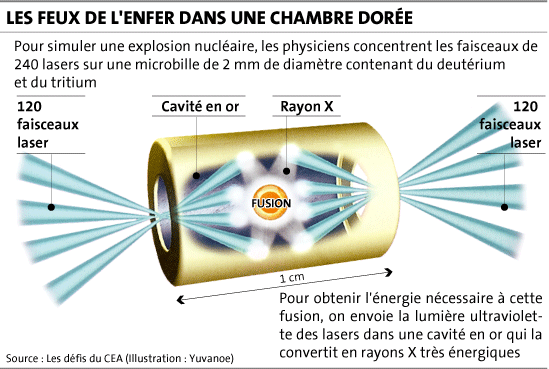
One might wonder how engineers expect to achieve implosive compression within the spherical target. The answer lies in a German word: Holraum, meaning "furnace." This involves placing a "light foam" inside a cylindrical chamber, which, by absorbing laser energy, would be heated to extremely high temperatures. The idea is that this material, once radiating energy itself, would transform the chamber into a furnace with constant radiation pressure, which would then act upon the "pusher" surrounding the spherical deuterium-tritium target. All of this remains highly speculative and based solely on computer simulations. A minor detail: all engineers involved in the project who questioned the feasibility of the operation were fired or sidelined. Like ITER, Megajoule is a "cathedral for engineers."
Near Bordeaux, the French Atomic Energy Commission has just laid the first foundations for the Megajoule Laser. This unique light source should be operational by 2010. Bordeaux, our special correspondent.
It is precisely this "uniqueness" that is astonishing. The Americans were the first, back in 1976, to use neodymium-doped glass lasers in attempts to achieve laser fusion. This technology is thus 28 years old. I was also the first non-American to see these facilities in 1976 (see "Les Enfants du Diable," Albin Michel, 1995). At the time, "SHIVA," equipped with 24 neodymium lasers, was under construction. The principle of laser fusion involves focusing powerful beams onto a tiny spherical target. These beams compress the target. Initially, the target is in liquid or solidified hydrogen form. The sphere is then compressed by a factor of ten (a thousandfold in volume), theoretically raising the mixture of two heavy hydrogen isotopes (deuterium-tritium) to fusion temperature.
All these attempts ended in failure. A spherically symmetric compression was never achieved. It was as if a housewife tried to compress dough in her hand and found it slipping through her fingers. Reading this text, one gets the impression that France is positioning itself as a leader in the race for laser fusion—despite having entered the field very late.
The site is massive. Several hectares of pine groves from the Landes region have been cleared from the grounds of the Aquitaine Scientific and Technical Studies Center (Cesta), owned by the French Atomic Energy Commission (CEA) near the town of Barp (Gironde), about thirty kilometers southwest of Bordeaux. The ground has been ripped open. Beneath the sparse grass, sand and fragile-walled holes await reinforcement to support the first foundations of a building of immense dimensions: 300 meters long, 150 meters wide, 45 meters high, with a ground footprint of 40,000 square meters.
The complex will be large enough to house the Eiffel Tower, according to a pedagogical article from the CEA's "Challenges" publication (July-August edition). It will be especially large enough to accommodate the Megajoule Laser (LMJ), one of the two most powerful lasers in the world, alongside the NIF (National Ignition Facility), currently being assembled by the Americans near San Francisco at the Lawrence Livermore National Laboratory. These two installations resemble each other closely, as they are the result of long-standing cooperation between France and the United States on this topic. Both aim to ensure the renewal of their nuclear deterrent weapons without resorting to underground tests, which they, like others, have pledged to abandon.
Huge nonsense. Americans and Russians have never stopped their underground nuclear tests, which have been conducted clandestinely and stealthily for decades. The technique has been perfected for a long time in both countries and is thoroughly described in a report by the American Geological Society. It suffices to detonate one-kiloton devices in cavities 20 to 25 meters in diameter, depending on the terrain. The resulting signal then does not exceed magnitude 3—equivalent to 450 kilograms of TNT, or normal mining activity. It is easier than ever to camouflage tests as "normal mining activity." Americans and Russians have not refrained from doing so for over twenty-five years. The U.S.-proposed moratorium on nuclear testing appeared precisely when the Americans had just perfected these techniques. The French followed ten years later—except that our country lacks desert regions.
But a desert does exist. It is a political, media, informational, scientific, and intellectual desert. Vox clamat in deserto. With Augereau, one can't tell whether it's naivety or complicity.
We are familiar with phrases like "scientifically correct," "politically correct," etc. Let's add "media-correct." What you see on your small screen is illusory. Everything is filtered. Calvi can say, "Do you believe, Mr. So-and-so, that bin Laden is still alive?" The viewer holds their breath. They tremble upon learning that terrorists might have mastered "chemical weapons."
But the real terrorists are those who detonate nuclear devices beneath our feet, near densely populated areas. This subject is not "media-correct," and you will never see it addressed anywhere. When I think of television or even print media, I feel like people are being given tranquilizers to suck on.
VERY SPECIAL GLASS
The new installation of the Directorate of Applications...