Technological Apocalypse: Truth and Plausibility
The True and the Plausible
March 14, 2005
If I were a philosophy or French teacher, I would assign an essay with the topic "The True and the Plausible."
These are entirely subjective notions. An incredible news story has just emerged. It was on March 11th. One of my readers directed me to a message, which, according to the source: yahoo.news from AFP, the French Press Agency. I echoed it. The text said that the implantation of subcutaneous chips is now mandatory in Australia, in the banking world and in the army.
Very quickly, other readers responded.
*- You risk discrediting yourself. Let's wait to see if this news is not a hoax. *
I chose to leave the text and say that we were performing checks. Three days later, we had the original message, which indeed came from the French Press Agency:
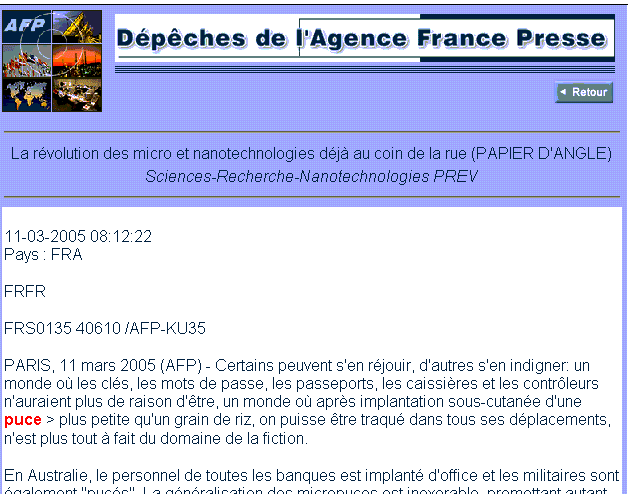
I reread these lines and I wonder if I'm not living a nightmare. What's worse is that I'm telling myself that this dispatch will probably go almost unnoticed by our "Big Press". Yet it's easy to imagine all that could result from this.
I recall a remark made by the man who first identified the possibilities of fission, of nuclear chain reactions, Otto Hahn. When his colleagues told him that they thought that man might, one day, create with this mechanism weapons of absolutely monstrous destructive power, he said:
*- No, God would not allow it. *
And yet it happened like that. And God did nothing.
We are currently living in trust in another god called balance. While we have experienced, through two successive world wars, major planetary imbalances, we, Western countries, endowed with the Earth, live in the illusion, the naive belief that a new balance is somewhere in our future, modulo "some rearrangements". Our world will evolve. We will have to adapt to new ... technologies. The subcutaneous implantation of chips is just one aspect of this nanotechnology that will revolutionize our lives. Some envision positive outcomes, such as the implantation of a chip inside the skull that could restore mobility to the paralyzed, even with "actuators", electric motors. What a beautiful project. But can one imagine the possible deviations that could arise from such technology? It is ... staggering and it is for ... tomorrow or even ... today, under the cover of national security.
There will be many other things, such as adaptive robotics, the beginning of artificial intelligence ("serving man", of course). Read "The Year of Contact". Human masses will have to adapt to all these changes. Maps will be redrawn. It will not make everyone happy, but "you can't make an omelet without breaking eggs". This is what scientists, economists, sociologists, politicians, and military "concerned about your security" will tell you.
By the way, it reminds me of a sentence from Candide by Voltaire. At one point, Professor Pangloss says:
- It is the particular small misfortunes that make the general good. Therefore, the more particular small misfortunes there are, the better things will be in the best of all possible worlds.
The great powers, those who have so far held the top, especially one of them, the one whose star, in this case, is red, will confront each other, essentially on the economic field, one might think. There is also the bear mending its wounds, looking for a new breath, and the confused crowd of "commoners". Everything will eventually be sorted out, with some damage, some poverty here and there, especially in poor countries. But they are used to it. Could one imagine a perfect world, without famines, without epidemics, without poverty? That ... is part of life. Well, on this planet, there are a lot of people. Too many. The human mass behaves ... like a huge living being. We lose our own cells, in all our organs, daily. But we are immortal, we know it.
And what if it doesn't happen like that? And what if we are sliding towards a beautiful, huge, unprecedented catastrophe?
I think back to a message from a reader who found me "too pessimistic". He would probably prefer that I adopt a "positive attitude" like Raffarin, or a contained, salon-style alarmism, of good manners, like Hubert Reeves. But no, I say, I believe that the boat is sinking and that things are only accelerating before our eyes. We are on the Titanic. In life, there are only convictions based on personal analyses, themselves based on information gathered, on experiences lived. Let's not be afraid of words. I don't seek to be interesting. I could use a thousand other methods. I can make you laugh, make you dream. Why choose among this palette of instruments the most grating one?
Because I believe it deeply. The AFP news confirms my fears. Reeves talks about thirty years. I say: less than ten. The countdown has started. All the elements are in place for us to have a beautiful Apocalypse ahead, and as tradition foresees: people will sleep, go towards this abyss as if anesthetized.
Why? Because this prospect is too huge, too unbearable for them. When people are afflicted with very serious illnesses, they have two reactions.
- Either they want to know the truth, to take it into account with calm and lucidity
*- Or they prefer that we lie to them. *
This happens every day in millions of places around the world. I saw with my own eyes my mother die in two months from liver cancer thirty years ago, surrounded by doctors who asked her "what she would do when she would recover". That was what she had chosen. However, in six weeks she had lost 30 kilos. Her skin was yellow and her body was decomposing to the point of emitting a foul smell. But she obediently, "wisely" took the placebos. She did this until the last day, until she fell into a coma. I watched all this happen before my eyes, helpless, and I said to myself "but, if you had been in this situation, wouldn't you have made the same choice?". It's easy to analyze people's behavior with an external eye. But when you are in such a situation, it's another matter.
Few people think about such horrors. But we are not chronic depressives, nor natural pessimists. I like to laugh, to make love, to discover new things and new people with wonder. I love people. I believe in the immense possibilities of human beings, in the benefits that science and technology, well managed, can bring us. I think we have all the keys to get out of this, with the technology and knowledge we currently have, largely. But I think that humanity is simply sick. Humanity and its techno-science, led by its techno-crat, techno-fools, techno-unconscious.
The word Apocalypse has two meanings. It is both synonymous with catastrophe and revelation. For the catastrophic side, I believe we have t...