MHD
../../bons_commande/bon_global.htm
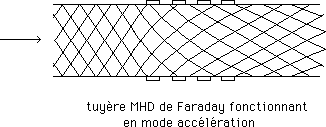
...What is Magnetohydrodynamics, abbreviated as MHD? It is the art and the way of acting on a fluid, liquid or gas, by applying electromagnetic forces to it, provided that it is sufficiently conductive to electricity. One would then speak of an MHD accelerator. It is also the art and the way of transforming the kinetic energy of a fluid into electrical energy. One would then speak of an MHD generator. More generally, whenever there is a direct conversion of one form of energy into another form (kinetic, electromagnetic), one would speak of an MHD converter.
...To get started with MHD, see my comic book "Le Mur du Silence" (aptly named) in the "cd-Lanturlu".
...In the sixties, France was at the forefront of this field. One could say: by chance. A major MHD research effort had been initiated at the beginning of the sixties in many countries: England, USSR, USA, France. Countries like Germany, and later Japan, joined this group. The goal was to develop MHD generators that could, in principle, have much higher efficiencies than thermal machines (up to 60%). The energy sources were of two kinds: hydrocarbon combustion or nuclear energy. For the process to be profitable, it was essential that the fluid from which we wanted to extract as much kinetic energy as possible had sufficient electrical conductivity. But in principle, all gases are very poor conductors of electricity. They are even true insulators. Therefore, everything that seemed possible was done to give these gases a significant electrical conductivity, by "seeding" them with alkali elements, at low "ionization potential" (mainly cesium). But the results proved disappointing, despite the large sums invested in this research, at a time of strong economic growth. It was then considered to operate these generators "with two temperatures, by giving the gas "free electrons" a higher temperature than that of the gas itself, made up of atoms. But a terrible instability, theoretically discovered in 1964 by E. Velikhov (who later became vice-president of the USSR Academy of Sciences) ruined all these plans, by the end of the sixties. In the middle of the seventies, most countries had abandoned the research, except for the USSR, which maintained, until its economic collapse, an important effort in this research field.
...When I was assigned to the Institute of Fluid Mechanics in Marseille in 1965, I found a small team gathered around a researcher: Georges Inglesakis, who had conducted direct conversion experiments, inspired by work done in the USA by a Swiss researcher, Bert Zauderer, using as a source of gas pulse a "shock tube". The experiments were of very short duration (less than a hundred microseconds) but the whole interest lay in the fact that the gas expelled at very high speed (more than 2500 m/s), under high pressure (one bar) was also very hot (ten thousand degrees), therefore very highly conductive to electricity. Under these conditions, it became possible to simulate the MHD generators we dreamed of, by compressing, therefore heating and expelling through a nozzle gases that are poorly conductive to electricity under normal conditions, such as argon, but which become conductive at the temperature to which they are brought. Of course, these experiments had no industrial interest. What to do with a generator that can only operate for a tenth of a millionth of a second every hour, even if it produces several megawatts during that time? At the time, no one realized (except the Soviets) that these pulsed generators would one day find their reuse in what was later called the "Star Wars" and which I will talk about on the site.
...The reader will later learn, and perhaps with surprise, that the father of Soviet MHD was none other than the brilliant Andrei Sakharov (also the father of the first Russian H-bomb). Sakharov was not a researcher, he was an inventor and a visionary. No one at this Marseille Institute where I had landed suspected the real possibilities of MHD. However, some spectacular results were obtained. In 1967, two years after my entry into the laboratory, thanks to a trick, rediscovered fifteen years later by a Japanese, I succeeded in operating for the first time a two-temperature generator (always during these short bursts), by taking advantage of the Velikhov instability (which developed in a millionth of a second). Plasma acceleration experiments were also successfully carried out, with velocity gains of 5 km/s over only ten centimeters of nozzle length. But all this passed completely unnoticed, against the backdrop of the general collapse.
...In France, research is in principle "directed". Organizations such as the CNRS or others therefore have "programs". The problem is that the people who set up these programs and those who have the ideas, and carry out the research, are not the same people. I don't know if you've ever cut the head off a duck with one stroke of an axe. Everyone knows that the animal is then able to run quickly. French research is a bit like a headless duck, the situation being worsened by the fact that French research institutions are closely dependent on:
-
The army
-
The polytechnicians
...When one understands all this, most often after many years of difficulties, there is nothing left to do but turn to the only research area where one can consider long-term work: theoretical research.
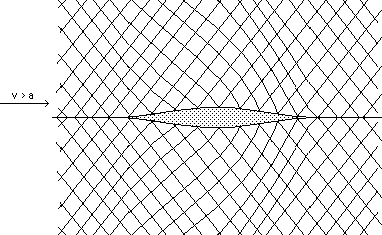
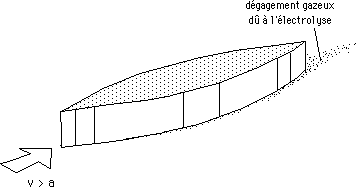
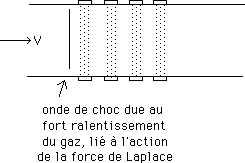
...I abandoned all MHD research in 1987, after having insisted for ten years after the official closure of French research programs. I abandoned it because I was forced to. I explained this in different books. I will return to this in this section of my MHD site. At the heart of this research was an exciting idea: is it possible to make a vehicle evolve in the air at supersonic, even hypersonic speed, in dense air, without creating a "Bang", a shock wave? A student, Bertrand Lebrun, wrote a doctoral thesis under my direction in this direction. Our theoretical work, accompanied by numerous publications in top-level journals and communications at international conferences, answered in the affirmative (see the list at the end of the document accessible via the link). In the middle of the eighties, I managed to convince the Director General of the CNRS, Papon, to help us set up an experiment. Funds were released. The idea was to work once again on short duration experiments, using the "shock tube" as a hot pulse wind tunnel. A laboratory in Rouen still had one of these ... antiquities. We had also recovered important equipment, a relic from the first "tokamak" of Fontenay-aux-Roses. Papon was delighted, seeing "that we were going to do cutting-edge research with discarded equipment". At the end of the eighties, we were on the verge of success. But the army sabotaged the project, deliberately. We later proved this, which I published in a book.
...The army, by definition, has all the rights, provided it is based on the criterion of defense secrecy. One can easily imagine the strategic advantage that a "MHD cruise missile" could represent, the only one capable of playing "jumping over the hills" in hypersonic (for the uninitiated: all current cruise missiles are subsonic). The fact that the army wanted to prohibit such research in a civilian context at that time could be at the limit understandable, if it had pursued these researches in its own sanctuaries, away from prying eyes. However, thirteen years later, it turned out that the French military were simply unable to continue these researches and that they had been abandoned rather quickly, due to a lack of ... skills. The investigation simply came to the following conclusion:
There is no French military MHD
...This was at a time when a group of military personnel from the IHEDN (Institute of National Defense Studies) raised an alarm, in a brochure published in July 99. They mentioned a fantastic American advance in the field, sounded the alarm. We will see later that these concerns could be justified. I am even convinced that they are and I will explain myself. But what is grotesque is that among those who are worried about this situation are many of those who, between 1976 and 987, were the main responsible for the failure of the French effort in MHD. Short-sightedness, incompetence. What is more extraordinary is that these same people are now holding out the begging bowl, demanding "an action-oriented response", energetic, asking to be given a blank check, while they are the main responsible for our delay in this field. Pretending to be conspirators, they try to imply that their spokespersons are supported by strong technical-scientific skills. But this is not the case. Unfortunately, all this is just a rather pathetic and useless gesture, because it is ... too late.
...What is difficult to bear for the researcher that I am is to see a person devoid of any scientific competence prate on television, declaring "we now know how to make a machine evolve at supersonic speed without creating a Bang". I thought then that it was good that the student, the teacher, the engineer, the taxpayer, the man in the street, and even ... the politician be informed, have elements of appreciation so that these people are not taken for fools again, twenty-three years later.
...As an appetizer, the reader will find, by clicking on the link below, a rather simplified presentation of this famous MHD experiment, the one we dreamed of doing, which we had fully calculated and which would have (as all the experiments I have done in this field) worked on the first try. An experiment that the military was unable to carry out.
.. How is this possible? Don't overestimate the military (and the polytechnicians). Remember the phrase of Clemenceau, at the turn of the First World War: "The best way to defeat Germany is to create a Polytechnic School there".
...Before moving on to this presentation of the experiment, in the style "one hundred microseconds that could change our vision of the world", an amusing anecdote to support my claims. After the first French nuclear tests at Regane, the military learned that the Americans were now conducting their tests underground. They asked them how they did it. The answer came quickly:
- Listen, you little frog-eaters, you're nice, but on the one hand you've left the NATO, and on the other hand we don't really want to see nuclear know-how spread all over the planet. So, figure it out....
...The military engineer polytechnicians, the "powder engineers", made careful calculations. They concluded that it was necessary to drill a tunnel in the mountain, place the nuclear device at the end, and fill the rest with concrete and scrap metal. This was done. A firing PC was installed practically in front of the sealed tunnel, and the Minister of Defense, Pierre Messmer, was invited to this corner of the Sahara to attend the test. It was actually him who told this story to the Paris-Match newspaper, which was then vainly trying (in our country we willingly cultivate secrecy) to write the history of the French bomb. We will immediately see why he made this confession. The Minister, even after all these years, was very upset.
...When the device was triggered, the pressure immediately ejected hundreds of meters of concrete and the tunnel behaved like a shotgun. Stunned, the Minister saw these debris pass at close distance. Everyone was irradiated, of course. The evaluation of the doses received proved difficult: the films (including that of the Minister) were completely fogged. Messmer was furious. That a legionnaire or the inhabitants of a village be irradiated is understandable, but ... the Minister of Defense, after all!
...In fact, and our military engineers eventually understood, it was not in a hard rock that the device should be placed, but rather under hundreds of meters of a fairly soft terrain to absorb the impact. Think. If you want to explode a grenade and analyze the products of the explosion, it is perhaps more logical to place it on sandbags than to pour it into concrete. Today we know how to operate. When the bomb explodes, a cavity is created in the terrain, compressible (like the substrate of the Mururoa atoll). The energy is thus absorbed by inelastic compression. At the same time, a shock wave rises to the surface, slightly lifting the ground, and that's it.
...All this to say that military sanctuaries may not be the pinnacle of fundamental research. I sometimes hear people say to me:
- But, don't you think that everything we are shown, all these television gestures are just "to amuse the audience", but that, behind this curtain, more serious research could be carried out?
...Sorry to disappoint you. Behind this curtain, there is nothing. Otherwise, the report mentioned above would not contain so many errors revealing the scientific incompetence of its authors.
I don't have the power to change the world, but I don't like people being taken for fools.
../../bons_commande/bon_global.htm
One hundred microseconds to change our vision of the universe