Untitled Document
Nuclear: The Myth of Safety and French Excellence
December 20, 2013
****January 5, 2014
I've been struggling to write my latest cosmology works. Now, the hard part will be to manage to publish this. But I've reached a goal I had set for myself: to come up with a bimetric model, with, in the second sector, at negative energies, not only shorter distances, but also a higher speed of light. I'm tackling the "Light Barrier."
Now a new imperative arises: to speak again and again about nuclear energy. I did so during two one-hour broadcasts on the site "Bob vous dit toute la vérité."
Bob had his show squeezed out of the "radio teen" circuit. Sometimes, "he went too far," for example, talking about September 11. So, in the "high circles," someone decided that his show would simply stop. Unless he agreed to do "only entertainment."
Bob therefore set up the first radio station operating "by subscription" and with "paid podcasts." A daring operation, without sponsors, without ads. For now, it's working. He has the minimum number of subscriptions that allow him to run. But a show needs to be filled. So there's all sorts of things. But in the mix, what matters is being able to express oneself, through performances that, unlike traditional interventions on radio or television, which reach more people but are fleeting.
This man, in his quest for freedom, also offers you yours, so think about it.
In certain areas, like nuclear energy, it is increasingly VITAL to inform people. What the French citizens do not realize is that the French nuclear plan is proceeding, inexorably and completely suicidal.
Anti-nuclear associations do some work, but it is totally insufficient in terms of information. The association Sortir du Nucléaire (14 full-time employees, "grouping 900 associations") does daily information, reporting the continuous flow of incidents on aging power plants. But the real problems, like the preparation for the deployment of fast neutron reactors, which is the secret plan, is not presented in a way that people can understand.
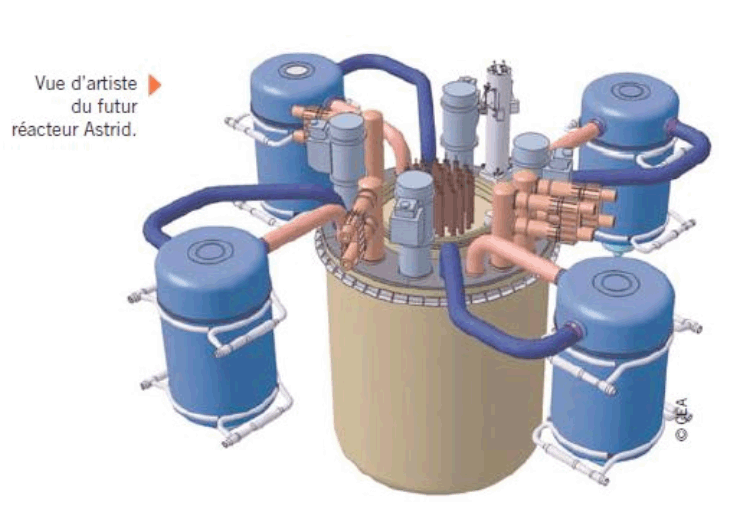
Hollande, who deserves his nickname "Flamby," signed the authorization for the study and construction of a fast neutron reactor, cooled by sodium, 600 MW, ASTRID, six weeks after being elected. And it passed like a letter in the mail. No one noticed this detail. Yet ASTRID is nothing more than Superphénix, renamed "4th generation reactor."
Have the Greens moved? No. Agreements had been made with the PS, which committed to not "launching new nuclear projects." The government presented ASTRID as "a project that had already been approved during Sarkozy's mandate." Thus, "Hollande was respecting the commitment he had made to the Greens." And no one moved, even though this gesture is serious. Why? Because the Greens have nothing, neither in the stomach nor in the head. They dither, they quarrel. I took time to understand that if Michèle Rivasi was so evasive, it was because political agreements had been made, such as "we would ease up on the side of ITER."
But nuclear energy is such a serious issue that it cannot be negotiated, as it concerns the health of future generations. If needed, to convince you, review my investigation on the French nuclear energy.
The decisions that should be made now are:
*- Abandon these projects for building EPR reactors (to "export this cutting-edge technology"). See below. *
*- Implement, with priority, major works focused on renewable energy. *
*- Stop the ITER project, which will not work (see the videos on my site). *
http://www.youtube.com/watch?v=Fi_uurHZY-g&list=PLfdj8oy5zeoEyEgTusYRznnwptG_n-OVo - Stop storing recovered plutonium, the key to the "French project, designed by our nuclear pathologists," from reprocessing at the Hague.
- Put an end to the Flexblue project, the reuse of nuclear submarine reactor technology to make submerged mini-power plants, left to their own devices.
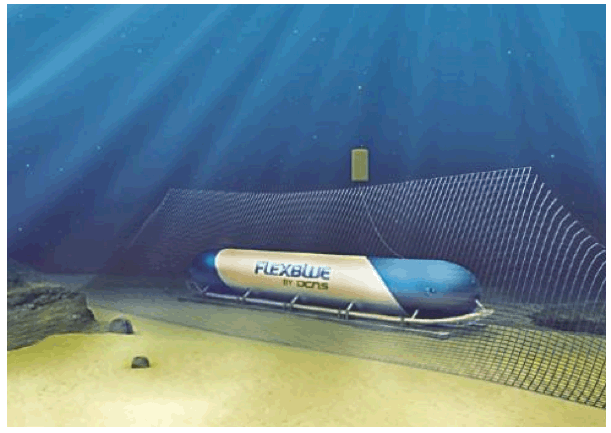
The project to convert submarine reactor technology (Cadarache)
A contract would already have been signed for the sale of such madness to a foreign country
****http://www.paristechreview.com/2013/11/15/
http://en.wikipedia.org/wiki/Nuclear_energy_in_Bangladesh
http://fr.wikipedia.org/wiki/Flexblue#Pol.C3.A9mique_sur_la_protection_par_l.27immersion ****
http://www.yourcommonwealth.org/2013/07/19/is-nuclear-power-the-answer-for-bangladesh/: ******
A comment from a reader, suggesting that the country in question could be Bangladesh. Source:
Excerpt:
It is estimated that the market for these submerged power plants could reach several hundred units over the next 30 years, especially in Southeast Asia, but also in other regions of the world. The competition is underway and the first modules will be on the market before 2020.
Another source:
Excerpt (translated from English):
Bangladesh also has agreements that could be made with countries such as the United States, France, or China. On May 29, 2013, the country's Prime Minister stated that a power plant could be built on an island, in the south of the country.

The Prime Minister of Bangladesh. The legend:
She insists on reducing the level of corruption in the country.
But the submerged power plants, not monitored, present the danger of blockage of the water intake holes by sludge.
Source (Flexblue):
The Bangladesh reactor could eventually lack water during the dry season (again ...). Source:
Excerpt (translation):
On the other hand, the Padma River is now heavily affected by the withdrawal of 75% of its flow during the dry season by India, using the Farakka barrage, located 40 km upstream. What remains of the water would then be insufficient to ensure the cooling of a 1000 MW unit (the minimum for a nuclear reactor). It is the IAEA that is overseeing the project ( ). Anyway, how can one imagine that nuclear projects do not end up in an insane risk in Bangladesh, given that this country is at the top in terms of corruption ( ).
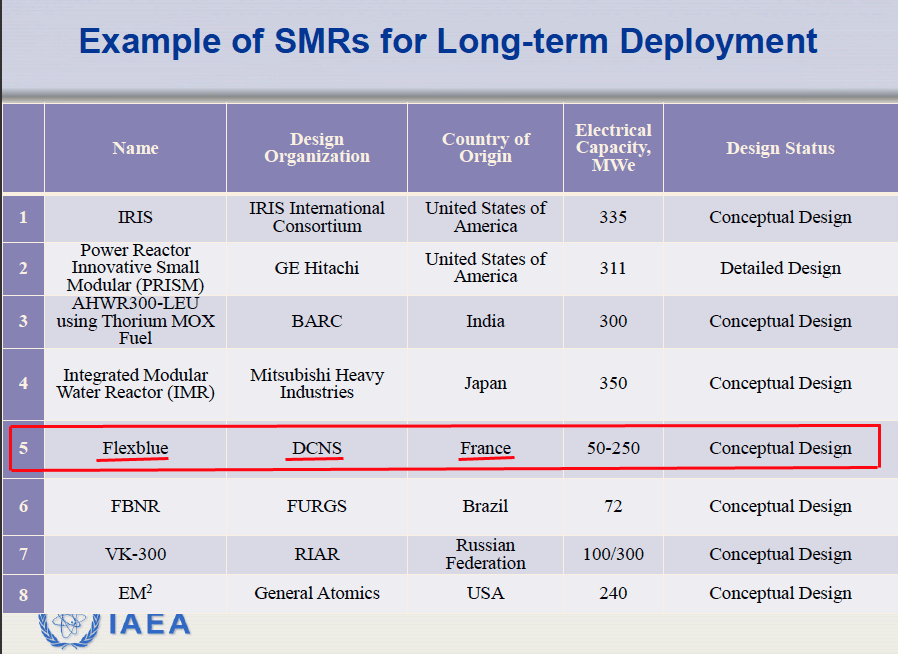
Regarding the development of Flexblue reactors ( : the internationalization of the know-how in nuclear reactors, derived from submarine technology, is evident by consulting the links on this French naval construction site, centered in the Hexagon at Cadarache) This project falls under the category of small modular reactors (SMR).
.
*- At the Hague plant, stop this reprocessing process that includes the storage of dangerous plutonium (60 tonnes at the Hague). Package the stored plutonium as ordinary waste, by vitrifying it. Limit activities at the Hague to vitrifying waste. *
*- Implement research on aneutronic fusion, on Z-machine, in a civilian and not a military context. *
*- Demand the creation of a proper reflection cell, focused on the rapid or immediate abandonment of nuclear energy and the transition to renewable energy. *
I invite you to watch a video showing the speech given by Gregory Jaczko, who was director from 2010 to 2012 of the NRC, Nuclear Regulatory Commission: the equivalent of the ASN, the French Nuclear Safety Authority, in the United States. Here is someone who has fully understood the scope of the problems and concludes, like me and an increasing number of people, that energy production through nuclear technology is not feasible, given the risks involved.
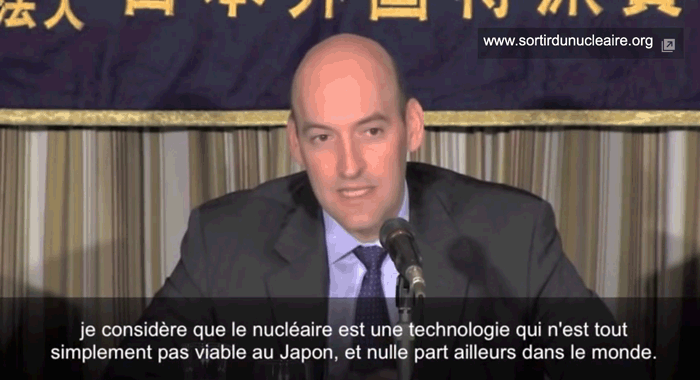
Gregory Jaczko's statements in the United States, former president of the NRC** American (Nuclear Regulatory Commission)**
http://groupes.sortirdunucleaire.org/Gregory-Jaczko?origine_sujet=LI201312
IN FRANCE:
You have just learned, above, the opinion of Gregory Jadzko, who was for three years, from 2010 to 2012, director of the Nuclear Regulatory Commission, which is the equivalent of the French Nuclear Safety Authority. This person is not a mere nobody. To occupy such a position in the United States, he necessarily had to know all the nuclear-related problems thoroughly. And he ... quit. His statements are devoid of any ambiguity: "nuclear energy is not viable, not in Japan, nor anywhere else in the world." I fully share his position.
This man is not an "extremist." He is an engineer who concludes based on FACTS. For 60 years, nuclear engineering and science have mobilized considerable efforts worldwide. Time, people, money. Sophisticated techniques have been developed.
Let's be clear: everywhere, the initial motivation was oriented towards military goals. Then came a civil nuclear energy, focused on electricity production. France, under the presidency of Giscard d'Estaing, plunged headfirst into this path. Now it's time for a balance: Is nuclear energy "playable"? Is there a "reasonable" nuclear energy?
I am categorical, like Jadzko: my answer is NO. One of the arguments is its danger, which no longer needs to be demonstrated. The second argument, perhaps even more weighty, is the inability to manage the waste of this industry. Moreover, the French must know that the (socialist) government of our country has given its green light for the continuation of a mad plan: the transition to nuclear reactors operating not with uranium, but with plutonium. This is infinitely more dangerous than uranium for reasons I have already mentioned many times on my site. In addition, the waste from this fuel contains components that require storage in pools for 50 years, until their thermal emission becomes low enough to extract them from their liquid element. By switching from uranium to plutonium, this pool storage time is therefore multiplied by ten!
Another point, also repeatedly mentioned: the operation with plutonium is already a reality in France. MOX is a plutonium fuel (93% non-fissile uranium 238, but "fertile," and 7% plutonium). The cores of current pressurized water reactors are partially loaded with MOX (25% of the core, I believe)
The EPR is designed to operate with a core loaded with 100% MOX. This has also been said and repeated.
This transition to 100% MOX will produce waste that the deep storage project GIGEO was not designed to manage (check it out)
Behind the EPR, the "4th generation generators, also known as fast neutron reactors, also known as ... Superphénix, sodium-cooled. All of this is in motion.
All of this is in motion. All of this is moving, and no one talks about it, not even the socialists, the so-called Greens and the actors of the current debate regarding the long-term waste disposal project.
?
J
e want you to watch this video. You will hear Monique Sené, former particle physicist. She is an expert in various situations. She is an ex-CNRS employee.
This is not new. In the opaque world of French nuclear energy, these things have always existed. When Superphénix was built, the Italians were supposed to build the linear moving overhead crane. During the load tests, it simply collapsed. Calculation error.
A
side of Superphénix, the French had built a pool for the storage of used fuel elements. When it was filled with water, the pressure it exerted caused a deformation of the ground, which led to a verticality defect in the reactor building! There had been no study of the terrain considering this load related to the weight of the water. Finally, it is known that the roof of the large building housing the heat exchangers and turbines, calculated by Parisians, who presumably did not know that it snowed frequently in Isère, collapsed under the weight of snow. "Fortunately," on that day, the reactor was ... shut down.
D
esign errors, the industrial world occasionally commits. Human errors, underestimation of loads, poor evaluation of this and that, poor quality of materials (concrete, on the EPR site!). These malfunctions grow exponentially with the number of participants, due to lack of adequacy of different components, lack of coordination.
L
e problem is that in nuclear energy, there is no room for error.
This video was posted on the Sortir du Nucléaire website. The problem is that this mega-organization, which only organizes skeletal events, ends the presentation of this strong text with "make a donation." To do what??? "Chains"? I remind you that Sortir du Nucléaire, which has a large audience, remained silent in the face of my proposals to write in-depth articles to really inform people, and which would be directly accessible on their site. Simply: no response....
ASTRID
You can compare this configuration with that of the EPR. It's simply because in ASTRID, everything will be ... buried, to protect the reactor from missile attacks.
You will easily find numerous articles about the recent incident (December 16, 2013) concerning "the polar bridge" of the Flamanville EPR reactor, which led to the order to stop work until the installations are compliant. I looked for the document that best explains what happened and I came across this video, which you can access through the following link:
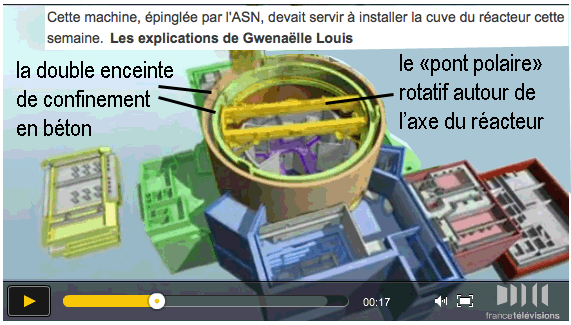
The polar bridge, in yellow
The following images, extracted from the video, show the manipulation of the reactor vessel, weighing 650 tonnes, using this polar bridge.
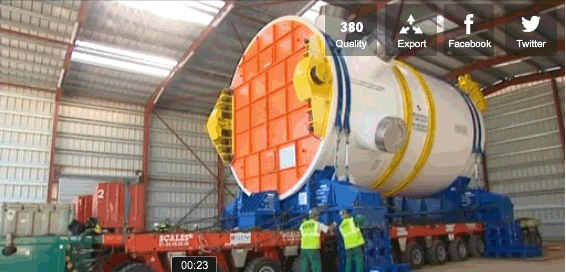
The reactor vessel. The people in the foreground give the scale ****
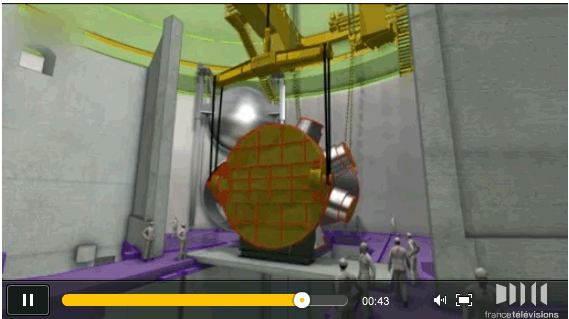
The polar bridge, in yellow, grips the vessel with its lifting lugs
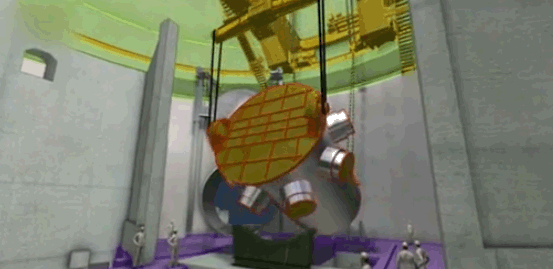
Beginning of the lifting of the vessel
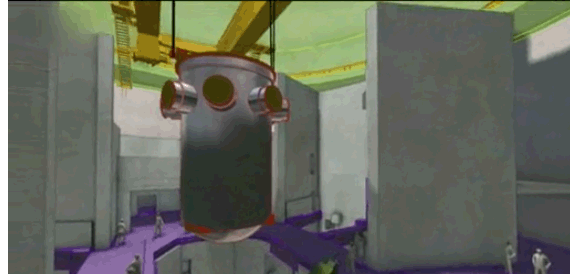
The vessel, suspended by the bridge, ready to be lowered
Gwenaëlle's comment on the video is very explicit. You can access the video a bit further down on the page . The causes of such a mess are multiple. First, there is the lack of coordination among subcontractors from different nationalities, the main goal being the search for economy (to be competitive against foreign producers). To this must be added simply the incompetence of the different partners.
This is not new. In the opaque world of French nuclear energy, these things have always existed. When Superphénix was built, the Italians were supposed to build the linear moving overhead crane. During the load tests, it simply collapsed. Calculation error.
Next to Superphénix, the French had built a pool for the storage of used fuel elements. When it was filled with water, the pressure it exerted caused a deformation of the ground, which led to a verticality defect in the reactor building! There had been no study of the terrain considering this load related to the weight of the water. Finally, it is known that the roof of the large building housing the heat exchangers and turbines, calculated by Parisians, who presumably did not know that it snowed frequently in Isère, collapsed under the weight of snow. "Fortunately," on that day, the reactor was ... shut down.
Errors, the industrial world occasionally commits. Human errors, underestimation of loads, poor evaluation of this and that, poor quality of materials (concrete, on the EPR site!). These malfunctions grow exponentially with the number of participants, due to lack of adequacy of different components, lack of coordination.
The problem is that in nuclear energy, there is no room for error.
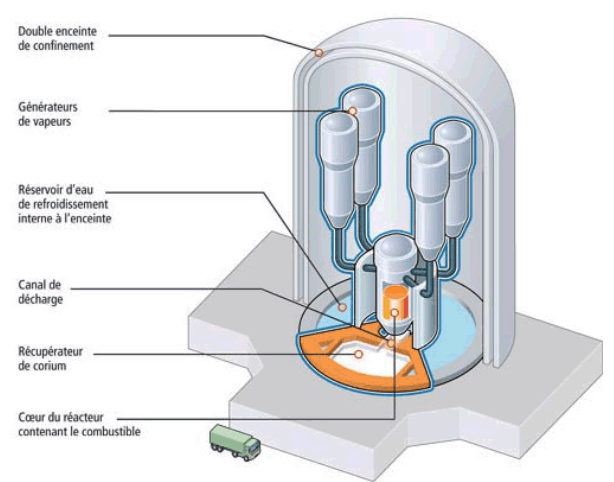
To finish, I give you this image of the EPR
In yellow, the corium collector, after a major accident, core meltdown, penetration of the vessel
Here is a technical drawing, the most official, which shows this "corium collector" system, which shows that in these projects, to ensure "safety," they have planned for the core to melt, which is a major nuclear accident.
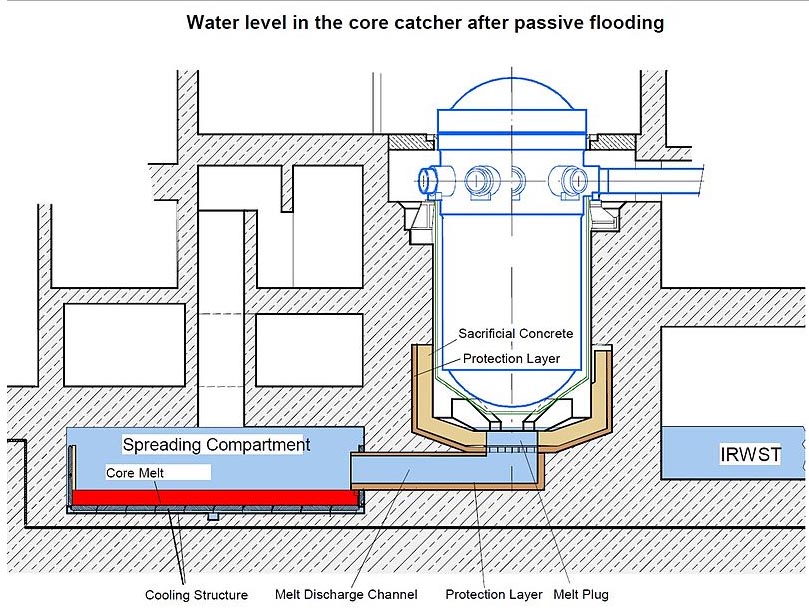
The English sentence above this drawing means: "Water level in the corium collector after passive (by gravity) drainage of it." Water intended to perfect its cooling. But why not start this cooling at the moment when the vessel is pierced and that this corium plug enters through the resulting opening from the melting of this container under the effect of heat? The reason is simple. The corium is not made up only of a mixture of uranium 238 and plutonium 239, since the EPR must operate with 100% "MOX". In addition to these two heavy metals, the residues of the zirconium cladding, which is known for its extraordinary appetite, at high temperature, for oxygen (contained in water molecules). It is this oxidation of zirconium that has led to the release of hydrogen, then the fantastic explosions that we could observe at Fukushima.
Thus, bringing a still too hot corium into contact with water could lead to the release of hydrogen, then an explosion, with the projection of ... plutonium.
Under the patronage of the Nuclear Safety Authority, everything is planned, even the worst. Because there is no zero risk, as is well known. What you see on this drawing is nothing more than a fantastic apprentice-sorcerer game. We must understand that in France, the awareness that nuclear technology, as it is (before the advent of aneutronic fusion, non-neutronic), is simply not manageable, has not been made. Among the Greens (EELV, where careerism and negotiations are happily combined) or within the group Sortir du Nucléaire, it is a thousand leagues away from being able to imagine that if humanity wants to avoid a major and irreversible environmental and health catastrophe, the immediate abandonment of nuclear energy is imperative. It is not a "reasonable transition," but a decision to be made.
And this, even though many countries are preparing to go nuclear and in France our nuclear pathologists are preparing, by 2050, the beginning of the deployment of "4th generation reactors" also known as fast neutron reactors, full of sodium, flammable in air and explosive in water. AREVA is dreaming of profits from exports. We continue to "reprocess," that is, to accumulate this deadly plutonium at the Hague
We think we are living a nightmare
Even more, we are beginning to consider educating the masses to give them individual responsibility in case of a major disaster. But that is only, on the technological level, the transcription of the principles of modern finance:
We privatize the profits and socialize the losses
Here, it is:
We privatize the profits and socialize the consequences of a major disaster.
http://coordination-stopnucleaire.org/spip.php?article38
The "tour" of Naoto Matsumura in France: a radioactive suicide in the spotlight?
Naoto Matsumura, nicknamed "The Last Man of Fukushima," is to travel to eastern France in March 2014 at the invitation of certain anti-nuclear groups.
Naoto Matsumura chose to live in a restricted zone a few kilometers from the Fukushima nuclear plant, in order to take care of domestic and farm animals left alone following the evacuation of the inhabitants of this territory after the nuclear disaster.
We don't all know Naoto Matsumura. We have never exchanged with him. We have no right to judge an individual's choice to remain alone, where he is exposed to deadly levels of radioactivity, in the short or long term.
However, we, members of the Coordination Stop-Nucléaire, who advocate for the immediate shutdown of nuclear energy and denounce the terrible consequences of nuclear disasters on human beings, are more than surprised by the content of the speeches accompanying his "tour" in France and before the European Parliament. (1) We think this staging goes against everything we denounce, it is counterproductive, and even dangerous. Here, we want to warn about the use that will certainly be made of it by the media and the nuclear lobby. We also question the motives that could be behind it.
The speech of Antonio Pagnotta, the initiator of this project, deserves attention. Facing the nuclear disaster, facing the reality of the radioactivity levels in the restricted zone, which will eventually cause serious pathologies for Naoto Matsumura or anyone encouraged to follow his example and settle and live in this zone, Antonio Pagnotta opposes a notion of "resistance" based on moral, sacrificial (2), spiritual and nationalist values.
First of all, it is values of "courage" that are promoted. Entering the restricted zone to visit Naoto Matsumura, Antonio Pagnotta himself removes his mask (3). To better approach death? To flirt with danger? To feel the big thrill? And finally to show that it is better to face the radioactive monster with an uncovered face, without protection: "When the disaster arrives, we will have to fight with our bare hands, and we will have to rely on what we know from ancient memory, that is, spirituality." (4) It is reckless to suggest that the radioactive monster could be confronted this way, without protection, and that it could be defeated by the sole inner forces of his spirituality. How can one not think of the liquidators of Chernobyl who "cleaned" the contaminated area. One does not "resist" radioactivity by the mere force of one's mind.
In the texts and videos of Antonio Pagnotta, there is also mention of dignity and honor (5) on behalf of which "The Last Man of Fukushima" would have refused evacuation, to avoid becoming a pariah, a leper. Note that the segregation system that produces these pariahs is not in any way questioned.
If it is, once again, an individual choice that concerns Naoto Matsumura, when Antonio Pagnotta describes it as a form of struggle, we think he is mistaken. Naoto Matsumura is in fact unable to fight.
He chose to stay. He is an example of the submission that will be required at the next disaster, during non-evacuation; submission to the irreversible effects of radioactivity and to the dictates of the international nuclear lobby according to which life in contaminated territory is not only possible, but desirable, provided some small precautions are taken.
Moreover, among the many Judeo-Christian and moral notions promoted by Antonio Pagnotta to justify Naoto Matsumura's choice, there is compassion for animals. He even dares to compare the loss of an animal to the loss of a "dear one," calling it a "emotional catastrophe" (6). Naoto Matsumura would thus have, "thanks" to the nuclear disaster, found "a meaning to his life":
"Matsumura shows the world that compassion is necessary after a disaster. Saving animals is also an act of humanity" (7).
According to Antonio Pagnotta, "He has overcome his fear of the nuclear specter. The loss of his dignity cost him more than the loss of his health, or his life" (8) ...
"We will be faced with the same choices and we will have to overcome our fears."
This call to overcome the fear of nuclear energy is not acceptable because it only serves the point of view of the nuclear lobby: the fear of radioactivity would have to be overcome because it is an irrational phobia.
This idea of an "irrational nuclear specter" is not new: one remembers the work of the pro-nuclear lobbyist Maurice Tubiana who, in 1958, sent a report to the WHO (World Health Organization) proposing psychiatry as an explanation for the harmful effects of radioactivity (9), and before dying, recently published a book titled "Stop Being Afraid!", inviting us to stick our heads in the sand regarding GMOs, waves, nuclear energy, etc. This also coincides with the controversial professor Sunichi Yamashita:
"If you don't smile, radiation will have an effect on you."
(10) We think, on the contrary, that this fear is legitimate, that it is not a question of "overcoming" it, but rather of freeing it. It must push us to act against nuclear energy, now, and not after the disaster.
There is nothing mystical or irrational in fearing the consequences of a nuclear disaster: nuclear energy is not a "specter." The dangers are very real: people, children, animals are irradiated, radioactivity enters the food chain, ends up in the soil, in the air, in the water, and people, children, animals develop pathologies, their genome deteriorates, their lives are degraded. Overall, most beings exposed to radioactivity die faster.
Another argument of Antonio Pagnotta, and which seems more than suspicious, is that of the "survival" of the nation.
"At Fukushima, Japan is playing its survival, its very existence as a nation," or again, "the Japanese government has learned a dramatic lesson from Fukushima at its own expense.
... It will be necessary to accept radioactivity..."
(11) It is barely believable: where could Mr. Pagnotta have drawn the conclusion that the Japanese government would have learned anything, except keeping the refugees in temporary housing for almost three years, refusing to compensate them if they want to leave, denying the consequences of radioactivity, and releasing thousands of tons of radioactive water into the Pacific?
The Japanese government wants to bring back the refugees to contaminated areas. The Japanese government wants to reopen the reactors in Japan and, being part of the international family of nuclear officials, is promoting its "nuclear expertise" abroad, just like France.
And Naoto Matsumura is presented as someone who would save "the dignity of his city and of all Japan" (12): a new "martyr" in honor of the Japanese nation? Like the kamikaze pilots of the Second World War sent to death for the honor and survival of the empire? While those who chose to flee from radioactivity are considered traitors to the nation?
We think that this theatricalization of Naoto Matsumura, a real victim of the Fukushima nuclear disaster, who would present him as a sort of "modern hero" against nuclear technology, but also as a "martyr" alone against TEPCO, goes against our goals in the fight against nuclear energy.
Naoto Matsumura's personal choice resembles a programmed and obviously accepted suicide. We think that elevating him as an example and praising a suicidal behavior is irresponsible.
Come on! A little courage, dignity, honor, a pinch of spirituality and compassion and the trick is done. To sacrifice oneself to save the dignity of one's country, the human condition and the animal condition, what a beautiful death!
But let's return for a moment to Antonio Pagnotta, author of "The Last Man of Fukushima," a book we certainly have no desire to purchase given his statements and videos (13), and the organizer of this "tour."
The least one can say is that he is not very careful about his associations when it comes to promoting himself. Why did he consider it useful to participate in a seminar in September 2012 organized at Sciences-Po Paris by the IDDRI (Institute for Sustainable Development and International Relations), whose president is none other than Laurence Tubiana, facilitator of the debate on the energy transition and who leaves no doubt about her convictions on the nuclear issue:
"Nuclear energy will still be with us for a long time, regardless of the decisions made after 2017" (14)? This same Laurence Tubiana also explains that:
"... safety and security in power plants... fall under the responsibility... of a citizen debate.
The risk taken must be fully accepted by society..." (15) The seminar was organized within the framework of the DEVAST project (16) whose coordinator, François Gemmene, states in the same vein:
"Everyone knows it is illusory to want to get out of nuclear energy. But the lie must stop, and this debate must stop being seized from the citizens."
(17) Regarding the stated goal of this project, Reiko Hasegawa, study officer, on the other hand, specifies:
"The question is how to increase the transparency of the authorities in managing the crisis, especially for the nuclear accident, and how the population can participate in this political decision. That is really the key question after the disaster." (18) Is it not exactly what our nuclear authorities, ASN and IRSN, are seeking in defining the CODIRPA: "In the framework of the post-accident management program: the decision-making process during the transition period evolves towards a concerted and participatory mode, involving the affected populations, economic actors, associations and local officials"? (19) Does Antonio Pagnotta ignore the motivations of such conferences or is he consciously playing the game? In either case, what a boon for all the "post-disaster managers" that the example of Naoto Matsumura, this man who chose to remain in the restricted zone, and "to [accept]... the risk."
Regarding this, a recent article by the "nuclear expert" of Greenpeace Belgium also pleased them greatly. He boasts of having allowed a farmer to stay on his farm 45 km from the Fukushima nuclear plant thanks to a measuring device developed by Greenpeace. (20) Yes, really, what a joy for all the promoters of "governance," "participatory democracy," "popular debate," all those who want "citizens" to become "stakeholders," willing participants in the tragedy imposed on them, provided that nuclear energy is "transparent," safety violations are punished, but above all, above all, it is not a question of ending it.
Yannick Rousselet, in charge of the nuclear issue at Greenpeace France, says nothing different after the national conference of CLI on December 11, 2013: "We are objective allies [ASN (Nuclear Safety Authority) and members of CLI (Local Information Commissions)] on safety and transparency...
Everyone benefits in these pluralistic exchange places, ... They are a very interesting tool for democracy and debate." (21) That anti-nuclear activists, known for their active struggle, support Naoto Matsumura's "tour" in France without any hesitation and without appreciating the consequences, does not bode well for the development of strategies to stop nuclear energy.
It is not responsible to succumb to the siren calls of easy media coverage without reflecting on the messages that the media and the nuclear lobby will be happy to relay, and on the goals that are being pursued.
Why would the nuclear officials refrain from seizing the opportunity offered to them and presenting anti-nuclear activists as a band of "mystic delirious," defenders of the animal cause and supporters of new idols: Naoto Matsumura, the "Buddha of Fukushima" (22); Ren Yabuki, who will be part of the French tour, the "Christ of Flies" (sic) (23), presented as "potentially a leader, a chief that the Japanese ecological movement ... needs in the coming years." (24). Why would they refrain from a new opportunity to describe anti-nuclear activists as a band of irrational laggards who refuse progress?
But alas, the madness does not stop there, because in all humility, the arrival of Naoto Matsumura is presented as "an inspiration" and an "amplification of all ongoing anti-nuclear projects" (25). Nothing less!
And we, we certainly have no desire to be "inspired," nor for our words to be "amplified" by what follows:
"Naoto dreamed with his eyes open. He was thinking about his great project: bringing Tomioka back to life. His meeting with Masamichi Yamashita of the Japanese space agency had opened up unknown horizons. The researcher had developed methods to reduce organic waste to one percent of its volume; a method useful in spacecraft or orbital stations. From the first weeks of the nuclear disaster, Dr. Yamashita had imagined using space technologies for decontamination. ...
The project that Matsumura wanted to develop was the basis of all civilization: a nucleus of life around which the city could begin to live again, the original farm.
The tiny village that Tomioka had been in the darkness of time could thus be recreated, the first necessary step for the return of civilization." (26) Finally, with all the madness, nausea, or simply unconsciousness that this speech contains, we think that if some wanted to sabotage the anti-nuclear struggle, they would not go about it any other way!
January 7, 2014, Coordination Stop-Nucléaire.
Still in this spirit of complete blindness, watch this video of Monique Sené, former research director at CNRS.
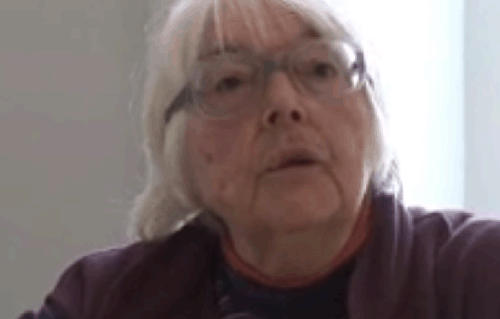
Monique Sené, former research director at CNRS, particle physics
" Neither for nor against, on the contrary..."
Here is the complete video, during the public debate on the waste burial project
Three years ago, I had several phone conversations with the Sené couple, including her, when the issue of the ITER project arose. Immediately, Monique Sené's reaction was to tell me, "We are too old, my husband and I, to consider a recycling in terms of plasmas, fusion."
When I heard her speak, I wonder if, although she has never worked in the nuclear field, but in particle physics, which is only adjacent, if she has realized the extent of the technical problems and their danger. I think not. For decades, Monique Sené has been active within the CLI, "Local Information Groups", sponsored by the ASN, the Nuclear Safety Authority, for "more transparency and good public information on the risks related to the nuclear industry."
But it becomes clear that this woman, as well as many others, is a thousand miles away from considering that "the only solution is the decision to abandon nuclear energy" and not "learning to live with nuclear energy." As de Gaulle had written:
Sometimes, old age is a shipwreck.
A shipwreck of thought, of scientific and technical reflection. Monique Sené will continue to dialogue endlessly with the Nuclear Safety Authority (which has approved, as mentioned above, that EPRs be equipped with corium recovery systems!!). While what should be aimed for is the immediate stop of all projects (while the project of the fast neutron reactor ASTRID is being launched! ), and in this perspective, the ASN would eventually ... disappear, as well as the CLI, along with ... nuclear energy itself.
****Cooling of MOX spent fuel takes 50 years !!!.
necessitating its prior cooling in pools for a period of 60 to 100 years.
the Tricastin plantpresentation of this center by AREVA
Concrete degradationstarting from half its volume in water** ** ****
**StocamineFire control proved impossible
Asse **** **** ****
As a reader, a scientist, reminded me after reading this page, reactors operating with plutonium differ significantly from those operating by burning uranium. The fission of uranium gives fission products whose activity, due to their decomposition, releases heat for 5 to 8 years. This is why the cores extracted from fission reactors must be stored in pools for this entire time before they can be handled, and before they can be stored dry.
The fission of plutonium leaves waste that, due to the slower decomposition process, will have to be stored in pools for 50 years before being able to be stored dry, for two generations. Already, half of the French reactor fleet operates with MOX. The waste they will produce must be managed, stored in a confined environment. This time, a deep storage of spent MOX fuel. The CIGEO project, the deep storage of Bure, was initiated 10 years ago in the Champagne Ardennes region, a site that was absolutely not intended to store waste from MOX. The project only concerns the storage of currently stored waste (at Marcoule, Cadarache and the Hague), an operation that should take 100 to 120 years, requiring a complex robotic system that must not fail at any cost! However, every 5 years the loading of all reactors reaches its expiration. These cores must be unloaded and stored. This usage time may be a little longer for MOX reactors, where the plutonium percentage has been raised to 7%, plus 93% uranium 238 (instead of 3% for the U235 + U238 mix). But this only postpones the problem. We stop using the cores when they no longer produce enough energy. In the case of uranium reactors, we unload when the 235 rate falls below one percent.
Why, then, not load these cores with more enriched uranium? Because this enrichment is expensive (for example, by centrifugation). In France, the isotopic enrichment of uranium ore is carried out at , Rhône valley, opposite Saint Paul les Trois Châteaux, a complex equipped with four pressurized water reactors, completely exhausted, where incidents are multiplying. Compare the previous link with .
The plutonium used to make MOX is not obtained by isotopic separation, but by chemical extraction from spent cores (because the plutonium produced in the cores does not have the same chemical properties as the oxides it is mixed with). France thus has a stock of 60 tonnes of Pu 239 (increased by an additional 5 tonnes per year, related to the activity of the "Hague reprocessing plant"), which it uses to make MOX, which it directs to its reactors, partially loading them with these elements, while the EPR will be designed to operate with 100% MOX.
In an episode devoted to the CIGEO project, the (young) responsible for this storage mentioned this MOX issue, adding:
- If the Bure site were to be required to store spent MOX fuel, its functions would then have to be redefined (...).
In short, Bure is not designed to store spent MOX, but only uranium fuel cores. What are we going to do with this mass of waste that has already resulted from the gradual, then systematic, transition to MOX in French reactors?
All of this makes no sense. It is complete irresponsibility. Opening a parenthesis on this CIGEO underground storage project, at Bure, where the decision to start the process must be made in 2019, in only six years, after studies on the site that have already cost 1 billion euros to taxpayers and continue to cost 100 million per year, we will give some aspects of the dangers involved.
Many used elements are packaged in bitumen, which burns in air at a relatively low temperature: 300°. Where could the heating come from? From the combustion of hydrogen released by plastic waste (nuclear accessories, gloves boxes, etc.). The decomposition of such waste is inevitable over time. These are currently contained in steel drums, and no inventory has been made. In fact, we do not know what is contained in the drums that we intend to lower 500 meters deep into Bure.
Steel corrodes.
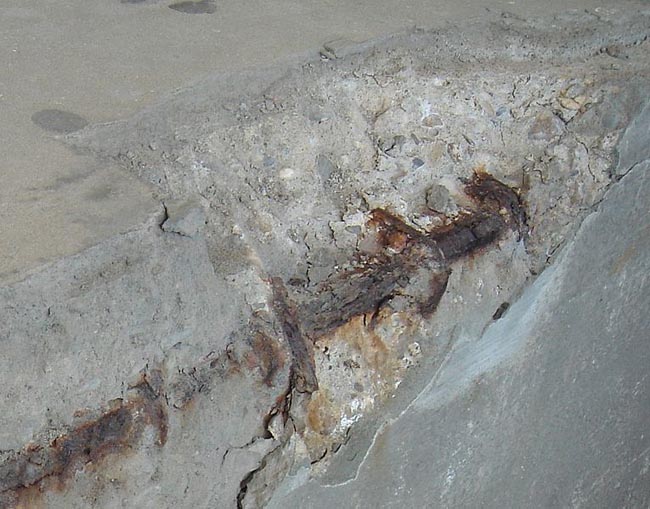
. Let us recall that concrete is only a combination of a binder, cement plus gravel, with ... water. A standard concrete is composed .(if you live in a building made of concrete, know that half the volume of walls and floors is made up of water!). When we wait "for the concrete to dry", it is not about the evaporation of the water it contains (otherwise the level of a concrete slab would decrease), but about the completion of the hydration process at the base of the construction material's constitution.
Acidic water, infiltration, will corrode the concrete. Beyond that, oxidation will corrode the iron rods that will constitute its reinforcement. Some modern concretes increase their resistance by adding plastic material, which itself is susceptible to degradation, releasing hydrogen. The arches of the Bure storage facility galleries will be built in ... reinforced concrete, by people unable to project themselves into the future beyond a century, while they are supposed to build installations that should last for a million years (6000 human generations!).
Installations that, after the century devoted to burial, would be ... sealed, inaccessible. But then, the collapse of the galleries would cause cracks in the clay, in contact, on its upper part, with limestone, whose presence of a karst system, with water circulation, is unknown.
The "concrete cancer" When a corium becomes active and emits, what emerges, in the form of bubbles, is nothing other than water vapor.
Poor quality concrete also has a certain porosity and the hydrogen, a tiny molecule, passes through ... anything. There have already been fires in mines where chemical waste was stored (, an old salt mine).
and these mines were sealed. In these mines were stored, among other things, asbestos and pesticides. The fire produced masses of toxic waste, including dioxin. This fire was not expected, this area not being supplied with electricity. The hypothesis is that the temperature increase would have been due to the unexpected fermentation of agricultural waste (...).
The current storage time of radioactive waste in France would be, on the site of Bure, at least a century (not taking into account the new waste from MOX!). Thus, given the lifespan of packaging such as concrete, steel and bitumen, fire risks would arise even before the burial of the current waste is completed. Anyway, maintaining the temperature at the bottom requires ventilation of 500 cubic meters per second. Who could say that the region will remain politically stable for the next century?
With the Stocamine accident, we already have an example of how things could go wrong, regarding the storage of chemical waste. What about the consequences of a loss of containment of waste whose danger lasts a million years? The "Bure parenthesis" is endless. As shown in a recent, well-made film, the development of this type of storage would be equivalent to a mining operation in good and proper form, regarding the excavation of galleries. These induce mechanical tensions that can cause cracks and deep ground movements. The example was given in the German site of Asse, which was an old salt mine.
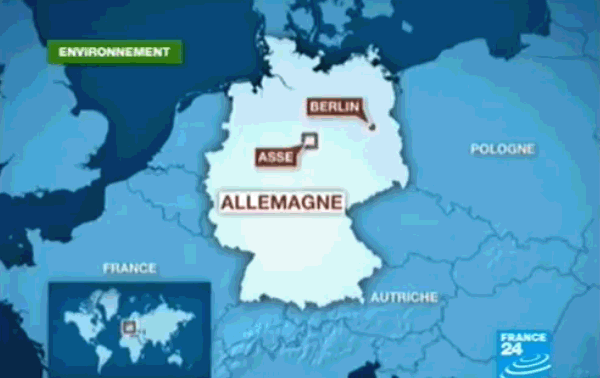
Asse storage site, location. Salt being hygroscopic, seemed to constitute a natural barrier against water infiltration. Geologically, the initial, primary salt mass could be considered by geologists as presenting stability guarantees. But for this mass of salt, plus the different excavations corresponding to the exploitation have created a structure that, mechanically, no longer presents the same guarantees of mechanical resistance.
Asse, and there were water infiltrations.
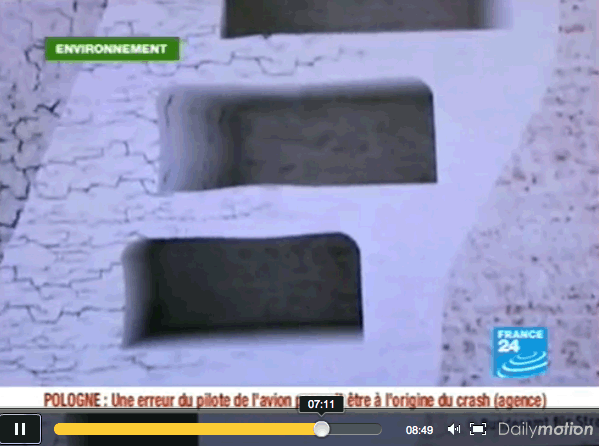
: the cracking of salt, linked to the excavation of galleries.
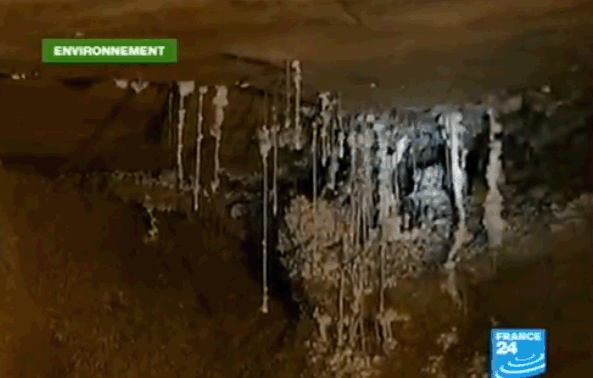
Asse: water infiltration. In inaccessible rooms, the drums are submerged.
Masses of drums, in bulk, in rooms whose access has been sealed, are currently in water, which accelerates their oxidation.
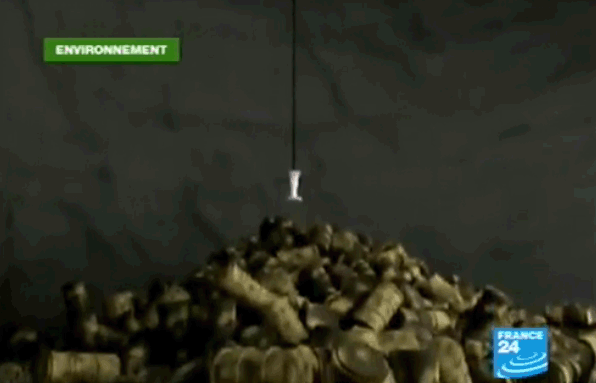
Asse: the storage mode of the "packages" (...) The result is simply catastrophic, although the burial of waste at Asse had been decided based on formal conclusions issued by "experts". Asse was not supposed to move for millions of years (of course, if we had forgotten to dig galleries! )....
It is even worse for the Bure clay, which simply dissolves in water.
I just watched a "public debate" as it was organized in the media, considering that holding a debate with the public present was impossible. There are the project managers of the ANDRA, plus Bernard Laponche (from "Global Chance"), the bearded one, Jean-Marie Brom. But I don't see Tuillier, the man who has worked the most on the risks inherent to deep burial. Return to this investigation:
As technical discussions are avoided in this way, there is only a philosophical debate that can be qualified. It's a pity I wasn't at that table. I could have mentioned a nuclear energy that could one day have a future and lead to an aneutronic fusion. Does the one who speaks of transmutations imagine a moment where physics was a century ago? We were in 1913. If nuclear physics had been mentioned at that time, it would have been considered science fiction (the neutron was discovered only in 1932...).
The man of CIGEO, the young one, talks about ... memory. But Brom retorts that they discovered near Lille a munitions deposit from the 14-18 war, whose existence had been completely forgotten. Laponche rightly recalls that if the CIGEO project starts, dozens of similar projects will emerge around the world and that in a century, man will have irreversibly polluted ... the earth's crust.
But nothing, apparently, will stop this race to catastrophe. Everything is a matter of money. Brom, a specialist in particle accelerators, does not have the expertise. I vainly tried to join Global Chance by meeting Laponche in Paris. But the blockage is there, and well there. Laponche also does not have the weight. Regarding this CIGEO project, neither he nor Brom were able to bring up the points that Thuillier had discovered in the ANDRA reports themselves.
All of this is completely crazy!
The solution?
A year ago, I was received by a figure of French nuclear energy, Paul Henri Rebut, creator of the tokamak of Fontenay aux Roses. He received me in his splendid apartment on the Place des Vosges, in Paris, decorated with antique furniture and master paintings. In 2010 he gave an interview to Science et Vie ( ) declaring; - I am personally skeptical about whether we can extract energy from fusion by the end of this century (that is, in ... 90 years!).
Two years later, in his living room, Rebut had changed his mind, telling me:
- Who says that ITER will not work?
We then had a technical discussion at his home, quite intense. The solution proposed by Rebut, to save this ITER project and manage a production of neutrons with an energy of 14 MeV, was to place in the first wall plates of uranium 238, "fertile", which would thus be transformed into plutonium 239, which could then be used in fission reactors, EPRs or fast neutron reactors. I reproduce the following exchange, which left me speechless:
But then, we fall back on the previous problem! We lose the advantage that fusion reactors could have, if they were to function properly, regarding waste.
Waste can be managed.
.
Of course, where was my head? The solution was right in front of me and I didn't see it: it was enough to store them in Rebut's living room, Place des Vosges!
Back to the general theme of this page. The EPR is nothing more than the transition to the fast breeder reactors, cooled by sodium, of which ASTRID will be the "demonstrator".
Who knows what this "new fuel", MOX, is? It is a mixture of 93% non-fissile uranium 238 and 7% fissile plutonium 239, infinitely more dangerous than anything used so far (this plutonium, produced by transmutation of U238, after absorption of a fission neutron, in the cores of uranium reactors, is extracted during the "reprocessing" operations carried out at the Hague plant).
Plutonium, the explosive of bombs. But who cares?
I too would need to escape sometimes, and my readers have no idea of the drafts that are sleeping in my attic, among which the "Jungle Underwater Book" is just one (I think of plays, a grammar course for Neolithic men ... )
People make a lot of mistakes. It seems they try to make as many as possible. But there is a human universe from which only good comes out, it is music. There is of course this nonsense that is military music, which helps men to march in step.
The street belongs to the one who goes down it
The street belongs to the flag of the white helmets
And against us the hatred
Against us the cries and insults
Treading the dark mud
Go the white helmets.
Through this link you will have access to an excerpt of a film recounting the Battle of the Ardennes. There we see young tankists, in Nazi uniforms, black, marked with the skull, barely twenty years old, singing this "manly" song, hammering their words on the ground. Exalted, as long as one only sees the impeccable uniforms and not the wounded and bloodied bodies.
This was not the only one. It was certainly not to the taste of the many Jewish students from Grandes Ecoles present. Out of solidarity and as a protest, the entire class decided to sing these songs (the song of the legion is the French translation of the famous Panzerlied sung by Nazi troops during the attack on the Belgian Ardennes) in German. Shock within the command.
*- We simply sing it in the original version. *
*- How! ? *
*- There are enough march songs in the French military repertoire to avoid those translated from German. * - The reaction was an avalanche of collective punishments, which remained ineffective.
The street belongs to the one who goes down it
The street belongs to the flag of the white helmets
And against us the hatred
Against us the cries and insults
Treading the dark mud
Go the white helmets.
Fortunately, there is a majority of compositions that have no common point with these manifestations. Music remains the common space of peace for all peoples.
Here are the links that will allow you to listen to a famous piece by the Argentine composer Astor Piazzola, called Libertango. It has been the subject of a very large number of adaptations and interpretations. But I find that those expressed through guitar duos are particularly beautiful.
First, two Chinese women, Wang Ya Meng and Su Meng, absolutely impassive. But what perfect technique, what sensitivity in their playing!

****Libertango, by Wang Ya Meng and Su Meng: The perfection of play and interpretation
****The Beijing Duo

The duo Olivier Bensa (composer) and Cecile Cardinothttp://www.agendaculturel.fr/duo-bensa-cardinot
*What is fantastic about the Internet is that these simple links allow to offer such treasures. *
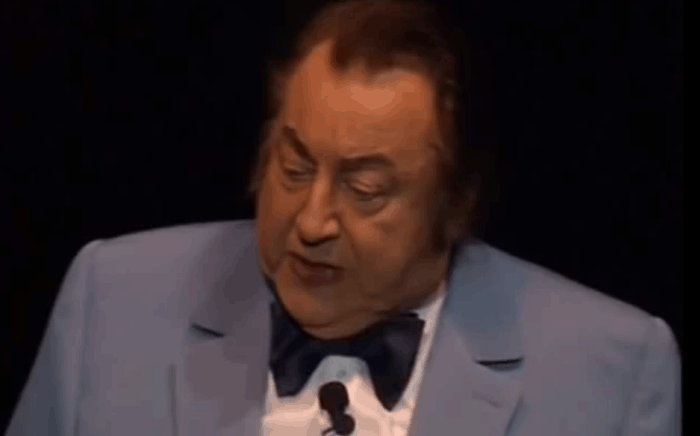
Raymond Devos at the Olympia in 1999
http://www.youtube.com/watch?v=eAxFoVGh6I4&list=RDAbs4Cuds9VI
**
| I just discovered a link leading to the recording of a show by | at the Olympia. Devos, poet, magician, orchestra man. A great evening, a way to relax. | It is also a humor that rises above what is heard more and more, which makes use of everything. But one can be both a comedian and a polemicist, but it is not given to everyone to do it with talent and lightness, while it is the finest traits that penetrate the most, it is the best words that are remembered. We do the heavy, the vulgar, the mediocre | . |
 |
|---|
Finally, for those who wish to inform themselves about valid alternative energy solutions, watch this report on solar thermal energy in Spain, with storage:
https://www.youtube.com/watch?v=8iBKtCfcPfk&hd=1
*Or hydroelectricity, in an episode of C'est pas Sorcier : *
https://www.youtube.com/watch?v=BbrFQfnnWqE
Houses-trees that ... produce energy (C'est pas sorcier)
https://www.youtube.com/watch?v=BpLuXnKN04w&hd=1 ---