Politics society history ideology
Plucking the petals of the daisy
Translated by Xavier Padilla
November 8, 2004
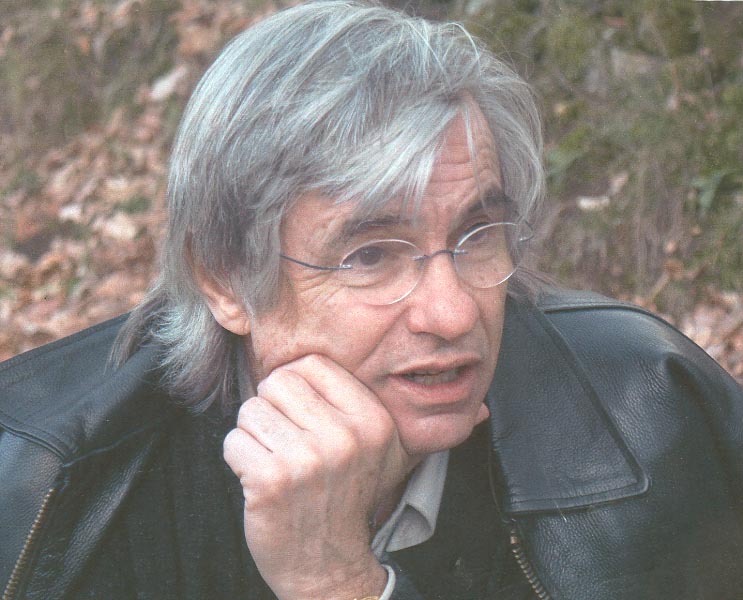
Jean-Pierre Petit, astrophysicist, 2004
People of my generation may remember that it was a Brigitte Bardot film. But it's not about this daisy that I'm thinking today. I'm thinking of an image that was passed on to me by one of my readers. In France and in a number of other countries, we pluck the petals of the daisy. The established power targets liberties, social achievements, one after another. As long as there is no new unity, no party or union capable of defending individuals or the staff of companies, everything will remain silent. Each petal of the daisy does not react when its neighbor is plucked, without realizing that one day it will be its turn.
We do not see the emergence of an alternative solution, which is now a fact reaching a desperate point. Periodically, Arlette Laguiller [French Communist Party candidate] runs into elections, delivering her little monologue in a monotonous tone, bleating. She talks about the "party of labor" and the "owners". If she denounces the glaring injustices and the erosion of social rights, her political message remains rather poor, non-existent, just like that of all those who claim to be from the "left", whether they consume caviar or not. Some remind us of the "self-management" preached by the "sixty-eights", the most beautiful nonsense we could imagine in our social history. No, companies do not function when Soviet-style workers take power. Communism did not work either. But, of course, things are more complex. Even if there was good will (and honest personalities) in the USSR, that empire, built in the most violent autocracy, like that of the butcher Stalin, died of economic suffocation, forced by the United States to develop a war arsenal that devoured the majority of its gross national product. The USSR had never had the means to keep both the butter and the cannons. Everything collapsed like a house of cards, and the Russians are having a hard time moving from one extreme to the other, from a "planned economy" turning in a closed vessel, to a market economy. It all seems as if they have accumulated all our weaknesses at once, without really benefiting from some of the qualities of this system, and now the halls of their train stations are filled with children who prostitute themselves, street markets are full of old people who sell herds to survive. The Soviet social security has been replaced by misery. In Cuba, the American Mafia, expelled quickly by Castro, will soon reinstall itself where its headquarters once was. Mao's China inherited the iron rod of its great quartermaster. There, they deal with the invasion of drugs by directly shooting anyone possessing even the slightest hallucinogen. China has escaped the whims of its leader-guru, this fresh flesh freak, this artist who, at one time, played the role of a metallurgist with the efficiency we know today. For those who don't know: this was done by deciding that peasants would now produce their own steel in the village blast furnaces. On the other side of the world, Stalin played the agronomist by simply deciding, after the war, that his people would dramatically increase their agricultural production by "plowing at a depth of one meter," transforming tanks into tractors. The result was that entire territories became infertile for a long period, thanks to the fact that the fertile soil had been moved to a depth of one meter, and the surface became unable to react to the seeds.
In Arab countries, existential anguish benefits religious leaders who throw the sharia and the burka on their flocks, like life rafts against an expanding Western confusion of manners. This has the advantage of being simple, even if it is a solution that goes back a good millennium. In any case, it answers everything. It offers a strict, well-defined way of life, an ultrastable social system that accepts all inequalities and all solutions to existential anguish. Everything is planned. While Westerners drown their spleen in antidepressants, build walls, or blindly fire missiles in pursuit of another biblical law, that of vengeance, on the other side, an escape is offered to the most desperate: suicide, with written guarantees regarding beatification in the afterlife. Unbeatable. But in Arab countries, as in the United States, political leaders do not send their children to the slaughter. Death, which has always been for the poor, at all times.
The system of Islamic fundamentalism presents itself even as a political force of international scale. This system of the kamikazes is unstoppable. It is "the atomic bomb of the technologically backward," against which cowboys equipped with lasers and thermonuclear weapons, assisted by hypersonic spy planes equipped with GPS-guided bombs, remain completely disarmed. Such a situation has never been known. Historically, it is extraordinary. The European countries, on the other hand, resemble bales of straw that only need to be set on fire. The Algerian war is there to show that things can degenerate extremely quickly. With the first bomb that explodes, the extreme right will revive its dormant OAS [Secret Army Organization during the Algerian war]. Under whose initiative? Good question. Who is pulling the strings? Who will launch the first wave of attacks in such or such European country? Will it be the religious leaders or... the Americans themselves, seeking a way to force the Europeans to join them in a crusade "against terrorism"?
Did the American hawks precipitate things by launching a self-attack, completely Machiavellian, on the famous September 11th, which as a case is no clearer than the juice of a pipe? An erudite operation of international policy, leaving the hands free to beautifully plunge into insoluble and humanly catastrophic situations. Iraq embodies the role of the Russian retreat. Historically, these two situations are comparable.
Science also does not offer a solution, collaborating closely, as it does, with the military-industrial lobbies (which seem to have become, today, a priority of its "research and development activities"), a job where science ends up discredited. It first serves the race for the highest profit rates and the circuits of power or monopolies, with absolute irresponsibility, while engaging in the adventure of GMOs, among others. Increasingly far away, the general public questions the great priests of science, the bearded ones wearing belts, or the disabled in wheelchairs who behave like gurus and promise them... everything, these same ones who advance theories "which will prove useful in a few centuries, since they are too advanced," evoking the TOE, or Theory of Everything. All of this is pitiful.
I have nothing to offer. It is a report, that's all. What needs to be shouted is the attitude of what is called our media. But what is media? The definition of Larousse is vague. One reads there "diffusion of a mass culture." But that is not all. Our media are the windows through which information professionals are supposed to inform us, to show us what is happening in the rest of the country and in the rest of the world. In reality, they flood us with stories of crushed cats, to better make us ignorant. Every day, our television news drenches us with trivialities to better mask the international situation, summarized in a few minutes. The German/French TV station Arte is the "alibi station," where "big issues" are discussed, where facts from half a century ago are denounced without care, to better hide what is happening before our eyes today. One wonders whether these people have not become professionals of misinformation, actively or by mimicry. I don't know if there are still French people who believe in their media, in what emerges from their small screen, in what they read in the columns of their newspapers (do you know that Le Figaro and L'Express belong to Serge Dassault?). I recently looked at a Le Monde issue (a press organ that Dassault vainly tried to appropriate; but who really owns this newspaper? Who still thinks that this press organ is "objective"?). I think it was the October 19, 2004 issue. A whole page was devoted to the extension of poverty in France. More and more unemployed, people "at the end of their rights," homeless people, people evicted from their homes unable to pay their rent, over-indebted people, etc. A whole page. But I did not see any of the great phenomena of our time, relatively recent, but which are likely to experience explosive growth, to which a name was given: "delocalizations." It is a very nice word. It required a specialist in "communication" to choose this term, so little "charged," with such a calming appearance, while covering future miseries, a vast expanse of coming suffering. A friend, Jacques, recently told me that a new European law had passed. For a company, "delocalizing" no longer requires being in difficulty. The move becomes legal if it "increases its competitiveness."
In a bookstore, I saw books praising Europe, "so that we can build a strong Europe, capable of standing up to the Americans." This reminds a line from a Prévert poem:
Those who manufacture in cellars the pens with which others will write that all is going well
(Globalization scares me. When we discussed the possibility of Eastern countries entering "our beautiful Europe," I had imagined France invaded by Polish engineers willing to work for wages much lower than those here. I hadn't thought that it wouldn't even be necessary to bring the Polish engineers, technicians, or workers here, but that it would be enough to "delocalize the companies." We are still lacking in imagination.
Do you remember robotics? We were told we would move towards "a civilization of leisure." Humans would no longer need to work, robots would do it for them while they turned their thumbs in circles. The truth is that this robotics, even if it increased productivity by employing workers who never protest, who don't need social security or sleep or holidays, has turned into millions of unemployed, like the former "silk workers," these textile workers who had been thrown on the streets by the appearance of the Jacquard looms. Unemployment paid for by a "generalized social contribution," increasingly heavy.
Do you remember telecommuting? We were told, "you won't need to go anywhere to work. You'll work from home." When employment was slipping away, people said to themselves, "we will become a population centered on services." Wrong: what I didn't see is that the staff of a company can also be "delocalized," including -and especially- those of service companies. I saw a documentary on employees living in Romania, working remotely for a French company, with a third of our wages. And these people were delighted. Brilliant, isn't it? Who realizes what is happening before our eyes? In Eastern European countries, workers cost three times less. Indian or Chinese workers may cost ten to twenty times less. A friend of mine has a small company. He told me, "in our products, 60% of the production cost is labor. I'll tell you something: next month I have appointments in the Czech Republic. That doesn't mean a loss of civic direction. Now, it's 'either that or disappear'."
Another one said, "we could put a label on the products saying 'made by French labor'." But who would do that? A consensus would form. The opportunity is too big and the phenomenon is now too common. And then, what has "100% made in France" become today? Nothing. Tomatoes are Spanish, screwdrivers are German, processors are made in Asia. By employing Czechs, Poles, or Chinese, we will slowly fill our pockets.
Where are we going like this? Which politician could still tell us where we are going? In a liberal model, capital, the production system, moves toward what ensures the highest profit rate, that is, toward regions of the globe where social security coverage is the weakest. It's in the logic of things. Since it has become possible, thanks to this globalization, to "delocalize" practically all activities, including now services "thanks to the Internet," we are moving toward a leveling of workers' living conditions downward, as well as a loud increase in the incomes of the "new rich" and the "old rich," who will become even richer by benefiting from increased profit rates and reduced indirect labor costs.
You see here where our democracies are converging, democracies that now take on the form of total complacency. What can we do? Practically nothing. There is no alternative politics, only a choice between one evil and another.
The poor countries will benefit. China is awakening, as Pierrefitte predicted in a bestseller, "The Day China Awakens." A billion people are thirsty to consume, to travel, to increase their standard of living. But everything will happen like in communicating vessels. Workers in the "rich countries" in which we live will pay the bill, and this bill will be huge. It has been reported that a major employer said, "we will continue to delocalize until French workers accept to be paid as the Poles are." I have a friend, a woman who is an educational advisor in a high school near Paris. She recently published an advertisement to recruit a monitor, a simple monitor (put yourselves in line with your classmates). She saw university graduates come. She asked them, "but why are you applying?" Answer: "It's better than working in a factory, and at least you see people." A sign of the times. All of this will become common in a few years. What is the response of our government? Chirac decides the creation of "employment houses."
No one talks about this in our media. They amuse us with television games. In these games, people "win" ("Let's see how much you win..."). Watching "Star Academy," young people dream of an easy way out of their misery, of achieving fame and easily earning money. This is what fascinates, all these "careers" that seem within reach of anyone: singing, playing ball, acting. They wave before us the "mirage" of television shopping. All of this makes disappear what should make humans reflect (the latest edition of the television science program "E = m6" is now just a sponsored show, in the form of games). Readers, viewers are like the panicked passengers of a sinking ship. They see people with first-class tickets rushing toward luxurious boats, real "rescue yachts" (in all bookstores you can find the magazine Yachting, with a wide selection of lifeboats for the rich). But for the passengers in the hold, nothing is planned. They simply feel the ship is listing and sinking, while the orchestra plays "Closer to you, my God," and a Pope in the style of Fellini continues to oppose the use of condoms.
The consumption of antidepressants is increasing. But why? What is wrong with these people that they take medicines like this? Is life not beautiful?
I just learned something: the Israelis would have received, ten days ago, a delivery of two thousand GPS-guided, self-directed bombs, capable of hitting their target within a few meters. The press is beginning to talk about it. This development makes sense. The Americans are completely stuck in Iraq. By taking the freedom to act, they have lost all credibility with the UN, whose resolutions are now just greasy paper. No one believes, even for a moment, in the existence of "massive destruction weapons" in Iraq, the pretext for this invasion. In reality, the goal was different. Iraq has very large reserves of crude oil. It is indeed the only country that could, by increasing production, cause a drop in oil prices and thus exert pressure on the Saudi regime, which finances the Koranic schools around the world, as well as all extremist movements. It does so because in the country, these radical Islamic forces are extremely powerful. Bin Laden is Saudi. The family that has ruled Saudi Arabia for a long time no longer controls the country. The only weapon left was "oil," and behind it the American stick, through Aram.
Someone else told me: "one could put a label on products saying 'made by French labour'". But who would do that? A consensus will be created. The opportunity is too significant and the phenomenon is now too common. And then, what is "100 per cent made in France" now? Nothing. Tomatos are Spanish, screwdrivers are German, processors are manufactured in Asian countries. By putting Czechs, Polish or Chinese to work, one will gently load the pockets.
Where does one go like that? Which politician could still tell us that we are simply going somewhere? In a liberal model, the capital, the system of production moves towards what ensures the strongest rate of profit, i.e. towards the areas of the globe where Social Security coverage is the weakest. It's in the logic of things. Since it becomes possible, because of this globalisation, "to delocalize" practically all activities, including now the "thanks to Internet" services, one goes towards a levelling to the workers' inferior living conditions, as well as towards a noisy rise in the incomes of both the "new rich" and the "former rich", who will become still more rich by taking advantage from increased rates of profit and from less important indirect labor costs.
Here you see towards what our democracies converge, democracies that take now forms of complete kiss-assholes. What can we do? Virtually nothing. There is no alternative policy, only a choice between an evil and another evil.
Poor countries will benefit there. China wakes up, as Pierrefitte forecasted in a book of success, "The Day China Will Wake Up". A billion men are thirsty to consume, travel, see their standard of living go up. But all will occur as in communicating vessels. The workers of the "rich countries" we live in will pay the bill, and this bill will be enormously steep. It has been repported that a big employer have said: "we will continue doing delocalizations until French workmen agree to be paid like the Polish". There is a friend of mine, a lady who is education adviser in a college, close to Paris. She recently put an advertisement to recruit a school supervisor, a simple supervisor* ("put yourself in row with your comrades"). She saw people graduated from university arriving. She asked them: "but why you postulate?". Answer: "it's better than assembly line work and at least one sees people". A sign of the times. All that will become current currency in a few years. The response of our government? Chriac decides the creation of "houses of employment".
There is nobody to talk about it, in our media. They amuse us with television games. In these games the people "win" ("We'll see how much you win"...). By looking at "Star Academy", young people dream of an easy means to get out of their filth, to reach notoriety, and make easy money. That's what's fascinating, all these "trades" which seem within the reach of the first who comes: singing, kicking on a ball, playing a comedy. They agitate in front of us the "miroir aux alouettes"** of the tele-shoppings. All that would put humans to think disappears (the lastest edition of the scientific TV programm "E = m6" is nothing any more than a sponsorized show, in the form of games). Readers, televiewers, are like the panic-stricken passengers of a sinking ship. They see people who have first class tickets forward themselves to luxurious boats, true "safeguard-yachts" (in all press shops you'll find the Yachting magazine, with a great choice of lifeboats models for the well-off). But for the steerage passengers nothing is envisaged. They just feel that the ship lists and downfalls, while on the backgroung the orchestra plays "Closer to you, my God", and that a Fellinian pope continues to oppose to the use of condoms.
The consumption of antidepressants increases. But why? What's so wrong with these people that makes them take drugs in this way? Life isn't beautiful?
I just learned something: Israelis would have taken a delivery, ten days ago, of two thousand bombs guided by GPS, self-directional, able to strike their target with a margin of a few meters. The press starts to talk about it. This development has its logic. The Americans are completely bogged down in Iraq. By taking the freedom to act along they've made the United Nations, whose resolutions are nothing any more but paper rags, loose all credibility. Nobody still believes for a minute in the existence "of weapons of mass destruction" in Irak, pretexts for this invasion. In fact, the goal was different. Iraq has very significant crude oil reserves. It is indeed the only country that could have allowed, by pushing the production, cause a drop in the oil price and by doing so exert a pressure on the Saoudien regime, which finances the coranic schools throughout the world, as all extremist movements. It does so because in the country these radical Islamic forces are extremely powerful. Bin Laden is Saoudien. The family reigning in Saudi Arabia for a long time does not hold any more the country. There remained the weapon "oil", and behind it the American cane, through Aramco. But all that is finished. Which country the United States could threaten? Where is the strategy of dominos which preached that by destabilizing Iraq all other Arab countries would follow? Uncle Sam is having a hard time.
The attacks against the pipelines cause a drop in the production of crude. Suddenly the price of oil goes up. By one of those whims of the economy, the dollar falls. Subsequently, America can export fully at will and Western economies end finding themselves doubly destabilized. But, with respect to the Saoudiens, who meanwhile fill their pockets, this effect is the opposite of what was required. Brilliant: Bush and his band have put their finger into the eye all the way down to the shoulder. What has to be done? To invade Saudi Arabia? To parachute special forces onto Mecca while threatening to blow up Kaaba? At the Pentagon that might has been considered.
One has never been in such a shit since the after war. Before, we experienced the cold war risks. There was the case of the missiles in Cuba. We re-examined the images where Russian commanders of submarines said "yes, we had thermonuclear torpedes in our tubes". But today the risk is completely different. Whereas the Berlin Wall does not appear any more, in the form of fragments, except in museums of modern art, the economic war is declared. It rages in all fronts. China is a swarming and industrious anthill which experiences an exponential development. In the country sports halls hundreds of Chinese learn foreign languages by howling nationalist slogans. The war of Opium, they will make us pay it, and expensively.
The United States, therefore, cannot threaten anybody any more. How to invade another country? With which troops, which men? The poor people which hope to obtain American nationality start to understand that one can simply be killed like a fool in this little game. Then Iranians decide to make isotopic enrichment. In all clearnes: they prepare the first atomic bomb of the Arab countries. Not the first of a Moslem country since the Pakistani have already theirs. But the Pakistani are already busy with India, which has also his, ready to tear them down if they bat an eyelid. Iran has already missiles of a sufficient range to strike Israel.
The Israelis informed in October: if in four months, from now to February nobody has stopped this bomb race in Iran, they will destroy the Iranian nuclear installations, with their bombs guided by GPS, piloted in descending phase, enjoying a precision of about a meter. They are people who do not joke. They already destroyed Osirak, the nuclear engine that the French had built for... Saddam Hussein (these are, by the way, the same French who nuclearized Iran). But who can do something? Who can prohibit Iran to continue its Great Opus? The United States, the UN?
One would believe oneself in Monte Carlo. Which are the options?
*- Understanding that Israelis will put their threats at execution, Iranians will raise the foot on the last minute. *
- Or? ...
Israelis do not have a choice. Of course, they have nuclear weapons embarked in submarines that cruise in the Mediterranean. They have their "deterrent power". It is said that they have 200 thermonuclear warheads. But their country is so small that with some bombs it can be erased off the map. This is tempting. But, well, if that happened, an Israeli submarine would fire a missile right on Mecca and the various large Arab cities would undoubtedly be wiped off the land.
What's your choice? If that's real, the third world war will begin in February. But that perhaps will not occur.
At any chance, go to the nearest church and burn a candle there. I go there at this pace. I have not another idea.
In this moment, the question which agitates French media is the opening of a gay pay-per-view TV station, with four porno movies per week. Patrick Sebastien tell us about a girlfriend of his which holds a brothel, and adds that "politicians are among the most perverse". Literally enthralling. Do you imagine a small Moslem who looks at this kind of programms, in his neighbourhood? The impression is simple. Our Western society is in full decomposition. However, what people do when a society breaks up? Either they completely let it go, plunge into depression, drugs, all possible drugs, or they seek "certainties", a "strong power", "inflexible laws". Currently, I find that there are only three possible options:
1 - You look at TF1*** every evening, by gradually increasing the amounts and you stuff yourselves of Prozac.
2 - You become integrist, of one edge or another.
3 - You try to think by yourself (that it is hardest).
In my website I have talked about the death of my friend [scientist] Jacques Benveniste, who was "killed on the spot by the front of scientific integrism, of bloody stupidity, of irrationality, of selfishness and of sillyness". I asked that people send letters to his laboratory. Simple gesture. Rate of reaction: 1 per cent. Indifference? No, saturation effect. In France people are drowned in their problems, their concerns, they are lost, desperate, and become passive. I believe that I start to undestand them better. I don't know if I would like to be twenty years old today. Often, between friends of my generation, we tell ourselves: if someone made us 45 years younger, what would we do? None of us finds what to answer. That recalls the famous sentence:
God died, Marx died and myself I do not feel very well
J.P.Petit, Oct 2004
Footnotes :
- A word game: school supervisor as "pion" in French, which means also "pawn" (from chess game) in English.
** Lure for attracting birds. *** Television Française 1, comercial TV station.
Back to News Back
to General Homepage To Lanturluland
Number of connexions sinces 2004, Nov, 8 th :