Untitled Document
FUSION
IN ALL ITS STATES
Cold Fusion, ITER, Alchemy
Biological Transmutations ...
Editions Trédaniel, 2012
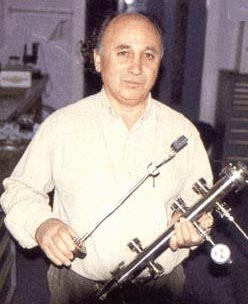
Jean-Paul Biberian
Former lecturer at Aix-Marseille University
Title representing the former title of "Assistant Master."
I am convinced that conditions exist which could enable fusion reactions through catalysis.
Since nuclear physics is nothing but the chemistry of atomic nuclei. Fission is an auto-catalyzed dissociation. Fusion reactions are analogous to chemical reactions. Therefore, it is logical to think that it is NOT impossible for the nuclear world to contain exo-energetic reactions with catalysis, possibly at low temperature. Every high school student has seen the platinum sponge glow red due to the heat released by the combustion of hydrogen in oxygen. But the platinum sponge does not merely allow this reaction to start at low temperature. If we were to place this sponge on a metal tube carrying a cooling liquid, the reaction would continue at ordinary temperature, or even below.
Freshly retired from Aix-Marseille University, Jean-Paul Biberian has just published a book entitled "Fusion in All Its States," with the subtitle "Cold Fusion, ITER, Alchemy, Biological Transmutations..."
His title is: "Fusion in All Its States," which seems to indicate that he will address the general theme of fusion from various angles. This would imply sections on ITER, laser fusion, and possibly Z-machine fusion. But the book is essentially dedicated to "cold fusion," a term given to research focused on energy production through fusion reactions at a temperature far below the usual requirement—on the order of hundreds of millions of degrees. Some results claimed, the first presented by Pons and Fleischmann in 1989, were allegedly obtained at ordinary temperature, according to these researchers.
Of course, these investigations are the subject of intense controversy. But we must not forget that catalysis, in chemistry, where it is still poorly understood, is something "absurd." As we mentioned earlier, it is possible to combine hydrogen and oxygen at ordinary temperature, whereas in the gas phase, without the use of "active sites" from the platinum sponge, ignition requires a temperature of hundreds of degrees. The auto-ignition temperature is 580 degrees Celsius. Flame temperature: 2500°C.
The same applies to superconductivity: the fact that, at very low temperature, one can pass very strong electric currents through conductors without any Joule losses. It is not a matter of "very small losses," but of strictly zero losses. If superconductivity, a quantum phenomenon, were discovered today, we would not lack physicists exclaiming:
- I’m willing to believe that lowering temperature reduces the Joule effect. We know that the electrical resistance of certain conductors depends strongly on their temperature. We call them thermistors. But to imagine that losses could become strictly zero is a leap we cannot make. If the experimenters failed to measure heat release, it is because their experimental protocol was insufficient. Such heat release must be present; otherwise, it would be physically absurd.
Quantum physics is full of "absurdities." The Young's double-slit experiment is an example, as is the Aspect experiment. In Young’s experiment, the same "photon" passes through both slits simultaneously and interferes with... itself. In the tunnel effect, a neutron can be both outside and inside a nucleus at the same time. Simply because its "presence," in the quantum view, is governed by probability. "There is a non-zero probability that this neutron is inside the nucleus." Since this tunnel effect has been confirmed by spectacular outdoor experiments (atomic bombs), there is no doubt. No one could say, "Do you believe in the tunnel effect?" Thus, the word "impossible" must be handled in science with the utmost caution. The subject was therefore inherently interesting.
Unfortunately, what one finds in Biberian’s book does not differ from what he says in lectures or what one can follow in his videos. It is... empty. A lot of chatter, anecdotes, and speeches that have little to do with the topic (such as his personal, very incomplete analysis—due to insufficient expertise—of ITER, a subject to which he devotes a chapter).
On the cover, he writes:
Cold Fusion, ITER, Alchemy, Biological Transmutations ...
C
hose who know Biberian and have followed him for years agree:
T
he book is "loaded" with "scientific publications, or presented as such."
But refer to page 192. I quote:
In 2003, at the ICCF10 (Tenth International Conference on Cold Fusion), held in the United States, it was decided to create a scholarly society for cold fusion.... Due to the difficulties encountered in publishing our results in scientific journals, it seemed necessary to create our own journal, of which I have been editor-in-chief since 2006, with a team of six other regional editors... At the start of this initiative, Peter Hagelstein from MIT (the prestigious Massachusetts Institute of Technology) was the editor-in-chief.
He wanted a high-level journal. Unfortunately, there were very few article submissions of that caliber... After two unsuccessful years, Hagelstein handed over the direction to me. It seemed to me that this journal should be less ambitious and simply serve as a communication channel for the community...
We were thus open to less well-established data (...). We no longer tried to prove the reality of cold fusion in each article, since the entire readership was already convinced (...); this allowed us to produce articles with credibility that was not necessarily absolute (...), but which always contributed to the field.
Regarding theoretical articles, I thought judging the validity of a theory is very difficult, so I took the risk, as editor-in-chief and not knowing what the future holds, to remain open to new ideas.
It is better to be a bit lax (...), with a chance of finding a correct theory, than to be too strict and miss it, because it might lie beyond conventional paths.)
This laxness is the end of all credibility. This admission opens the door to self-discrediting.
Biberian devotes 5 pages to alchemy
and mentions his meeting with the alchemist Albert Cau in 1998. Under his guidance, he attempted an experiment, and on page 161:
**
| A possible solution might be: drop molten silver into quicklime. The thermal shock should produce transmutation. I conducted a few experiments of this type, but again without success. |
|---|
A bit further on, in this short chapter of 5 pages, Biberian discusses his analysis of "alchemically purported silver coins" held in a German museum. He tested the isotope abundance ratios, hoping to discover a ratio different from that found in natural silver. The result was negative.
In short, this chapter could be summarized by the sentence:
- When I have nothing to say, I say it...
Does this mean alchemy is nonsense? I wouldn't go that far, and I will mention a personal experience (I have so much to tell and... to do).
Around the same time, Cau contacted me. He was living miserably in a small room in Paris and was seeking a sponsor to fund his research. To do alchemy, the first thing one needs is a proper furnace. Cau couldn't experiment in his attic. So he conducted these experiments in his sister's garden on the outskirts of Paris.
He knew I was friends with Alain D., a wealthy industrialist from southern France, who owned a private jet used for his numerous professional travels. Cau proposed to demonstrate transmutation of a material into gold before him. We offered him the following deal: We would buy the materials ourselves and conduct the experiment ourselves under his guidance. He would touch nothing. If the result was positive, Alain would pay for an electric induction furnace capable of heating samples of a few cubic centimeters to high temperatures, placed in a crucible. Alain would cover travel and accommodation.
Cau accepted. It was a so-called spagyric manipulation, where silver would be transmuted into gold. Alain bought silver and the second ingredient: quicklime. His wife made pottery in a kiln, which we would use. Prudent, Alain had bought Plexiglas masks and protective gloves. Cau stayed at a distance and touched nothing. From ten meters away, he gave his instructions. We followed his orders:
- We melt a mixture of silver and quicklime in the kiln, inside a refractory clay crucible.
- I am in charge of opening and closing the kiln door.
- When we estimate the mixture is molten, I open the door. Alain grabs the crucible with tongs and quickly pours the molten silver and quicklime mixture into a cylindrical basin 30 cm in diameter and 40 cm high, filled with tap water.
- The water boils violently. But very quickly, once the boiling stops, we can recover an object. In fact, the molten mixture has transformed into something that resembles popcorn, even in size.
Cau warned us: it doesn't work every time. But relatively often. Let's say, once out of two. Then we hear the equivalent of a loud hammer blow, evoking a shock wave. And then, oh surprise, this popcorn is "gold-plated." It's not just a slight iridescence. No, all these hollow, small-diameter metal bubbles are completely "gold-edged." I unfortunately didn't keep any. Alain might have one at home.
Is it gold? Cau intervenes, dissolves one of these small golden spheres, extracted with tweezers, from the 4-5 cm object, and places it in nitric acid (we followed his every move). The silver turns into liquid silver nitrate. At the bottom of the test tube, fine specks remain. The amount is infinitesimal, perhaps fractions of a milligram. But the deposit is clearly visible.
Cau continues the analysis. The specks are dissolved in aqua regia. And he concludes, "It is indeed gold."
It would have been better to continue with a mass spectrometer. But regardless, the golden, shiny appearance of the "bubbles" was undeniable. Raw silver is dull gray.
Alain takes out his checkbook and increases the amount for the induction furnace: 3,000 euros. Cau leaves for Paris that same evening. As I drove him to the station, I said:
- Of course, if this is truly alchemical gold, we can't say the process is industrially profitable, given the quantities produced and the energy expended. But I see a way for you to make a little money. Why not, with the furnace Alain is giving you, produce these specks? You could embed them in transparent resin and sell these objects—medals, necklaces, rings—at a reasonable price, as samples of alchemical gold, with a certificate from your hand and explanations.
Cau stares at me with fury. I don't know what became of that man.
We left it at that. Alain and I had many other concerns at the time. We never had time to clarify this matter. Moreover, by opening and closing the kiln door, we damaged it due to thermal stress. The door no longer closed properly, and Alain’s wife complained because we had damaged her appliance. Alchemy didn't care. Only men dream of such things.
Did the silver we used contain traces of gold? It would have been easy to verify. It would have sufficed to take a small amount of this silver, "untreated," of the same mass as the sample analyzed by Cau, and dissolve it in nitric acid. If it contained gold, a deposit would have formed at the bottom of the test tube.
If there was no deposit, that would have been remarkably interesting.
But life is a torrent. We never returned to this topic. If anyone wants to repeat this experiment, it is without shadows, at no point, and I think it is very likely reproducible. Alain had acquired "industrial silver," and Cau couldn't have falsified anything. During the operations, he stayed five meters away.
Anyway, there remains an incredibly spectacular effect. Even if this silver contained gold, what phenomenon could have projected this metal, lining the outer surface of this "silver popcorn" to perhaps a few microns in thickness?
Biberian devotes a chapter of 7 pages to biological transmutations,
announced in a sensational manner on the cover page.
On page 151, he writes:
- Not being a chemist, and not knowing how to perform quantitative chemical measurements... I have never liked chemistry, with its test tubes and precise dosages (...)
He immediately mentions experiments conducted by a certain Kervran. On page 207, Corentin Louis Kervran is cited, and on page 212, it appears he has passed away (1901–1983). I translate:
- Kervran is certainly the most well-known scientist who has worked in the field of biological transmutations. He possessed extensive knowledge in installations, geology, and nuclear physics. He published his discoveries in French in ten books. Some have been translated into English. He was also nominated for the Nobel Prize.
On Wikipedia, we read:
*In 1993, he received (posthumously) the Ig Nobel Prize in Physics for concluding that the calcium in chicken eggshells is created by a cold fusion process. *****The Ig Nobel Prize (named as a pun between "Nobel Prize" and the adjective "ignoble") is a parody award given to individuals whose "discoveries" or "achievements" may appear bizarre, funny, or absurd. Sometimes derogatory and critical, the prizes are intended to celebrate the unusual, honor imagination, and stimulate interest in science, medicine, and technology.
There seems to be a clear difference between "receiving the Ig Nobel parody prize" and "being nominated for the Nobel Prize." It gives the impression that Jean-Paul Biberian's book is a hodgepodge where he verifies nothing while "listing facts he considers proven." His discourse is the most complete artistic ambiguity, full of errors.
http://www.lasarcyk.de/kervran/kervwork.htm
| May 6, 2013: | A reader writes: Kervran was indeed nominated for the Nobel Prize in Medicine: | This contradicts the Wikipedia assertion |
|---|
Page 152, Biberian writes:
*- I successfully reproduced part of Kervran's experiments.
Where, when, how? Where was this published?
I don't know whether these biological transmutations are real or not. I've seen enough in my life to know that hasty conclusions, in either direction, are always risky. I recall discussions about calcium in chicken eggs "that they couldn't have absorbed from their food." A commentator on Kervran suggested that these birds might have drawn calcium from their skeleton, or more generally, from calcium already present in their body, in their cells. Thus, these birds could use their skeleton as a calcium storage structure. But that's just an idea.
Another observation: when a woman is pregnant and produces a "little man," she must monitor her diet. Otherwise, she will demineralize. This simply means she draws calcium from her skeleton to build her future baby. The skeleton thus seems to function as a calcium storage system.
Imagine a "poor" woman forced to carry her pregnancy with a calcium-poor diet. She would still build her baby's skeleton at the expense of her own. Would one then imagine she performs a biological transmutation to create the calcium needed for her fetus?
Calcium can be "unlocked" relatively quickly. Witness the demineralization experienced by the first astronauts during long-duration flights, if they don't take precautions to stimulate their skeleton through appropriate gymnastics.
Page 205 of his book, you will read:
ANNEXES
Selection of scientific articles published in various peer-reviewed journals, in English
It begins with a paper by Jean-Paul Biberian. Look at the small text at the top:
- Condensed Matter Nucl. Sc. 7 (2012) 11-25
This is... the journal of which Biberian is the editor-in-chief and the sole referee for French-language articles since 2006. The list of other editorial board members is indicated in a footnote on page 192.
Indeed, not everything that glitters is gold.
I have published books on a topic that is extremely controversial: the UFO subject. Some of my books included reproductions of scientific articles and communications. But each time, they were high-level publications, with genuine peer review and presentations at international conferences, at the top level of the specialty. In Korea, 2009, and Prague, 2012, Doré and I presented undeniable, high-level experimental results from experiments conducted in... his garage. At any moment, I would be ready to immediately respond to any challenge of these works. The courageous Doré is still finalizing, in that garage, the work that will be the subject of our next presentation at a conference where we will... give thanks to donations made to our association UFO-science.
Personally, I have been "banned from seminars" for years. At least twenty years, to be precise. The door of the Institute of Advanced Studies in Bure-sur-Yvette is closed to me, by Academician Thibaud Damour, who wouldn't want to face me publicly, face to face. The same goes for Carlo Rovelli's seminar in Marseille. The same at the Paris Institute of Astrophysics (Alain Riazuelo affair), or regarding Joa Magueijo at Imperial College, London (on the topic of variable speed of light). All have miserably backed down. All know that in forty years, in seminars, I have never lost a battle. Riazuelo wouldn't last a round against me in his own territory, and he knows it very well.
Alain Blanchard had also previously fled publicly, in response to a request I made in front of my colleagues during a seminar he gave at the Marseille Observatory, when I was still working there. I had read aloud in front of my colleagues the foolish criticism he had made about my cosmology work, within the CNRS committee I belonged to. As a response, Blanchard gathered his slides and fled running through the back door. And one of my colleagues present stood up and said:
- You saw! He's running away, he's fleeing!
It seems he now heads the Institute of Astrophysics in Toulouse. There, I was told "that if I asked to give a seminar there, it would be seen as a provocation" ( ... ).
- Cowards, cowards, cowards, without courage, without honor!
On December 5 and 6, I gave three two-hour seminars at the mathematics department of the University of Toulouse-Mirail. Attendees: 6 people at the first seminar, 3 at the two others, including the mathematician who invited me (at my own expense), and... I haven't heard from him since. At 71 years old, he is a seasoned expert in the field of Clifford algebras. His project was that we write a book together, published by a major German scientific publisher, where he had connections. He was supposed to contact me.
I doubt he will.
Were there any criticisms during these seminars? None, on the contrary. The mathematician who had asked me to give these seminars was delighted "because the connection was good." This first visit was supposed to be followed by others. But from my arrival in Toulouse, the hostility of the astrophysicists was evident.
After this Toulouse trip:
- I've had feedback about your performance. What's curious is that, broadly speaking, astrophysicists agree with your work, but paradoxically, they don't want to engage with it.
Of course, "because of the UFO context," all that these works entail, on the non-impossibility of interstellar travel (a second matter, within which the speed of light is 50 times higher than ours).
I found myself face to high-level geometers, with whom, indeed, "the connection was good." During the first seminar, the deputy director of the astrophysics institute was present. A decent man, but he looked like a ping-pong player lost on the Centre Court at Roland Garros on the day of a final.
I believe it was truly there, after 38 years of work, that I realized what I was doing was comprehensible only to mathematician-geometers. But at least with these people, dialogue is possible. With astrophysicists, no.
Let’s return to Jean-Paul Biberian’s book. Colleagues who have known him for a long time say:
- Jean-Claude, he's an Oriental...
Yes, his videos, like his book, resemble the tales of One Thousand and One Nights. This cold fusion, which, they say, could sometimes produce up to 24 watts of anomalous heat, occasionally, and often capped at the watt level, or even the... milliwatt, is stalled. You will find in this book, which reads like visiting a souk, an exhaustive list of all cold fusion experimenters, the work of the "cold fusionists." Often, these experiments are in the hands of tinkerers, sometimes self-taught. None proposes a theoretical model, nothing. You bring "this and that" together, immersed in "that," and watch what happens.
What most resembles cold fusion is cooking.
But cooking can produce delicious dishes.
Biberian repeatedly mentions Rossi's cold fusion machine.
- If this concept holds up...
- If, as the Spartans say.
If you enjoy oriental tales, go ahead and spend your 18 euros. I dare hope this empty book won't "go viral" online and won't spark passionate debates in major media, because, as it stands, the mountain gives birth to a mouse. I think there are more urgent paths we should be pushing toward than following dreams with no real substance, marked by numerous failures.
- It didn't work. No energy release could be observed...
We would be delighted to echo significant advances, ideas with coherence. But years pass, and cold fusion remains "a topic one can discuss among friends."
What annoys me is that for 40 years I have strictly respected the scientific game, placing my "goals" (at the cost of how much sweat!) in the real playing fields, in high-level journals and conferences, while in Biberian’s approach, lack of rigor is everywhere. I have nothing against the man, absolutely nothing. Personally, I believe research on catalyzed fusion should be supported.
Before discussing what could be attempted toward sonofusion, let’s conclude by quoting further excerpts from Biberian’s book.
In his book, he says one