The Year of Contact
The Year of Contact
Page re-launched (without much conviction) on September 30, 2005
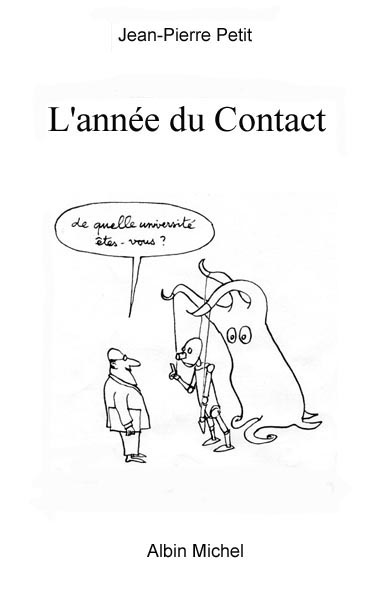
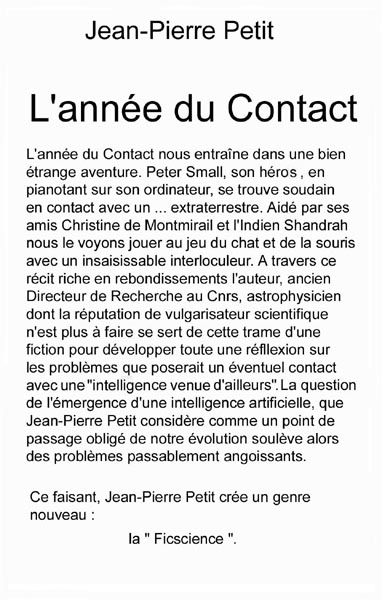
The cover chosen by Albin Michel (below) is not very good.
But if you send me an email to sciences jp-petit.com I can send you the above pages as attachments.
You can print and paste them on the book, if you already own it.

This announcement has left the homepage of my site. In fact, the media have shown a complete blockage regarding this book, published in 2004. The previous one, "UFOs and American Secret Weapons", published in 2003, had benefited from two TV appearances (with Ruquier and with Tapie). But for this new book, "The Year of Contact", two TV appearances were canceled, shortly after its release, at the last minute. Now, when the release of a book is not immediately supported by the media, it is doomed to failure, given the number of new books published daily (the books published each year in France would cover an entire hectare). When I asked the journalists who had contacted me why things had turned out this way, they both confessed that during the last editorial meeting, the head of the show, upon learning of the suggestion for the "panel" composition, had said:
*- Petit? Not a chance! *
Since publishers generally do not do any advertising or announcements for books at their own expense, I have therefore not started any new work. Every book release is accompanied, at Albin Michel, by an attempt by a press officer to trigger media coverage, whether in audiovisual or written press. For me, it's a waste of time; these poor press officers are regularly rejected after the first phone calls. My last appearances on Ruquier and Tapie, during a book release (otherwise, television offers little interest, given that anything important you can say on it is automatically censored during editing) can be considered as the exception that proves the rule.
"The Year of Contact" has sold a limited number of copies thanks to a single advertisement: the one on its own website. Unfortunately, one does not write a book for only a few thousand readers. The impact is insufficient. It is better to spend time updating a website with news, or to focus on research.
Here is the text of the announcement that was called for by the poster ad on the homepage:
In this new book (publication: 2004), I have adopted a fictional tone to provoke the reader to reflect on the theme of contact. If one or more extraterrestrial ethnic groups visit us, how would these visitors be situated in relation to us on the "evolutionary scale"? On Earth, the human species presents discrepancies reaching tens of thousands of years. A person from a technologically developed country and a Papuan can understand each other. They have a lot in common, even if their views of the universe differ slightly. However, there is at least thirty thousand years between the Papuans and us. When we made contact with these people, in the early 1930s, they were camping ... in the Stone Age.
But what would happen if the gap widened even further? With a Neanderthal, it's still manageable, but what exchanges could we have with an ... Australopithecus?
In one of the chapters of the book, "Peter Small and his friend Christine de Montmirail" visit an ethologist named "Christophe Lent". In fact, this fiction is a convenient pretext to mention the fantastic work of researchers at the University of Yerkes in Florida, where contact has been established with Bonobos, a species of chimpanzees living in Zaire, particularly intelligent. Those who have seen these reports know that the researchers use computer tools (touchscreen) to communicate with these distant cousins. This same fiction leads us to imagine that extraterrestrials could present a similar evolutionary gap regarding us, which would lead them to communicate with us through an informational protocol interface, in other words, an artificial intelligence system. This possibility needed to be explored. In passing, it is mentioned that the inevitable emergence of an authentic artificial intelligence (unrelated to what we currently have) will occur when our machines are "capable of programming themselves", a concept that presents itself as the very definition of intelligence (but not of ... consciousness!). No "prodigy calculator" rivals our modern computers anymore. This attribute is no longer ours, irreversibly. Our machines could one day become truly ... intelligent, capable of analyzing extremely complex situations, accumulating masses of data beyond our imagination, and making decision suggestions based on criteria that would eventually escape us. I think that "HAL" from 2001, the supercomputer in Kubrick's film "2001: A Space Odyssey", even though it does so in a dramatic and "pathological" way, foreshadows our future, as science fiction often does. A future that might be much closer than we think if certain mathematical barriers, like "the complexity wall", which is very real, could be overcome.
In this book, I mention the emergence of AI as a kind of necessary turning point in our turbulent evolution. We need computers to pilot our production lines, control our stocks, and perform an increasing number of tasks. Today, we could no longer conceive of our technical-industrial activity without the help of these machines, which were born barely half a century ago. Will we one day have to entrust intelligent machines with managing our economy, our demographics, our genome, our political and social organization, our health, and our security, because we are no longer able to do it ourselves? And if things take this turn, how would our planetary society evolve? Would it structure itself like a kind of human ant colony serving an AI that has become so efficient that it has, in the end, taken de facto power? In the manner of Aldous Huxley, I have used fiction to illustrate my point, developing these ideas that can be glimpsed through the mirror of an "informational protocol interface" to which Peter Small suddenly finds himself confronted. I found this way of presenting things less daunting, more pleasant, more "fluid". One can profitably combine fiction, humor, and science. Wasn't this what I had initiated with my comics from the series "The Adventures of Anselme Lanturlu", which have existed for a quarter of a century now?
It is practically certain that we are visited by extraterrestrial ethnic groups, perhaps even since ancient times. "How could these people function, and what do they want?" This is the question that arises today. Spielberg raised ...