Asteroids

October 9, 2003, reprinted at the end of the file on October 11, then on December 2, 2003 and October 20, 2004**
Update from April 20, 2005. Source: NASA: an asteroid passed within 40,000 km of Earth
**You can't imagine the number of asteroids that constantly cross Earth's path.
This four-megabyte file downloadable will show you their infernal dance over a year. ** ---
While scientists and media regularly raise alarms about asteroids that are about to hit Earth, and then regularly admit their mistakes, one of these objects, 2003 SQ222, recently passed our planet at the closest distance ever recorded... in complete ignorance! It was photographed by the Lowell Observatory. It is a rock block of about 10 meters in diameter, part of the large family of asteroids orbiting the Sun between the orbits of Mars and Jupiter. Eccentric, its path also crosses Earth's orbit, which it did on September 27th at 23:00 UT, at an altitude of **82,000 km, or five times less than the Earth-Moon distance. **
But the story gets complicated in that the asteroid was only detected by the Lowell Observatory, in Arizona, which is specialized in the search for these objects, the next day, September 28th, as 2003 SQ222 was moving away from our planet. A bit late to raise the alarm... Conclusion of astronomers: if we want to protect ourselves from the fall of extraterrestrial objects, there is still a lot of progress to be made.
This event occurred 10 years after a meteorite crashed in India, injuring two people and destroying two houses. On March 29, 2003, the city of Chicago suffered a meteorite shower, causing extensive damage to homes.
See also these addresses:
http://users.skynet.be/meteorite.be/Bodaibo.html
My comment:
In terms of damage, this asteroid, if it had hit us, could have created the equivalent of the Tunguska event at the beginning of the century. If it had hit a major city, it would have destroyed it. In my book, I mentioned the possibility that a planet, at the time when the solar system was in its most primitive state, could have been both ejected by a slingshot effect, passing near a giant planet, and at the same time broken into a myriad of pieces when entering its "Roche sphere".
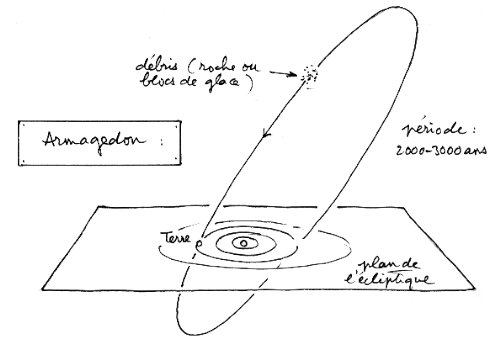
The periodic passage of these blocks, assuming they cross Earth's orbit, could lead to catastrophes of various magnitudes. In principle, the planets interact with each other by tidal effects, "the antenna" in terms of gravitational field being ... the Sun. They cause deformations of the solar body that are centimetric. This represents a distortion of the gravitational field and this "signal" is then perceived by all the planets in the system and modifies their orbits. Since the tidal effect varies with the inverse of the cube of the distance, it turns out, for example, that the tiny Mercury deforms the Sun more than ... Saturn. In terms of gravity, within the planets, democracy is the rule.
Can we imagine a planetary system in formation? We can imagine it in a very primitive state. The idea that comes to me is that planetary systems form almost at the same time as the stars themselves, at least regarding the main actors of the story: the giant planets. Indeed, they hold the majority of the angular momentum (M r V: mass M by distance r from the center of the system, by orbital velocity V), while the Sun holds the majority of the mass of the system. Let's say that when the system forms there is:
-
A star at the center
-
Dust, dense elements nearby
-
Light elements at the periphery.
In this primitive situation I imagine that the star, born in a cluster, is still quite close to its neighbors and that these systems "collide". The French word collision is the only one we have to describe "binary interactions between objects". The English word "encounter", "meeting" is more evocative. These proto-solar systems brush against each other and this has the effect of transferring angular momentum to the periphery more than to the central object. This excess of angular momentum (mainly held by Jupiter) would, in my opinion, be the signature of a close encounter that took place in a distant past.
I tend to think that when the solar system formed, the giant planets did not have satellites. These are objects that they would have captured later. In a planetary system, the planets interact with each other, via the Sun, and the plane of the ecliptic forms quickly. This is the plane of Jupiter's orbit. Later, everything happens according to three phenomena: the absorption of one star by another, the acceleration by the slingshot effect, and the fragmentation of small objects by passing through the Roche sphere of a larger one. The example of an object breaking up by passing through the Roche sphere is given by ... the rings of Saturn, whose outer edge is precisely 2.5 times the radius of the planet, that is, at the "Roche limit". When did this happen? No one has the slightest idea. There is no element that allows dating this event.
If the acceleration resulting from a slingshot effect is too great, the objects can reach a speed exceeding the solar escape velocity and go lost in interstellar space. Our solar system has thus ejected an inestimable number of small objects. The intermediate situation corresponds to comets that the slingshot effect sent "into the great solar suburb".
Gravitational interactions between planets tend to bring them to orbit in the same plane and to "circularize their orbits". They then distribute themselves according to the "Golden Law" established by Souriau, whose Titius-Bode law is only an approximation. A "relaxed" planetary system should therefore appear as a clockwork mechanism that hardly evolves anymore, with giant planets on the periphery and terrestrial, denser ones inside. But in fact we do not know the entire solar system, rich in various anomalies. One can cite the case of Uranus, whose rotation axis is almost in the plane of the ecliptic, and there are many others that we will not list. All this supports a "recent" perturbation (it is difficult to attach a number to this adjective). Let's say "occurring in a past that is small compared to the age of the entire system".
Astrophysicists have always been reluctant to consider these "catastrophic" theories. It took many years before it was accepted that the Sun was not born alone, but within a star cluster. This cluster naturally dispersed. This group of stars can be likened to a "gas". Binary interactions between stars tend to bring the system into a state close to thermodynamic equilibrium. This means that the distribution of velocities tends towards a Gaussian curve with a majority of objects presenting an average speed, some slow and some fast. Those that acquire a speed exceeding the cluster's escape velocity leave it. By objects, we mean stars, plus their entourage of proto-planets.
In the middle of all this, one or more massive stars that die quickly in the form of supernovae before the cluster has even dispersed, seeding it with heavy atoms. The lifespan of clusters is, I believe, proportional to their mass. Large clusters like the Hercules cluster continue to lose stars, but very slowly. They are as old as the galaxy itself. The primitive cluster to which the Sun belonged eventually disintegrated. Even a system composed of three stars is unstable. Only "single" stars and "married couples" can survive, in comparable numbers.
A remark in passing: what applies to stars also applies to galaxies. I think they also form from clusters, more or less rich (I will develop this in the book I am currently writing: "Journal of a Savanturier"). It is the collisions, the close encounters when these galaxies are still against each other that give them their angular momentum, their rotational speed. What moves them apart is not of the same order: it is simply ... the expansion. When Andromeda formed, we had it ... in our arms. Do the calculation. The primitive stars then formed in large numbers. When galaxies contained a large number of stars, this irradiation gave the atoms such a speed that it exceeded the galaxy's escape velocity. It left without hope of return. Where is this gas and what is its temperature. Answer: between the galaxies. If you convert the escape velocity of these same galaxies into thermal agitation speed, you then get temperatures of the order, if I remember well, of millions of degrees. When these atoms collide, they produce X-rays. Hence this X-ray emission from the gas present in the clusters, whose mass, as I have read, is greater than the mass of the cluster itself.
These massive galaxies that have lost their gas are the ... ellipticals.
Close encounters rotate the galaxies. The gas is heated, expands. When the galaxy is not too massive, this gas, kept at a distance, forms a sort of spherical halo. Meanwhile, binary collisions will still occur, transferring angular momentum to this gas, giving it this strange rotation law with peripheral velocities. This phenomenon is the signature of one or more past binary interactions. Then the primitive stars calm down. The gas naturally cools by radiation. Its atoms collide and radiation is emitted from these inelastic collisions, leading to a loss of energy. This gas deflates like a soufflé but, retaining its angular momentum, keeps its vast expansion. If no new stars were formed, this gas would have degenerated like Saturn's rings. It is continuously fed by young stars, emitting in the ultraviolet and supernovae (one per century). The gas forms a fairly flat system. In my thesis (1974), I had compared this to a duvet filled with feathers that cannot collapse on itself because, periodically, fireworks explode inside it. But let's get back to the topic of the day.
It is not because we have a very schematic idea of the genesis of a planetary system that we know the story of our own. It is only recently that the hypothesis of the collisional origin of the Moon has become fashionable again. Before, it was considered heresy. But in astrophysics, the heretic of today is the conformist of tomorrow and vice versa. A collision between planets of almost comparable sizes is not trivial. If we accept this idea, then the hypothesis that other situations related to past catastrophes and capable of generating future catastrophes is not to be excluded. We come back to this hypothesis of this famous "Planet X" which could be a ... swarm of asteroids that time has partially dispersed along its trajectory.
One can be surprised by the increased frequency of asteroid passages near the Earth. I open this file to keep track. Readers who follow this more closely will give me the dates, masses and distances of passage relative to the Earth corresponding to the events of recent years. Armageddon may be approaching, on tiptoe. It is clear that if one day the Earth crosses the path of a swarm of asteroids or ice blocks, what would happen would then resemble the description of the Apocalypse according to John. By nuclear winter effect, "the sky would be rolled up like a book", etc.
In fact, what is curious in the contemporary world is a near impossibility of imagining catastrophes. Scientists are there to reassure, like Reeves who sprinkles the audience with star dust, like a sand merchant. But what would be the point of worrying people?
It's an outlook.
But when you are a scientist, it's difficult not to think...
**October 10, 2003. Reported by Adam. **
A celestial body fell north of Irkutsk on September 25, 2002 at 1:45 a.m. Bright light, a shining object entering the atmosphere at an angle, then impact, crater. No casualties in this desert area. Same scenario as for Tunguska. Trees down. Vegetation scorched at 15 km distance. "The power of an average atomic bomb" estimated the Russian physicists who came to the site (in May following).
http://www.ufocom.org/pages/v_fr/m_news/meteorite_siberienne.htm
**October 11, 2003 **
A professional astronomer reader, retrieving observation data confirms the size of the object 2003 SQ222: ten meters. He indicates that it has a very low albedo: 0.04, meaning it reflects little sunlight. But at the distance where it was when it passed us, it received 1.3 kW per square meter of solar energy, that is, 130 kW on its surface. Even with an albedo of 0.004 it reflected 500 watts of light energy towards Earth. Considering its exceptionally low distance from us (six times the diameter of the Earth!) it seems unthinkable that such an object was not detected. There are several hypotheses. No one can deny that the frequency of passages of objects capable of causing serious damage on Earth is increasing year by year, even if the "bearded priest with smiling eyes" repeats to us with his eternal accent "that the probability is extremely low for that...". A probability calculated on what basis?
So, what is it? Could it be the precursors announcing the arrival of the "big bundle of stones and ice blocks" mentioned above? One must realize that if such an object is wandering on a very eccentric orbit, being part of the solar system, all its components:
-
At the same time continue to form a relatively concentrated mass, the blocks being linked to each other by gravity
-
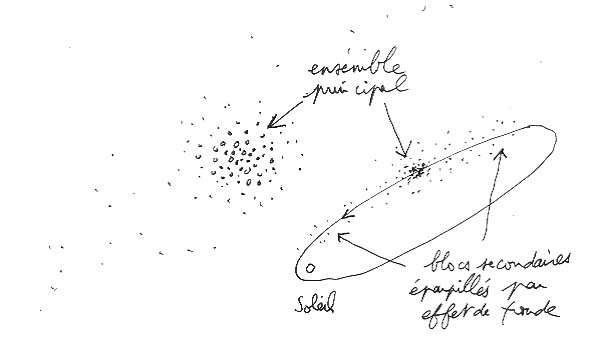
At the same time scatter objects on and near its trajectory, simply because of the slingshot effect within this block ensemble. There are small and larger ones. The large ones accelerate the small ones by the slingshot effect. The image one can have is that of a swarm of blocks, individually too small to be detected by our telescopes at a distance. Too scattered to form a quasi-point image, also detectable. "A swarm of bees, seen from afar, does not resemble a stone". It is an ensemble that leads behind it a myriad of scattered blocks following nearby trajectories. This scattering phenomenon is natural. It will be all the more noticeable that the overall mass of the swarm is low. In the case of "Shoemaker-Levy 9", the blocks were already distributed over a considerable distance after half an orbit (before they hit the giant planet). It would be possible that we collect these small objects and if this hypothesis is confirmed, the frequency of their observation should increase over time.
That's the first hypothesis. The second is more vertiginous and brings us back to the SL9 file, included in my book, which leaves behind all science fiction ideas. If the Americans have high-speed space probes, equipped with MHD thrusters with very high "specific impulse", carrying colossal energies under a low weight, in the form of antimatter, then there would exist a "crypto-NASA" whose capabilities would far exceed what we are shown. Space probes with astonishing performance, capable of accelerating and decelerating, could travel through the solar system and possibly slightly affect the trajectory of asteroids orbiting the Sun with quasi-circular trajectories this time. We know there are many. Some astronomers have even predicted collisions with Earth but for distant futures: thousands of years. So it would not take much to modify such a trajectory to make a small block of ten meters in diameter pass near Earth to refine the "SL9 scenario".
A long chapter of my book discusses this vertiginous hypothesis: that the United States (or at least "a certain power" geographically located in the USA) could have secretly developed hyper-bombs with antimatter, tested first on the Sun, then on Jupiter and its satellites (including Io), serving as "anti-comet weapons". In case of a deluge of comets and asteroids (at 40 km/s!) it would be necessary to go to meet these objects, then turn back (which no rocket could do, due to the required energy). It would be necessary to dock with these objects, then drill a hole to place the bomb inside. A bomb exploding on the surface would only fragment the object without much damaging it. To move the danger away, its destruction would have to lead to fragments not exceeding one meter, if possible less. This is only possible if the bomb explodes inside the object. The Americans have shown this to us in a lot of movies, remember.
If it is true that the United States has conducted real-scale tests on Jupiter, camouflaged as comet debris impacts (the SL9 affair), then logic would suggest that this "crypto-NASA" would try "firing at a moving target", possibly bringing an asteroid close to Earth to check if the docking and drilling techniques are ready. They would stop there. No question of testing an antimatter bomb at such a close distance to Earth.
Some will say: "Little has a lot of imagination" and smile, shrugging their shoulders. Perhaps (in any case I would prefer). I was often mocked in the corridors of the CNRS in 76 when I launched my theory of the annihilation of shock waves, especially Couturier (who I believe has become director of the Paris Observatory, an astro-functionary I had the displeasure of meeting on the TV show of Tapie, at the beginning of 2003). Now the ONERA (Office National d'Etudes et de recherches Aéronautiques) is working on contracts whose theme is "reduction of wave drag", 27 years later.
If I force myself not to take everything I say completely seriously, on the result of my own speculations, I also try "not to take my own statements and reflections too lightly". I have often been right, long after and information from unidentified sources that have reached me have turned out to be correct (such as those concerning directed energy weapons, received in 75, which motivated my trip to Livermore and Sandia in 76). But it is difficult to get a clear idea of what one thinks and the credibility of what is here and there. Information or disinformation? I ask myself the same questions as you. I only see that the non-detection of the ten-meter object that passed six times the diameter of the Earth has something suspicious (for professional astronomers).
What is happening on our old Earth and in its surroundings? Paraphrasing Voltaire, I would like to write:
- So true is it that the general big lie brings tranquility to all, so that the more particular lies there are, the better things are in the best of all possible worlds. * ---
**April 20, 2005. **Source: http://neo.jpl.nasa.gov
( jpl means "jet propulsion laboratory " )
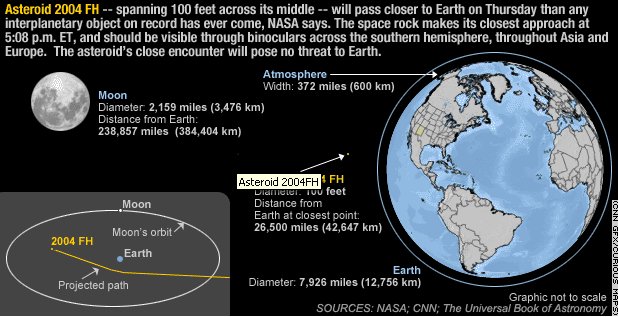
Reported by Luc Pillonel: On March 18, 2004, an asteroid of 30 meters in diameter passed within 40,000 kilometers of the Earth, that is, it crossed the orbit of geostationary satellites. The diameter of the Earth was 12,800 km, the distance between the Earth and this asteroid represented three times its diameter. But it is also one tenth of the Earth-Moon distance. The radius of the Earth's orbit around the Sun is 144 million kilometers, this approach distance represents two ten-thousandths of this distance. It is especially this number that should be remembered.
An asteroid of this size, while not endangering the existence of life on Earth, would have a destructive capacity comparable to the impact of the object of Tunguska, in 1908. It would particularly be capable of destroying one of the world's great metropolises.
Back to Guide Back to Home Page
**Number of consultations since October 20, 2004 ** :