Price increases
The price increases
March 11, 2008
This PowerPoint file sent by a reader will inform you about what you already know. These increases affect the most disadvantaged, obviously.
Among the multiple causes of this surge, there is the sudden increase in the price of wheat. Now, wheat is involved in numerous food sectors: bread, cookies, pasta. Wheat is "the oil of food". Why is this price suddenly soaring? Simple law of supply and demand. Supply can no longer keep up with demand. For more explanations, read my album
here are some excerpts:
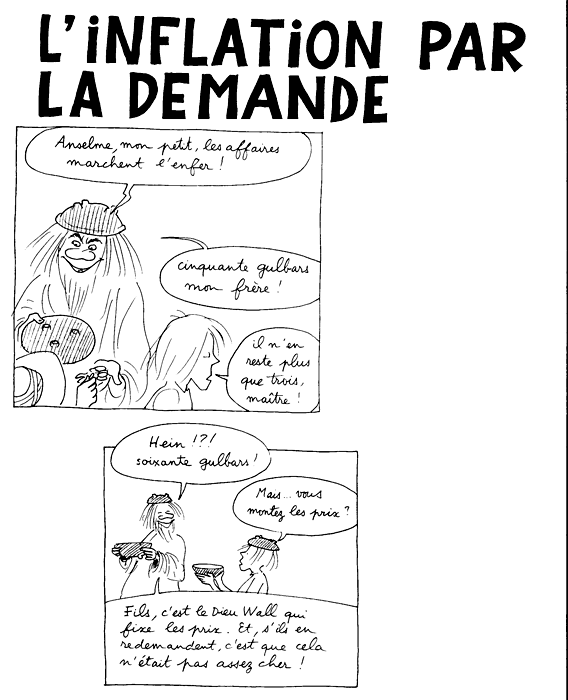


What are the causes of the wheat price surge? Multiple but converging. In the United States, 20% of biofuels must be incorporated into fuels by 2030. This orientation completely changes the agricultural sector. The demand for corn destined for ethanol production has increased by a third this year. Therefore, the price of this cereal has skyrocketed. Producers then chose to plant more corn, at the expense of wheat. Being rarer, wheat has become more expensive. The areas cultivated with wheat have therefore been increased, at the expense of soy, whose prices have also risen. Biofuels are mainly responsible for the current surge in agricultural commodity prices. But this price increase has been reinforced by bad weather conditions. Droughts have occurred in Ukraine, which is the breadbasket of Europe, but also in Morocco and Australia, where production last year dropped by 60% compared to 2005.
Faced with inflation on these commodities, some of the world's largest exporters have restricted their supply. After China and Russia, Kazakhstan has taken this decision. This country is the fifth largest wheat exporter. Only the United States and Canada currently have the necessary capacity to supply cereals on the global market. Therefore, there is a relative shortage due to strong demand. Currently, global wheat stocks represent two months of global consumption. Soybean reserves do not exceed one month. The harvest should reduce these tensions, if weather conditions are normal. In case of bad weather or another drought, wheat could be 40% to 50% more expensive in 2009. As countries like China and India become wealthier, they adopt new dietary attitudes, more focused on proteins and meat. The demand for cereals for animal feed is growing rapidly.
Are we on the verge of a major economic crisis? It is reasonable to ask this question, which everyone is asking. There is definitely a global issue, which is only getting worse, that of offshoring, mainly to China. The Middle Kingdom has understood that the most effective war is the economic war. A war where the United States, by pushing the Soviet Union to spend increasingly on military expenses, finally brought its adversary to its knees, without firing a single missile.
The first export product of China
Under Putin's firm grip, after the mafia-like clientelism of the drunk Yeltsin, Russia is regaining its strength. Should we be worried? What seems obvious is that if any great power becomes master of the world, as the United States was for a time, all kinds of excesses are possible for this "New Rome." Without a counterbalance, the shift towards a fascistic grip is a major risk. Anyway, international politics is never clean. One of my readers, whose wife is Tutsi, mentioned in an email what he witnessed during the Rwandan genocide, where the French, according to him, only played the role of passive spectators.
Behind all these behaviors, there are financial interests, and nothing else. While our planet is rich in resources. While we have all the technological means to solve our problems. The tropical seas, with the large temperature differences between the surface and deep waters, are sources of unimaginable energy. Submerged power plants, anchored thirty meters underwater, which would allow them to withstand the worst storms (insensitive below 20 meters of depth) could generate electricity, discreetly and robustly, using Stirling engines. These power plants could be installed in lakes, where the temperature differences are phenomenal once you go below ten meters of depth. This temperature difference exists everywhere. Do you know what the average temperature of the water is in the depths that exceed a few hundred meters? Between 1 and 4 degrees. All you have to do is bend down...
But the Russians and the Chinese have started nuclear power plants ... floating, which they will install near the coasts of energy-deficient countries. On one hand, it is assured catastrophe, and on the other hand, it will put these same countries in a state of increased technological dependence, which would not be the case with the Stirling generators, invented in the 19th century.
Elsewhere, the sun floods the planet. The deserts are sources of fantastic, unexploited energy. The emirs of Dubai desalinate seawater by burning their oil in a fantastic thermal power plant to create the grass that borders their highways, using an underground circulation system. They "invest in luxury". Take a look at their pharaonic projects. You know their ski slope:
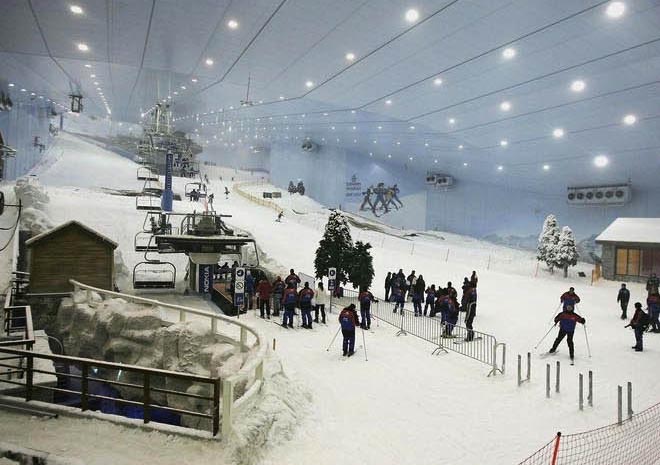
Dubai's ski slope. Outside: 40°C
While just moving away from the coast, you find a fantastic deposit... of solar energy. It would be enough to build "solar towers" of a thousand meters high to generate electricity in hundreds of megawatts, while simultaneously regulating the climate and enabling hydroponic crops. It's enough to have space to install the greenhouse systems, circular, which must accompany them at their base. The sea is very close. The greenhouses, carrying large liquid masses placed under simple black plates acting as sensors and heated to 80°C, would serve as accumulators, allowing night-time operation, with better efficiency due to the lower temperature of the air at higher altitudes.
In the deserts, there is no lack of space. Dubai could export tomatoes. In passing, such towers, acting as "atmospheric lightning rods," spewing a column of hot air at thousands of meters altitude transformed into a vortex, would prevent the tornadoes that ravage the southern United States every year by reducing local temperature and humidity differences between the ground and the altitude. ...