The Belem
Four days elsewhere, or a brainwashing with seawater.
September 11, 2012
I learned sailing on what are now called "old rigs." Specifically, on an ex-Breton fishing boat, in Brittany. Today, it seems rather "physical." There was no "winch." This is how we tightened the halyards.
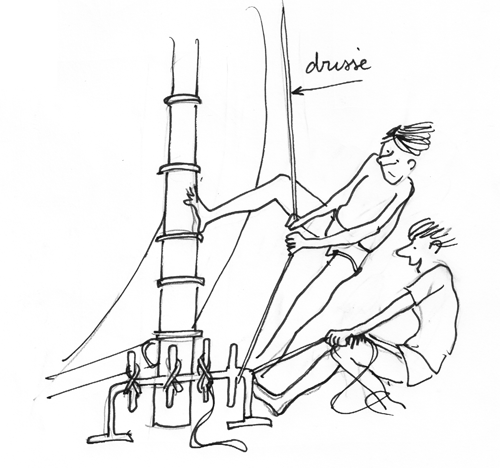
I really liked rough weather. One day, the "bead" broke and the fork (is that the right term? I can't remember now?) came loose from the mast. I had to go up and reposition it, sitting on a monkey's ladder (same question).
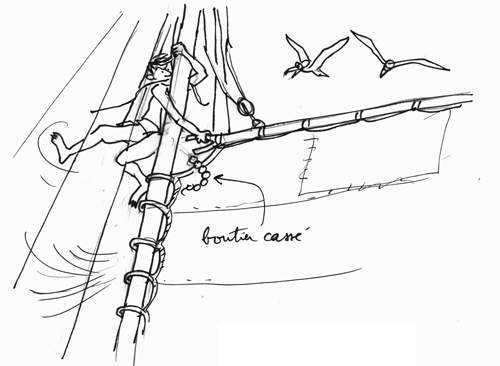
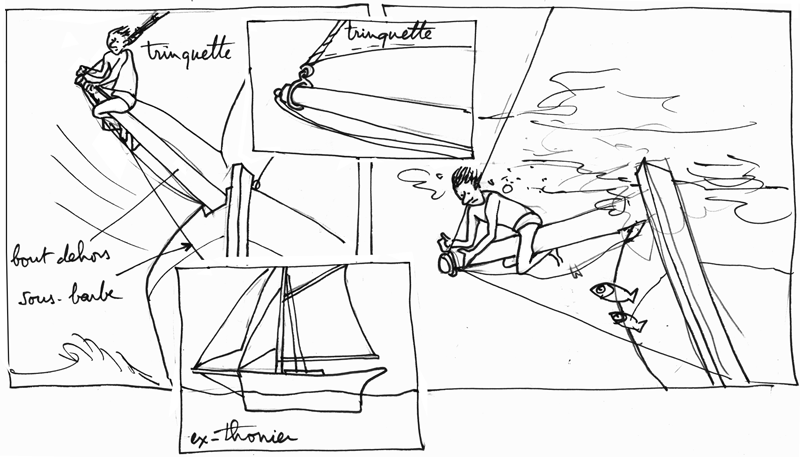
Another time, the ring where the spanker was secured was jammed at the end of the outer boom. I had to unfasten it while holding the outer boom between my legs. It was so unstable that when the boat nosed down, I ended up underwater.
This summer, my wife and I wanted to treat ourselves to a four-day "training session" aboard the Belem. I recommend it. It's fantastic. Save up and treat yourself to this once in your life. You'll never forget these moments. And it's also the most powerful way, when you have the financial and physical means, to forget everything for a few days and undergo a seawater brainwashing. Sometimes, it does no harm.
On the Belem website, you can order a two-DVD set. One recounts the history of this ship, built in Nantes in a year and a half, launched in 1896, at a time when such vessels could still compete with steamships, which were burdened by unreliable machinery and carried their black wind in their holds. Owned by the Meunier chocolate company, it sailed to Belem, Brazil, to fetch cocoa.
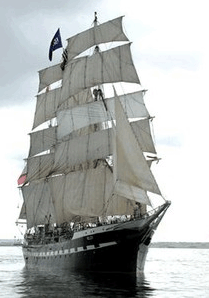
The Belem, then and now
Length: 58 meters. Width: 8.8 meters. 540 tons.
It has seen many things. On its first voyage, it loaded about a hundred mules in Montevideo, destined for another Brazilian port where they were supposed to pull trams. But a fire broke out aboard, and the mules perished. Severely damaged, the Belem returned empty to its home port, Nantes. The ship, nicknamed the "Yacht of Nantes" by sailors due to its sleek lines, came back in poor shape.
I'll let you discover the rest. It narrowly escaped in 1902 during the eruption of Mount Pelée in Martinique, thanks to a sudden surge of hot ash. Due to lack of space, it had to anchor on the opposite side of the island. The next day, the entire population was killed in seconds by a surge of gas at 400°C, traveling hundreds of kilometers per hour, a "two-phase" mixture of burning gas and rocks. Thirty thousand people died in seconds. Ships at anchor caught fire immediately, capsized, and sank. The rain of rocks mixed with gas, descending at 150 meters per second, collapsed buildings. An unimaginable disaster, due to its brutality and speed.
September 26, 2012
I found a video, an archive from INA, that provides further details on the effects of the pyroclastic surge.
This document is very interesting. It gives a rather misleading impression of the phenomenon. There was indeed an explosion of the volcano's summit. There was a plug, and beneath it, a very high pressure built up. Beneath this plug was semi-liquid lava with a large volume of dissolved gas. When the solidified lava plug gave way, this "two-phase" mass (a mixture of gas, liquid, and solid) expanded violently. The expansion was so abrupt that it generated a shock wave.
In fluid mechanics, a shock wave travels faster than the "interface" between the air and the explosion products. This shock wave, propagating through the air, preceded the front of the pyroclastic surge. What collapsed the buildings were two things. First, instantly, the overpressure caused by the shock wave's propagation through the air—so powerful that it was enough to knock down all buildings facing it. The lighthouse was... swept away. But the walls that were "in the wind's path" remained standing.
I don't know the exact value of the initial pressure just before the explosion. This value could allow us to calculate the "shock Mach number." With a very high value, this wave represented not only the propagation of pressure but possibly also a "thermal wave."
We can say that, in this respect, the eruption of Mount Pelée was comparable in intensity and power to a nuclear explosion. In the video, we see bodies whose side facing the explosion had been burned.
After the shock wave passed, came the "interface," the front of the pyroclastic surge, and behind it, the volcano's contents—released, a mixture of gas and rocks of all sizes. The propagation of these rocks occurred at supersonic speed.
Thus, the city was subjected to:
- A strong shock wave,
- Followed by a flow moving at supersonic speed.
This is a situation hard to imagine, but it explains the scale of destruction. The rocks caused additional mechanical destruction. The city was engulfed in a flow of burning gas that set everything on fire.
As is typical with such explosions, the inertia of the ejected masses created a depression at the epicenter, which triggered a rarefaction wave. This explains why bodies were found disemboweled and shattered.
The shock wave's power was still strong enough at the shore to vaporize the lighthouse. So the anchored ships were instantly dismasted. Their superstructures were scattered in all directions. Roofs were pulverized, just like wooden houses seen in films when hit by a nuclear explosion's shock wave (those who've seen such films will remember the "reflux motion" observed then).
The most fragile hulls were ripped open (but all anchored ships, in fact, presented their bow to the impact). After the shock wave passed, the arrival of the pyroclastic surge completed the destruction by setting fire to all buildings.
These phenomena should make us reflect on the effects of new weapons developed by major powers. Think of these megabombs, where an aerosol is first dispersed over a large volume, mixing with the air. Then, this large volume is ignited. A "blast wave" results, killing in two ways:
- By the overpressure it creates, which humans can partially protect against by taking cover behind obstacles, in trenches, or in bunkers.
- Then by the rarefaction wave, which cannot be protected against unless one is sealed in an airtight chamber. This air depression will burst the chest cavities of people who thought they were safe in their bunkers or at the bottom of their trenches.
This second effect explains the very small number of survivors in Saint-Pierre, even those "protected."
I recommend buying the four comics released by the site. One recounts these moments. The author did a good job with the script, settings, colors, and, of course, sailing technique. The colors are superb. Only amusing detail: "he can't draw people." They all have the same nose, same mouth, same eyes. In short, they all look alike. But given everything else, it works very well, even though it's often hard to tell who's who. The album dedicated to the eruption of Mount Pelée is excellent. It dramatizes what very likely happened on the island, where the "authorities" refused to order evacuation, "fearing panic," "due to economic impact," relying on the advice of "experts," and ultimately... to avoid contradicting themselves.
Only one captain, an Italian who had been born and raised near Vesuvius, decided to interrupt loading and... set sail. It saved him and his crew. When a functionary told him, "This will cost you a heavy fine," he replied:
- There won't be anyone left to collect it. Tomorrow, you'll all be dead.
In the comics, you'll find an accurate depiction of the atmosphere aboard at that time, discovering that this 58-meter-long, 8.8-meter-wide ship, with its 22 sails, 4,500 meters of "ropes," and 220 "turning points" (also called "capstans"), was handled by a crew of 12 to 14 men, eight of whom were sailors. Profitability demanded it. Last week, with 48 "trainees" aboard, we weren't short of arms, even if we lacked heads, to handle the ship day and night, scrub the decks, clean the toilets, polish the brass, and serve meals.
Journey: Departure from Ouistream, Normandy (site of the Allied landings), arrival in Saint-Malo, where I had my Mac iPhone stolen from a café at the port. Too bad—I had taken all the photos and videos with it, including from the Grand Cacatois, holding onto the yard with my elbows. If my thief still has the SIM card, please send it to:
J.P. Petit, BP 55, 84122 Pertuis
Fortunately, I can draw, otherwise I'd have nothing to bring back from these four days at sea. In passing, I carefully collected the email addresses of all trainees and crew members to send them the PDF. But I lost a sheet with about fifteen names. Those of you who happen to visit my site can download it here.
Four days aboard the Belem (2.3 MB)
September 26: I assembled another PDF with images sent by another trainee, taken from the yard of the cacatois where we were perched. These photos give a good idea of what you can see from up there:
View from the highest yard of the Belem
If you have photos, please send them to me at:
or send a CD to JP PETIT, BP 55, 84122 Pertuis, or let me know where I can download them.
On the cacatois, my neighbor on the yard:
- I admire your nonchalance...
Indeed, I had filmed these videos while holding my phone with both hands, gripping the yard with my elbows.
You'll find many photos on the Belem website. The panoramic views alone give a good sense of the "setting." In the photo below, you see the "cargoes," which scrape the square sails of the three "lamps," the lines that allow these sails to be pulled against their "yards," where the "topmen" can then grab them and secure them with "ropes."
For the former recreational sailor (and sometimes skipper) that I was, maneuvers aboard such a ship are completely different. On a modern sailboat, rope maneuvers are limited to "sheets," "halyards," and possibly "belaying pins." On the Belem, the "foresails" cannot fall under their own weight. A "hale-bas" must be used to pull them down (on modern sailboats, the hale-bas is simply a system to limit the boom's upward lift). The other sails must be furled using multiple "cargoes."
During sail changes, we must act not only on the "sheets" but also on the "arms" attached to the ends of the yards, which steer the yards.
On modern sailboats, the main sail and foresails are lowered from the top down and fall under their own weight. Square sails are furled from the bottom up, using multiple cargo lines operated by the crew from the deck, before being secured to the yard by the topmen using "ropes" called "rabans" (with a "capstan knot," whose principle I momentarily forgot).
A tack takes about twenty minutes. The Belem can sail into the wind at 72° (45° for a modern sailboat). This means that if it tacks into the wind, it must rotate 144° instead of 90°. On the Belem, as on all ships of that era, this rotation could not be achieved using the ship's momentum (its acquired speed). Tacking into the wind is impossible without the engine; on the Belem, it must be under 3 knots.
With the rudder fully turned, the rotation begins slowly, then the ship stops and "falls astern"—yes, it goes backward! We complete the tack by "counter-steering," reversing the rudder's turn. A sudden gust can jeopardize such a maneuver, so sailors prefer a "loft to loft" tack, known today as an "end-for-end turn," which modern sailboats avoid: it's brutal, causing the boom of a Marconi sail to suddenly swing, risking mast breakage.
Sails are subtly used to facilitate these maneuvers. Of course, during transoceanic crossings, the reaching course was standard for weeks on end.
The very limited ability of large sailing ships to sail into the wind meant this course forced them to "square the yards." However, all courses had to be used during coastal approaches and port landings without engine power. That said, these landings could be negotiated more cautiously, with sails furled, thanks to towing by a small boat.
I hope I haven't said anything foolish; someone will correct me if I have.

My wife and I climbed onto the yard of the great cacatois, attached to the mast bearing the blue flag.
It's the highest. The perspective is deceptive. See the sail plan below.
On the Belem, we watched a stunning video. It refers to a circumnavigation by the training ship Peking in 1930. The film depicts the ship's passage around Cape Horn, a four-masted vessel launched in 1911 in Hamburg, where the crew, surprised, was first trapped in a complete calm for two weeks. Then, a storm of exceptional violence erupted very quickly, with winds reaching 180 km/h. The Peking was 114 meters long, double the Belem's length. Its height above water was accordingly greater. Yet monstrous waves relentlessly swept its deck. When the storm hit, extremely rapidly (in about 20 minutes, I believe), the crew was urgently sent aloft to furl the sails as fast as possible. We see an image of a yard where 10 or 15 sailors struggle to control a sail.
Despite the safety nets, two sailors were swept away.
Can this DVD be purchased, and how?
I reproduce the few drawings I made during these four days.

The maneuver manual distributed to trainees, whose reproduction quality explains the cover drawing.

Detail of this "hatch." The topman must leave the shroud he's climbing and move higher, after a traverse over the edge.

Photos by Nelly Nesquel, PDF

This was a poster. But I don't think it's still available. Beautiful photo.
The Belem is neither Club Med nor Disneyland, nor even Bernard Tapie's Phocéen. It's a fantastic time machine. We can never thank enough the "madmen" (so called in the Belem DVD) who saw in the Belem something more than a floating museum moored on the Seine, who stubbornly worked to get it sailing again against all odds. Volunteers, mostly, who labored for years to restore it.
The income from trainee fees covers only a third of its maintenance. The spirit of the Belem is to allow "as many people as possible" to experience this, not just a handful of privileged individuals splurging on these mini-cruises. It wasn't the French who negotiated its interior renovation, replacing the luxurious cabins installed by the Duke of Westminster, who once owned the ship (and who toured all the casinos along the French Riviera with it). These were replaced by a large hall where young Italian naval cadets could hang their hammocks. It was an Italian benefactor who, after his son's death, wanted to enable orphans of sailors—sons of seamen—to undertake voyages suited to their limited physical abilities.
Today, the ship's midsection (formerly the main hold) has been converted into a long table with benches, allowing excellent meals to be served to all present in two sittings. The layout was negotiated to accommodate as many trainees as possible. On either side of the "dining hall," six cabins restore the space available to sailors, with two "bunks" each—narrow but comfortable. Each cabin holds eight bunks and replicates the space sailors had (though they were then housed on deck above the holds, the ship's belly being used for cargo). The toilets are very clean: sinks, mirrors, showers, and toilets that work by suction, like on airplanes. Men on the starboard side, women on the port side. A discreet ventilation system ensures appreciable comfort.
Instead of a comic book, which already exists (in four volumes) and is well done, I might create a more lively, less austere and less obscure manual for trainees, in the Lanturlu style—mixing skill, precision, and humor. But I don't know if this would align with the "foundation's spirit," where "The Belem is France's ambassador," as recently in London. Well, if they're interested, I can do it.
September 26, 2012: We live in an increasingly absurd world. I read that an Eastern billionaire had a 143-meter yacht built, priced at one billion euros. Anyway, in a world growing poorer, our media never miss an opportunity to talk about these people "throwing money out the portholes." In this festival of vanity and stupidity, you'll find the blue ribbon of bad taste:
Would you like to sail on this thing? Not me.
My readers should know I'm currently finalizing a new comic book, a sequel to "The Wall of Silence," published 28 years ago, between two articles for Nexus (currently, four pages of ruthless critique on ITER in the September-October issue, and four more on Megajoule in the next issue: same theme, same punishment).
I have in my files stacks of pages and notes for a comic titled "The Voyage of Pytheas, the Massaliote," full of color. Maybe one day I'll finish it. I should, because it's very funny. I have half a dozen Lanturlu works in draft form. But I must admit that the poor sales of "The Amber and the Glass," despite its beautiful colors and modest price (8.50 euros, including shipping), have greatly discouraged me from creating new albums.
This summer, I recorded videos on various topics. Some concern nuclear energy, fusion, ITER, Megajoule, and the outsider: the Z-machine. Others will gradually replace the nine DVDs, in the form of one-hour thirty-minute interviews recorded in spring 2011 and broadcast by an unscrupulous individual, from which the association Savoir sans Frontières has received not a centime in over a year, in violation of the agreements made. A reader, commenting on the site, calculated, based on figures he provided himself, how much he owed Savoir sans Frontières. Six months ago, he cavalierly replied, "I'll pay when I have cash." A letter from the association's treasurer, sent at the same time via registered mail with acknowledgment of receipt, demanding the owed amounts, remains unanswered. Thus, potential buyers who imagine that purchasing the sets supports Savoir sans Frontières should know that not a single centime will reach the association's coffers.
On my stolen phone in Saint-Malo was the video report my wife and I shot on this aqua-gym basin, this "Relaxotron," which allowed me, in a few years, to go from a rolling walker (2009) to the cacatois of the Belem. At 75, I don't know how much life I have left. A cardiologist, after examining me:
- I've never seen people of your age with a heart like yours.
But my spine remains my Achilles' heel for life, a legacy of my 1976 workplace accident...
During my time aboard the Belem, I met people my age who wanted to do something other than just sit in front of their TVs. The oldest was 77. So I'm not the only one of my kind. It contrasted sharply with a Costa cruise we took three years ago "to rest," accompanied by "real old people" (just as there are "fake young people"). Sometimes, I wake up in the middle of the night, in a full-blown nightmare, imagining I'm still on one of those luxury hotel-ships, floating shopping malls.
Never again...
This summer, the Vinon gliders completely forgot about me. Three two-seater flights last year, sharing rental costs; zero this year. Even if reasonably repaired, I can't operate the hangar doors or safely pull gliders. So I've marked this sport as done. The album "The Carpenter of the Clouds," on meteorology, will never see the light of day. I'll return to diving, and Jie will join me.
I'll also create an association focused on fundraising to rent halls and give talks, mainly in the capital. Taxpayers must understand that, on the nuclear front, we are managed by fools—greedy, incompetent, and cowardly. For eighteen months, I've never managed to confront, in filmed public debates, "responsible" figures from the CEA or ITER Organization. Read the Nexus article: ITER is now just a ship without a captain, a drunken boat, which rats abandon before it's even built.
The deployment plan for fourth-generation reactors, breeder reactors based on France's 300,000-ton stock of uranium-238, is sheer madness. Backed by deputies Vido and Bataille. The same goes for the project to bury long-lived waste at Bure in Champagne, against which the brave Guéritte has fought fiercely for years. The explanation is that the "experts" are incompetent and the decision-makers... irresponsible.
We're drawing up plans for a nuclear future by the end of this century, while the field based on aneutronic fusion (Boron-Hydrogen), pulsed (in compressing MHD Z-machines), is advancing at full speed. The eight-billion-degree threshold was surpassed in 2011, five years after Sandia reached 3.7 billion. The Russians are building the Baïkal machine, which has a strong chance of achieving ignition.
This fall, in principle, a seminar presentation on my work in geometry and cosmology. I'll gather my notes and compose a book on nuclear energy, which I'll self-publish and sell by mail through my website (I'm banned from media). Don't expect anything from Hollande. His first act was to sign the decision to build Astrid, a fast-neutron breeder reactor, rebaptized "fourth-generation." He's merely honoring commitments made to those who managed his election, who are in fact... his real bosses. A reader wrote to me (I don't know if this quote is his or from some other figure):
To govern is to lie.
Eco-politicians: you've seen, it's not impressive. No matter which direction you turn, these people aim for seats, make deals, shine by their complete lack of imagination, epic spirit, or even basic competence. They're windmills. And let's admit it, they're raking in money to buy property in the south of France or an apartment in a nice Paris neighborhood, or even both, why not?
I no longer expect anything from these people. I'll write this book, period.
News
Guide (Index)
Home Page


