Grow and multiply
May 8, 2009
It’s time for ecology. Let’s take a look at Larousse, always at hand:
Ecology:
A branch of biology concerned with studying the relationships between living organisms and their natural environment.
We are living beings. Therefore, we fall under the purview of ecology. We’re both those who conduct these studies and… the subjects of those studies—one of the subjects, one of the components, and not the least important ones.
There’s no need to search far online to find countless videos explaining that we humans, who began “calling the shots” on Earth 200,000 years ago—while life supposedly appeared here over four and a half billion years earlier, more than twenty times sooner—are currently destroying all biotopes and depleting all resources; this depletion is expected to occur within less than a century from now.
Moreover, we’re multiplying rapidly. When I was a kid, school taught us there were five billion humans on Earth. Today, it seems there are seven billion. Tomorrow, nine, twelve, etc....
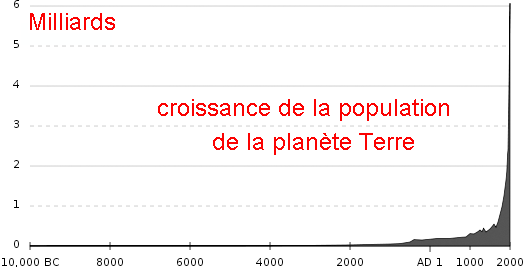
There’s no need for extensive education to realize that we’ve reached a rate of growth (which mathematicians call exponential) that’s completely uncontrollable.
Question: what’s a reasonable number of humans who can live decently on a planet like ours? Would anyone dare ask such a question nowadays? Here’s a map showing fertility rates worldwide. Source: Wikipedia.
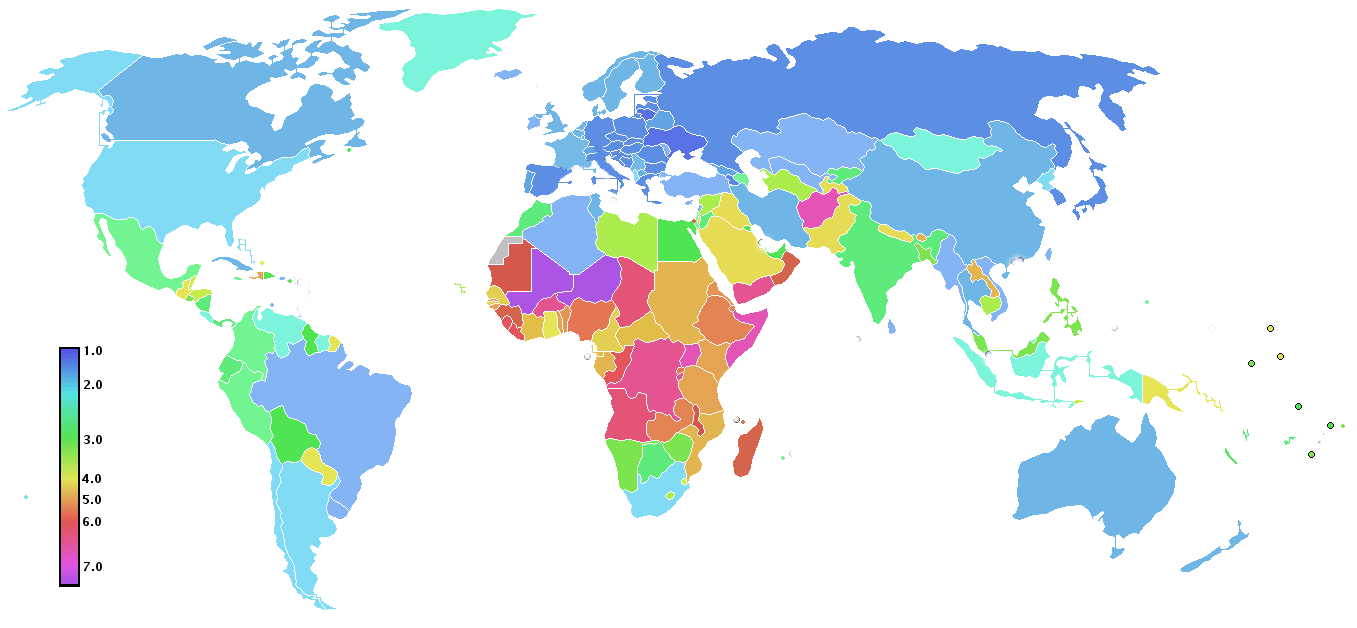
http://fr.wikipedia.org/wiki/Taux_de_f%C3%A9condit%C3%A9
On the left, you’ll see a color code: dark blue means low fertility; red through violet indicates high fertility. I quote:
“The general fertility index is calculated by dividing the total number of live births in a given year by the average number of fertile women (aged 15–49).”
The encyclopedia mentions other ways of calculating demographic figures, but I couldn’t find any maps. Regardless, this wouldn’t change the qualitative information.
Fertility rates in various regions of Earth
You can also refer to the
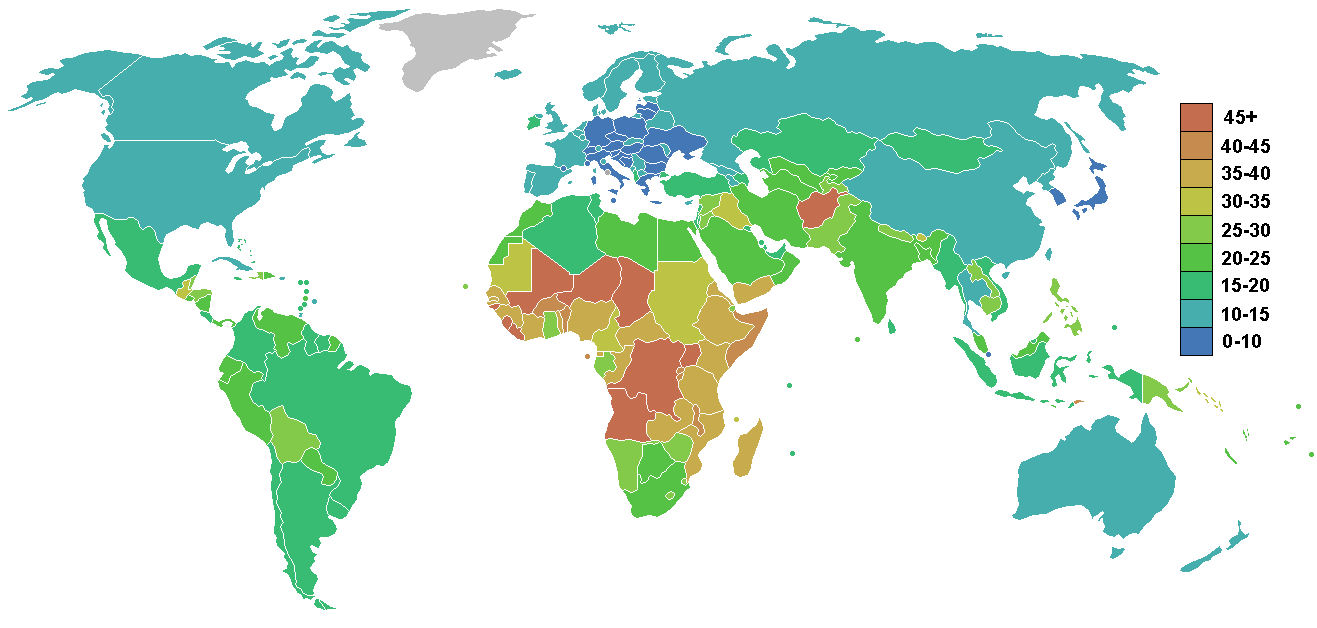
birth rate. I quote again:
“The birth rate is a statistical figure representing the number of live births per inhabitant (average yearly population). It’s used for demographic studies, especially in geography. It doesn’t easily allow comparisons across space and time, since it’s affected by life expectancy, which varies greatly.”
Birth rates in various regions of the world
But if you compare these two maps, or others of similar type, you’ll arrive at the same qualitative results. It’s clear there are “hot spots” regarding demographics and “cold regions” where birth rates are dropping (possibly compensated by strong immigration, legal or illegal). Let’s mark regions with high fertility rates, for example:
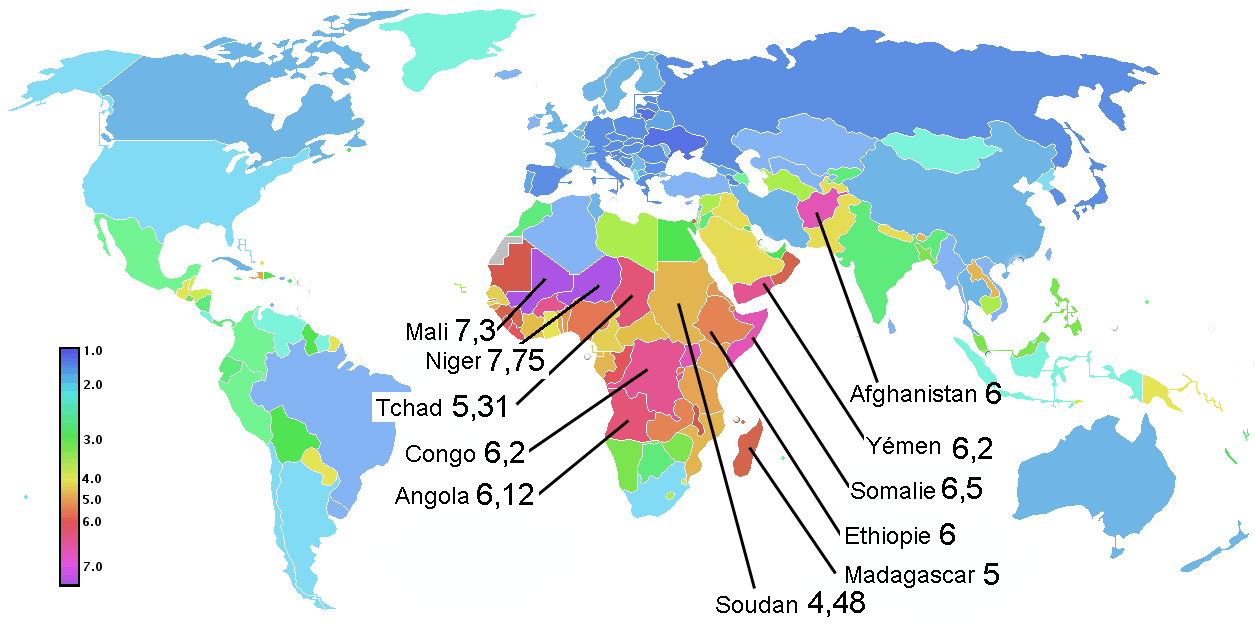
Fertility rate is the raw measure of a population’s ability to grow. Clearly, the most intense “demographic hotspots” are located “in the south,” in poor countries—which won’t surprise anyone.
Africa is the planet’s main demographic hub.
Lack of contraception, great sexual freedom, no future prospects, unemployment, patriarchal social structures, etc. Regarding contraception, here’s an example of human stupidity at its peak:
Record-high fertility rate in Afghanistan? There’s no mystery here: women are confined, denied any schooling, turned into mere egg-layers. In German, referring to a retrograde attitude toward women’s status, one says: “Kinder, Kirche, Küche”—meaning “children, church, kitchen.” In Afghanistan, replace “church” with “Quran.”
Some will immediately say: this is the general rule in Muslim countries! But no, there are exceptions. In Iran, the fertility rate is 1.8; in Turkey, 2.2; likewise in Turkmenistan.
In countries with a “medium standard of living,” we accept that a population “stabilizes” demographically if, roughly speaking:
Critical birth rate: 2.11
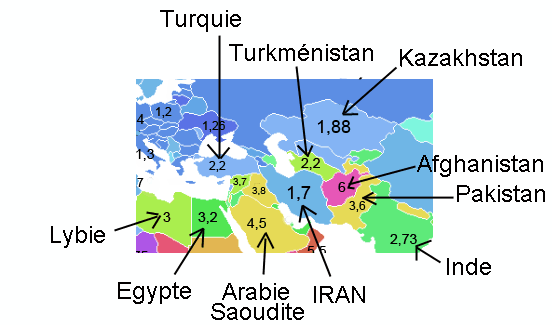
Iran’s fertility rate remains below the critical standard value of 2.11.
Despite its Sharia laws and Islamic veils, Iran isn’t a major demographic hotspot. Why? Because even under its current regime, women study and work.

The key is being able to use a microscope.
Turkey’s rate hovers around 2.2. We’ve already seen Afghanistan’s record level of 6. High fertility rates go hand in hand with illiteracy and lack of freedom for women.
In Saudi Arabia, it rises to 4.5 (6.2 in Yemen, not shown on this map).
Now let’s look at countries where birth rates are plummeting:
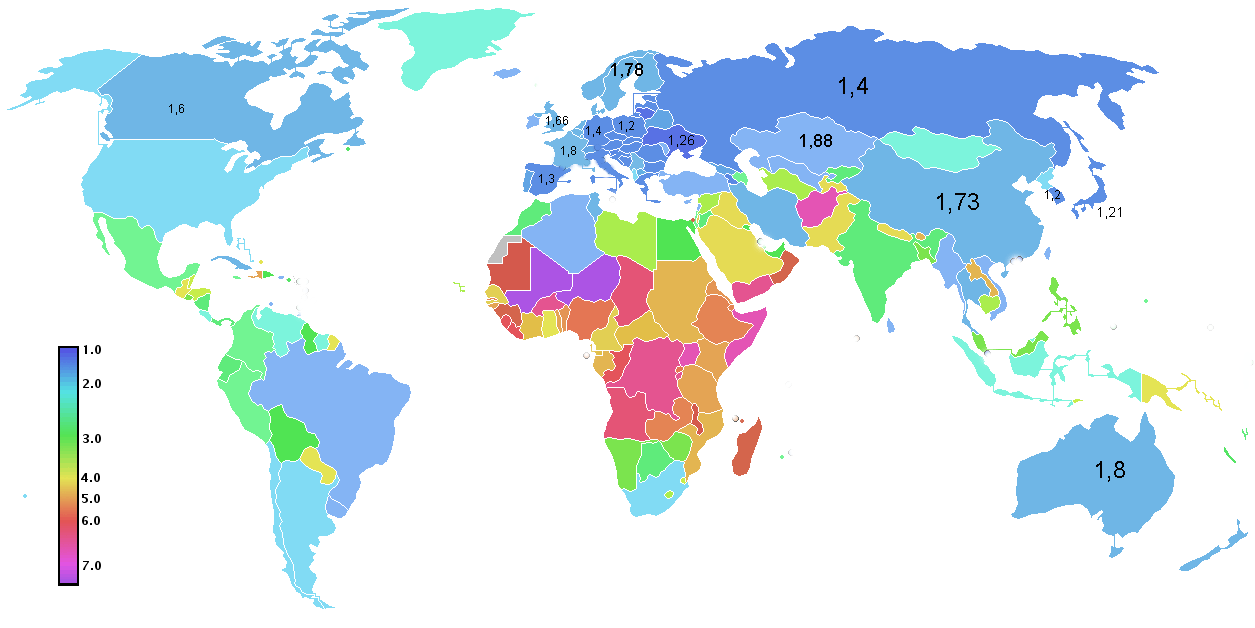
Countries experiencing a decline in fertility rate
Demography is always tricky to navigate. In China, Mao instituted the one-child policy to curb population growth. The effects of such policies manifest only in the long run. A country that curbs its demographics (while life expectancy rises thanks to improved medical care) sees its population age. This phenomenon displays considerable inertia. In 1950, 7.5% of China’s population was over sixty; in 2005, this percentage rose to 11%. For comparison, in India it’s 6%, and in Europe, 17.3%.
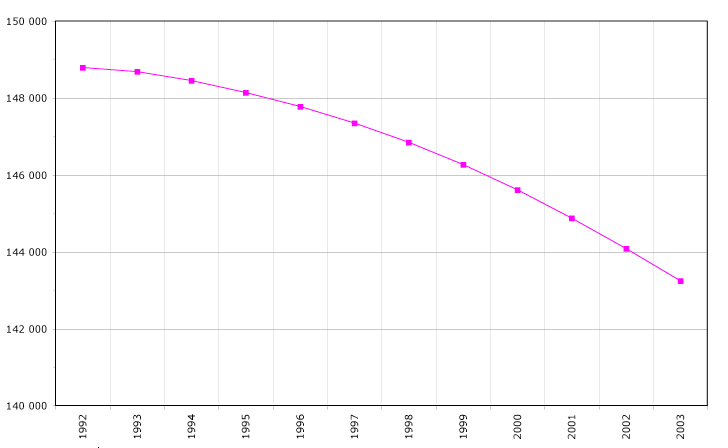
Demographic crash
(Source: http://fr.wikipedia.org/wiki/Crash_d%C3%A9mographique)
Like you, I’ve only vaguely heard of this; I explore it, discover it. The numbers are staggering, while the overall curve of Earth’s population growth is exponential. Russia loses 500,000 inhabitants each year, simply because generations aren’t renewing themselves and because women are aging beyond childbearing age.
Causes:
-
Urbanization, cramped living conditions, no need for young labor to till the land, now farmed mechanically. Farming is becoming increasingly unprofitable; fifty percent of the population lives in urban areas.
-
Rising standard of living.
-
Availability of abortion.
-
Late marriages; widespread use of contraception (amplified by fear of AIDS). People no longer marry “because the partner is pregnant,” as happened in my case.
-
Separation of sexual life from marital life.
-
Longer lifespans have masked the drop in fertility rates among women past forty, when they’re no longer at risk of birth defects.
-
Moral crisis: why bring children into such an uncertain, unjust world, amidst such insecurity regarding jobs and life itself?
-
Rising alcoholism and suicide rates in Russia.
-
Loss of faith in existence itself, given the collapse of traditional values: family, respect for neighbors, solidarity, contrasted with blatant social inequality.
-
Reaction to the impossibility of revolt, lacking any ideological driving force (except for Muslims).
-
Possibly declining fertility rates among both men and women, linked to biological factors (diet, environment).
-
Influence of anti-natalist messages advocating degrowth.
In European countries, this could be summed up by this famous quip:
God is dead, Marx is dead; inside myself I don’t feel too well either.
This phenomenon is universal throughout Europe. Germany is the hardest-hit country. For details: http://fr.wikipedia.org/wiki/D%C3%A9mographie_de_l%27Allemagne. Similar forecasts predict a population loss of 300,000 per year by 2050; the age pyramid will shift dramatically: by 2050, over 40% of the population will be over sixty-five. Even accounting for substantial immigration (mostly Turkish), this still occurs; immigration tends to offset this demographic drain but also sparks ethnic tensions in large cities where immigrants already make up 20% of the population.
Let’s turn to England:
http://fr.wikipedia.org/wiki/D%C3%A9mographie_du_Royaume-Uni
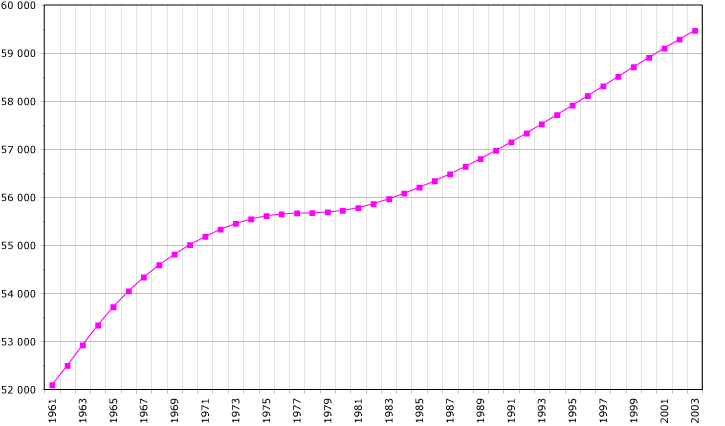
Population growth in England, in thousands of inhabitants
Sixty million inhabitants; 89% live in cities; 380 inhabitants per square kilometer. I found no explanation for this trend; perhaps it’s a post-war baby boom effect. Immigration flows are stronger than in France.
In France:
http://fr.wikipedia.org/wiki/D%C3%A9mographie_de_la_France
65 million inhabitants as of January 1, 2009 (INSEE). Growth rate: 0.58% annually.
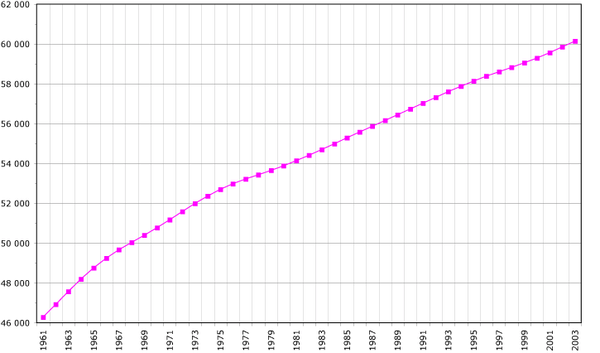
France: population trends, in thousands of inhabitants
Half of all births involve at least one foreign parent. I quote:
Thus, births to French mothers rose by only 2.75%, while those to foreign mothers jumped nearly 33%. Women from North Africa and Asia had 30% more babies (over seven years); “other African women” (mainly from former black African colonies, Madagascar, and Mauritania) saw an impressive rise of over 70%. This is largely due to massive family migration by Africans in recent years.
Analyzed via fertility rates
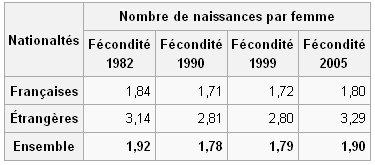
I quote:
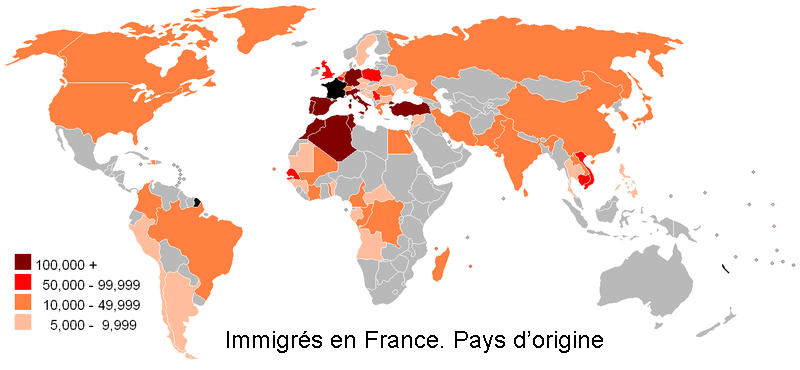
Compared to European immigrants, those from Africa and Asia show particularly dramatic increases, especially Moroccans and people from sub-Saharan Africa. Algerian immigration, present in France for a long time, shows notable aging, though counterbalanced by continual influx of young immigrants thanks to family reunification. After dropping from 1982 to 1999, it’s now stabilizing and even rising sharply according to 2004 data.
Fertility rates have risen for all women, including native French women. True, the increase is highest among foreign women, but this correlates with the steep rise since 1999 in the number of women from Asian and African countries with high fertility rates. In other words, the composition of the immigrant population has changed considerably due to recent waves of immigration. Thus, births to mothers from Black Africa rose from 14,861 in 1999 to 21,452 in 2004—an increase of over 44% in five years.
Religion:
A recent survey (December 2006) by CSA Institute, involving 2,012 respondents, showed only 51% of French people identifying as Catholic, versus 31% non-religious, 4% Muslim, 3% Protestant, and 1% Jewish.
In France, we’re seeing growing demographic contributions from mixed marriages:
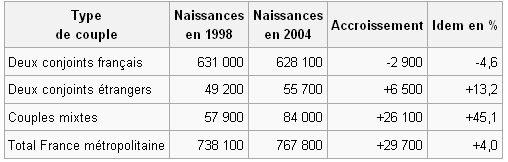
Demographic contribution based on marriage mix
When there’s immigration, the only desirable outcome is assimilation, integration into the local culture—the “melting pot.” Separation into distinct communities inevitably leads to conflict, whether through ghettoization or separation based on cultural or religious grounds. We’re fundamentally a secular country with a monogamous tradition. When moving to another country, it’s not advisable to try exporting one’s own culture. In a sense, this is colonialism. Such colonialism can “succeed” only by exterminating indigenous peoples, either by force or disease (example: colonization of North America). A failed example: French colonization of North Africa. The Pieds-Noirs were shocked to see an “Algerian nationalism” arise a century later, which seemed totally unjustified, since “Algeria” hadn’t existed prior to French colonization (not just to seize land, but also to end Barbary piracy long entrenched in coastal ports). This nationalism, violently suppressed by France, led to a bloody war of independence, resulting in a million Pieds-Noirs fleeing to France.
Another problematic case of colonization: creation of Israel. See the file “Land of Suffering and Hatred,” which I’ll expand upon. Effectively, Jewish immigrants were merely colonists, though, like the Pieds-Noirs, they “developed” the land. This colonization (see file) didn’t originate after the Holocaust or WWII; it dates back to the Zionist movement at the end of the nineteenth century. Arab reactions also predate 1948; violence and retaliation between communities have been constant. Israelis, citizens of a self-declared nation (Declaration of Independence), face a burgeoning Palestinian nationalism they deem untimely and illegitimate. Condemning Arab terrorism, they forget that their state itself was founded on Irgun terrorism; most Israeli leaders were genuine terrorists themselves (Menachem Begin, initiator of the King David Hotel bombing, killing 90; Yitzhak Shamir, responsible for murdering UN mediator from Sweden, etc.). See the file; it’ll surprise many.
Currently, Europe experiences reverse-colonization driven by Islamism: certain ethnic groups seek to impose their laws and customs on host societies (wearing veils, demanding recognition of Sharia, public prayers, forbidding women from being examined by male doctors, banning photography, etc.). In many European nations, radical Islamists openly aim to turn all European countries into Islamic republics. Criticized, they invoke racism and disrespect for their ethnic identity and traditions.
Jewish colonization benefited from massive financial and material aid from abroad, mainly from Jews in the United States (7.5 million Jews in Israel and 7.2 million in the US alone). Islamic colonization relies on high birth rates and France’s inability to integrate younger generations. Like Israel (Gaza territory), these ghettoized groups are offered Islamic activism as an identity outlet.

Jewish population in the US equals that of one US state
(50 states, 300 million inhabitants; average 6 million per state)
As seen, France’s recent rise in births stems primarily from mixed marriages. In 2004, 139,700 newborns had at least one foreign parent, i.e., 18.2% of total births, up from 14.5% in 1998. Real mixed marriages are far more numerous than these figures suggest; many couples with two French-born partners consist of one naturalized foreigner and one French-born person. Yet this phenomenon can’t yet be quantified. Note that births to two French parents peaked in 2000 at 657,600.
France’s demographic situation is thoroughly documented via INSEE statistics. Refer to them.
Japan:
In 2005, Japan’s population dropped by 30,000. Projections estimate a 30% decrease by 2050 (Japan also holds the record for suicide rates, linked to stress). Seventy-three percent of Japan’s land area consists of mountainous terrain; thus, habitable zones are scarce, and Japanese crowd into them. Tokyo’s population of 33 million equals that of Canada. Japan’s aging process is the fastest on Earth; at current fertility rates, 40% of its population will be over sixty-five by 2050! Social costs, especially healthcare, will skyrocket. Japan has historically opposed immigration (only 1.5% of its population is non-Japanese). Life expectancy is 78 years for men and 85 for women. Endless...
This raises a question: at what age should one die? How long should one live?
Medical advances and improved quality of life in some countries mean life expectancy keeps rising. Of course, in most nations countless people don’t ponder this question, preoccupied solely with survival. But in wealthy countries with comfortable pensions and housing: at what age is it decent to pass away? Personally, having turned 72 recently, I can’t imagine reaching 100; I simply lack the requisite profile.
Aldous Huxley wrote in 1931 his wonderful book “Brave New World,” describing a world where death is managed via ever-increasing doses of a drug called “soma,” eliminating all stress. He foresaw the emergence of antidepressants. Meanwhile, those nearing death spend most of their time watching “sensory cinema” (basically, television).

Aldous Huxley, 1894–1963

In a dialogue between the Administrator General of Brave New World and one of few dissenters, Huxley envisioned modern social control principles...
“- The optimal population resembles an iceberg: eight ninths beneath the waterline, one ninth above.
-
And are they happy, beneath the waterline despite such dreadful labor?
-
They don’t consider it dreadful at all; on the contrary, it pleases them. It’s easy, childlike work. No excessive mental or physical strain. Seven and a half hours of light labor, then soma rations, sports, unrestrained copulation, and Sensory Cinema. What more could they possibly want? Society is stable now; people are happy; they get what they desire, and never desire what they can’t obtain. (...) They’re conditioned so they practically can’t behave otherwise. And if anything goes awry, there’s soma. We must choose between happiness and what was once called ‘great art.’ We sacrificed great art; in its place we have Sensory Cinema and scent organs.
-
But they’re utterly meaningless!
-
They provide viewers with lots of pleasant sensations. (...) This requires enormous skill. We make cars using minimal steel and produce artworks using almost nothing but pure sensation.”
“- It’s not just art that’s incompatible with stability; science too. Truth is a threat; science is a public danger. We must keep it tightly chained and muzzled. (...) It gave us the most stable equilibrium in history. But we can’t permit science to undo what it accomplished. Hence we carefully restrict its research scope; it may tackle only the most immediate problems. All other research is discouraged.”
Eternity is long, especially at the end
(Woody Allen)
Returning to global fertility rates: these figures should be taken with caution (they’re CIA data). Essentially, they give a qualitative overview.
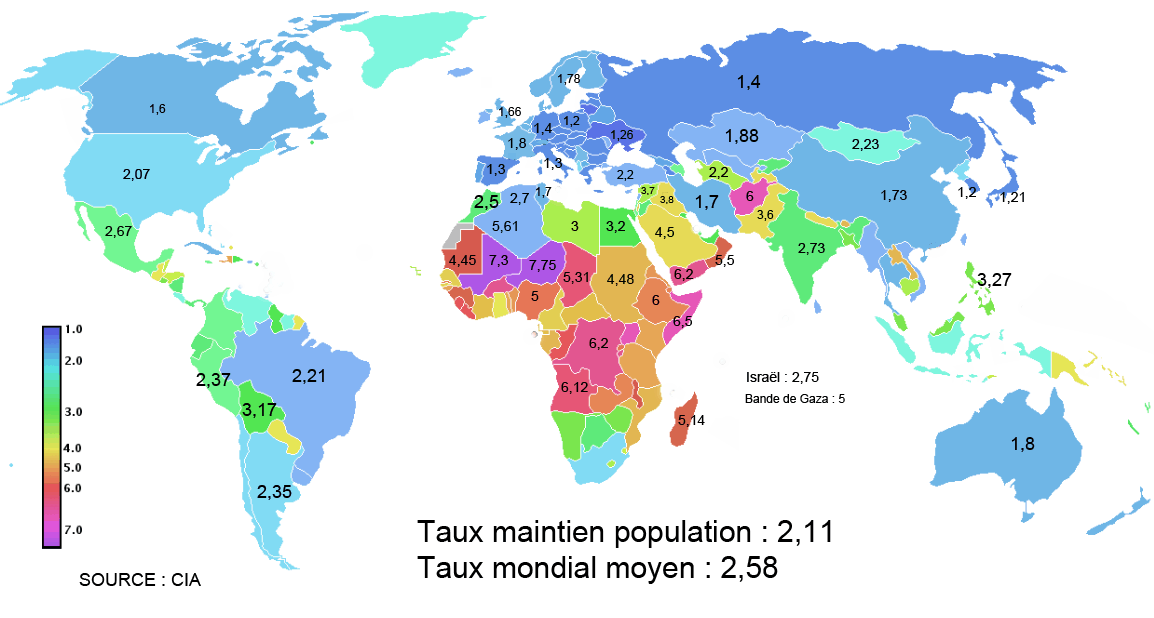
Incidentally, compare Israel’s fertility rate (2.75) with Gaza’s (5). That explains it.
A small aside:
A Jewish friend forwarded an email circulating in Israel, responding to calls to boycott the country as protest against events in Gaza. I reproduce it here; it’s essentially Israel... as seen from within. A document.
Boycott Israel?... Go ahead!
What if we take you seriously?!?!?
Though rare Western supporters of Hamas—who shamefully call themselves “pro-Palestinian” (sic!)—are slow to react and rather timid, they seem to be beginning to grasp that boycotting the Zionist Entity (sic!) shouldn’t merely entail avoiding delicious Jaffa oranges, Carmel avocados, movies starring Natalie Portman, Tomer Sisley, or songs by Noa or Yaël Naïm... If you’re septuagenarian, even Rika Zaraï might appeal to you (!)...
Henceforth, don’t buy DVDs or watch films featuring Natalie Portman (Israeli citizen born in Jerusalem), Tomer Sisley, or any of the countless Hollywood productions directed by Arnon Milchan (“Mr. & Mrs. Smith,” “Fight Club,” “Brazil,” “Pretty Woman,” etc.) or Avi Nesher (Marvel series, Superman, Spiderman, etc.). These four Israelis are renowned staunch supporters of their homeland... Not to mention Leonardo DiCaprio, who’s been passionately involved with gorgeous Israeli supermodel Bar Rafaeli for years. We certainly don’t mention all Jewish artists, filmmakers, distributors, or producers who fervently back Israel.
Therefore, no money for US cinema, DVDs, etc.!
And while at it, boycott artists who’ve enthusiastically visited Israel in recent years: DiCaprio, Will Smith, Sharon Stone, Paul McCartney, Madonna, David Lynch—to name the most famous—but also French singer Raphaël, Gérard Depardieu (who adores Tel Aviv and returns often), Sophie Marceau, Juliette Binoche, Jane Birkin, Victoria Abril, Georges Moustaki, Michel Jonasz, Djamel Debbouze, Arthur, and Gad Elmaleh (obviously!). Also authors Erik Orsenna and recent Goncourt winner Atiq Rahimi!
Good luck, then!
Addendum: Israel manufactures most of its own weaponry, including the heavy Merkava tank

The IDF is equipped with sophisticated gear thanks to cutting-edge Israeli firms like Elbit Systems and Rafael IAI.

Its armored corps comprises nearly 2,500 combat tanks (not counting artillery, troop transporters, Hummers, and jeeps). These include Centurions, M60A1 reserve tanks, and frontline Merkavas.
Israel’s navy operates three Dolphin-class submarines: Dolphin, Leviathan, and Tekuma. Length: 56 meters; propulsion: diesel-electric. Torpedo tubes and Harpoon missiles can be launched while submerged:
Harpoon missile fired from Israeli submarine

Fifteen warships and 48 patrol boats; special forces units as well.
Israel’s air force is its strongest asset; it boasts over 710 modern combat aircraft, notably F-16s and F-15s. It also has 181 combat helicopters. Israel stands out internationally for producing and deploying numerous attack and reconnaissance drones, minimizing human casualties. Thanks to invention of “Shouval,” Israel outshines other drone manufacturers.
The IDF has about 161,000 soldiers, but can mobilize 425,000 reservists; its technological edge is considerable. Israeli firm “Elbit Systems” invented the first robot soldier: “VIPeR,” carried in a backpack, armed with a Uzi, capable of grenade-launching, shooting, climbing stairs, and traversing any terrain.
The Uzi submachine gun is as famous worldwide as the Kalashnikov; sold in over fifty countries. Israel is a major arms manufacturer and supplier; this technological facet was previously missing from its arsenal.

Uzi submachine gun
In issue #9, page 15 of the Largo Winch comic series
Israel excels at manufacturing miniature submachine guns—mini-Uzi and micro-Uzi—ideal for commando operations.

The Israeli satellite Ofeq-3 (330 kg)
Purpose: military intelligence
Israel possesses nuclear weapons. Experts estimate it has 60–400 warheads, based on Teller-Ulam design. Mounted on Jericho III missiles, they can strike all Middle Eastern countries and parts of Europe.
I’ll return soon to the delicate topic “Land of Suffering and Hatred.” Israel is paradoxical: only 5–6% of Israelis claim to be religious and follow Torah rules, yet base their state’s legitimacy on fundamentally religious traditions. This issue involves numerous problems concerning immigration and settlement, affecting many countries today. We live in an era of massive migration; its roots can be traced to this file on global demographics. Will France preserve its republican principle of secularism?
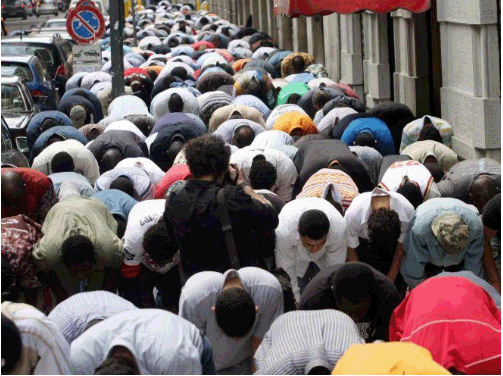
Public prayers in Paris streets
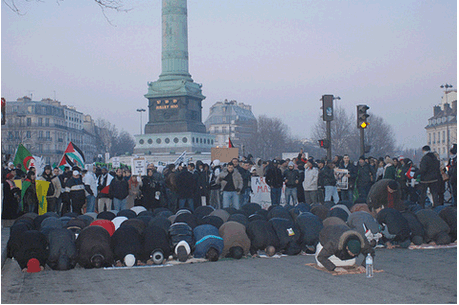
Demonstration by Islamic activists at Place de la République
(...)
News
Guide (Index)