FUKUSHIMA: Start of Fuel Rod Removal Work from Reactor No. 4 Pool
November 19, 2013
Recommended:
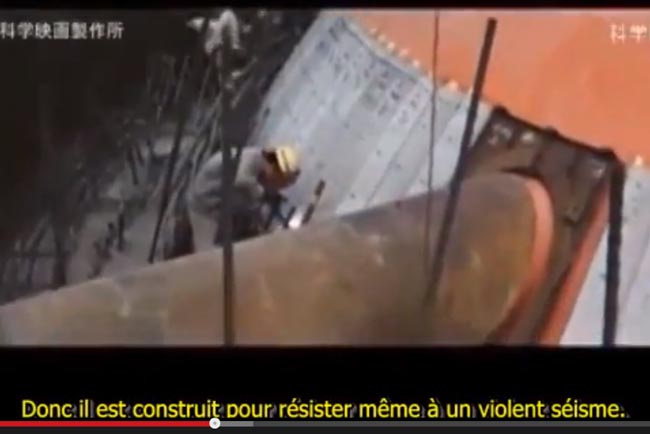
Before reviewing what I posted on November 19, 2013, I strongly recommend watching this two-part video that traces the construction of the Fukushima Daiichi nuclear power plant, Japan's most powerful (4700 MW).
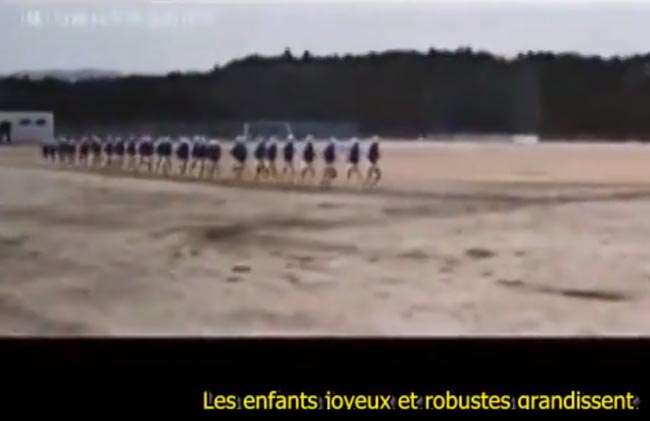
At best, it's not even propaganda. It's the expression of a triumphant Japan, firmly focused on the future (construction began in 1966). The film evokes a bright, high-tech future. But we must not forget that boiling water reactors were not Japanese inventions, but licensed versions of American-designed and developed reactors—for example, similar to the unit at Three Mile Island.
At the end of this dossier, you'll find a link to an ARTE investigation into one of the failing Japanese reactors, Reactor No. 1. There, you’ll see that much of the trouble stemmed from inadequate staff preparedness. When the control room lost all power due to the tsunami, the cooling pumps were disabled, along with two backup power sources: a diesel generator and batteries, both located underground like the fuel and thus submerged. The operators did not know that the valve controlling the activation of a passive cooling system (relying on natural convection) automatically closed, requiring manual reopening—a procedure familiar to American personnel but completely unknown to the Japanese staff. If these valves had been manually reopened, experts estimate the core meltdown could have been delayed by at least seven hours.
Given this incident, you can compare it with the enthusiastic tone of the video presenting this marvel of technology—the Fukushima plant, where everything was supposedly planned and safety was emphasized (...).
( ... )
The Nuclear Rising Sun
You’ll find the same rhetoric in presentations of projects like the EPR and especially
ASTRID,
a fast-neutron breeder reactor, which François Hollande authorized for study and construction six weeks after his election. Project leaders manage to convince themselves of their soundness. The same applies to the ITER project. Faced with questions they cannot answer, these people simply say, "It won’t happen!"
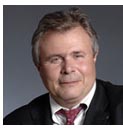
Christophe Behar, head of all CEA reactor projects for electricity production, including ASTRID
When a project contains an alarming gray area, the project leader responds, "We’re working on that issue." This link to
ASTRID
directs you to the CEA website page dedicated to this project. Christophe Béhar, head of the CEA’s Nuclear Energy Division, was present in November 2011 during hearings led by Christian Bataille and Bruno Vido at the French National Assembly, as part of the Parliamentary Office for Scientific and Technological Choices. You can see him in the YouTube videos I’ve posted, accessible from my homepage. I don’t recall which one features this exchange.
At one point, someone raises the issue of the impossibility of visual inspection inside a reactor cooled by molten sodium (550°C). In pressurized or boiling water reactors, when the reactor is shut down, work can be done visually. With sodium, that’s impossible. Behar stammers, "We’re working on this issue" (ultrasonic imaging). But clearly, the problem remains far from solved. Still, we’ll move forward anyway. As for possible technical incidents, Béhar claims that if the project is carefully managed, there will be none.
And it continues. The entire nuclear world operates this way and carries a massive element of irresponsibility. Then, when incidents occur, offering apologies and saying "we’re sorry" serves little purpose.
Epilogue ...
Sources for what follows:
Released by TEPCO (November 2013), 26 pages, in English, technically very detailed:
http://photo.tepco.co.jp/library/131030_02e/131030_01-e.pdf
The YouTube video, in English:
http://www.youtube.com/watch?v=XkGQost13DM
November 18, 2013:
Japanese company TEPCO has begun work extracting 1,300 spent fuel rods and 220 "ready-to-use" fuel elements submerged in the storage pool adjacent to Reactor No. 4.
A brief reminder of the situation is necessary.
When a tsunami caused by a magnitude 9 earthquake—whose epicenter was offshore Japan—hit the Fukushima nuclear plant, it had four reactors.
- Reactors 1, 2, and 3 were operational. Steel pressure vessels contained active cores. In an emergency shutdown, control rods rise and are pushed upward by hydraulic cylinders (in boiling water reactors, they are located beneath the reactor vessel, which has numerous holes allowing their passage).
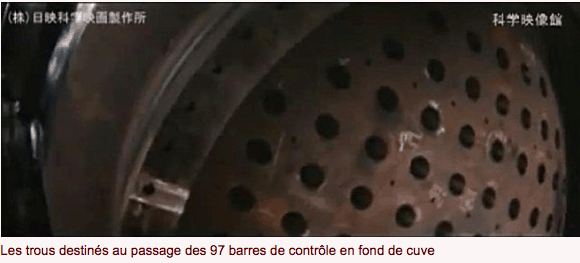
Image of the reactor vessel bottom at Fukushima showing my 97 holes allowing control rod passage
In pressurized water reactors, they are located on top and can thus descend by gravity. But even if reactors are "shut down," the fission products they contain remain active. As they decay, they generate heat. Thus, a "shut-down" reactor must be cooled at all times.
The tsunami (a 14-meter wave) disabled backup pumping systems by submerging diesel generators and oil tanks meant to power them, both located underground. Core temperatures then rose rapidly. The cores melted, and unless contradicted by solid evidence, they penetrated the vessel bottoms and flowed onto the 8-meter-thick concrete foundations. It is highly likely that this concrete was quickly breached by what is known as "corium"—a mixture of fuel elements, uranium-238, uranium-235, and plutonium-239—especially when the fuel load included partially MOX (mixed oxides, where fuel contains plutonium; MOX produced and exported by the French). See the dossier on corium at the end of this page.
At Chernobyl, the reactor core melted. But the corium mass, as it spread, did not generate intense heat through criticality. Thus, this mass remained in place, resting on the concrete foundation without penetrating it.
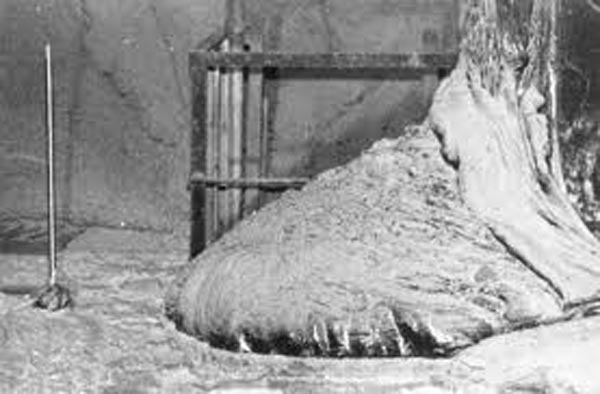
Chernobyl’s corium today, solidified into a metallic mass
Over time, as the activity of this mass decreased, it became possible to insert a camera and photograph the cooled corium from the Chernobyl reactor—an enormous solidified metallic mass.
No one can say what is the current state of penetration of the corium from Reactors 1, 2, and 3. In these three units, constant spraying is necessary to keep temperatures below 50°C. For more on this, see the video produced by Le Monde: "Two Minutes to Understand Fukushima":
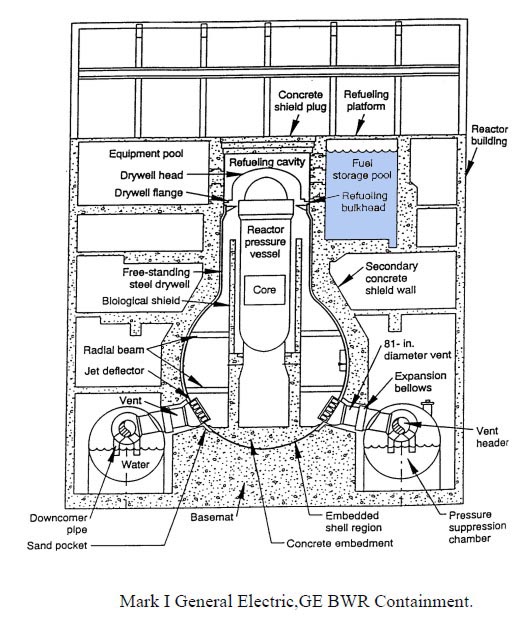
- The situation at Unit No. 4 is entirely different. When the tsunami arrived, the reactor was defueled. Near all such reactors (boiling water reactors, BWRs, like Fukushima’s) or French installations (pressurized water reactors, PWRs), the vessel containing the fuel elements is adjacent to a storage pool. The pool for Reactor No. 4 measures 10 meters by 12 meters on the side. It holds fuel elements 4.5 meters tall, topped by 7 meters of water. Its depth is thus about twelve meters. This depth allows for underwater extraction and transport of fuel rods. Here is the general layout:
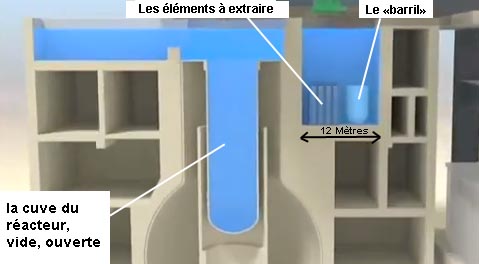
General layout of Fukushima Reactor No. 4
The recently released TEPCO PDF specifies that the pool walls were designed to be especially resistant to earthquakes. The reinforced concrete walls are between 1.4 and 1.8 meters thick. For watertightness, they are lined with welded steel plates, 6 mm thick. There are no openings in these pools leading outward. The pool support structure has been reinforced:
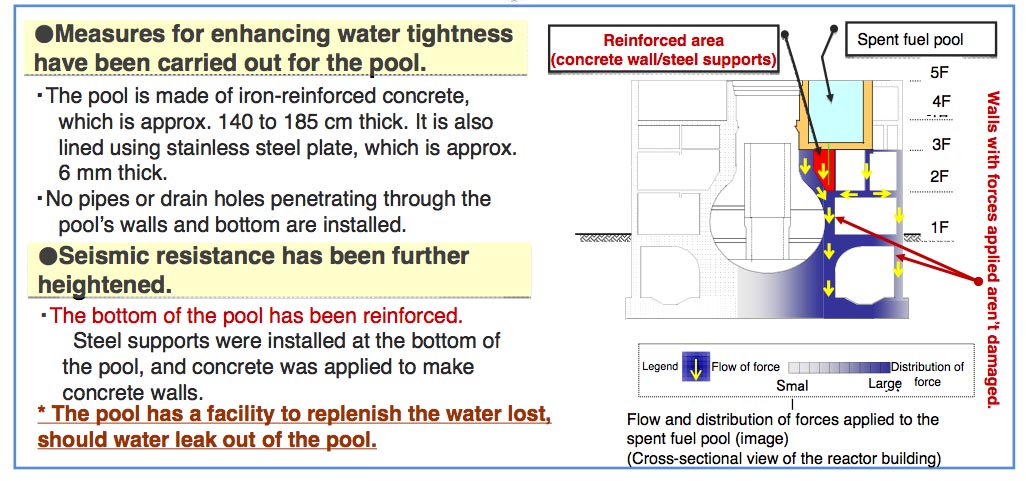
Reinforcement of the spent fuel pool (via support pillars, shown in red)
Fuel elements are rectangular parallelepipeds, elongated. They contain "rods"—zirconium tubes filled with small cylinders of uranium or plutonium oxide stacked end-to-end. Zirconium is used because it does not absorb neutrons; otherwise, this "cladding" would melt.
Below, in July 2012, TEPCO employees examined fuel elements extracted from the pool to assess corrosion caused by saltwater. One of the 64 rods was removed. It was one of the 220 "non-irradiated" elements—thus containing no fission debris. The inspection was considered satisfactory.
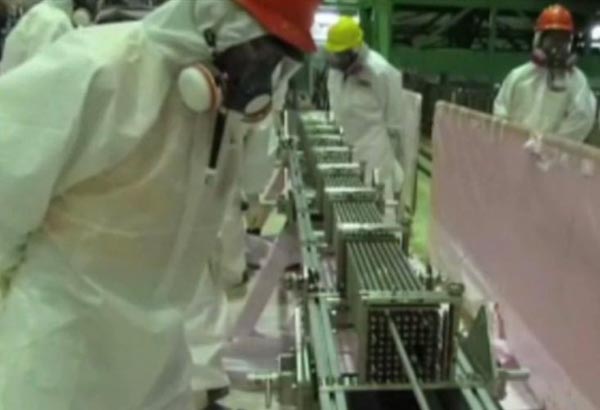
Example of standard elements to be extracted (cross-section 15 cm x 15 cm)
This pool contains 220 elements, previously stored there for future loading. These are not dangerous and do not generate heat. Having not undergone fission, they contain no waste products resulting from the decay of fissile nuclei, which themselves decay exothermically.
It is the other 1,300 "used" elements that pose the problem. These generate heat and contain terrible poisons. Their permanent submersion is essential.
TEPCO first cleared the area around the reactor building. In the image below, you can see it just after the tsunami. The roof was lifted, and lateral components were ejected.
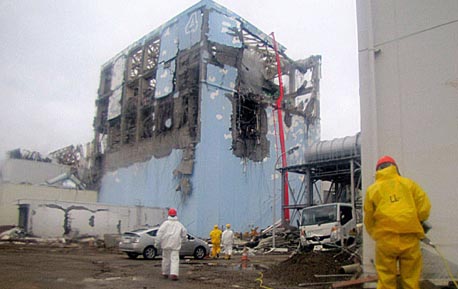
Reactor No. 4 building immediately after the disaster
The damage to this building, according to TEPCO, was caused by hydrogen ingress from the adjacent Reactor No. 3. Hydrogen is produced when the core heats up and zirconium cladding oxidizes, taking oxygen from nearby water molecules. Hydrogen is then released. The fact that a valve remained open allowed this hydrogen—produced in Reactor No. 3—to enter Building No. 4, mix with air, and explode.
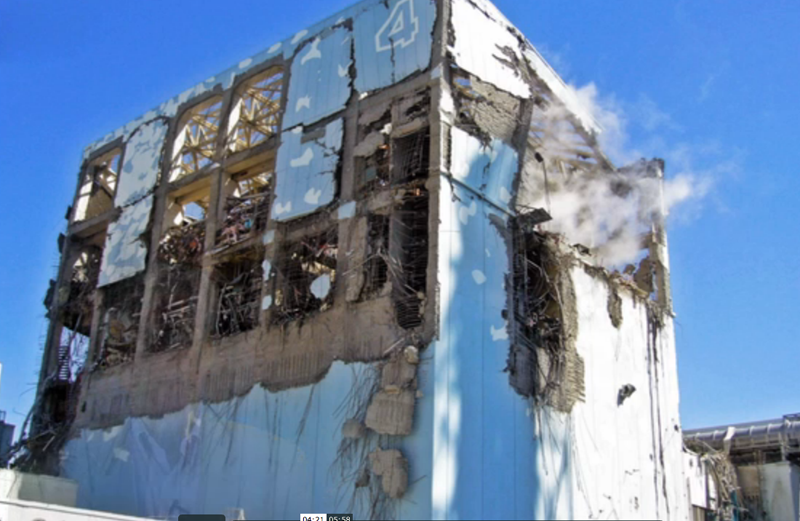
Close-up, striking
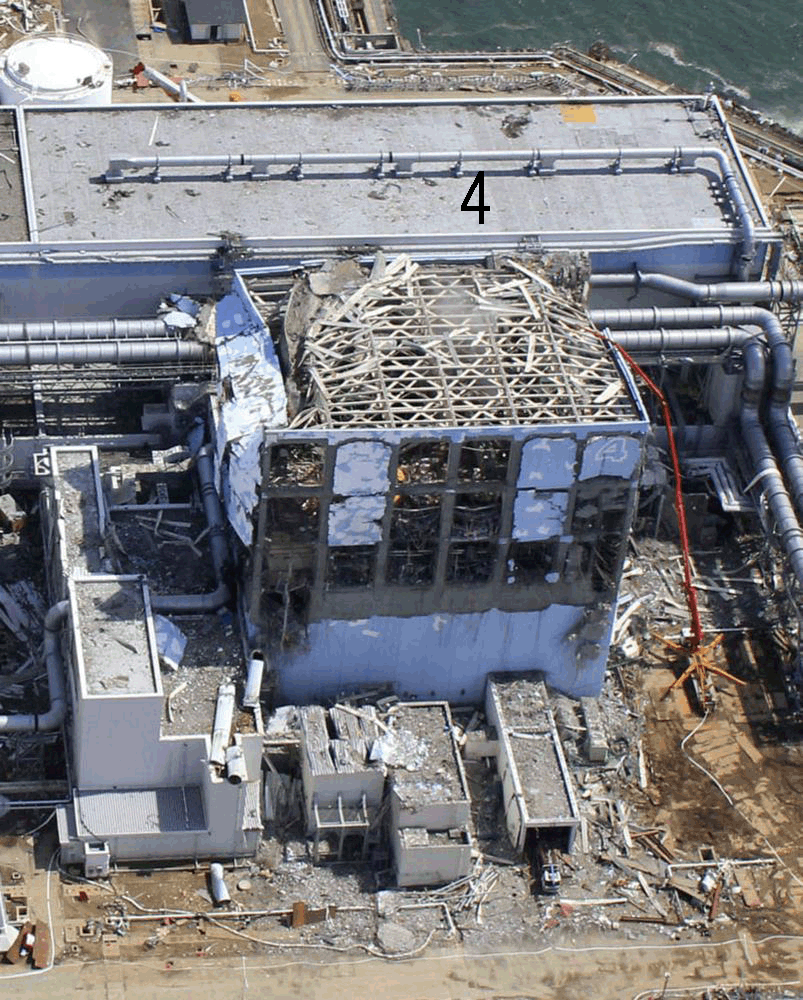
Aerial view of Reactor No. 4 building.
After two and a half years spent cleaning the site, TEPCO first reinforced what remained of Building No. 4.
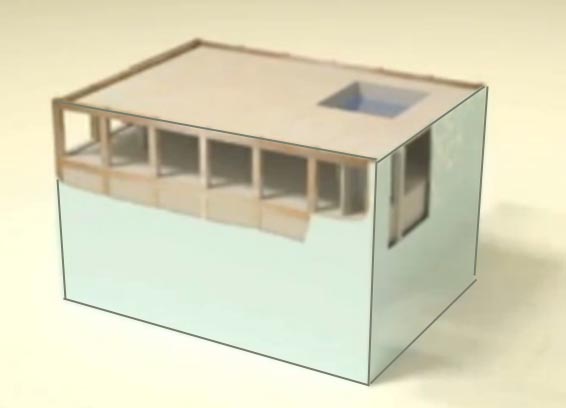
Reactor No. 4 building, consolidated, with opening directly above the pool
Initially (if I’ve understood and interpreted the diagrams correctly), the company positioned a structure resting on the portions of the building capable of bearing limited loads. See the left-hand diagram:
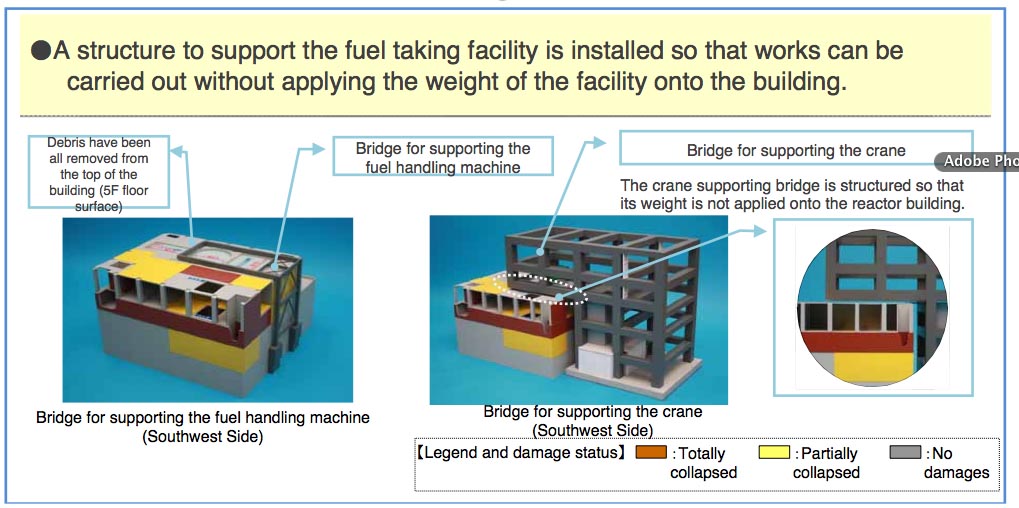
On the left, the gantry spanning the pool top, on which a lightweight overhead crane runs, intended for extracting spent fuel elements. On the right, the heavy cantilevered structure.
Colors indicate structural degradation: brown = completely collapsed; yellow = half-collapsed; gray = no damage. Such a structure allows pulling fuel elements with a maximum traction force of one ton. However, it was planned to begin by storing a number of these elements in a 90-ton armored barrel before transport. Thus, relying on the remaining building structure was ruled out. TEPCO therefore began constructing a massive metal-and-concrete structure whose foundations are located just beside the reactor.
It is fair to say that this is a complex and considerable undertaking by the Japanese.
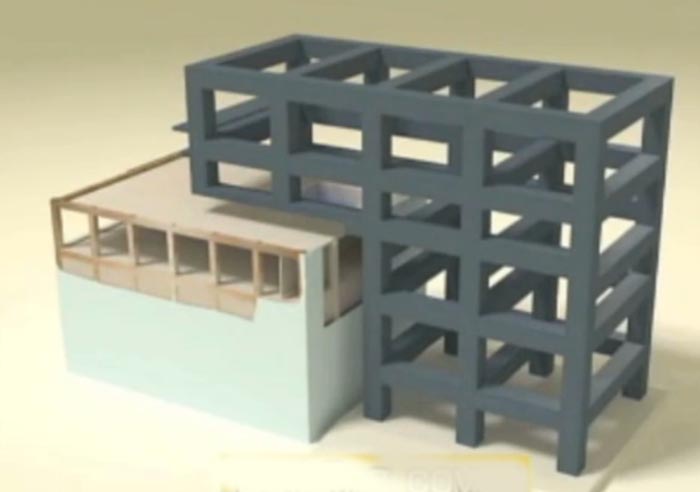
TEPCO's structure, spanning above Reactor No. 4 building
The entire gray structure rests on a massive monolithic reinforced concrete base.
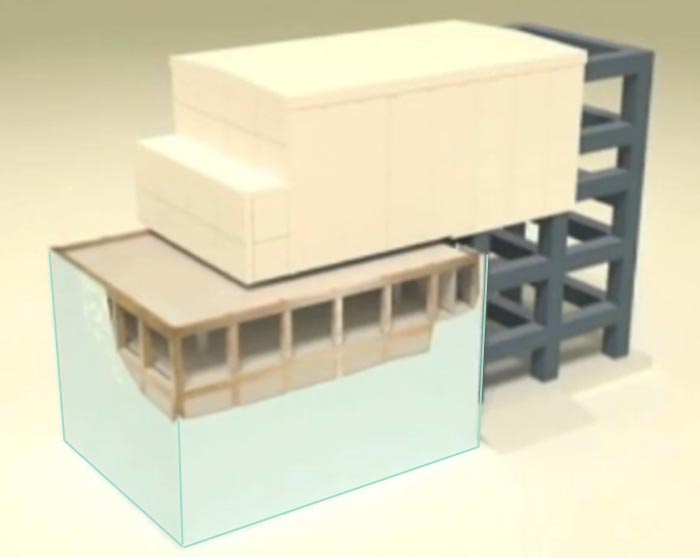
This device, completed with isolation of the work zone to prevent accidental gas release outward
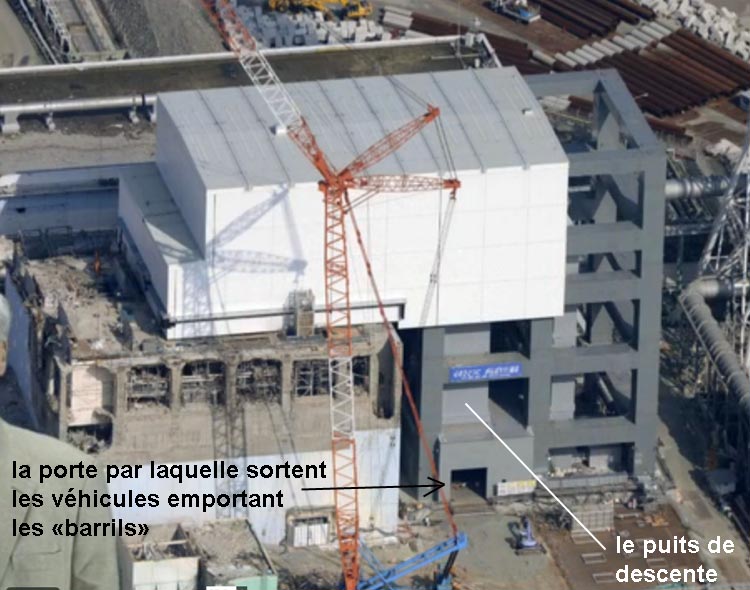
The same device, in concrete
TEPCO diagram. In blue, the lightweight gantry on which the fuel element lifting system runs, seen resting on the upper part of the vessel:
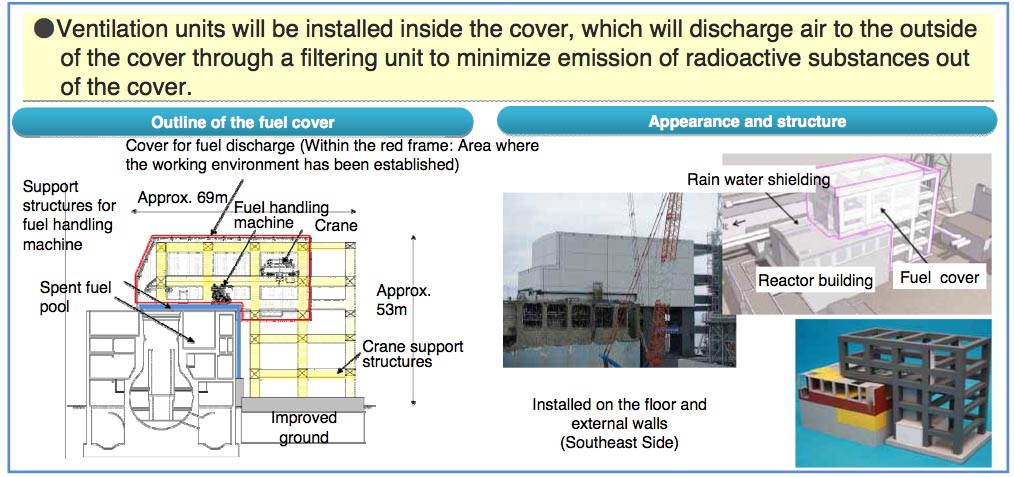
TEPCO’s diagram. Blue: lightweight structure supported (on the vessel). Yellow: heavy cantilevered structure. Red: isolation walls of the work zone, facing outward.
These gas releases may result from fuel element rupture during handling. The enclosed space includes a ventilation system with filters to recreate normal atmospheric conditions inside and prevent radioactive substance release outside the building.
This structure continues with a portion cantilevered over what remains of the reactor building. It is cantilevered, but TEPCO personnel claim it has been designed to withstand an earthquake. The reactor building has been reinforced as much as possible. However, it was so weakened by the quake that using a heavy overhead crane on its remaining structures was excluded. The lightweight (relatively speaking) crane that served this reactor was destroyed, and its remains had to be extracted and removed.
The Japanese have therefore installed two overhead cranes. The most powerful runs on rails suspended above the remnants of Building No. 4. Small debris were removed using various clamps and placed into wire baskets. This work took two and a half years.
All these operations are visible in this video:
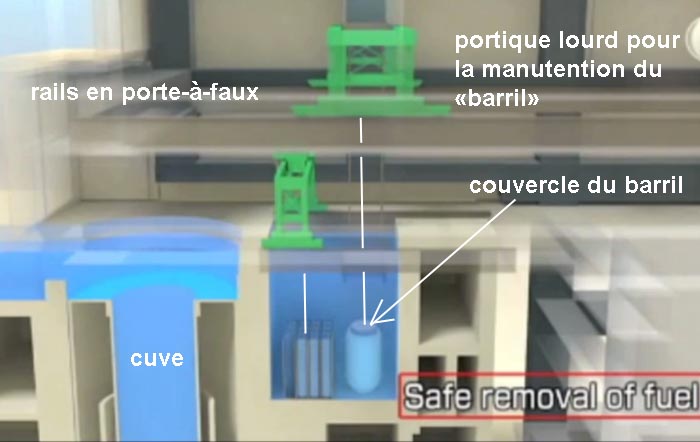
Two overhead cranes for handling
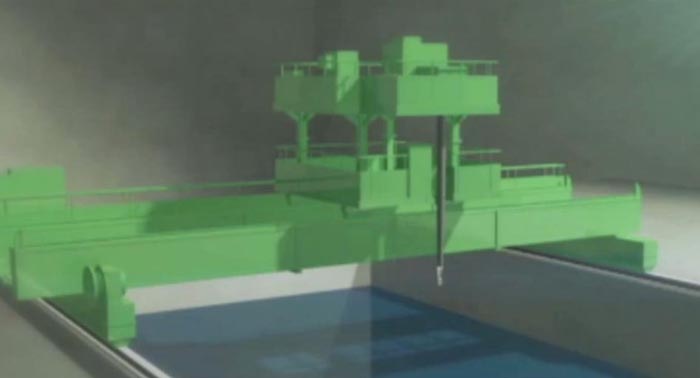
The crane designed to extract and handle fuel elements
This crane is similar to the service overhead crane previously used to load and unload fuel elements, each weighing 300 kilograms. It can exert a maximum pulling force of one ton (to avoid damaging the elements being extracted).
With the upper part of the reactor cleared, extraction work can now begin. It occurs in two phases. The upper gantry is used to lower a large barrel weighing 90 tons into the vessel, in its cleared section.
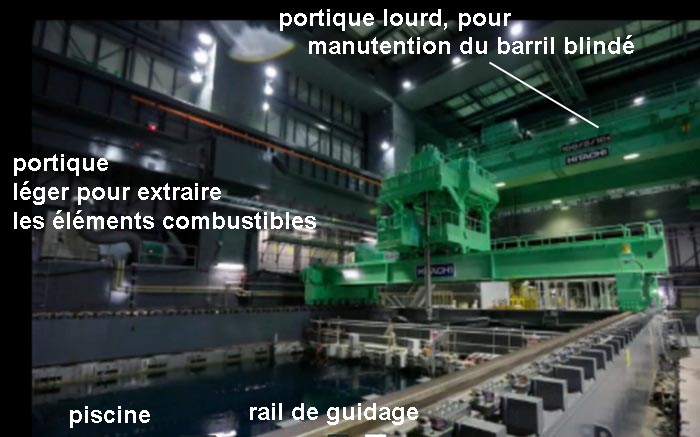
Photo showing the two overhead cranes
Side view showing the positioning of the two overhead cranes
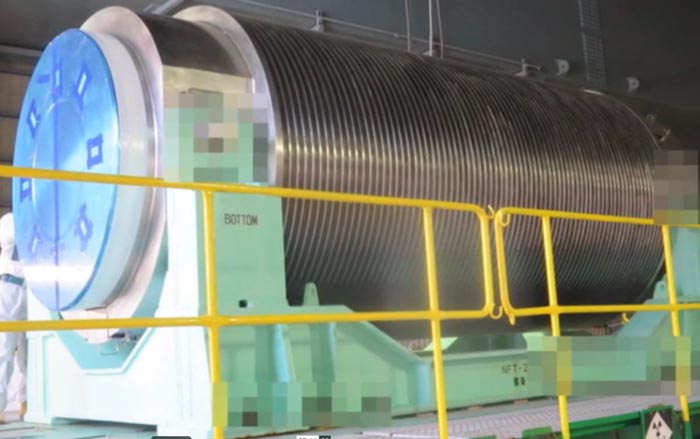
90-ton armored barrel, lying on its transport carriage
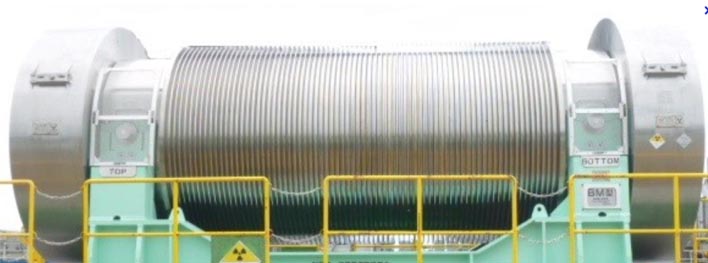
The same, viewed from the side
This barrel is armored. It was designed to block radiation fluxes that might be emitted by damaged elements.
The lower gantry is then used to extract elements one by one, like removing cigarettes from a pack. As Arnie Gundersen noted, these elements—grouped in "bundles" (packs, blocks, faggots)—have suffered corrosion due to the urgent use of saltwater for cooling. This corrosion may make extraction difficult, especially if structural deformation occurred during the quake. And Arnie adds:
- Removing cigarettes from an intact pack is easy. If the pack is deformed, it’s much harder.
Condition of fuel elements in their racks, to be extracted one by one
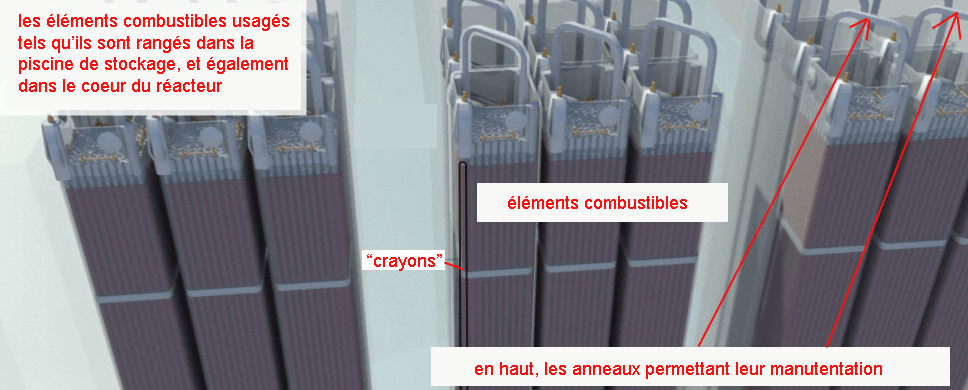
Fuel elements in their racks, with lifting rings, to be extracted one by one
Before extraction, each element is inspected. Then a lifting hook applies a limited pull of one ton.
The Japanese attempted to assess corrosion resistance by exposing similar but new elements to saltwater (photo above). They were extracted in 2012 from the 220 elements present in the pool—“ready for use,” thus non-radioactive.
Extracted one by one from their racks, the elements are then placed into the barrel. Once loaded, the upper gantry lifts the barrel. Sealed with an airtight lid, it is hoisted and transported outside the reactor building, just above a rectangular-section shaft where it descends.
Below, it is received on a specially designed vehicle. It is laid flat on its platform and then directed to a new storage site, where the reverse process will be carried out.
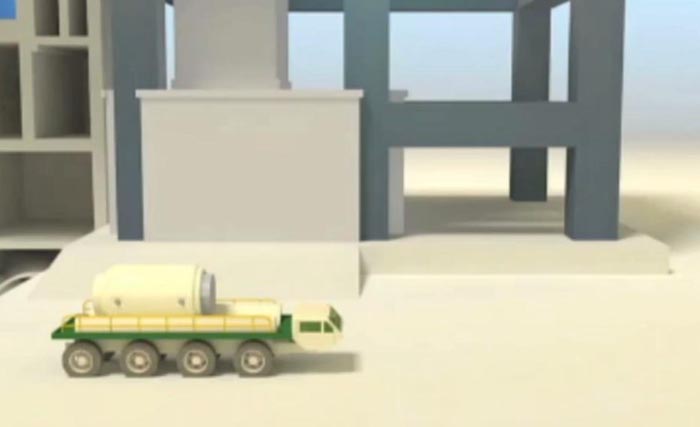
Transport of the barrel, lying flat on its carriage, on a self-propelled vehicle
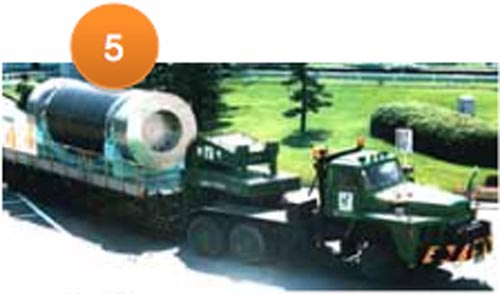
Photo of the vehicle and barrel on its carriage (TEPCO)
Below is the complex procedure for storing recovered elements.
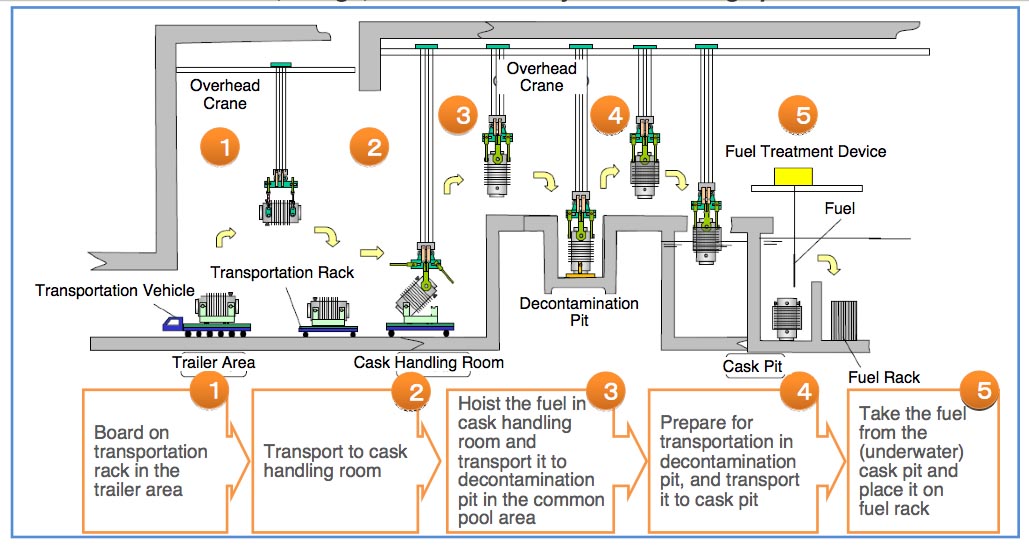
Procedure for storing recovered elements (TEPCO)
TEPCO has decided to store all recovered fuel elements in a single location. After the issue of the elements in Reactor No. 4’s pool is resolved—hopefully without incident—a similar procedure will need to be applied to Reactors 1, 2, and 3. First, an analogous technique must be applied to the buildings. Debris will be removed and the site cleared. Then, structures with overhead cranes will be built to first complete clearance, then reach and recover... whatever can be recovered.
The work undertaken at Unit No. 4 has allowed testing these heavy and costly techniques. Urgency required that this work be prioritized. Around Buildings 1, 2, and 3, the work will be much more difficult due to intense heat emissions. Assuming no re-criticality of the cores and that the heat emission is solely from decay of fission fragments, it will be necessary to achieve clarity. Currently, we can only continuously spray these sites to prevent temperatures from rising above 50°C. If not cooled, zirconium cladding containing the fuel elements would crack, releasing dangerous radioactive gases that, mixing with steam, would spread across the entire Japanese territory.
Thus, continuous spraying and ultimately storage in tanks—and the inevitable leakage of contaminated water into the Pacific—constitute a lesser evil. It is considered better to poison fish than to allow radioactive substances to poison vast areas of Japanese territory (Tokyo is 200 km away).
The reactor vessels, which have very likely been breached, present colossal obstacles to accessing the active parts of the site located below. This may prove simply impossible.
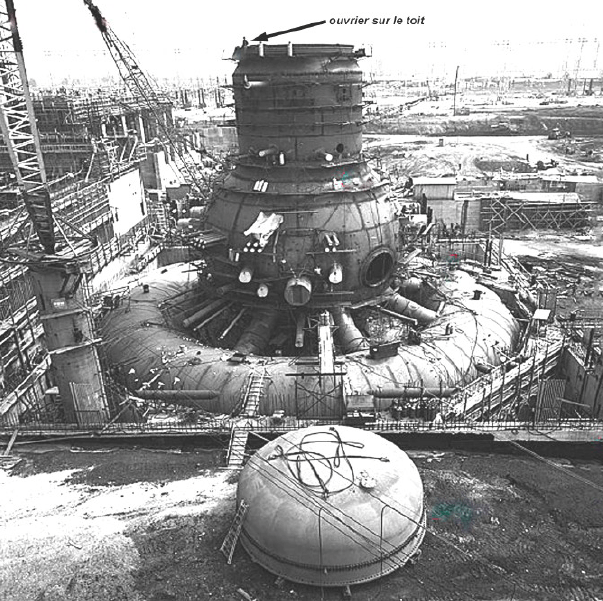
Boiling water reactor vessel. The worker at the top gives the scale
At best, we may still recover the contents of the storage pools of the three reactors. Their content, certainly far more degraded than that of Unit No. 4, will join the extracted elements within twelve months. TEPCO estimates the site remediation will take 20 to 40 years.
Who said nuclear power is cheap?
When examining TEPCO’s solution, one is tempted to think it is optimal for the task at hand. The priority (as in all fuel element handling operations worldwide in water-cooled reactors) is that all manipulations occur underwater and that elements are never exposed to open air.
If this were not the case, an uncooled element would heat up very rapidly, become damaged, and release radioactive gases into the atmosphere.
To prevent any gaseous release, TEPCO has completely covered the entire building section where fuel handling operations take place.
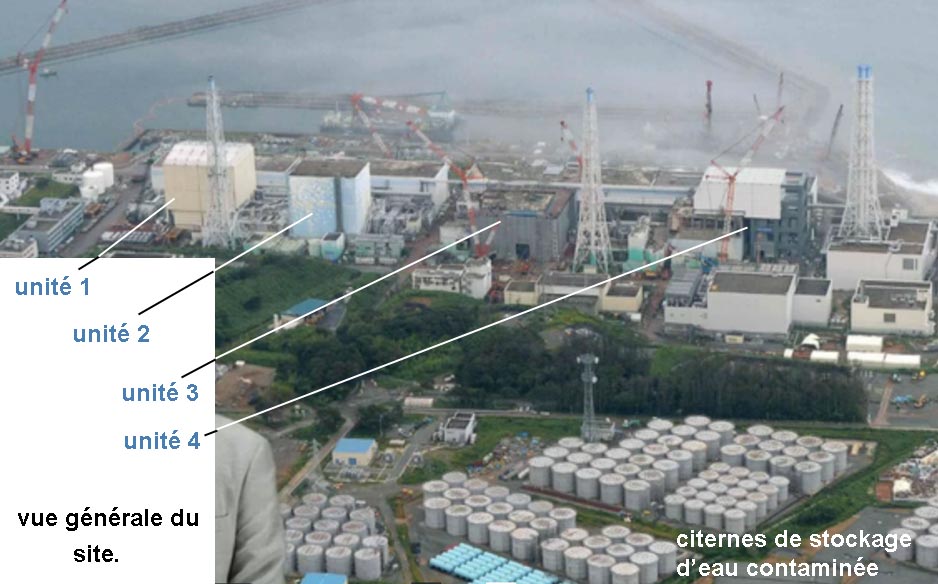
General view of the site, November 2013
In previous months, the press highlighted the danger posed by the presence of these 1,300 spent fuel rods perched 18 meters high, reminding that if an earthquake damaged the pool and emptied it, these rods would heat up immediately, deform, become impossible to extract—constituting a nuclear catastrophe on a planetary scale.
The little information that has leaked in recent months reveals the Japanese mindset, where legendary pride is evident. Their policy of non-communication amounts to saying:
- This is our problem, and we will manage it as we see fit. You have no business interfering. We don’t need help or expertise from anyone.
At this stage, are there technical criticisms to be made? Could other solutions have been considered? The operation carries risks, which Arnie Gundersen points out. We can only hope the year-long operation proceeds without incident. When these troublesome 1,300 elements are safely stored in a new, apparently nearby but secure pool, humanity can finally breathe a sigh of relief.
Arnie Gundersen, who in his career worked on fuel element fabrication and packaging, lists the dangers inherent in this recovery and relocation operation of spent fuel elements.
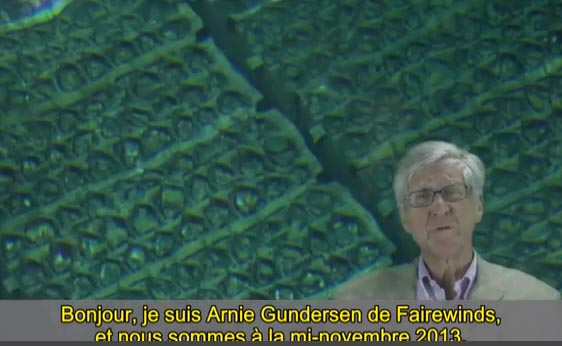
http://www.youtube.com/watch?v=LjZZOLT_E3c
(Preview)
In the background, the racks where fuel element assemblies are stored
Let’s list the technical remarks raised in his video, where Arnie Gundersen continues to fiercely challenge TEPCO’s competence.
This image shows the storage system for fuel element assemblies—consisting of hundreds of zircaloy tubes containing small cylinders of uranium (or plutonium in MOX cases) oxide.
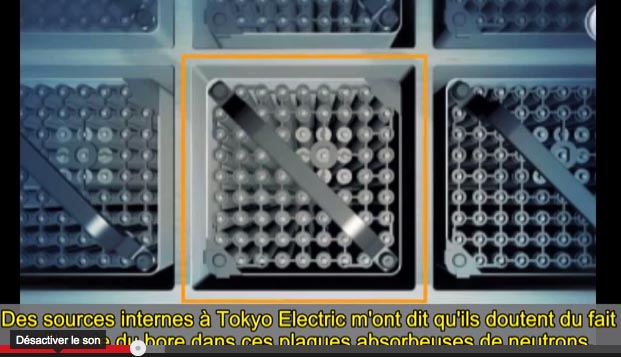
The elements are stored in racks whose walls contain a neutron absorber, boron
This is a synthesized image. Across each rack, the metal handle used for manipulation—and in this case, extraction. These walls containing boron (highlighted in yellow) perform the same function as "control rods" in boiling water reactors. They are not rods but cruciform elements, raised and lowered from the bottom of the vessel—perforated with 96 holes—using hydraulic cylinders. Below is a schematic layout of these elements when inserted between fuel elements:

Positioning of boron shields to stop nuclear reactions.
Placed this way, they absorb fission neutrons. Since the mean free path of emitted neutrons exceeds the cell size, secondary reactions do not occur and neutrons are absorbed by these removable shields. It is only when they are lowered gradually that the reactor undergoes controlled chain reactions.
In the storage pool, the boron-rich walls play the same role. Since fuel elements are still fairly tightly packed, without these partitions, there would be a risk of criticality. Gundersen casts doubt on the integrity of these boron-lined walls, suggesting they may have been attacked by saltwater and degraded when the pool water temperature rose. To avoid this risk, TEPCO has maximized the amount of boron in the water. Boron is a light metalloid. It will dissolve in water as borate.
The risk lies in the rupture of the "cladding"—the zircaloy tubes containing fuel pellets and now various waste products. Gundersen cites Krypton-85, a beta emitter with a 17-year half-life. It is a heavy gas, 3.7 times denser than water. I don’t know how it behaves if released into the pool water upon tube breakage. It seems to explain why containerization occurs underwater.
There are 1,300 spent fuel elements to extract, each having resided four years in the reactor core. Neutron bombardment caused transmutations in their support materials, and Gundersen says they are weakened. To what extent? He adds that the racks containing them are deformed, making extraction problematic—and compares it to removing cigarettes from a deformed pack.
These are the risks inherent in the operation. Could another approach have been taken? Gundersen does not say. He doubts TEPCO’s staff competence and claims the company lacks both the skills and the scope to manage such a task, suggesting Japan should have called on foreign specialists. And here we touch a key point of Japanese mentality in general: the refusal for foreigners to interfere in their affairs.
What else can be said?
Wait and see
Does this mean we can congratulate TEPCO for excellence in this performance? Some already write that the Japanese have developed entirely original recovery techniques for work on a damaged site.
Engineers and technicians might be tempted to celebrate this success with a sip of sake. But we must not forget the root cause of this tragedy: installing a nuclear power plant just a few meters above sea level in a region prone to monstrous tsunamis.
As suggested by an internet user, we cannot conclude this account of events at Fukushima without saluting the courage, self-sacrifice, and even the spirit of sacrifice of those working on-site, who will pay with their health for the mistakes made by the site’s designers. At Chernobyl, it was different. Everything resulted from a human error and a poorly conducted test in a reactor type that could experience such incidents—still poorly understood at the time.
At Fukushima, the fundamental error was underestimating the possible scale of natural phenomena. A magnitude 9 earthquake, waves over ten meters high—this had never been seen in living memory among the Japanese. If you examine the videos of the plant, you'll see that they leveled the coastline to position the reactors closer to the sea, for example to facilitate handling steel tanks weighing 40 tons. In the film, it is stated that the coastal terrain lies 30 meters above sea level. The plant could have been built at this height, which would have completely protected it from a tsunami. We must remember that the plain was dotted with 260 ancient stone steles, inscribed with: "Do not build beyond this line, due to tsunamis." Warnings placed by people who had good reason to issue them.
See this article

The Aneoshi stele, bearing the warning
Some might have considered building on higher ground excessive. Until the facts proved them right. And then, what disaster, what terrible consequences.
Now the tragedy is complete and people are paying the price, in their flesh, in their lives.
In the category of imprudence, add the fact that emergency pumps, diesel generators, and oil tanks were installed underground—just as in France at Blayais, at the mouth of the Gironde, and in all our nuclear installations. For more on this, see my investigation:
http://www.jp-petit.org/sauver_la_Terre/complement_enquete_2011/nucleaire_francais_enquete.htm
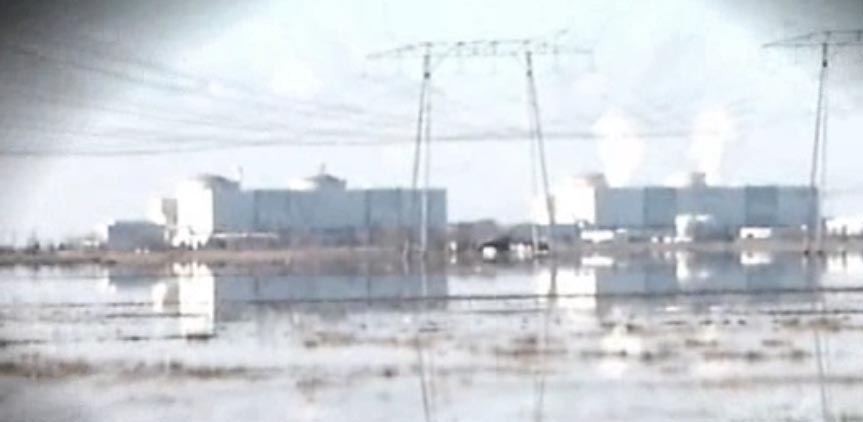
The Blayais nuclear plant, at the mouth of the Gironde, after "the storm of the century."
If the second emergency generator had been flooded, just like the first, it would have been... Fukushima-bis.
Moreover, at Fukushima, there was a lack of preparedness among the teams, as well as unexpected failure of essential measuring instruments, as discussed in this investigation by ARTE:
http://www.youtube.com/watch?v=hpLQUKhFXwE
The Fukushima plant had been designed to withstand a tsunami of 5 meters, but not one twice as high. Yet we must keep in mind that France's Gravelines nuclear plant (six reactors), located in Pas-de-Calais and also right at sea level, was the epicenter of a magnitude 6 earthquake in 1580. But who in France cares?
http://fr.wikipedia.org/wiki/Tremblement_de_terre_de_1580
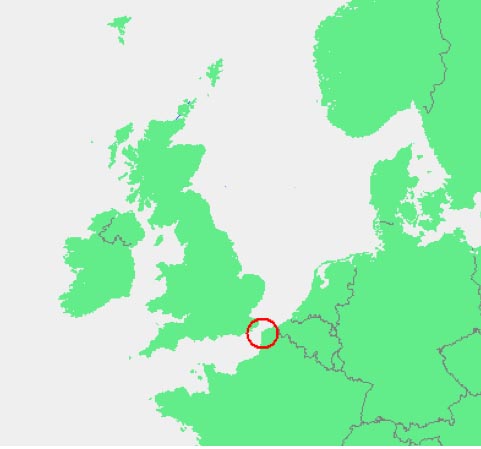
The epicenter of the 1580 magnitude 6 earthquake, right on the Gravelines site!
We are reassured by statements from Allègre, former minister:
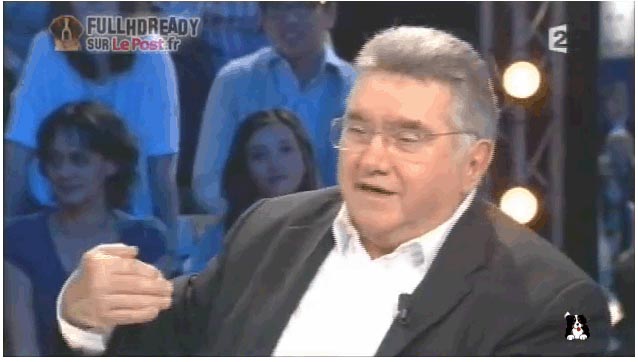
- We must stop walking on our heads. France is not a country with high seismic risk!
Seismic risk is one thing. It's impossible to rely on predictions in this matter. The earthquake that damaged the Fukushima plant was the strongest ever recorded in Japanese memory: magnitude 9. Similarly, the resulting tsunami was unprecedented in recent historical times.
But there exists a far greater danger linked to solar eruptions. It would be unreasonable to ignore it. Earth has recently experienced a surge in solar eruptions, as evidenced by those occurring on October 25, 2013:
http://www.journaldelascience.fr/espace/articles/soleil-connait-vague-deruptions-solaires-3295
The risk of a solar eruption comparable to the one in 1859 occurring soon—before new technologies emerge or a wise return to renewable energy changes the current situation—is not zero. The consequences for nuclear power plants would be incalculable. In comparison, Fukushima would seem like a minor incident.
Let’s recall the facts:
http://fr.wikipedia.org/wiki/%C3%89ruption_solaire_de_1859
The plasma jet affected Earth at very low latitudes (as far as the Caribbean). At the time, electrical industry was barely developed, limited to wired telegraphy. Yet telegraph operators were injured by violent discharges, and fires damaged transmission lines due to strong electric currents induced on the ground by the plasma jets hitting the upper atmosphere. In effect, nature gave us a small preview of the impact of our current EMP weapons (electromagnetic pulse).
When we consider the effects on these simple wired telegraph installations, we can imagine the impact on dozens or even hundreds of nuclear power plants.
We often hear: "There is no such thing as zero risk."
True, but in this particular case of nuclear energy—with consequences potentially spanning thousands or tens of thousands of years—can we really afford to speak like that?
Can we, regarding nuclear energy, accept a non-zero risk?
If the removal of fuel rods from pool number 4 can be successfully carried out, problems remain for units 1, 2, and 3. There is little visible solution here. These sites remain active. Witness the periodic bursts of radioactive vapor emanating from them, especially visible at night before the source was covered. And there remains the necessity to continue cooling these sites to keep temperatures below 50°C (though it should be noted that this heat release may have two sources: decay of fission products and energy released by new fissions linked to a possible re-criticality). In any case, as highlighted in a short video produced by Le Monde, Japan continues to discharge radioactive-contaminated water into the Pacific Ocean.
Technically, containing these leaks is then a problem that is more difficult to solve, or even impossible. The Japanese first dug a vertical trench, a "ditch," between the reactors and the sea, where they poured a reinforced concrete barrier in an attempt to block the spread of contaminated water toward the Pacific. Was this barrier deep enough? Did it crack? In any case, infiltration continues. Measurements confirm this. Subsurface water flows remain extremely complex. We’ve heard that one proposed solution would be to create a barrier where the ground is locally strongly cooled. This cooling would cause any liquid flow tending to reach the Pacific waters to freeze.
We have no information on the status of the reactor cores’ melting at units 1, 2, and 3. Have they penetrated the 8 meters of concrete beneath the vessels? If the corium remains active (temperature around 2500–3000°C), these concrete layers are extremely illusory barriers—the material vaporizes at 1400°C, descending at a rate of one and a half meters per hour. In a video whose link appears below, CEA personnel filmed the behavior of simulated corium (uranium-238 without fissile content), heated by induction. We clearly see vapor plumes lifting the solid crust—corresponding to the vaporization of concrete (we must remember that concrete is a solid material resulting from a hydration process).
If the molten core penetrates the reactor vessel, a pool of corium forms beneath it, presumably quite viscous—like "cow manure." If criticality conditions exist within this material, heat release will be maximal at the center of this "puddle." Thus, as the concrete vaporizes beneath the center of this viscous mass, it creates a cavity allowing the corium to concentrate in this depression, thereby becoming even more active and more "critical." We would have here a natural phenomenon of confinement and concentration of the core material.
This is the "
Chinese syndrome
," mentioned in a 1979 film with Jane Fonda, Jack Lemon, and Michael Douglas. According to this scenario, the corium—naturally concentrated—could continue descending indefinitely by gravity (the materials composing it are heavier than lead). It is not impossible that this process, now entirely beyond human intervention, has already begun at Fukushima. When this corium crosses groundwater layers or water-rich strata, periodic vapor emissions would result (though in the plant’s subsoil, there isn't strictly speaking a "groundwater table"—the entire subsoil contains water diffusely, geologists have told us).
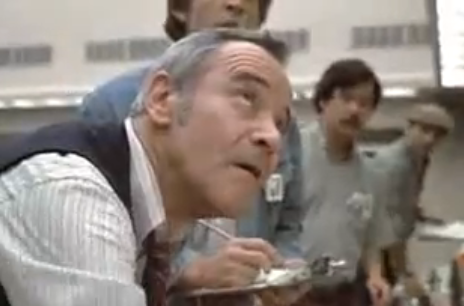
Jack Lemon, reactor construction engineer, listening to the vibrations of a cooling pump.
The process will gradually weaken over time as the potential energy in this mass dissipates and the fuel is exhausted. In normal reactor operation, the decline in available fissile material occurs within a few years. In corium, the process would be much slower. In reactor loading, we find 3% uranium, 7% plutonium if it's MOX. When the fissile material is uranium, we discharge when the U-235 level drops to 1%. At that point, heat emission is considered no longer "profitable." We discharge and replace fuel elements. But the question of "profitability" doesn't apply to corium, which would see its activity gradually decline even if fissile content fell below 1%.
Another observation: the presence of groundwater only worsens matters because, by slowing down emitted neutrons and acting as a
moderator
, it promotes fission reactions. This is what occurred at OKLO in Gabon, where water presence billions of years ago allowed ore (with U-235 levels still high, close to 3% as in industrial reactors) to achieve slight criticality, making OKLO a "natural nuclear reactor" operating for 300,000 years. This slight activity caused the residual U-235 percentage (0.72%) to exceed the standard 0.71%, corresponding to natural U-235 decay—this rate applies to all ores regardless of geographic origin. Moreover, the presence of certain elements and isotopic richness indicated this past activity.
A side note: supernovae create all elements heavier than iron found in the universe and on planets. All isotopes of different elements are created in similar quantities. Unstable isotopes disappear according to their various half-lives. Supernovae produce all possible uranium isotopes, including U-238 and U-235. The 0.7% remaining in ore corresponds to the half-life of this isotope. In fact, these are "half-lives." The half-life of U-235 is 700 million years, while that of U-238 is 4.5 billion years. Since the half-life of uranium-238 equals Earth’s age, we must consider that only half of what was collected at Earth's formation remains in ore.
Supernovae also produce plutonium-239. But since its half-life of 24,000 years is ridiculously short compared to planetary and geological ages, none remains on Earth. This isotope was artificially recreated (and discovered in the process) in 1940.
When Fukushima's coriums have "calmed down," a significant mass of solid or gaseous fission waste will remain in the environment around these cooled, solidified blocks. This waste will continue polluting the surrounding fluid environment for a time limited only by the half-lives of the radioactive isotopes involved—lifespans reaching 200,000 years.
When referring to the photograph of Chernobyl's corium, it did not experience re-criticality. Its temperature maintenance was due to energy release from the radioactive decay of fission products it contained. The time until this energy release becomes sufficiently weak for safe storage in a non-aqueous environment depends on the reactor type. This is why pools are located next to reactor vessels. After discharge, fuel elements remain submerged, and water’s high thermal conductivity, combined with convection currents, ensures natural cooling. After a certain time (I believe five years for uranium reactors and much longer for MOX or plutonium fuel), these elements can be exposed to air and packaged (possibly "reprocessed," extracting residual plutonium and byproducts). But they will continue releasing heat, even as it diminishes over time, due to long-lived fission products.
While the Japanese have focused on the most urgent task—securing the 1,300 spent fuel elements in pool number 4—a problem of comparable gravity now awaits them.
No one can say whether criticality has resumed in the corium of reactors 1, 2, and 3, or at what depth they might be located, or their level of activity. We can only hope that the observed heat release—inevitable—corresponds solely to the decay of fission products.
For now, the Japanese have tried building barriers in trenches to resist the spread of waste toward the Pacific. The latest approach involves locally freezing the water contained in the ground.
If this succeeds (for how long must this cooling be maintained???), engineers might again hail "the excellence of this new technique deployed."
But the best solution would be never to face such problems again—thus, never installing reactors near coasts, right at sea level. Even better: stop building new plants and shut down all existing ones!
Last spring, a conference was held at the École des Arts et Métiers in Aix, open to the public, given by a representative of the CEA. Organized by an association dedicated to nuclear development, its theme (hold on tight) was:
- Now that the situation is normalized at Fukushima, a status update on the restart of Franco-Japanese nuclear collaboration.
This single sentence reveals the level of nuclear irresponsibility among French officials.
In 2011, I closely followed events at Fukushima. I have no intention of doing so again for its decommissioning. TEPCO estimates it will take 40 years.
This event made us realize the inherent danger of nuclear energy, tied to the lasting consequences it produces.
A few kilometers from my home lies the village of Lambesc, devastated by a magnitude 6.2 earthquake in 1909. Forty-five dead, 250 injured, three thousand buildings damaged.
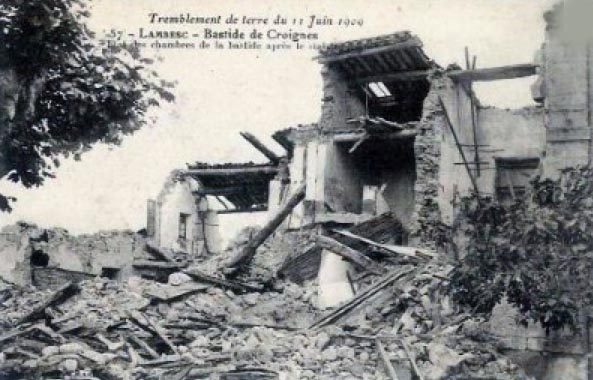
Lambesc, Vaucluse, a few kilometers from my home, in 1909
Less than a year later, debris had been cleared, and houses were being rebuilt. A few decades later, no trace of the disaster remained. The dead were buried, the injured were treated, and then died in turn.
All this applies to damage from any war. After World War I, northern France was nothing but a vast wasteland of ruins.
Debris was cleared.
The dead were buried.
Heroes were decorated.
The wounded were treated, and invalids compensated.
Monuments to the fallen were erected in villages of all belligerents.
We began rebuilding everything, even better than before.
Half a century later, no trace remained of that Great War—except vast areas left untouched, preserved for future generations. Monuments were raised, museums built.
The same applies to cities like Berlin, Dresden, Tokyo, completely devastated by bombing.
And today?
All these cities, all these countryside areas, have regained their vitality and prosperity.
But what about nuclear energy? That’s a different story entirely. Currently—and I’ll return to this with a substantial dossier—our nuclear enthusiasts, including those in parliamentary roles like MP Christian Bataille and Senator Bruno Vido, are concocting with the help of companies like AREVA, EDF, Bouygues, and the CEA, a future that is utterly nightmare-like, centered on deploying "fourth-generation reactors," otherwise known as fast breeder reactors using fast neutrons. Thus... Superphénix rises from its ashes.
Six weeks after being elected president, François Hollande signed the decree authorizing construction of such death machines’ prototype, ASTRID, at 600 MW. The Greens viewed this as compliant with their agreement with the PS, where "no new nuclear project would be launched." Yet precisely what ASTRID represents is a project aiming to deploy an entire fleet of highly dangerous plutonium- and sodium-cooled fast breeder reactors. But Hollande considered the agreement signed before his election by Sarkozy, thus not a "new project."
The Greens were either blind or remarkably foolish. Or perhaps their real aim, which is highly probable, is simply to gain seats, power, comfortable salaries, and golden pensions—just like everyone else.
http://www.cea.fr/energie/astrid-une-option-pour-la-quatrieme-generation
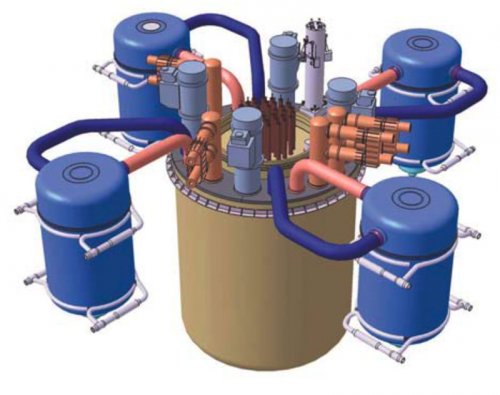
The ASTRID fast breeder reactor, sodium-cooled.
An article on ASTRID I sent to Mediapart a month ago.
No response.
This layout differs from the one we’ve been accustomed to for France’s 58 operational reactors. The reason is simple: everything will be located below ground level, making the nuclear installation less vulnerable to terrorist rocket or missile attacks. And it will also be more discreet. In brown, at center, the core, with its 5,000 tons of sodium, which burns on contact with air and explodes on contact with water. Around it: four steam generators.
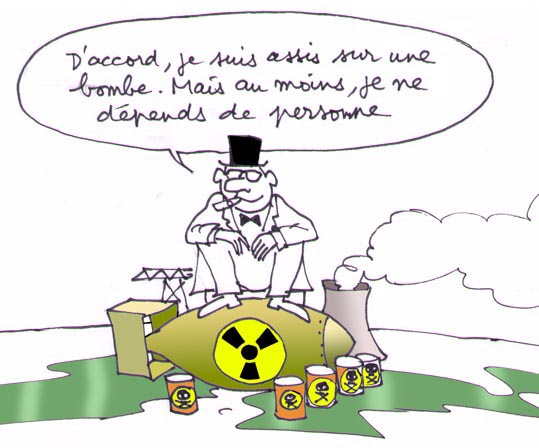
In 1977, sixty thousand demonstrators converged on the Creys-Malville site in Isère, coming from several countries: France, Italy, Germany, Switzerland. Five thousand CRS awaited them on a bare field where nothing could be damaged or destroyed. The demonstrators were met with volleys of offensive grenades. Michalon was killed when a grenade exploded against his chest. Another had a hand blown off, another lost a foot.
Today, the association Sortir du Nucléaire, uniting 900 associations (paying their dues), employs 14 full-time staff in Lyon offices and remotely manages "friendly" demonstrations where people hold hands in chains, shouting "No to nuclear!"—lamentable pantomimes.

Sortir du Nucléaire: emasculated, infiltrated, undermined. It organizes demonstrations with no effect and minimal mobilization. The French public remains completely uninformed.
I imagine a street interview:
- Sir, Madam, what do you know about the ASTRID nuclear reactor, which François Hollande authorized for construction immediately upon taking office?
Rather than dwell on the (perfectly real) shortcomings of the Japanese, I prefer to consider nuclear energy as a whole. For me, the question is clear: we must stop this race toward death and poisoning. Facing this, there are two policies:
-
Better manage resources, avoid waste, and massively develop renewable energies.
-
Explore pathways enabling clean nuclear energy via a boron-hydrogen aneutronic pathway, with no radioactivity or waste (no, the thorium pathway is not the solution. No, continuous fusion via ITER will not work).
ASTRID
(Advanced Sodium Technological Reactor for Industrial Demonstration) is a woman’s name. Obviously, we won’t call a generator LUCIFER or ARMAGEDDON.
What would emerge from another street interview focused on the EPR?
What distinguishes this EPR from our current pressurized water reactors, aside from being more powerful and vastly more expensive? Two things. First, they will be able to operate with 100% MOX fuel, thus exploiting fission not of uranium-235, but plutonium-238. And we have a lot of plutonium stockpiled thanks to reprocessing spent fuel, which produces it.
But that’s not all. Look at the drawing below:
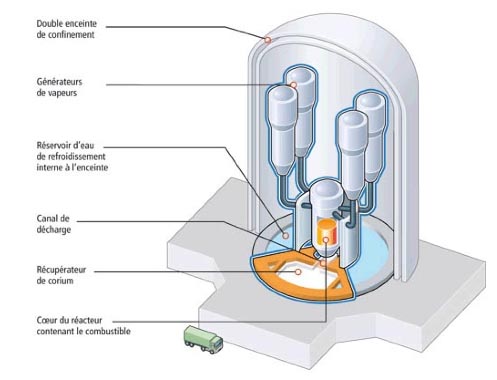
What do you see in yellow next to the large truck, which gives scale?
A corium collector!!
Isn’t that nice? In case of accident, if the core melts, it passes through the vessel but spreads into this basin. This spreading prevents criticality, the Chinese syndrome.
No one notices this. Year after year, I remind citizens of things they ignore, summarized by this curve produced by the Parliamentary Office for Scientific and Technical Choices Assessment. This is what we’re preparing for by 2100.
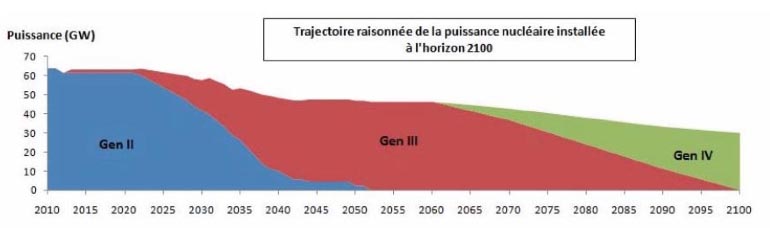
In blue: currently operating reactors. In red: EPRs, running on plutonium, labeled "Generation III," and in red again: fast breeder reactors, running on plutonium and sodium, with ASTRID as the "demonstrator."
Changing the figure’s title to "irrational trajectory" would still be far below reality. This project is managed by dangerous lunatics. But who will stop them? The Greens?...
August 12, 2011:
The corium.
Here are two excerpts from a website dedicated to tracking Fukushima events, approached from a strictly technical angle. They contain impressive data. Excerpt:
- Corium Progression
Referring to a study by Oak Ridge National Laboratory discussing a similar accident scenario in a boiling water reactor like those at Fukushima Daiichi, we know that it takes 5 hours for the core to lose water coverage, 6 hours for melting to begin, 6.5 hours for collapse, 7 hours for the vessel base to fail, and 14 hours for the corium to penetrate an 8-meter concrete layer at a rate of 1.2 meters per hour (5). We can reasonably assume that the reactor 1 vessel at Fukushima Daiichi was penetrated by corium as early as the evening of March 11, and this incandescent paste had passed beneath the slab by March 12, 2011.
http://fukushima.over-blog.fr/article-le-corium-de-fukushima-1-description-et-donnees-81378535.html
http://fukushima.over-blog.fr/article-le-corium-de-fukushima-2-effets-et-dangers-81400782.html

Excerpt from a video produced by the Japanese Ministry of Industry
Illustrating the process of core melting and vessel penetration

On the left, the glowing vessel base. On the right, a pool of corium on concrete

The corium (1500–2500°C) melts and vaporizes the concrete (which withstands only 110°C), sinking into the cylindrical pit it carves in the concrete.
The escaping smoke indicates the concrete’s gasification due to heat.
Another excerpt:
The worst case would be if corium entered or became trapped in concrete or soil, which would not only offer the best possible form to preserve its integrity and increase neutron recovery, but also make the mass, in effect, inaccessible and thus impossible to cool.
This scenario appears to be occurring currently at Fukushima for at least one reactor (unit 1). Hence the idea of building an underground enclosure to limit radioactive dispersion into the soil. But TEPCO, a financially drained private company, seems uninterested in protecting the environment, as this project, if submitted to shareholders, would likely be rejected due to excessive cost.
During the Chernobyl accident, the Soviets had not hesitated to build a concrete slab beneath the reactor to prevent corium descent. Why didn’t the Japanese do the same? Perhaps due to cost, perhaps due to water presence, perhaps because it was too late?
In the following video, you’ll find footage from the Vulcano experiment conducted under the auspices of the Institute for Radiological Protection and Nuclear Safety (IRSN), studying the effect of corium heated to 2000°C on a concrete support. The experimenters recreated the corium composition by mixing uranium-238 oxides (non-fissile) with zirconium cladding debris, melting the mixture and heating it to 2000°C via high-frequency induction. The slow boiling you see corresponds to gas release resulting from the concrete’s attack by the corium. You are thus witnessing what may be happening beneath Fukushima’s reactor foundations if the concrete is attacked by a mass of corium whose high temperature is sustained by fission reactions with some criticality. This would only occur if sufficient corium had leaked from perforated vessels—quantities impossible to assess without direct access. But initially, the amount of corium from these reactors is far greater than that from Chernobyl. As detailed in the linked articles, once concrete melting begins, the corium "self-confining" and its descent into this material, potentially reaching 1.2 meters per day, becomes unlimited. At the end of the video, you clearly see how the corium sank into concrete it had vaporized. This invalidates a statement by a French ASN (nuclear safety authority) official who said, "Don’t dramatize. There’s still 8 meters of concrete!" A remark devoid of relevance.

Concrete gasification by corium at 2000°C
http://www.irsn.fr/FR/popup/Pages/Experience_Vulcano.aspx

Excerpt from a Japanese documentary, uncaptioned, describing the plant’s construction:

" When people built cathedrals...
.."
Bernard Bigot in video: "Without trust, there is no possible future"
http://www.dailymotion.com/video/xatls0_bernard-bigot-et-les-dechets-nuclea_news
We could reverse the statement:
"With such a problematic future, trust is impossible."
News
Guide (Index)
Home Page