On Heroism
On Heroism
December 13, 2008
I just watched, on DVD, the film by the excellent actor Russell Crowe: "Master and Commander: The Far Side of the World" (two Oscars in Hollywood). Aesthetically, the "rendering" is very successful. The action takes place on an English warship, the HMS Surprise, in 1805. As it is said in the first minutes of the film, Napoleon has become master of Europe. Only England resists and is under the threat of an invasion. It can oppose the little Corsican only thanks to its mastery of the seas, which remains intact. And this mastery, it must keep it at any cost. The French have built line-of-battle ships, of high rank, and have sent them to attack all the seas of the globe. One of them is a frigate of 44 cannons, the Achéron. The English have received orders to try to intercept and sink this ship, on its way to the Brazilian coast.
Note in passing: this film is inspired by a novel by Patrick O'Brian, which features Englishmen and a ship ... American, the USS Norfolk. However, to be accepted by an American audience, in the context of the USA-Iraq war, the director replaced it with a French ship.
In this revised version, we learn throughout the story that although the English have spies in the French admiralty, the reverse is also true, and when the story begins, it is the Surprise that almost falls into the trap set by the French ship, apparently perfectly aware of its route plan. The images of the film represent an absolutely fantastic reconstruction of the atmosphere of naval confrontations of ships from this era. We already knew the comic series by Bourgeon "Les passagers du vent" (Casterman), which are part of my personal collection of the best comics. If the images are so successful, it is because the director used an American three-masted training ship, an exact copy of an English ship from 1800. The American midshipmen are very lucky to be able to sail on such a marvel.
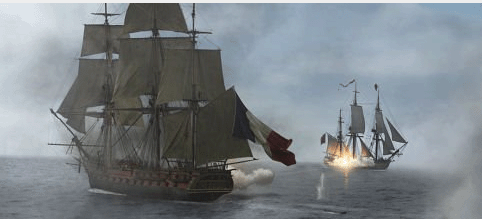
On the left, the frigate Achéron, on the right, the English ship Surprise
Look at the image above. It is worthy of one of the best paintings in the Marine Museum of Trocadéro, which is one of the most beautiful in the world, along with that of Gothenburg, Sweden. It is indeed beautiful. These gestures are indeed "heroic". If you go see this film or rent the DVD, try to watch it with eyes other than those of a spectator who is entertained. We have before our eyes images of war, which are meant to be realistic. A specialist would say that the atmosphere on board a line-of-battle ship of that time was probably closer to that evoked by Bourgeon in his comics than in this spectacular film. The story tells us that life on board was extremely harsh, that the crews were kept under iron fists. Hierarchy, discipline, very severe punishments for the slightest infraction (whipping, the "great hold," evoked by Bourgeon). In the film where Crowe plays Captain Audrey, the atmosphere is good, the supervision is friendly, from the second officer to the master at arms. One would think of an English school led by a friendly staff. The sailors are patriots who follow "Jack the luck," their brave, daring, and always victorious captain "who always wins in the end."
You will see how, thanks to his daring and intelligence at sea, he manages to defeat a ship of 44 cannons, while he only has 27, to capture a French line-of-battle ship commanded by a crew twice as large as his. A powerful, fast ship, with a very resistant hull, "two feet thick," and with a cannon range far superior to that of the Surprise.
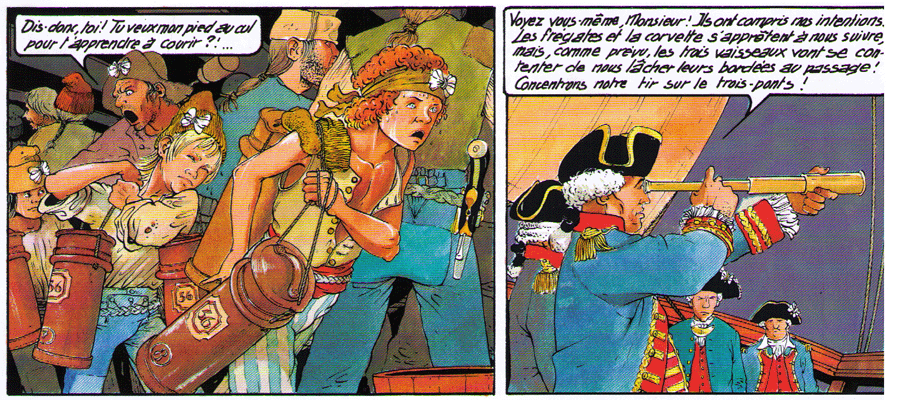
You will see, and it is perfectly authentic, that these warships carried children on board, from young sailors (the "mousses") to child officers (the midships). Below is an image (page 32 of the first album of the series, titled "La fille sur la dunette") showing the mousses carrying the gunpowder charges for the cannons.
The young officers can be found in the film. One of them is the son of a lord of the British admiralty. How old can this blond Lord Briteney be? Twelve, thirteen years old? If you follow these images, you will see that many members of the crew are fourteen or fifteen years old. In this war navy, a man of twenty is already experienced. A man of forty is a ... miracle. At the first engagement, the English ship, surprised, is hit by a French fire that kills nine men and injures 27, including this young lord who is wounded in the arm. The ships exchanged shells of different calibers. Those handled by the English gunners are 18 cm in diameter. But the calibers could be much larger. The action on Bourgeon's albums takes place on a three-decker armed with 74 cannons. Under sail, such a unit would completely hide the Arc de Triomphe of the Place de l'Etoile. Eight hundred men on board! The aircraft carrier "Foch" of that time.
These ships are made of wood. When these shells hit, they launch thousands of wooden splinters capable of inflicting terrible injuries. It was by two splinters of wood that the young lord was wounded in the arm, which would be enough to cause his amputation. Who can imagine being on board one of these ships during an engagement? The scenes described in the film are relatively discreet. The English seem to ignore fear, keep smiling. Bourgeon's writing is more brutal. During these battles, limbs were flying. Entrails spread on the floor. In the very heart of the battles, medical teams operated. The doctors sawed off arms and legs in series. Antibiotics ... did not exist. In the film, the wound on the young lord's arm becomes so bad that amputation is decided. We witness it. Finally, if one can say so. The young lord is very brave.
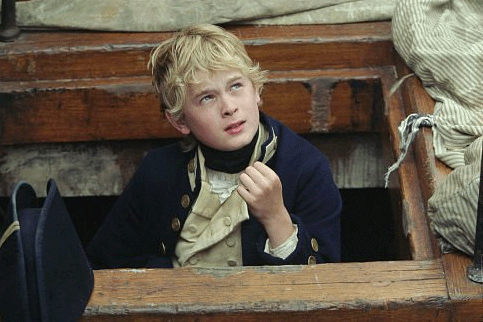
Lord Briteney, midshipman, soon to be an amputee
But, very quickly, Lord Briteney junior regains control. Even convalescing, sitting in his hammock, with one arm missing, he keeps smiling. Captain Audrey, who visits him, offers him a book about the life of Admiral Nelson, a great English hero. In the continuation of the film, the blond child never leaves his angelic smile. Then the spectator says to himself, "losing an arm during a naval engagement, when you are twelve, must not be so terrible, since this boy keeps his irresistible smile." Later, we will see him follow the doctor during his exploration of the Galapagos Islands, already converted to Natural Sciences.
In the continuation of the story, we will see him participate in everything, and even in the battles, with one arm missing. During the final confrontation, boarding is planned, with what one can imagine: a merciless fight in a confined space: deck, lower deck. From the yards, soldiers fire, throw grenades. Grenades are also thrown through all the openings, but the cameraman does not show us the devastating effects in such confined spaces. The cannons did not only fire cannonballs. At short range, they were loaded with shrapnel and all sorts of gadgets, which you can find in museums, ...