Eight Days Elsewhere
May 25, 2010
Where am I? Where are we? Anywhere, at sea. A cabin, a large bed, the engines' muffled rumble lulling us. Five days of doing nothing but sleeping, resting, gazing at the endless sea. A complete break.
We're on our way back. I've recharged the batteries a bit. I needed to.
Inside the cabin, there's a TV. An object I've grown unused to. I turn it on out of curiosity. The only French-language channel aboard: TV5. I flip through casually. A Drucker show, champion in the art of polishing the brush. Everyone's beautiful, everyone's kind. Tonight's feature: the Air Force. Everything's covered, from recruitment to the war mission in Afghanistan. Reality TV. Everything, except the unaskable question: "What are we even doing there?"
A young officer gives the answer, as if memorized:
"I am convinced we are here to help Afghans build their country, establish a lasting democracy, implement an educational system, a public health service. That's why I climb into my fighter jet, to fulfill my mission of supporting ground troops."
It's beautiful, moving. The golden shoulder boards gleam under the studio lights. The dark blue uniforms are impeccably tailored.
Drucker, addressing a young woman dressed head to toe in khaki:
"So, you're a sniper, Miss. What does that entail?"
"Well, aboard the helicopter, I'm the gunner for a machine gun, ready to respond instantly to any hostile target, any enemy."
A spotlight hits a young pilot-officer, a 38-year-old man flying a Mirage 2000 armed with a nuclear-tipped missile. (We still don't have a female pilot in this role, but that won't last long.)
"What's it like being aboard an aircraft carrying a nuclear missile? And who, first of all, would authorize launching such a nuclear strike?"
"It's the President of the Republic, who, as you know, is the Supreme Commander of the Armed Forces. If he gives the order, it's because all diplomatic efforts have failed, and this strike remains the last resort to defend the nation."
"And where are you based?"
"Istres."
"How many aircraft are equipped with this ultimate weapon?"
"Two Mirage 2000s, on twenty-four-hour alert."
Picture Nicolas Sarkozy launching a nuclear strike. How can one, with a little finger pressed against the seam of one's trousers, be ready to die carrying out a mission of absolute monstrosity, under the orders of a "People's President," a figure of incomprehensible vulgarity?
The brain replaced by a program
Interlude: Singer Sardou, gesticulating, sweetening strawberries, a has-been of song and everything else, takes a ride in a Mirage 2000. He returns "transported," declaring:
"If I hadn't pursued a singing career, I'd have joined the Air Force. These young men are fantastic!"
A glimpse into the selection of pilot candidates drawn "from the masses of youth." Fourteen candidates. Often just high school graduates. Cold speech from the base commander welcoming them:
"Do you know how many were selected from last year's group of thirteen?"
The naval aviation cadets fall silent. The commander replies, squinting:
"Four."
The young candidates shiver. It feels like Top Gun. At the end of training, after selection, four young pilots are sent to the U.S. for specialized training at a base designed exclusively for military pilot training. They feel they belong to an elite. They are the best. Among them, a young woman, elegant in her navy-blue and white naval aviator hat. Exciting, isn't it? A future killer?
The audience shivers. The carefully made-up young woman smiles and says:
"We are constantly preparing for the possibility that one day the aircraft we fly will be armed, and we may be called upon to use them to carry out the missions assigned to us."
The viewer shivers. Michel Drucker shivers. Michel Sardou shivers. How beautiful this youth is, ready to spill their blood for the country, to douse "insurgents," "rebels," with a deluge of shells, napalm, fragmentation bombs, or even nuclear charges on orders! And how televisual it all is! A splendid, highly successful show.
Of course, because in Afghanistan, everyone knows, we're there solely to serve the French Nation, nothing else, to remain faithful to democratic and humanist ideals, very much our own, to contribute to France's global influence, maintain its standing among nations, demonstrate its strength, its determination.
I recall that in our UFO-science association, we had to part ways with a 31-year-old man who had mistaken our 1901 for a milk cow. He, too, had been part of a group of candidates to become a fighter pilot, but, to his great disappointment, hadn't been selected. I had asked him:
"Would it have bothered you to one day be piloting a fighter jet armed with shells and missiles, ready to drop them without hesitation on a target designated to you?"
"I'd rather do that than live a mediocre life."
Fortunately, our paths diverged. For me, the epitome of a mediocre life is precisely abandoning all moral judgment of one's actions, leaving that assessment to a hierarchical authority. Likewise, the epitome of a mediocre scientific life is using one's intelligence and knowledge in the service of the military.
Back to Afghanistan. Forty-five young Frenchmen have already fallen there, "on the field of honor." In addition, how many amputees, disfigured faces, severe burn victims? You calculate the numbers.
In this Drucker show, an emotional truth segment. This time, we're not in the Saint-Dizier base, painstakingly turned into a TV studio, but in Afghanistan. Two pilots prepare for a ground support mission in a Mirage 2000. Drucker stays in the background, listening to an officer's commentary "to avoid distracting the crews." The tone grows serious. Drucker says:
"We're about to see them depart, and this time, we won't be envious of taking their place."
All this, this entire media circus, reminds me of Algeria in the late 1950s. At Supaéro, we had a military training program, even though the school was supposed to train civilian pilots, and a military office headed by a colonel, an old man from the Normandie-Niémen group. According to a friend who lived through that era:
"Your colonel was too high-ranking not to be given command, but too stupid to carry it out properly."
That became obvious quickly. He was assisted by a red-faced sergeant, caricatured to the extreme. It was he who took us to shoot at the Issy-les-Moulineaux range, which I've already mentioned in another file. A building now destroyed, to erase an inconvenient trace, during the era of France-Germany reconciliation managed by de Gaulle and Adenauer. This shooting range served, throughout the war, as a place of execution for people brought from nearby Lauriston Street, where the French Milice tortured resistance fighters. The site also functioned, as early as 1942, as an experimental gas chamber capable of processing 200 people at once with Zyklon B, whose bodies were then incinerated in the chimneys of the nearby, now vanished, thermal power plant.
At Supaéro, we could easily obtain scholarships to learn to fly. I started on sturdy Piper Cubs from World War II, flying at 90 kilometers per hour, without radios.
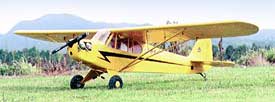
A Piper Cub
But those who wanted to and showed some aptitude for flying could join the "PN group," the "Navigating Personnel" group. They flew on fabric-covered biplanes Stampe, sleeker to handle, capable of performing every possible acrobatic maneuver.
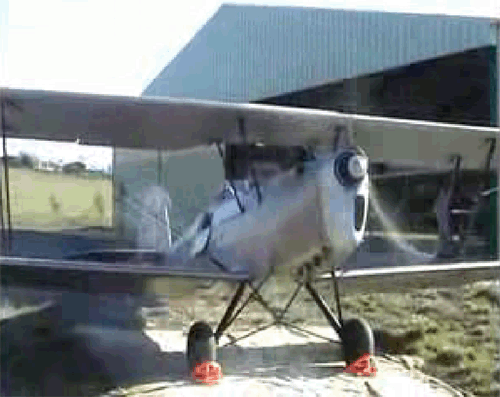
A biplane, two-seater Stampe
A Stampe. Click to see it in flight
We were five or six in this group. All students at the school flew from the Guyancourt airfield near Paris.
One day, a young man showed up. He weighed about 60 kilograms, but his khaki jacket, covered in patches, gave him more bulk. He was an "old-timer," a couple of years older than us. I imagine he came to Guyancourt out of nostalgia, or perhaps because he had no girlfriend in Paris to keep him company during his leave.
He had short hair and a dull eye, like a young man who had prematurely aged.
-
Where are you from?
-
In AFN.
-
And there, what do you do?
-
We fly T6s and conduct strafing runs on the fells.
-
What's strafing?
He looked at me as if I were a fool.

An American training aircraft T6, used during the Algerian War. Under the wings: 12.7 mm machine guns
-
The T6 carries 12.7 mm machine guns. With that, we strafe the Fells, and also drop special canisters on the mechtas where they hide.
-
What are the special canisters?
-
Napalm.
-
But how do you know they're Fellaghas?
-
There, it's all Fells...
It was spring. Before us, the graceful yellow Piper Cubs were performing circuit after circuit.
Back at school, located at the time on Boulevard Victor in Paris's 15th arrondissement, I told the others in the PN group:
"Hey, guys, did you know that after our training on the Stampe, we'll be sent to North Africa to fly T6s?"
"Yeah, we know, and so what?"
"That means we'll be sitting in an aircraft equipped to kill people, about whom we know nothing. All of us are utterly clueless about politics. At best, we know Algeria is across the Mediterranean. Here, after our years of being underground, we're just focused on decompressing, chasing girls in the Latin Quarter, and going to parties."
"Well, where are you going with this?"
"Has it never occurred to you that we might be ordered to shoot at people, when we don't even know why we're there?"
"You're overthinking it. We're going to fly."
"Then you'd do anything to fly! I'm sorry, but I refuse to fight a war I don't understand. Tomorrow, I'm resigning. I'd rather spend my free time flying after my service is done."
The next day, I was in the colonel's office.
-
So... you want to resign from the PN group? You're a good pilot, according to the instructors.
-
I've discovered a passion for communications, and I'd like to be assigned to that branch.
-
Well, if that's your decision.
A page written five years ago
The sun has barely risen over the deserted sea, visible through the large window. The day before, the 20-meter-wide ship passed through the Corinth Canal, which in the 19th century turned the Peloponnese into an island connected to the rest of Greece by a few bridges. A detail: the canal is 21 meters wide. The ship, towed by a tugboat, slowly passed—five meters per minute—between two steep walls. The maneuver was delicate. When the 145-meter-long vessel, modest compared to the floating skyscrapers now cruising the world's oceans with thousands of tourists aboard, engaged its engines to help the tiny tugboat attached to the bow by a fifteen-meter rope, it sucked water in along its hull. Since the distance between its hull and the rock wall was only fifty centimeters, the Venturi effect tended to press it against the cliff. The system was unstable. The tugboat pilot and the ship's captain had to constantly perform coordinated maneuvers to keep this massive object aligned.

On the left, between the ship's hull and the wall: 50 cm
This passage will leave a dent several meters long on the forward port side.

You can see the ship is no longer aligned. Ahead, the tiny tugboat struggles to reposition it.
More information about this cruise
At Supaéro, we had a teacher with blue blood: Baron Hugues de l'Estoile, an old French family. A long name, but a Parisian "titi" manner of speaking and unflinching vulgarity in speech. Very well connected in arms sales. One day, he gave us a partial exam topic. The theme was: A bomber carrying a nuclear weapon must perform a "stand-off" bombing maneuver.

Stand-off bombing with release during climb, followed by an Immelmann maneuver
The aircraft first flies over its target, a city, at high speed and low altitude. After passing it, it begins a climb. During the ascent, it releases its nuclear bomb, which then follows a ballistic trajectory close to a parabola. The bomber uses this moment to recover, at an altitude sufficient to allow time to take cover from the weapon's effects, which will reach the ground after a parachute descent and be detonated at a few hundred meters altitude to maximize effectiveness.
Out of seventy students, only two of us stood up and left the room, saying we weren't studying for three years to prepare for such "work."
Baron Hugues de l'Estoile watched us leave with a look of bovine incomprehension in his eyes.
Afghanistan resembles Algeria. This war is impossible to win, for several reasons. The first is geographical. The country is mountainous. Roads wind through narrow gorges, perfect for ambushes. The Russians learned this the hard way. Afghans know the terrain like the back of their hands; outsiders do not. Next, there's no way to distinguish a Taliban ready to use an anti-tank rocket or missile from a simple farmer using his hoe. The Russians lost 320 heavy Hind helicopters, whose armor could withstand frontal 20 mm fire, destroyed by the light Stinger missiles used by the "insurgents."

Heavy Russian Hind helicopter. The Taliban destroyed 320 of them using Stinger missiles
(visible at the Brussels Aviation Museum)

A Taliban "insurgent" shouldering a Stinger
The third reason is the impossibility of winning over Afghans to the Western cause, to the project of establishing a "democracy" in the country. Like the FNL troops in Algeria, the Taliban represent a merciless, deadly threat to "collaborators."
There's a Russian film I have a DVD copy of, illustrating the final months of the Soviet occupation in Afghanistan, before the complete withdrawal of troops. Everything is shown: a troop transport is destroyed shortly after taking off from Bagran by a missile. We witness a typical ambush in a narrow road. A deadly operation, followed by the attackers' retreat through tunnels carved into the rock centuries ago, where Russian soldiers dared not follow.
Before the Russians, it was the British who lost their "Afghan wars" in the 19th century. The British retreat during the winter of 1842 was a true disaster, and of the 4,500 soldiers involved, only a tiny fraction reached Jalalabad. In these Anglo-Afghan wars, the words that keep recurring are
chaos
and
quagmire
.
The Russians, who invaded Afghanistan in 1979, suffered the same fate and had to withdraw in 1989.
Today, Westerners rely on their night-vision systems and drones to dominate the terrain. Every day, a unit of pilots stationed in Virginia launches drones that slowly patrol the Afghan valleys, almost silently. Occasionally, a pilot, chewing gum, a beer in hand, spots on his screen a man in a black turban and black beard, digging a field twenty thousand kilometers away. Nothing looks more like a hoe than an AK-47.
- With that face, he's definitely a Taliban...
He presses the red button on his joystick. The electrical signal is relayed by satellite, reaches the valley. The small machine fires a missile. Red flash, explosion. Taliban or... collateral damage.
- Well, let's kill them all; Allah will recognize His own.
A war with zero casualties, fought from Virginia. The future...
Obama sent thirty thousand new soldiers to Afghanistan, for a limited time. "After that, kids, we go home."

After that, we go home...
This guy is a fool, he's had enough. Revisit the analysis of
his speech to West Point cadets in December 2009

.
I promise you that veterans, especially the disabled,
will be treated better than those returning from Iraq
No need to look far. There are N videos discussing what's happening "in our great ally, Pakistan": the "Talibanization" of the country. Attacks are multiplying. Four thousand civilians have already died in Pakistan. The government survives only thanks to American money. In reality, it's the military who hold power, and within the army, corruption is unimaginable. Do you remember
the Karachi attack
that killed 14 French citizens, including eleven engineers involved in arms construction in Pakistan? Do you remember Minister of the Armed Forces "MAM," Michèle Alliot-Marie, coming to comfort the families?

Michèle Alliot-Marie comforting victims of the Karachi attack
blamed on the "Al Qaïda nebula." The "heartbroken minister" version.
That nebula is indeed nebulous. We suspect it might have been a warning shot from Pakistani military figures, due to untransferred campaign funds intended for Edouard Balladur's election!

The "brave" Edouard Balladur
Pinch me, I must be dreaming...
Pathocracy.
You wonder why "news" brings its daily dose of absurdity. Some say you can't govern without getting your hands dirty, that it's impossible to hold a high office without a minimum of Machiavellianism. If that's true, then this position inevitably leads this oligarchy, this "France from above," to gradually lose contact not only with citizens' interests, with "France from below," but with any moral sense. When the transformation is complete, the adage "power corrupts" applies—madness. The entire world is under the control of an oligarchy we can call
pathocracy
, government by the mentally ill, convinced they have no other choice. And this applies to all countries. Religious leaders are no better.
One morning, a secretary of Michèle Alliot-Marie must have said to her:
"Remember, at 3 PM you must comfort the victims of the Karachi attack."
"Oh, right. You're right to remind me."
So, Madame Minister opens her closet and searches for the right mask—not smiling, that one. The "grieving mother" mask. She puts it in her bag, so she won't forget. She mentally notes:
"3 PM..."
"Madame..."
"What now?"
"Don't forget the box with the Legion of Honour medals. I've prepared everything."
The Minister rolls her eyes.
"Oh, right, I was about to forget the Legion of Honour..."
Now, we dine with a retired geologist, former teacher at the French Institute of Petroleum, talkative, amusing, cultured, always with a story on his lips. He doesn't understand why I haven't closely collaborated with the military.
"But after all, that's where the money is! When you work with the military, you have everything—funding, equipment. I participated in developing infrared cameras for ground animal detection, and I received all the help I needed."
"Animals, or people..."
"Yes, but that's not your problem. It's theirs. After that, what they do with it, you don't care."
"Imaging is where blood is least visible. There are more direct applications for killing. For example, MHD, where all applications are 100% military. At the September 2008 international conference on High-Power Pulsed Systems in Vilnius, 80% of the presentations dealt with rail guns, which will one day replace all types of cannons, whether naval or anti-aircraft. At one point, an American even presented his work: a new type of MHD bullet. It's the successor to the "Tazer," but wirelessly, with far greater power. The projectile carries an explosive charge that generates a powerful electromagnetic pulse when fired upon impact, compressing a magnetic field. It's a miniaturized version of the flux compression systems invented by Andrei Sakharov in the 1950s."

And the American speaker concluded his talk with a big laugh.
"With this, when you unplug a man, you don't have to clean up the blood on the carpet afterward!"
I stood up and went to draw in my room.
Science without conscience is only ruin of the soul
But which scientist today still has a conscience?
I watched an interview with Strauss-Kahn, President of the International Monetary Fund, conducted by journalist Arlette Chabot. If this person becomes our future president, we won't gain much. On speculation against the euro, he offered this response:
"Speculation isn't the heart of the problem. If countries managed their finances properly, there would be no speculation."
What kind of fairy tale is that?
On the loan system, see
my comic strip on the fate of the island of Santorini
, a highly probable story reflecting the Greek economy.
When will citizens around the world finally understand that there's no longer an economy, only finance? The planet is ruled by the crook and the phynance stick. We worry about the health of the markets. Stock index displays resemble temperature readings. The UK has already quantified its cuts to social budgets and implemented its austerity plan. In her annual address to Parliament, the Queen Mother set the tone: "fight the deficit and aim for growth."
I'm preparing a press conference I'll give in Strasbourg on June 9, announcing
the "Science-UFO" conference organized by Michel Pradines.
In very violent attacks posted on an Anglophone site:
http://lucianarchy.proboards.com/index.cgi?board=general&action=display&thread=7859
an anonymous participant, signing as Garuda, claimed that a former GEIPAN official had stated he believed Pradines capable of fleeing with the ticket sale revenues.
A former manager of the French official GEIPAN stated "(the organizer) is a mythomaniac who could run away with the revenue of ticket sales."
Pradines then questioned Jacques Patenet, now retired, who is the only "previous responsible" for GEIPAN, since Yvan Blanc was only the second. The response was immediate: No, he never said such things. But Patenet quickly added he doesn't wish the content of his email to be reproduced.
Thus, the entire story was just a fabrication aimed at sabotaging this conference project. Who lies behind this sordid, dishonorable maneuver? I'd really like to know. If responsibilities can be established, with proof, the names of the perpetrators will be displayed on my website in large letters. If they're responsible for a UFO association, that group will instantly lose all credibility.
I think I'll prepare to publish Amos Oz's book, "Voices of Israel," first published in the Israeli newspaper Ha'aretz, then as a book in 1983, with the French edition by Calman-Lévy.

The book, out of print, is no longer available except on the secondary market, where I managed to acquire it. I asked the publisher if they planned a reissue. No reply.
The book contains very heavy passages. The author interviewed a wide range of Israeli citizens. One of them wished to speak under the pseudonym "T." In the second edition, the author notes that many intellectuals questioned the existence of such a person, who openly claims "Judeo-fascism." He replies that Mr. T does indeed exist, but still wishes to remain anonymous.

A year ago, through his French publisher, I asked Amos Oz if he planned to reissue his book, and whether, after twenty-seven years, it seemed ethical to continue shielding this Israeli citizen under anonymity. I asked if the man was still alive and able to express his wish to remain anonymous.
No reply.
I believe my readers should become familiar with this book's content, and unless formally prohibited by the publisher or author, I plan to present it on my site as a series of chapters in PDF format. As of today, I'll resend my requests to Calman-Lévy with registered mail and receipt. Even though the book dates from 1983, I believe it will shed light on what must represent the majority of the country's population, on the essence of today's Zionism.
Regarding the book currently in production: Amber and Glass, finished two months ago: accumulation of delays due to file format issues and the Parisian printer's lack of responsiveness. I may have erred by announcing the release date too early. But everything will be done. We have the funds and are ready to pay for a two-thousand print run upon receipt. Shipments will then begin immediately.
I'll return to the Fishbird album with full force after this week of complete rest. Thank you to readers who pre-paid for the book. Their 200 checks are in a cardboard box and will be cashed at the time of printing (as a rough estimate, simple colorization in Photoshop represents a month of work).
New
Guide (Index)
Home Page
