Hypersoar
Hypersoar
January 20, 2003 – Note added May 25, 2004
Source:
http://www.fas.org/man/dod-101/sys/ac/hypersoar.htm
FAS stands for: Federation of American Scientists
Military-Grade Data Analysis Network
Title:
HyperSoar: An Unlimited-Range Hypersonic Aircraft
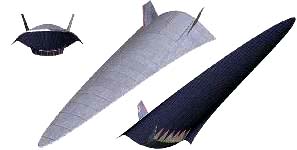
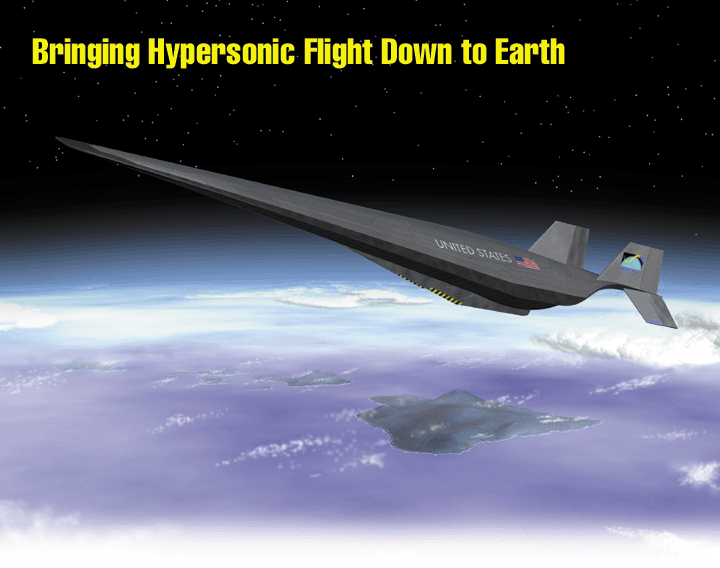
Below is an artist's rendering:
Remove the fins and you have... Aurora with its "duck tail."
About the size of a B-52 (...) the HyperSoar is an unlimited-range reconnaissance and attack aircraft, as well as a bomber capable of delivering its payload anywhere on Earth, operating at altitudes and speeds that immediately place it beyond the reach of any defensive measures. It can complete its mission and return to land on American soil without requiring mid-air refueling. The aircraft can function as a drone or carry pilots and specialized equipment. It can fly at approximately 6,700 miles per hour—about 12,000 km/h (Mach 10)—while carrying a payload roughly twice as heavy as that of an aircraft with the same takeoff weight. The "HyperSoar" concept involves significantly less thermal stress than previous hypersonic aircraft designs, a problem that until now has been a major obstacle to hypersonic development (the "heat barrier"). A Hypersoar would climb and operate at an altitude of approximately 130,000 feet (55 km). *It would then shut down its engines while flying at the edge of the atmosphere. *Restarting its air-breathing engines (how?) would allow it to make another leap into space, repeating this process until reaching its destination. It would thus travel in a manner similar to a stone skipping across the surface of water. A mission from the center of the United States to East Asia (Japan) would require about 25 such skips and would take just one and a half hours.
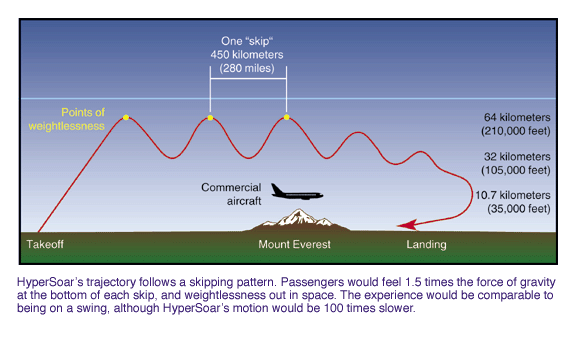
During these climb and descent phases, the aircraft’s angle of attack would be only five degrees. The crew would experience an acceleration of 1.5 g during the burns, while experiencing weightlessness in the upper portions of the trajectory. This level of acceleration is very mild. It would not discomfort passengers on a civilian flight, nor would it affect the aircraft’s performance as a weapons platform or orbital delivery system. In fact, the accelerations experienced by passengers during these skip maneuvers would be comparable to those felt by a baby being gently rocked by its mother—except that the motion would be 100 times slower. Although the primary goal of this project is to develop a civilian transport mode (...) with excellent safety prospects, there is also a military and orbital payload application. In most previously considered hypersonic projects, rockets were envisioned to carry the vehicle to the edge of space, from which point the craft would simply glide down to its destination (the X-15 being the predecessor of such vehicles). In other projects, jet engines were considered to attempt to propel the vehicle beyond the atmosphere. In all these designs, engineers immediately faced the challenge of extreme air temperature rise at the stagnation point and on leading edges. The HyperSoar would experience lower thermal stress because it spends most of its time outside Earth’s atmosphere. According to the HyperSoar vehicle concept, heat collected during atmospheric phases could be partially dissipated when the vehicle is in the "cold" of space.
JPP Note: This "cold of space" is relative. Outside the atmosphere, there is no energy loss through conduction. Only radiative cooling occurs. At very high altitudes, space is actually "hot" (2500°C), but extremely rarefied. Conduction plays no role.
The HyperSoar system uses engines that burn fuel with intake air. Most hypersonic vehicle projects have been based on rockets, and none considered achieving such speeds, nor this type of "skip" flight. Air-breathing engines have fundamentally better efficiency than rocket engines. Moreover, the HyperSoar would use its propulsion system only to provide acceleration, not for cruise propulsion. This would simplify the systems and reduce technical risks. Waveriders (vehicles riding on their shockwave) are designed so that the shockwave they generate remains fully attached to the leading edge of the wing at the intended Mach number of flight. This configuration creates a region of high pressure within the volume bounded by the shockwave and the wing surface, resulting in high lift with relatively low wave drag—i.e., high aerodynamic efficiency. Waverider vehicles also enable a uniform airflow into the upstream section of a scramjet propulsion system (supersonic combustion ramjet).
JPP Note: The performance claims for HyperSoar closely resemble those of the Aurora vehicle. The additional concept developed—already mentioned in my book—is that of "flight via a sequence of skips." However, the article then veers into misinformation when authors suggest the propulsion is scramjet-based and completely ignore magnetohydrodynamics (MHD):
This combination of a waverider configuration and scramjet reduces engine length and weight—important goals in scramjet design. For this American spaceplane, the chosen fuel is liquid hydrogen, which provides high specific energy, high combustion speed, and serves as a significant heat sink. Before being directed into the combustion chambers, the liquid hydrogen is routed through all parts of the vehicle subject to high thermal stress. The HyperSoar system has been under study for several years (...) at the Lawrence Livermore Laboratory (California), in collaboration with the U.S. Air Force and various government agencies. The LLL has also secured collaboration from the University of Maryland, which contributes to optimizing the vehicle’s shape and trajectory. Other potential applications of the HyperSoar system include orbital payload deployment. Studies show that orbital launch costs could be halved (I fully agree with this point). As a civilian transport, such an aircraft could connect any two points on Earth in less than two hours (i.e., distances up to 20,000 km).
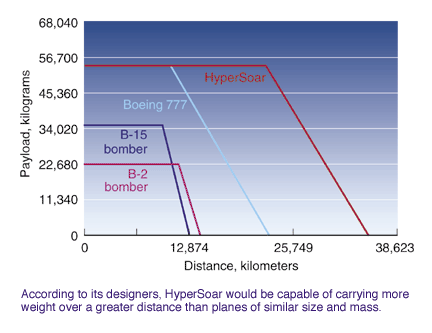
Distance Covered and Payload Capacity of Various Aircraft
One can see that...