Subcutaneous Implants: The Mark of the Beast
Subcutaneous Implants: The Mark of the Beast
December 19, 2003 - Added on November 17, 2009
December 19, 2003
This file dedicated to subcutaneous implants definitely needs updating. We all have in mind this passage from the Book of Revelation (Rev. 13:4-5, 16-17-18):
| They worshipped the Beast.... he was given a mouth speaking great things and blasphemies.. He forced all people, small and great, rich and poor, free and slave, to receive a mark on their right hand or on their foreheads, and that no one could buy or sell unless they had the mark, that is, the name of the beast or the number of his name. Here is wisdom. Let him who has understanding calculate the number of the beast, for it is the number of a man: six hundred and sixty-six. |
|---|
The microchip or microship is a long-standing project (over thirty years). Companies like IBM, General Electric, Honeywell, and Teledyn have worked on this project. This is what a microchip looks like:
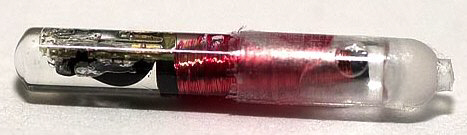
One of the problems is the power supply for such an object. Its consumption is low, and thus its power supply could be ensured by exploiting local temperature variations. These are most significant on the hand and on the forehead (...).
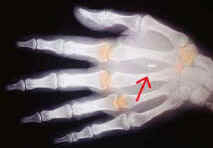
They are already commonly used to tag pets or racehorses. It is possible to implant these tiny objects, smaller than a grain of rice, using a simple hypodermic syringe, in body areas where they are difficult to remove.
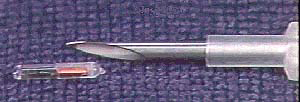
One can then immediately know, for example, the identity of a stolen horse, by using a simple reader. The next step is to consider implanting such objects in human beings. The applications are multiple. The chip can replace, internationally, an identity document. It can also store data specific to the individual concerned, masses of data of all kinds. These chips have 18-digit serial numbers, divided into three groups, resulting in 6-6-6.
The chip also allows tracking an individual via GPS, the Global Positioning System. Anyone can understand that in the era of nanotechnologies, these chips will see their dimensions continuously decrease, as was the case with computers. The pretexts for implanting such objects can be multiple. In the USA, there is a bill intended to authorize the implantation of microchips in children, from birth, "for identification purposes." Furthermore, under Article 100 of the 1986 Immigration Control Act, the President of the United States has the power to implement any form of identification he deems necessary, including a microchip inserted under the skin.
The company Applied Digital Solutions (ADS) already markets the subcutaneous chip under the names "Verichip" or "Digital Angel." Mexico, South Korea, Venezuela, Argentina, Colombia, Russia, the Caribbean islands, and the Dominican Republic are already contaminated by this trend of subcutaneous microchips. In Mexico, implantations are reportedly being performed on children. In Australia, banks and their staff have accepted the mandatory implantation of the microchip. New Zealand has also adopted the microchip. In Europe, the object has only just arrived "for animals."
Some luxury vehicles already have an anti-theft GPS tracking system. One of the propaganda methods in favor of implanting microchips in humans is the ability to prevent kidnappings, or to remotely track criminals, people with poor credit, or various types of patients, "at-risk individuals." But beyond this simple tracking, we must inevitably consider everything that can be done thanks to these microchips. Potentially, the microchip is also an antenna, of the same type as a mobile phone. But unlike having it in your hand or under your skin, you could have it... in your head. Its miniaturization would make its detection potentially problematic.
It has been demonstrated for thirty years that human behavior can be influenced by pulsed microwaves. These waves, pulsed at audible frequencies, are perfectly perceived by the brain, although the decoding mechanism has not been fully elucidated. At a subliminal level, conditioning can thus be operated. An implanted chip, possibly without the "target's" knowledge, would allow specific action on certain individuals or groups of individuals. Note in passing that simple mobile phones could be used to broadcast, hidden within users' conversations, subliminal messages for various purposes.
By coupling these receiver systems with large-scale projects like HAARP and its derivatives, we arrive at techniques that would allow acting, a priori, on very large human groups.
Father Ubu's brain-decorticator is already in gestation, just like the merde-hook and the phynance stick.
A site dedicated to the fight against the microchip:
http://www.geocities.com/nomicrochip/homepage.html
October 9, 2003:
Readers are reacting by pointing out various sites, such as this one:
http://sens-de-la-vie.com/Archepages/vsv_72_futur-cyborg.htm#Malaisie
I am like everyone else. I try to form an idea about the present and the future while trying not to sink into complete paranoia. It is certain that everything mentioned on this site is truly apocalyptic. But as a scientist, I can only say one thing: many of the manipulations mentioned are feasible. Nanotechnologies are currently exploding, or very close to doing so. They could bring immense benefits to humanity. But it is obvious that, like any new technology, there is a negative side, which these sites evoke. Unfortunately, one can say that when man has the possibility of doing horrors, he does them. As an example, I will cite what I already included in another file, referring to the abominable experiments of the Japanese Hi-Shi in a part of China invaded by Japan in the 1930s. What we learned from distributed documents defies imagination:
- We had realized that the best way to select strains for bacteriological warfare was to use the subjects themselves. If they died, it meant the strains were of good quality, virulent. Then it was enough to anesthetize them and take their blood. They served as natural bacteriological reactors. To better extract their blood, a soldier would jump repeatedly with both feet on the heart.
We also learned in this file, broadcast by Arte about a year ago, that the Americans, discovering these interesting researches, ensured the impunity of their authors in exchange for the non-destruction of their archives, and resumed these researches for their own account.
Yesterday, October 9, 2003, I followed, like many others, a documentary on the CIA where one of its former leaders, grilled by an investigation committee, finally admitted that CIA services had been behind 20,000 assassinations in North Vietnam, as provocation, to trigger the war, under Johnson (who allegedly said to a general: "Get me elected and you'll have your war"). A war that was lost and cost the lives of 55,000 Americans and one million Vietnamese. Another CIA member, "pragmatic," said, "But political assassinations have always been part of the game. Why be surprised?" Another said, "All political assassinations carried out by the CIA have always been done with the prior agreement of the President." Thus, the nice Kennedy would have given his green light for multiple assassination attempts directed against Castro, after the failure of the Bay of Pigs operation.
All countries in the world are hardly better. But what can be said of America is that there, planetary paranoia takes on a whole other dimension due to its technological capabilities.

American leaders are no crazier than others, but they have more means, particularly technological ones. All this is extremely worrying. The election of Schwarzenegger, "Robocop," as Governor of California is perhaps a symbol of "American anything-goes" (after Cowboy Reagan, the robot-soldier Schwarzie). I watched on television a report showing a complete follow-up of the California Government election, which was won hands down by "Schwarzie." He skillfully avoided face-to-face encounters of all kinds and awkward questions from journalists. Television channels pitted him against sidekicks, lamentable clowns. A dwarf, a child, an old man, a porn actress. These were not aiming for election but simple personal publicity. In France, we already have a poor idea of what is called "politics." We see people "indicted" for very embarrassing cases, linked to "fictitious jobs," reappearing shortly after as spokespersons for a political party (Alain Juppé). Elsewhere, it is a convicted criminal, Carignon, who runs again after having "served his sentence," spent several years in prison, and who is quietly re-elected. One thinks one is dreaming. Or else it is a nightmare comparable to the film "The Matrix."
Where is reality? Will a person, after showing you "the inside of the cards," ever say to you:
Welcome to the real world.
I think of Thierry Meyssan who told me, "In truth, I no longer know quite what to do." One feels overwhelmed by events. It remains that the United States took a significant step: launching a war without the approval of the Security Council by invading Iraq. And this while investigators sent on the ground failed to find the slightest trace of facilities intended to develop "weapons of mass destruction." Nothing... That doesn't look good. And it is all the more ridiculous when one sees Bush asking for help because this war is starting to cost him dearly.
History is unfortunately very human. It is written by men, until proven otherwise. In a lifetime, a human being happens to do... anything. Perhaps this is what is unfolding before our eyes right now. It is the rise of a kind of generalized paranoia. On one side, war operations are launched somewhat haphazardly. On the other, legions of suicide commandos are launched. When religious convictions get involved, hello. I was reading an old article from Le Point, dedicated to Jewish settlements, where a settler evoked a part of the law that forbids Jews from leaving their land. A land they abandoned for more than seventeen centuries. How can one hope to find any rationality in this conflict?
We are all responsible. All states are responsible, but no one wants to pay the price. No state wishes to send its soldiers here or there to prevent things from degenerating. If the UN sent an international force to Israel, it would immediately become the target of extremists... from both sides.
We are discovering Saddam Hussein's mass graves. It is a sinister reality. During the first Gulf War, UN countries formed a coalition to "liberate Kuwait." What happened next? The USA imposed an embargo that atrociously made the Iraqi population suffer, with no result. While people were starving and dying of disease, the dictator, a complete mental invalid, continued to live in his palaces, topped by bunkers. But the aftermath of this war was that the Kuwaiti Emirs were reinstated in their palaces and continued to gorge themselves as before.
Following the dramas of September 11, I wouldn't say we discover, but we draw people's attention to tax havens. Eva Joly, in her book, describes the invasion of our economy by these parallel circuits escaping all control. American investigators, tracking Bin Laden, naturally come across these money paths passing through all these little havens. But there is no question of lifting these banking secrets. The Americans use them too....
What I have become aware of in recent months is the illusory nature of information. Journalists do not think, or think little. Many are at the disposal of those who own their means of expression and pay their salaries. Almost all are seated on ejector seats. A simple pressure and hop, they are gotten rid of. Heads of state do anything. Bush does anything, Putin does anything, day by day. And defining his "axis of evil." Not the same as the other's, obviously. Scientists do not think either and do anything, like the others. De Gaulle became famous for quite a few of his phrases, in particular "The French are calves." Before him, Pétain had said, "The French have a short memory."
Extend this to all of humanity.
Earthlings have a short memory and are calves.
Add:
Their leaders do anything.
Having done this, go to your medicine cabinet and swallow a good dose of tranquilizers or turn on your television and watch a game show. Apparently, at a sufficient dose, it works. It is:
Father Ubu's brain-decorticator. March 9, 2004: A brief remark. We know that the brain is sensitive to very low-frequency electromagnetic waves, such as 16 hertz. I read in magazines that the firm Motorola would have equipped the mobile phones it produced with systems generating these low frequencies, undetectable with usual electronic means. Father Ubu's brain-decorticator is a priori not fiction. One comes to wonder if all this could not one day soon become a reality, or if it is not already a reality. Fiction and reality seem indistinguishable. All one can say is that as soon as man found the means to commit a folly, he did not deprive himself of it. How could a highly technologically developed country resist a project consisting of stupefying the rest of the world, making people passive (we know that these low frequencies can in particular make people abulic).
Looking for a ride on a flying saucer, to any other planet. Willing to share costs.
September 21, 2004: We have seen that Americans were marketing (freely) incapacitating weapons that plant two needles connected to a high-voltage source into the flesh of "targets," paralyzing them for about ten minutes. The development of nanotechnology makes it extremely easy, when the "suspect" is unable to react, to implant a microchip without their knowledge, which will then allow tracking them. No one will be able to prove that they were implanted during this arrest. There is no reason why these chips, whose size (known) is smaller than a grain of rice, could not see their size reduced to that of a ..pin. It is also possible to make such objects no longer detectable by radio. The feasibility of remote implantation of a chip on a subject is no longer to be demonstrated. The subject will have the impression of "having been bitten by a mosquito."
Science fiction is never anything but the science and technology of a future that seems increasingly close. One gets the impression of saying, "Let's imagine the most delirious things, adopt a completely paranoid attitude: we will probably be below reality."
Three years later (April 2006):
http://www.lemonde.fr/web/article/0,1-0@2-3230,36-760094,0.html
Digital boys
LE MONDE, April 10, 2006
Like every Saturday night, Marco Elshof, 21, arrives around midnight at the Baja Beach Club, the famous nightclub in Rotterdam. Unlike ordinary customers, he does not need to go to the cash register. He signals to a hostess, who approaches with a portable scanner. He extends his arm towards the device, and immediately, his name, photo, and employee number appear on a screen screwed into the wall. Without a word, the bouncers step aside to let him in. The Club's computer system has recognized him, because he had a "Verichip" implanted in his upper arm: an ultra-resistant glass tube the size of a large grain of rice, containing an electronic chip, a transceiver, and an antenna.
In one second, the scanner activates the implant remotely, captures the unique 16-digit identification number contained in the chip, and transmits it to a computer containing the files of all "implanted" customers. Marco crosses the immense room of the Baja Beach Club, with its performance stages, boat-shaped bars, bikini-clad waitresses, and bodybuilder bartenders. He climbs a staircase leading to a vast raised platform: it is the "VIP Deck," reserved for important customers and Verichip holders. He settles into this comfortable space, protected from the crowd, then orders a drink from the bartender. To pay, he brings his arm close again to a scanner fixed near the bar. In addition to his name and photo, the screen placed on the bar displays the status of the account he opened at the Baja, which will be debited automatically. If he prefers to be served at the table or in the jacuzzi, the waitress will bring her scanner along with the drinks. The other bars of the Baja Beach Club will soon be equipped in turn.
To become an "implanted VIP," one must pay 1,000 euros, which covers the purchase of the chip – the microchip –, the installation, and, as a promotion, credit at the VIP Deck bar. The operation is performed by a doctor, who gives an anesthetic injection in the patient's arm, then injects the implant between the dermis and the muscle using a large beveled syringe. Marco, who consumes a lot and often invites friends, must replenish his account with 100 to 200 euros per week. From a very wealthy family and already a businessman despite his young age, he likes that his VIP status is inscribed in his flesh: "In fact, I like everything that is extreme and crazy. I do bungee jumping, sport parachuting, slightly risky business. For me, having a chip under the skin is of the same order."
At the next table, Dick Carlier, 34, an industrial design engineer, also pays for his whisky by passing his arm over the scanner: "When I decided to get a chip implanted, my parents were afraid it would break or wander around anywhere in my body. But they noticed that everything was fine, and they don't think about it anymore. Personally, I never had any worry. Here in Rotterdam, there are lots of people with incredible piercings, and everything is fine for them. I have even better: my chip is a secret piercing, I feel unique, original. It is also an invisible credit card, I like it. When I talk about it to people I meet, they all want to touch my arm, to feel the chip under my skin."
Originally, this unprecedented project was imagined by one of the owners of the Baja, an American who has been living in Europe for about twelve years. "I was looking for an original and fun system to retain my most famous and richest customers," explains Conrad Chase. "When I read an article on the Internet about the Verichip, I immediately understood how I could use it. It fascinates me: before launching into the entertainment industry, I studied electronics in the army and at University." To set an example, Conrad Chase insisted on being the first to get an implant. Several of his employees followed suit, although they didn't really need it. Today, 70 customers of the Baja Beach Club, including about ten women, have a Verichip. The oldest is a businessman in his fifties, the youngest is 19 and had to borrow to pay the 1,000 euros.
Jo van Galen, the other co-owner of the Baja, is still surprised by the success of this business: "When Conrad first told me about it, I thought he was crazy. I was wrong. To launch the Verichip, we organized a big evening, which was broadcast on television. A doctor installed in the middle of the room implanted 25 people in a row. Subsequently, we decided that there would be no more than 70 VIPs, because if the VIP Deck was overcrowded, it would lose its reason for being. New candidates had to make an appointment with a doctor in town. We don't want impulse buying; it must be a considered decision. Despite this, we have a waiting list of several dozen candidates." Conrad Chase owns another Baja Beach Club in Barcelona, and equipped it with the same system. There, the success of the program is even more spectacular.
The Verichip, based on the so-called RFID (radio frequency identification) technology, is manufactured by the American company of the same name, located in Florida, which simply improved a system commonly used in the United States to tag livestock and pets. In October 2004, the "human" Verichip obtained its market approval from the federal administration, and since then the company has been actively approaching various sectors.
In the United States, it primarily targets medical applications. When a hospital emergency department receives unconscious injured people or patients unable to speak, doctors waste precious time identifying them and finding out about their medical history. If they had a Verichip, they would be scanned upon arrival, and emergency staff would have immediate access to their medical records – which would be stored in a centralized database. Anticipating demand, the Verichip company has already created a server center in Florida in an underground bunker reputed to be inviolable. In early 2006, 78 hospitals had agreed to participate in pilot projects. The Hackensack University Medical Center (New Jersey) has already installed the necessary equipment in its emergency room and informs its patients about this new program. About thirty residents of Hackensack have had themselves implanted – patients, but also doctors and nurses.
Verichip is also seeking to conquer Latin American markets. In Mexico, the authorities immediately considered this novelty as a control and security tool. In January 2006, several dozen officials from the Ministry of Justice and the Mexico City Prosecutor's Office had Verichips implanted at the administration's expense. The Attorney General himself summoned the press to be photographed, sleeves rolled up, having his implant put in.
Now, the doors of ministerial offices housing confidential documents and various secure locations are controlled by Verichip readers: unlike magnetic cards and beepers, implants cannot be lost, stolen – or resold.
When more powerful scanners are installed in the corridors and stairwells, the system will also allow recording the comings and goings of officials…
In early 2006, more than 2,000 people around the world had a Verichip in their arm.
Verichip is the only commercial company present in this market, but it has been facing unexpected competition for a few months. In the United States, volunteers passionate about new technologies have undertaken to manufacture their own systems by hand, and use them without reporting to anyone. On the Internet, they have created a very active informal community.
They have named themselves "The Tagged."
Mikey Sklar, 28, lives in a loft in Brooklyn and works as an IT specialist at the New York Stock Exchange. For a few months, he has been living with a RFID chip implanted in his left hand, between the thumb and index finger: "It's a low-end model, a bit big, mass-produced for livestock. I paid $2 for it, and the readers $40 each. At first, I wanted a vet to put it in. Eventually, I called on a surgeon friend, but he still inserted the chip with a gun designed for cows. Healing took a bit longer, but now, everything is fine."
Then Mikey started inventing applications for his new toy: "I connected a RFID reader to my Macintosh. It turns on as soon as I bring my hand close to the keyboard. I also made a small wireless screen: when I pass my hand in front of it, it recognizes me and displays my emails or favorite sites." Mikey decided to quit his job to devote himself to inventing this kind of systems, and to go live in a small town in New Mexico. He has already planned to equip his new house with a whole range of gadgets and tools working thanks to his implant. That said, for him, the practical side is not the essential thing: "I have always been attracted by the idea that, one day, man and machine would merge, interpenetrate. This process is already underway, with the multiplication of increasingly sophisticated medical prostheses." Mikey says he is close to the "transhumanist philosophy," a school of thought born in Anglo-Saxon universities about twelve years ago. Transhumanists predict that soon the human species will cease to passively undergo its physical evolution, and will succeed in mastering it, notably thanks to implants. Mikey is convinced that in the near future, healthy people will want to have prostheses implanted that will multiply their physical, mental, and sensory performance. The RFID chip is only a first step.
In Bellingham (State of Washington), Amal Gaafstra, 29, boss of an electronic messaging company, has taken a further step. He has an implant in each hand: "It was my family doctor who put them in. On the left, I put a simple chip, for standard uses. On the right, it is smaller, but much more sophisticated, it has a memory allowing to store longer messages, erasable and modifiable at will. The reader costs $600, but the potential applications are infinite." Then, Amal installed an electric lock and a RFID reader on his apartment door, which opens by itself as soon as he brings his hand close to the handle. Same thing for his car: opening the doors and starting the engine are controlled by his left chip: "I got used to it in a few days. Today, I use it mechanically."
Amal wrote a manual for self-taught people, titled RFID Toys, and is starting to gain followers. After hesitating for some time, his fiancée, Jennifer, 23, has just had herself implanted: "At first, I didn't see the point, but I saw Amal using it every day, I understood it was too cool." Amal went to Jennifer's, who lives in Vancouver, Canada, to install readers on her computer and front door: "Her chip controls my devices, and vice-versa. One day, the machines around us will recognize us individually and adapt to our particular needs."
That said, the gang of "the tagged" does not dream of a world where the entire population would wear a chip, and some say they are ready to fight to enforce the rights of those who won't want one. For their part, they will refuse the turnkey systems sold by commercial companies like Verichip, whose software is locked and secret. They swear to remain faithful to homemade systems, which are free, open, and manufactured with full transparency through collective work.
Wild implants crossed the Atlantic almost as fast as the Verichip. Dan Lane, a 25-year-old British IT specialist living in Norfolk, has one in his left wrist, to activate his doors and computers. Dan, who takes care of his punk look and defines himself as the "Digital Boy of the 21st century," feels like a pioneer, but not for long. According to him, the general public will quickly appropriate this technology: "In England, I see clearly that piercing and tattoo enthusiasts will adopt implants, as a fashion. We will witness the merger between two urban tribes, technology enthusiasts and body modification enthusiasts. Besides, my chip was put in by my girlfriend, who runs a piercing salon. Then, all these young people will freely invent new ways of using implants, according to their needs or their whims."
Yves Eudes
Article published in the edition of 11.04.06
Before having it in the body ...
November 17, 2009 - Continuation of the page initiated in ... 2003
One of the arguments of people who doubt this bodily implantation is the small size of the chips, correlated with the weakness of their range (in transmission). A first answer is to say that RFIDs have three functions:
*- Reception *
- Data writing
- Transmission
The power supply poses no problem, due to the use of nanotechnologies. The chip can, for example, exploit variations in atmospheric pressure (clocks were once created that worked on this principle).
The size of the chips allows them to be located, in numbers, even inside cells. Their current small size allows them to cross ectoplasms. As of November 17, 2009, we know from a reliable source that the walls of the chips have thicknesses of the order of 60 nanometers. Hundredths of a thousandth of a millimeter. Complete chips have sizes of the order of a micron (one thousand nanometers). One must not imagine that a human being would be "infected" by only one of them. A whole range of micro-objects could have different functions. Some could lodge themselves at "neuralgic points," in the literal sense of the term, constitute pain receptors, serve as relays vis-à-vis the auditory nerve, to be able to distill, without being able to escape them, subliminal messages constituting a permanent manipulation, coming from relay antennas or even from space.
Other micro-objects could create cancers, various ailments, complete the panoply of bacteriological weapons. There are indeed chips that are considered for releasing, on demand, a medication. This could just as well be replaced by a poison.
Still in passive mode, the nano chip lends itself to the inscription of a multitude of rewritable data at will. The individual thus walks around with their "criminal record," their political opinions, their ethnic belonging, their entire past, engraved in their own body, without their knowledge.
In active mode, the chip will "respond," at short distance: a few meters or a few tens of meters. The complement to RFID is the extension of "relay antennas," of which the "mobile phone" movement gives only a very weak idea. Relays that will have no need for a power supply, will be energetically autonomous; discreet, undetectable. No need to install them on roofs.
We speak of the "social body." This evolution is only "copying the living." Our body is the seat of multiple communication networks, of which we are only beginning to make an inventory. Neuronal transmission, but also chemical, and presumably, as Jacques Benveniste was the first to identify, in radio-electric form, at very low energy, in an ultra-selective manner, using as primary energy the ambient electromagnetic energy background.
Everything biological will find its counterpart in nanotechnology**
Discretion will mean that coercive, negative applications (making individuals sterile, for example) will only multiply. By infecting them in this way, one can make a targeted population receptive to unbearable pain, which will allow "zone prohibitions."
The meshing by receiving antennas will allow the inscription in the chip's memory of the path followed by the individual, data which can then be queried remotely, by another system.
I think of a scene in Besson's film: "Angela," where we see Dlamel Debbouz, hunted by criminals, trying to find refuge at the United States embassy, "as an American citizen," and who finds himself facing an employee who, using a simple computer, manages in a few seconds to pinpoint his convictions. One day we won't even need a keyboard....
If you ski, you have already gotten used to Radio Frequency Identification Devices, in the form of ski lift cards. When you buy them, the seller inscribes in their memory their validity limit, or the number of lifts you are entitled to. And when the date expires, the gate remains closed (with a subcutaneous, or intra-cranial chip, there won't even be a need for a gate). All functions: data inscription and remote reading are already present. Today we will find cheap Swatch watches, which will make you carry this card with you, day and night, wherever you go.

Here are the technical data:
**
Time indication and contactless smart card function (RFID*) Fun Boarder models with altimeter function - Compatible with Skidata Ltd. systems.
Contactless RFID* chip EM Microelectronic, 125 kHz, EM4150 V2 f/40 - Read/write memory - Up to 4 independent applications storable on the chip (protected by a firewall) - Data protection by cryptography - The chip works independently of the watch battery - Each watch has its own identification number.
This number is programmed during the manufacture of the RFID chip and is tamper-proof. For visual control: this same identification number is engraved on the back of the watch.
- Shock-resistant and water-resistant up to 30 m - Swatch design. Possibility to customize the strap and the buckle.
Applications:
- Equipment for more than 700 ski resorts worldwide - Ski pass and access to ski areas – possible combination with your hotel room - eTicketing – Online ordering of your personal ski pass on the website of your favorite resort (if this service is offered). Additional information at www.swatch.com/snowpass.
Swatch SA, Rue Jakob Staempfli 94, CH-2500 Biel/Bienne 4, Switzerland.
Nota Bene: this dates from ... May 2006!
Note the possible combination "with your hotel room," or with the self-service restaurant, the nightclub. One day you will find it unpleasant that someone, having seized your watch, took advantage of these benefits without your knowledge. The watch will then be equipped with a code that you can enter manually, to activate it for the day. But one day you will forget this code, and lose the benefit of the multiple functions offered. The solution will present itself to you quite naturally.
- Why risk losing your RFID pass. How to ensure that your pass accompanies you discreetly, everywhere you go, including under your shower.
Opt for the subcutaneous pass. Simple, discreet, painless. Your office, your directory, your useful data, the state of your accounts at ... your fingertips ---
Back to top of this page** created on October 6, 2003**