Russian Music
One of my songs translated and performed by Artem Dekelbaum
January 14, 2009
January 19, 2009: a czardas by JPP, translated by Artem and sung by him
One of the translators of Savoir sans Frontières, Artem Dekelbaum, has translated one of my songs "Sainte-Lucie" into Russian. He performs it:
This song has a story. Behind every song, there is one, anyway. St. Lucy is an island in the Caribbean. In 1974, my son Jean-Christophe and I had taken a short cruise with my friend Louis de Fouquières on his sailboat. We had to reach Martinique. But I took the wrong plane. At that time, one could not say that there were real airports in these islands, nor signs indicating "flight to X ... gate Y ...". I say this to find some excuses, but obviously I have never met anyone who took the wrong plane. We ended up on this island with no money. I remember that with what we had left, we could afford a drink. It took several days before they agreed to put us on another plane to Martinique, where we were expected by friends of Louis. I had our return tickets in my pocket. But until then, we were without a penny on an island lost in the Caribbean Sea.
We were therefore on the island of St. Lucy. We were taken in by a young man in his early twenties, Ricardo, who lived in a wooden shack with five brothers and sisters, all with different fathers. The youngest was about eight years old. Their mother had abandoned them. They slept on the floor on cardboard. We did the same. There were no furniture. Only a fireplace with stones and iron bars, which allowed to heat a pot with a wood fire.
We shared Ricardo's and his family's meager food. He earned his living by spitting fire in front of restaurant terraces. The next day he told me he would go to work doing that. I told him we could go together because I also knew how to spit fire. He was very surprised and asked me if in the world of research they taught how to spit fire. I told him no, and I admit that at that moment I don't remember at all where and when I learned to do that. It's true that I've done so many different things that I sometimes get a bit lost. In fact, it's not complicated. But I wonder if, by explaining how to do it, I might cause catastrophes. Well, let's go ahead.
It all depends on the liquid used. It is absolutely necessary to use refined oil and nothing else. It can be found in a pharmacy. Then you need a flame, acting as a torch. A piece of cotton or a rag stuck on the end of a wire rod does the job. You moisten it with oil and light it. Then you fill your mouth with oil. It doesn't have a great taste, but it's bearable. Then you hold the flame at a distance, at arm's length, slightly elevated. Then you just spit the oil on the flame. It ignites on contact. The heat released creates an updraft and the burning liquid rises immediately. The harder you blow, the more spectacular the effect. It must be done outdoors, of course.
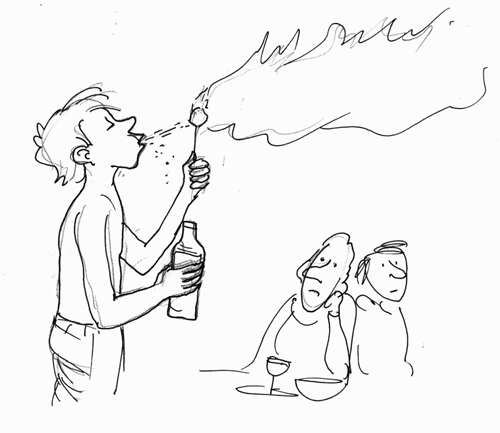
You will see that generally fire-sellers work shirtless. There is a reason, other than seeking spectacle. When you do this, there are quite a few drops of oil that fall on the shirt. I remember once a friend of mine absolutely wanted to try. She did very well, but completely ruined her Chanel suit.
So we went to spit fire, Ricardo and I, in town. We did it every day, until I found us a place on a plane to go back. My son was surprised to find such poverty, but I told him that in the world many people live like that. Personally, I appreciated knowing early on the huge difference that existed between people of different social strata. When I was a teenager I traveled in Spain. Then I headed north to reach the south of France, which I didn't know. The water of Toledo was known for causing severe diarrhea. As I went back to France I started getting quite sick. I walked or hitchhiked, sleeping under the stars with just a blanket. I had imagined, to protect the little money I had, to put the bills in "Dop" bottles, small transparent plastic containers, 5 cm by 5, used to contain shampoo. I slipped the bills in and imagined sealing the bags with an iron. Then I sewed everything into my underpants, so that I wouldn't leave it within reach of anyone when I went swimming. But my trick didn't work. I realized the bills were wet. I took them out and put them to dry on the wood of a dock, where I fell asleep.
When I woke up, the bills had dried and the wind had taken them. I looked for them, in vain. In an instant I found myself without a penny, like in a Fellini film. I then continued my journey east, quite ill. I took trains without paying, evading the inspectors by jumping over the platform barriers. Then I arrived in Saint Raphaël. I went to the police station asking what insult I should utter to be able to spend a few days in prison and have a bed and something to eat. But they kicked me out, like in the movie "Angela" by Besson. It was depressing. I was so sick and tired that if I could have spent a week in prison, I would have appreciated it. And here they didn't want me.
I spent the night on the beach. I was cold. In the morning a man came towards me. He quickly realized I wasn't in the best of health and offered me to come to his place. In fact, he was a homeless person. He and his three companions "were on the road," as they said. They lived by the sea, in a construction site villa, which had not been completed, probably because the owner didn't have the money to finish the work. The man told me I had a bit of dysentery and that to stop it I needed to drink some paregoric elixir. In fact, he was an ex-pharmacist who had one day left his home after some dramatic story. That's what his friends told me.
I stayed a week with these people, sharing their life. During the day we went to collect fruits "barely damaged." There was also an entire network of people in town who helped them. I remember a butcher, who had tattoos and gave us meat. We could feel that these people had heavy pasts and I avoided asking them too many questions. They told me that the butcher had also "been on the road" a few years earlier. Finally, when I was a bit better, they gave me some money and I went back east, on my own. I thus arrived in Cannes. In the meantime I had bought a block of paper, a quill, and a bottle of Chinese ink. I had the idea of drawing the boats at the dock and offering my works to the owners. The trick was to fa...