Why the food riots
Why the food riots?
May 11, 2008
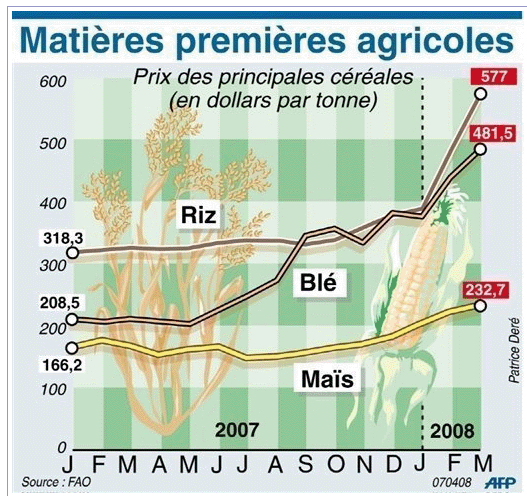
June 3, 2008: The situation is worsening daily. Liberalism and the profit strategy are the main culprits of this "price surge."
The FAO hopes that rich countries will increase their financial aid so that poor countries can buy this food that has become
too expensive, but no one dares to criticize the deadly effect of the liberalization of agricultural prices.
A petition to "mobilize emergency funds "
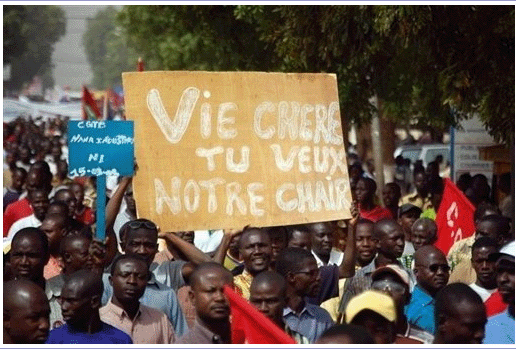
| For the poor, especially in urban areas of net food-importing developing countries, the situation will worsen. According to the World Bank, this surge in food and oil prices has plunged 100 million people into poverty. | • | Ahmed Ouaba | (AFP/AFP) Thursday, May 29, 2008, |
|---|
Protest in Africa (Burkina Fasso
Marcel Mazoyer, researcher at INRA, National Institute of Agronomy, will explain it very simply, by answering a number of questions:
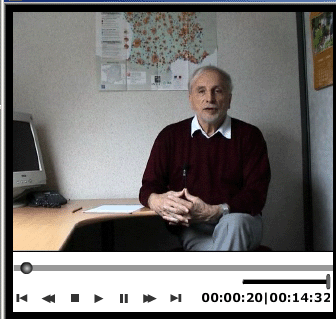
The prices of cereals have suddenly risen, and he explains why.
Stocks have decreased, and suddenly the supply has become less than the demand. So the prices have soared. This is the "Wall Law." See page 19, in my comic strip "L'Économicon":
http://www.savoir-sans-frontieres.com/JPP/telechargeables/Francais/economicon.htm
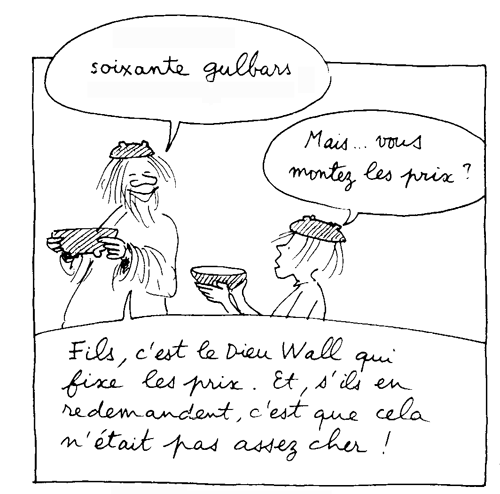
The Wall Law
****An article on the speculative aspect that accompanied this price surge.
In trade, what are we trying to do? To make as much money as possible. What determines the prices is "the law of supply and demand."
Is there a limit? No! What is in an inescapable demand and is becoming scarce automatically sees its price soar, if the market is free. In Haiti, a poor country, the price of food products suddenly doubled. As Mazoyer explains, cereal stocks have gradually decreased. After that, he says, it takes just a little. A drop in production in producing and exporting countries, like Australia, due to bad weather conditions, an increase in demand (Chinese imports, demands for biofuels), and the spiral starts. He adds that this crisis was completely predictable because it was known that cereal reserves were decreasing.
But it is not the Chinese demand or the sudden demand for biofuels that is the primary cause of the phenomenon. They are only the trigger. The cause is elsewhere.
Let's skip the terrifying figures that Mazoyer delivers with weariness. Nine million men, women, and children die of hunger every year. Three billion are below the poverty line, surviving with two euros a day. Two billion are anemic due to the poor quality of the food they consume. Eight hundred and fifty million (he specifies that the number increases every year) are starving.
In this interview, Mazoyer lets out a sentence that must be caught: "the Marrakech agreements." Quickly, search. Step by step, the explanation comes up quickly, and it has a name: the WTO, the World Trade Organization. Go to Google, type WTO. This organization likes to present itself. It was born on January 1, 1995. Its headquarters are in Geneva and it has 151 member states.
 http://www.wto.org/French/thewto_f/whatis_f/tif_f/utw_chap1_f.pdf
http://www.wto.org/French/thewto_f/whatis_f/tif_f/utw_chap1_f.pdf
The brochure immediately sets out the goals that the WTO has set for itself.
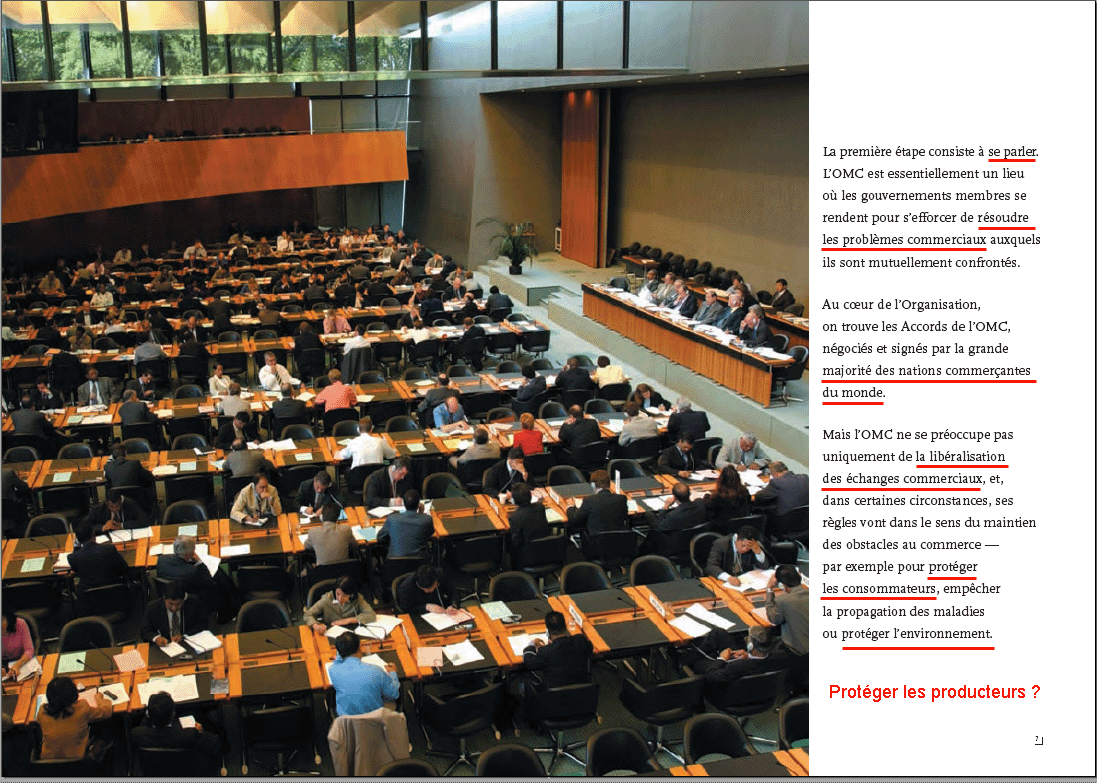
On this page, in red, one immediately notices an omission, the concern of:
Protecting producers
While this is what Mazoyer indicates as the only solution.
Before the WTO, the world corresponded to the GATT (General Agreements on Tariffs and Trade: general agreements on tariffs and trade). This agreement, signed in 1947 by 23 countries, corresponds to post-war trade. All of this goes hand in hand with the creation of the World Bank, whose Wolfowitz,, appointed by George Bush, was one of the presidents and the IMF, the International Monetary Fund.
We are now at a stage, an era, where it is necessary to inform ourselves, to read what is available.
Let's stay at the level of the World Trade Organization. It is the tool of economic globalization. This organization is based on a creed: the disappearance of customs barriers, a hindrance to trade. This creed is "the more active the exchanges will be, the more we will allow free competition between different producers and the more the prices will decrease, the more it will benefit the consumer."
It is evident that in all areas of economic activity, this favors small producers whose activities are characterized by higher production costs. I believe it is not necessary to insist for everyone to be aware of this phenomenon. The big ones eat the small ones. The small ones disappear, the weak are eliminated. It is the economic version of Darwinism. At the same time, countries "specialize." The country that will be able to claim a large share in production will be the one that offers the lowest production costs. Mazoyer cites Brazil as an example, which cultivates on vast territories, undergoing deforestation, using cheap labor. In these regions, the production cost of cereals can drop below 100 euros per ton.
On the other hand, small producers, farmers who work on poor land, who face scale factors, who do not have mechanical equipment, nor even draft animals, have production costs four, five to six times higher. In the production cost, everything must be added up: from the cost on the land, to the cost of the collected goods, transported, stored (ensuring its conservation), distributed, whether on an international market or on a domestic market. A farmer living in a remote countryside can be crushed by the arrival of imported goods.
http://www.arkepix.com/kinok/DVD/CONNOLLY_Bob/dvd_first_contact.html
| &&& | I | there is a document that I would like to find again. It is a series of reports shot in Papua, one of which was called "Joe's friends" I think. This one, and these video reports offer a striking shortcut of the joys and sorrows...