Sarkozy economist
 ../VIDEOS/sarkozy_economiste.mp3
Rich or poor, what does it matter as long as you have money!
January 10, 2009
Here is an audio document that a reader sent me. As announced by a journalist who comments on it, this statement comes from the "Sarkozy candidate." Even though it dates from before the subprime crisis, it reflects the "policy" of our president Sarkozy, which is to "do as the Anglo-Americans do."
To summarize. When you want to take out a mortgage in France, banks have guidelines. The loan is only granted under certain conditions. They require that the loan be granted only if it is estimated that the borrower will be able to manage the repayment and if these installments do not exceed a third of his salary or income, in short, "if he doesn't have bigger eyes than his belly." This measure is marked by wisdom. But in the case of real estate loans, the contract also includes a mortgage guarantee.
When someone buys a property on credit, it is the bank (or the loan agency acting as a intermediary) that pays the seller. But if the borrower proves to be in default, if he can no longer pay his installments, the credit agency (and the bank behind it) can enforce the mortgage, "taking the animal," and they become the owner of the property, "having rights," and put it up for auction. It is then very common that the property is sold below its initial purchase value. If the borrower had already repaid for a few years, the bank still ends up losing money, since by selling the property cheaply, it manages to recover what is still owed. But if the borrower quickly proves unable to pay, then the mortgage guarantee will not cover the loss recorded by the bank, which will then have to seize the accounts, furniture, anything belonging to the defaulting borrower. And it will not hesitate, since the law allows it. There is an entire population of people who, "having liquidity," make profitable real estate operations by frequenting auction rooms and buying the properties of defaulting borrowers at auction.
In this American real estate crisis, all loans were granted based solely on a mortgage guarantee (this is what our economic genius suggests). Moreover, these loans were "variable rate."
Meaning: in this loan system, everyone borrows from everyone. When loans are granted at variable rates, it means that the lender, who is at the beginning of the entire operation, has the possibility to change the interest rate. And this change will cascade all the way to the borrower. In the US, the amounts that borrowers had to repay started to increase. They could not face this increased burden. Then, facing non-payment, the banks put the properties up for sale. This influx of property sales devalued them (law of supply and demand). There are streets, neighborhoods, entire cities that have been affected by this phenomenon, where real estate prices have collapsed. The owner-borrowers were thrown out on the street. But that... is normal. However, the lending institutions, the banks, which themselves had borrowed, found themselves in difficulty.
The "Securitization"
Everyone knows about SICAVs, or stock portfolios. When people have money to invest (people or banks, insurance companies, any financial institution, private or public), it is common for them not to make these investments in a precise, well-defined way, for example by buying specific stocks. They are offered "financial products" that are a mix of different basic products.
Imagine you go to the market to buy fruits. You are not 100% sure that all of them will keep the same way. For example, there are sellers who keep their fruits in the freezer, delaying their decay. When you buy them, they come out of the fridge. You go home and, boom, the next day they start to deteriorate.
A solution is to change suppliers. It is said "don't put all your eggs in one basket." Paraphrasing, it would be advised "not to buy all your fruits from the same merchant." It is the same with investments. Some are less safe than others. Generally, the riskier investments are those where you are offered the highest profit rates. SICAVs, or various stock portfolios, are a mix of different "basic products." It is a bit like if you were sold baskets that represent a mix of different fruits, bought from different merchants. By spreading your investments in this way, you can also run less risk than by betting on a single supplier. Going back to the fruit analogy, it may happen that some fruits rot quickly, or even be rotten when you buy the basket.
The "financial product sellers" are like fruit buyers who compose baskets and offer them for sale. But in doing so, they could get rid of bad debts, that is, mix healthy fruits with already clearly rotten ones.
The last decades have seen the development of a wide variety of financial products, increasingly complex, adorned with the most attractive virtues.
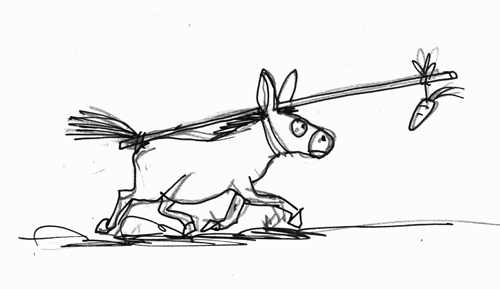
From primary products (a type of fruit offered by a producer), we have seen a whole range of "packaged products," "baskets of baskets of baskets of fruits" bought by wholesalers, then resold to sub-wholesalers, then to ....
Banks and insurance companies, all the major financial institutions have in fact become customers, buyers of these complex products, real time bombs. Some, sensing the catastrophe approaching, hurriedly got rid of some "bad debts" by camouflaging them among fruits that looked more acceptable. Real estate debts deceived more than one, their seller saying, "you risk nothing. It's guaranteed on the property, through a mortgage." Monumental nonsense was done by bank or similar institution managers.
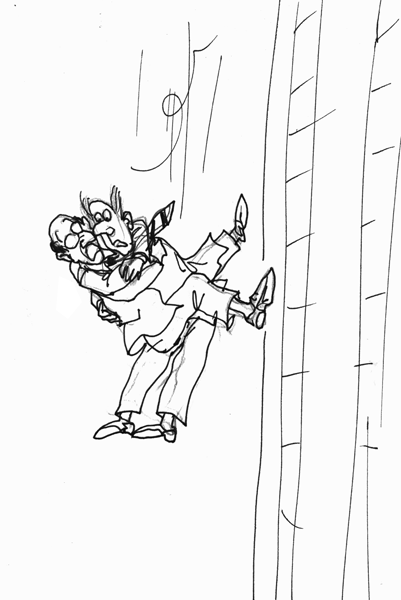
**The shareholder and the bank manager, who, unlike the drawing, is equipped with a parachute **
But golden boys, these great finance artists, had been hired based on contracts containing "parachute" clauses that were more than comfortable in case of bankruptcy. I'll skip this point. The news has flooded us, is flooding us, and will continue to flood us with scandals related to "golden parachutes."
The great illusion is to believe that "managers" are smarter than others. Look at Sarkozy. Who is he? An ex-attorney, like Mitterrand and many other politicians. When he is behind his podium, he does not develop an idea, he is arguing. You know as well as I ...