Untitled Document
Dreams of nuclear fusion energy, charlatans, and a lame duck.
Bottling the sun's energy will always be 20 years away.
By ****Charles Seife| Published on Thursday, January 3, 2013, at 5:00 AM ET
The article in French, in PDF format
The cryostat forms the vacuum-tight container that surrounds the vacuum vessel of ITER and the superconducting magnets, essentially acting as a huge refrigerator. It will be made of stainless steel with a thickness ranging from 50 mm to 250 mm. The structure is designed for 8,500 m3. Its dimensions will be 29.4 meters in diameter and 29 meters in height. Its weight will be more than 3,800 tons, making it the largest stainless steel vacuum bottle ever built.
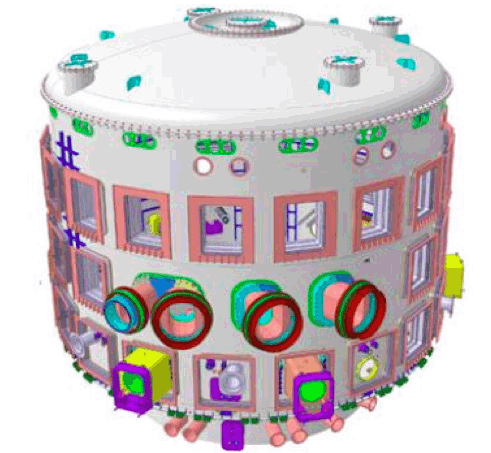
Only a few weeks ago, a group of fusion researchers used South Korean money to start designing a machine that no one really thinks will be built and that probably won't work if it is. This makes the machine just a bit more ridiculous than the French one, which will or will not be built, and which, if and when it is finally completed, certainly won't serve its original purpose. If you guessed that the story of fusion energy can be a bit strange, you're right.
On one hand, the story of nuclear fusion energy is filled with madmen, charlatans, naïfs, and idealists who dream of chasing the solution to the planet's energy problems. One of the most famous of all, Martin Fleischmann, died last year. With a colleague, Stanley Pons, Fleischmann thought he had converted hydrogen into helium in a beaker in his lab, never once considering that if he had succeeded, he and his colleagues would have been fried by the radiation released by the reaction. Fleischmann was not the first: Ronald Richter, a German expatriate who got entangled in the intrigues of Juan Peron's palace, beat Fleischmann by nearly four decades, and the new charlatan, Andrea Rossi, won't be the last.
The reason is easy to see: On paper, fusion energy has almost unlimited potential. The fusion reaction releases an extraordinary amount of energy by combining light atoms, such as hydrogen, into heavier ones, such as helium. (Fission is essentially the opposite: breaking heavy atoms, such as uranium, into lighter ones). Fusion is the process that powers the sun, and it is so efficient that we would have enough atomic fuel on Earth to satisfy all the energy needs of our civilization, essentially forever. The problem is that it's really hard to smash these atoms together strongly enough for them to fuse. You have to get extreme temperatures of tens or hundreds of millions of degrees Celsius, so that the atoms move fast enough to start the reaction. But as you heat your fuel, you have to keep it contained. A plasma of 100 million degrees wants to explode in all directions, but if you want to keep the reaction going, you have to keep it contained. How do you make the bottle?
The sun's bottle is gravity. Because the sun is so massive, more than 300,000 times the mass of our planet, it has a huge gravitational field. It is this field and these constraints that compress and contain the combustible hydrogen and prevent it from flying off in all directions. But without a solar-sized mass to provide gravity, we have to find other ways.
One method that works very well is to use an atomic bomb as the bottle. On November 1, 1952, America used fusion energy to eliminate the Pacific island of Elugelab from the surface of the planet. The device at the heart of the "Ivy Mike" test was essentially a large cold tank of heavy hydrogen. At one end was a Nagasaki-type plutonium bomb, which, when it exploded, compressed the fuel, heated it to millions of degrees, and kept it bottled up. In a fraction of a second, the power of a sun was unleashed on the surface of the Earth. The bomb that destroyed Hiroshima was equivalent to about 15 kilotons of TNT. Ivy Mike was about 10 megatons, nearly 700 times more powerful. And there is no theoretical upper limit to the size of these devices if you want. (The Soviet Union exploded a 50-megaton monster in the 1960s.)
The device works, but it's a pretty bad solution for the planet's energy needs. It's difficult to turn a fusion bomb into a safe electricity provider. This doesn't mean we haven't tried to take advantage of the hydrogen bomb. Edward Teller, the father of Dr. Strangelove of Ivy Mike, tried to convince the world that fusion weapons could be used for peaceful purposes, control the weather, extract shale gas, carve a port in the rock of Alaska, and even atomize the Moon. Yes, Edward Teller wanted to atomize the Moon, according to his own words, to "observe the kind of disturbances that it could cause."
Teller's dream of unlimited fusion energy is not dead with him. The Lawrence Livermore National Laboratory, the former playground of Teller, is now the site of a monstrous machine costing more than 4 billion dollars, a fusion project more commonly known as the National Ignition Facility. The idea is to compress a pea-sized hydrogen pellet using a laser so huge that it would make a lunar atomizer proud and red with emotion. The presumed goal is to generate more energy from the fusion of hydrogen atoms than the energy deposited by the laser. And the scientists at NIF predicted they would achieve success in 2010... then they would succeed in October 2012... then, the NIF succeeded in demonstrating that the scientists' predictions of success were completely wrong. (The French counterpart to this project is the Megajoule project.)
It's a perfect score. Livermore has predicted the imminent success of laser fusion since the late 1970s, always failing lamentably to meet all its predictions. In fact, critics (including me) have long said that all representations of NIF as a source of fusion energy were absurdities. The laser is designed for nuclear weapons research, not for producing energy. (And it won't even be very good at doing weapons research.) Yet, the scientists at Livermore continue to claim that their expensive laser research will somehow produce fusion energy, even if they have had to pass the idea that they have a chance of success through a Rube Goldberg-like representation. (For those keeping score, the latest project will also be a lamentable failure if it is ever funded.)
Livermore is far from alone in over-selling fusion. Since 1955, avan...