Submarines and DGA
Gun merchant!
This might sound like the cry of a street vendor. "Chestnut seller! Gun merchant!" Yes, our military engineers design and build submarines for the Pakistanis. It's normal—since they have atomic bombs, eventually they'll need underwater platforms and missiles. So we'll sell them everything, discreetly if necessary. Of course, these submarines built by France aren't large enough. They're too small. But every journey starts somewhere, and a missile launcher doesn't need nuclear propulsion. A lucrative deal. A long-term collaboration.
I once wrote a book:

The press never said a word about it. If you're interested, you'll have to order it from Albin Michel. Why "the Devil"? Because in our scientific circles, that's what we call the military. You'll see—it reads like a thriller, but by the end of the book, you might feel a little... uneasy. Yes, people are mad beyond all measure. Mad and especially stupid—like baskets, like suitcases without handles, irresponsible. A high-ranking political figure will send someone to reassure the Pakistanis. Then he'll express his emotion by praising the courage of French technicians, etc.... (he'll find the right words).
But what are we doing over there? Always the same thing. "Politics"—that is, a mix of power and money. It's called "expanding our sphere of influence," developing markets. "Gun merchants!"
Very young, I came into contact with this world. Take a look:
It's me, at 25, at SEPR, the Society for the Study of Jet Propulsion. The photo was taken at the Istres test center. I'm riding a solid-fuel rocket. By the way, notice a detail: the rocket is mounted on a frame with four sturdy wheels. It pushes forward against a dynamometer. But since accidents are always possible with such devices, the front was fitted with a "chapel"—a steel diaphragm that bursts if there's overpressure in the chamber. Indeed, if overpressure occurs, it could crack the propellant, increase the combustion surface, raise pressure further, and cause a total explosion. So the diaphragm was supposed to burst, drop pressure, and extinguish the engine. Unfortunately, the engineer who calculated this was wrong (it wasn't me). When the chapel burst, the rocket didn't just fail to shut down—it actually continued thrusting. The force from the gas jet at the front turned out to be slightly greater than that from the nozzle visible in the foreground. So the rocket, which nobody had thought to secure, simply went for a walk at the pace of a man strolling, spewing two jets of gas over a thousand degrees—one forward, one backward. A few tens of meters away, the engineer, eyes glued to the periscope emerging from the bunker firing post, watched it pass. It crossed the entire test center, narrowly missed the guard post, then vaporized the fence and stopped beside the car park. In subsequent tests, we added strong brackets fixing the wheels to the ground—very visible now. You can also see several thick cables encircling the beast to prevent another wild ride.
I could tell you many stories like this. You'll find plenty in the book. All this costs money—lots of it. But "it keeps people working," it "creates jobs," they say. Personally, after a few months in that company, entirely focused on perfecting the MSBS (Strategic Submarine-Launched Ballistic Missile), a four-nozzle solid-fuel rocket, I preferred to move on to MHD research at CNRS, working on a civilian project. In my next book, hopefully coming out this summer and titled something like "UFOs: The Veil is Torn," you'll discover what military MHD produced after 25 years of ultra-secret research in the USA—the technical dossier being definitive. The Europeans were beautifully fooled by the Americans, who in 1972 made them believe they were giving up. Brilliant!
Why am I talking about MHD when we started with a submarine built for Pakistan? Because the French will equip it with torpedoes that travel at 120 kilometers per hour. In my book, you'll learn how American MHD torpedoes work—operational for twenty years now, traveling over 2,000 kilometers per hour. Solid-fuel propulsion. Part of the energy powers the tens of megawatts that suck water along the torpedo's hull, eliminating all friction. French torpedoes are mere wheelbarrows in comparison. But the Pakistanis don't know this. They can always shop around with the Russians. The Russians have Sqwal torpedoes, so outdated today that they're even selling them... to the Chinese!
Gun merchant!
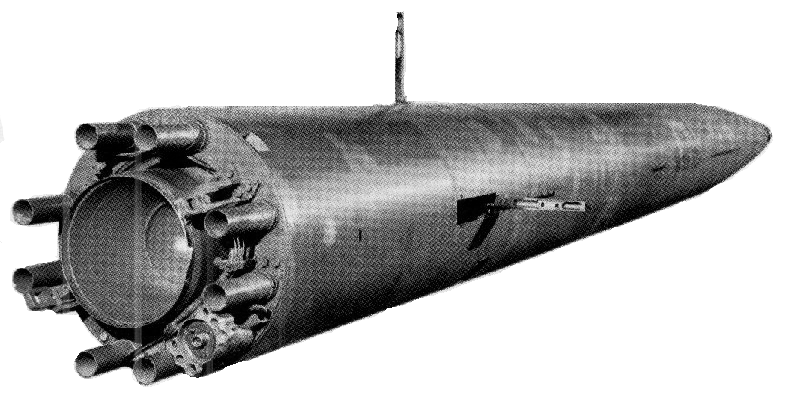
These old Russian torpedoes are also solid-fuel propelled. An invisible gas generator at the front spits gas through "pores." This reduces friction. But this super-wheelbarrow doesn't exceed 400 km/h (the French don't have such gadgets, having only recently discovered them). On the back, you see the tubes used to vent excess gas. Still, it's beautiful technology, isn't it? But all of this is so outdated, obsolete, one might say. It has its charm...
Don't worry—our military engineers are already working on "hypervelocity" torpedoes. Though in military MHD, they're 25 years behind, an unbridgeable gap (and perhaps better that way—the people who make mistakes are already numerous enough).
Our engineers are assassinated in Pakistan. Suicide commandos. But what are we really doing over there? State secrets, money deals, spheres of influence. French engineers die for France. We should replace the great wheel at the far end of the Champs-Élysées with a "Tomb of the Unknown Engineer." That way, we could periodically rekindle that second flame.
In my next book, you'll tour the backstage of human folly—exceeding even your wildest dreams, surpassing the most delirious science fiction films. Hypersonic cruise missiles, antimatter bombs, hypersonic aircraft breaking through the "heat barrier" thanks to MHD. Science is beautiful. I already gave a brief preview in a January 2002 interview on Europe 1. An aerospace journalist, annoyed, declared I was "spouting technological delirium." He was listening amid a crowd of anxious officers, who kept asking, "Well, what do you think?" When people read the book, they'll judge based on the technical data provided. I don't think the press will cover it, nor will I have the chance to debate such a topic on TV or radio. The military haven't forgotten a certain face-to-face confrontation with their spokesperson back in the early '80s, when he, live on air, discovered the words "terawatt" and "Star Wars" for the first time. I'm "scientifically dangerous." Better to face me with "ufologists"—less risk.
No jealousy—no doubt we'll sell submarines to the Indians too. They'll need platforms, eventually...