The Stellarator
Wendelstein 7-X
December 17, 2015
Finally, after 19 long years, the Germans have completed the construction of this true technological nightmare—the stellarator. At the beginning of December, this machine produced its first plasma, decades before ITER. Naturally, visitors to my website bombarded me with questions about this machine.
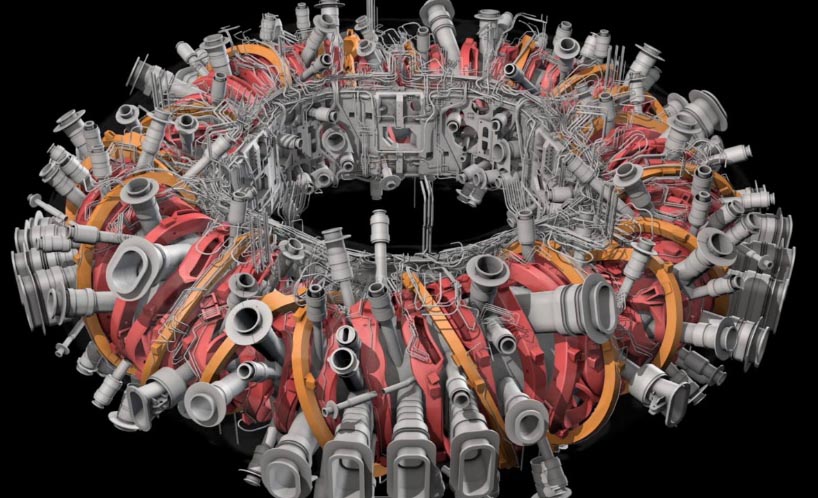
It took 19 years and a million hours of work for this project to come to fruition. It features 20 planar coils and 50 non-planar coils. Why this distinction? When trying to generate a magnetic field in these coils, one must pass an extremely strong current through them—up to 12,000 amperes. However, when such a high current flows through a coil, centrifugal forces act upon it, causing it to assume a circular shape. In extreme cases, these forces can even cause the coil to break. Given the highly complex geometry of the German Stellarator…
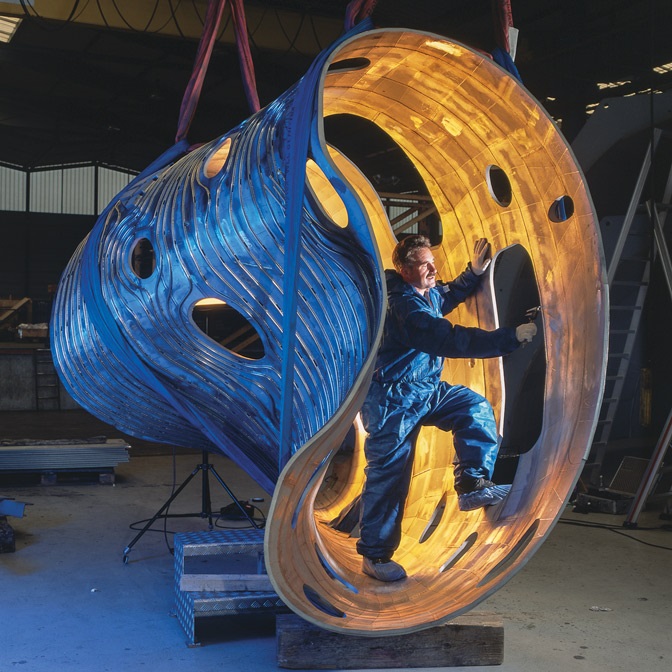
…it was necessary to design coils that weren’t just circular, but also irregularly shaped:
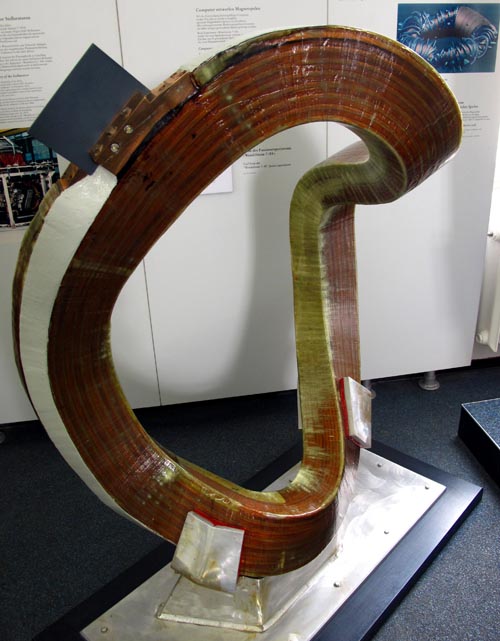
Why such a complicated geometry? If you watch the five videos I’ve posted on YouTube, you’ll see the basic principles behind tokamaks. These principles stem from ideas proposed by Andrei Sakharov and Artsimovich. If we equip a toroidal chamber with regularly arranged circular coils, the magnetic field will be strongest near the machine’s axis, where the coils are closest together. Plasmas tend to migrate toward regions where the magnetic field is weakest; thus, the magnetic field effectively pushes the plasma outward. The tokamak represents one possible solution. By using a solenoid along the machine’s axis, a slowly increasing magnetic field is generated (up to 13 teslas in ITER); this field induces a circulating current within the plasma. This current generates its own magnetic field, which combines with that produced by the surrounding coils. As a result, magnetic field lines form a spiral pattern.
Charged particles naturally follow these magnetic field lines, thereby keeping the plasma centered within the chamber. Another solution, proposed by American scientist Lyman Spitzer in the 1950s, is the Stellarator. The Wendelstein X-7 machine is a Stellarator:
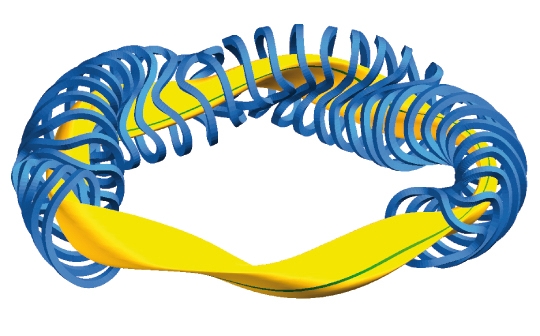
In yellow, we see the machine’s chamber; blue indicates the numerous coils. During its design phase, countless computer calculations were performed to optimize both the chamber’s shape and the coil layout. All this required tremendous effort—a full million hours of work.
Why choose a Stellarator over a Tokamak? In Tokamaks (including ITER), the main problem is the risk of disruptions occurring. Inside the chamber, the “plasma current” (15 million amperes in ITER) can be likened to a snake biting its own tail. Essentially, a disruption occurs when this current loses its orderly arrangement. Then, the “snake” releases its tail and “bites” the chamber walls. In ITER, this “bite” corresponds to 11 million amperes.
The cause? MHD turbulence. Even worse: this distortion of the magnetic field leads to gradients that accelerate charged particles—primarily electrons. These electrons gain relativistic speeds, approaching the speed of light, and acquire enormous amounts of energy. Once they reach a certain velocity, they cease interacting with ions. They become what’s known as “decoupled electrons.” But via an “avalanche effect,” they accelerate other electrons. This creates a multiplicative effect—especially significant in ITER.
Such phenomena do not occur in Stellarators. That doesn’t mean other instabilities can’t arise; only experimentation can provide answers. For half a century, plasma machines have brought nothing but disappointments, making gradual progress essential.
The German machine boasts a magnetic field strength of up to 3 teslas. Its microwave heating system operates for 10–50 seconds. Additionally, a neutral particle injection system delivers 8 MW of energy. With these tools, researchers hope to achieve a plasma density of 3×10²⁰ nuclei per cubic meter at temperatures ranging from 60 to 120 million degrees.
However, the German Stellarator won’t produce self-sustaining fusion plasma—where the energy released by fusion itself maintains the plasma temperature. With various machines, scientists strive to ignite “nuclear fire.” You can liken this to trying to ignite slightly damp wood using kindling or a lighter. While the damp wood burns, it contributes to the overall energy output. But once the dry wood or kindling runs out, two scenarios arise: either enough heat is generated to sustain the fire, or it dies out, requiring another attempt with new kindling.
No plasma machine worldwide has yet achieved such conditions. The most successful, JET, managed to achieve a Q-factor of 0.6 (energy injected vs. energy produced). ITER aimed for a value exceeding 1. Unfortunately, we have no idea how self-sustaining fusion plasma would behave. Predictions in this area remain elusive.
The German Stellarator cost a fortune, proportional to its complexity. I believe expenses totaled around a billion euros. Yet this project has reached maturity: the machine is built, its magnetic systems operational, and in early December, researchers achieved their first plasma. Next, they’ll increase energy input—via microwaves and neutral particle injection, techniques already mastered in tokamaks. The key question remains: “Does this machine fulfill expectations regarding plasma confinement?” Preliminary results seem promising.
Is the Stellarator a viable solution for fusion energy production? Too soon to say. But its cost is 16 times lower than ITER’s. It holds a major advantage over ITER: it functions, and researchers needn’t fear immediate damage from disruptions—unlike in ITER.
This risk severely hampers ITER. Given its design, replacing any component poses immense challenges. Components prone to disruptions include elements of the “divertor”:


The first image illustrates the size of this component relative to the entire machine. There’s a video showing technicians performing intricate maneuvers to install these parts. Replacement will prove equally difficult. See: https://www.youtube.com/watch?v=pt70mO2nQac
Incidentally, disruption risks rise alongside desired energy output levels.
The German Stellarator serves merely as a research tool; it isn’t intended as a prototype for a fusion power plant. Still, it’s a worthwhile project grounded in rationality. ITER, conversely, was conceived as a colossal undertaking. Technical and scientific hurdles were grossly underestimated.
France lacks any Stellarators, even experimental models. Personally, I suggested testing a “cloverleaf-shaped” configuration, which also entails spiral magnetic field lines yet relies on circular coils:

This chamber is based on equations:
x = Cos t + 2 Cos 2t
y = sin t - 2 sin 2t
z = 2 sin 3t
In a circular cross-section, maximum magnetic field points rotate 270° per cycle—this should ensure plasma homogeneity. Circular coils allow reaching 10 teslas (ITER’s nominal field is 11.8 teslas).
Yet attempts to build even a modest 50-cm model in specialized labs yielded nothing. Notably, the CNRS division handling hot plasma research stated that potential research avenues comprised only two options: ITER and Megajoule.
As an indication, results from America’s National Ignition Facility (NIF)—Megajoule’s counterpart—were dismal. Thus, hopes of studying laser-driven fusion via Megajoule are unfounded. NIF uses 192 neodymium-doped glass lasers; France’s version will feature 176. Despite NIF’s failure, France will still complete its project.
Why such failure? Since the mid-1970s, Americans knew via the classified Centurion Halite project that compressing deuterium-tritium spheres to induce fusion required 10–20 megajoules of energy. NIF could deliver merely 0.18 megajoules—55 times less! Though lasers generated 1.8 megajoules, 80–90% of this energy heated the gold “oven” housing the target:

The gold “oven” containing the target

Proportion of energy actually absorbed by the target.
Deploying fifty times more lasers was impossible. Project theorists like John Nulholls proposed compressing solidified D-T layers instead of a liquid sphere. Risk: Rayleigh-Taylor instability, wherein one fluid exerts pressure on another, causing chaotic behavior:

Rayleigh-Taylor instability
Confident in his simulations, Nulholls claimed this instability wouldn’t affect outcomes. He predicted success by 2012, with adjustments needed only to align simulation parameters with experimental data. Instead, tests ended in disaster: Rayleigh-Taylor effects dominated.
How to detect this? Trace atoms in the target reveal implosion speeds via Doppler shifts. Fusion demanded speeds of 370 km/s; actual values fell far short, showing no consistency whatsoever.
Thus, a $6-billion experiment failed entirely due to reliance on supercomputer simulations. Moreover, Nulholls and team silenced critics by labeling their code “classified defense information.”
What of France? During the 1970s–80s, when Megajoule was being planned, did French researchers know the 10–20 megajoule requirement? Yes. Logically, this knowledge should’ve halted the project. Yet France followed America’s lead. Elsewhere—Russia, Japan—researchers had access to terawatt-scale laser arrays. But others waited to see America and France’s results before proceeding.
Unless Russia had its own Centurion-Halite equivalent.
NIF and Megajoule never aimed at practical fusion energy generation; laser efficiency stood at just 1.5%. Proposing fusion plants based on these projects was pure fantasy. Actually, they served purely military purposes: replicating nuclear weapon compression via X-ray irradiation from plutonium-239 devices. Why such failure?
In France, aside from ITER and Megajoule, no research exists on miniature Stellarators or Z-machines. Sphinx, a military-run facility in Gramat, cannot facilitate MHD compression—its ramp-up time is 800 nanoseconds. Shortening this is impossible; another setup is required.
Why does a 100–150 nanosecond ramp-up time matter? It implies currents at 100 MHz frequencies. High-frequency currents flow along conductors’ surfaces—the “skin effect.” Z-machines use hair-thin wires carrying 70,000 amperes; slow ramp-ups cause deep penetration, destroying wires. Brief ramp-ups limit damage to surface plasma formation.
Other designs, like MagLif, employ different methods. France would’ve benefited from adopting such approaches. But ITER and Megajoule stifle similar research.
I won’t dwell further on these failures. One anecdote amused me greatly: last time I flew a glider near Vinon with a friend. Until then, the landscape remained uniform; now, a massive metal framework—housing ITER—stands there. Months prior, a Spanish pilot landed nearby. After chatting, he took off, turned left, and headed straight for ITER. Air traffic controllers shouted warnings over the radio, but he replied:
“Yes, yes, I understand. I’m turning away from this ‘recreation park’...”