Ants in the legs
February 27, 2006
A reader, Frédéric Boiteau, kindly offered me the book by the Norwegian Thor Heyerdal, The Kon-Tiki Expedition, published in 1951 by Editions Albin Michel. I am going to ask this publisher, who has not exploited this work for ages, whether it would be possible to make these pages accessible to our readers again, after having scanned them and put them into text form by OCR.
It makes one dream. At one point Heyerdal seeks to complete his team of six people. He has never sailed and has just suffered a mocking reception from a great professor in New York, responsible for a prestigious museum, to whom he had vainly tried to hand a paper in which he sets out his theory, according to which the peopling of Polynesia would have been linked to the migration, in 500 and then in 1100 after Jesus Christ, of the first inhabitants of South America, bearded and white-skinned, driven out by the arrival of the Incas. Let us quote the passage from the book, page 23:
Around us, in carefully arranged display cases, were spread fragments of pottery, traces of a distant past. On the wall were lined up books of which certain ones, works by the same author, could not have had more than ten readers. The old man who, for his part, had read them all and had written a few of them, was sitting at his table with an expression of good humor under his white hair. But I had doubtless stepped on his toes, for he gripped the arm of his chair with an anxious air and looked at me as if I had interrupted him in the middle of a successful trick.
"No!" he said. "Never!"
Father Christmas would have taken on roughly the same expression if one had dared to assert to him that next year's Christmas would fall on Saint John's Day.
"You are mistaken, you are completely mistaken," he repeated, shaking his head with indignation to drive away the idea I had suggested to him.
"But you have not yet read my arguments," I insisted, showing him the manuscript that lay on his table.
"Arguments!" he said. "One cannot treat ethnological problems like the enigma of a detective novel."
"Why not?" I said. "I have based my conclusions on my own observations and on facts established by science."
"The goal of science is research, pure and simple," he remarked calmly. "Not the will to prove this or that."
He carefully pushed my unopened manuscript aside and leaned over the desk.
"It is entirely true that South America was the home of some of the most extraordinary civilizations of the past, and that we know neither what they were exactly, nor where they disappeared to when the Incas took power. But there is one thing, in any case, that we can affirm with certainty — that no people of South America ever went as far as the Pacific islands."
He gave me a searching look and continued:
"Do you know why? The answer is quite simple. They could not get there because they had no boats."
"They had rafts," I objected in a hesitant tone. "Balsa-wood rafts, you know."
The old man smiled and said quietly:
"Well, you can try going by raft from Peru to the Pacific islands."
I was caught off guard. It was getting late. We both stood up. The old scholar gave me a friendly pat as he accompanied me to the door and told me to come back and see him if I needed help. But that from now on I had to specialize in Polynesia or in America, and no longer mix two separate fields. Then he returned to his desk.
"You have forgotten this," he said, handing me back my manuscript.
A few months later Heyerdal was preparing his crossing. He had obtained from the Pentagon survival equipment, rations, a rubber dinghy, a radio set, various things that shipwrecked pilots and sailors have when they are lost at sea. The army had estimated that this experiment would make it possible to test these various materials. Heyerdal confides that on seeing all this display of various materials "he had felt like a kid, taken by a rich aunt into a candy store."
All that remained for him was to complete his crew as quickly as possible, so as to be able to leave within a few months, before the hurricane season.
It is known that Heyerdal made up his group with people of very varied origins, ranging from a painter friend, guitarist and freshwater sailor like himself, but capable of handling a sextant, to Norwegian resistance fighters, having taken part in numerous raids during the war, including the one that later formed the subject of the film "The Battle of Heavy Water" and in which the sabotage of a factory located in Norway reduced to nothing any chance the Nazis might have of possessing the atomic bomb (heavy water is a neutron moderator and is used in nuclear reactors, see Energétiquement vôtre).
I cannot help reproducing the exchange of telegrams between Heyerdal and Torstein, one of these young heroes.
- I am going to cross the Pacific on a wooden raft to support the theory that the Polynesian islands were populated by men from Peru. Do you want to join us? I guarantee nothing but the trip free of charge there and back and you will have the opportunity to put into practice your technical skills as a radio operator. Answer at once.
Torstein's reply:
- I'm on my way.
Perhaps I should have been born Norwegian.
Do you know at what period the first crossing of the North Atlantic took place by the worthy descendants of the Vikings, shortly after the discovery of the Oseberg longship, intact, serving as the tomb of a chief buried there with his ship, his weapons, and all his equipment in view of his journey to the beyond?
1898 .....
Without GPS, without an escort and logistical support vessel, without satellite communication. In Provence where I live people seem to have long since lost the adventurous spirit of a Pytheas.
Since I put on my site &&& all the elements that could serve as a guide for the construction of a high-seas boat, directly inspired by the ships of the Ancient Egyptian Empire, I have received no visit or call from a naval architect, or even from simple amateurs. The Midi is surely a terrific place to retire but unfortunately I do not yet feel any taste for that kind of withdrawn existence, between two chats among friends.
A friend, Claire Bougain, who is an English teacher and also writes very pretty poems, has translated my article concerning my theory dealing with the construction of the pyramids and high-seas navigation under the Ancient Empire into good English. Thanks to an Egyptian friend, Hussein, I had them handed personally to Zahi Hawas, President of the Supreme Council of Antiquities in Egypt. But since then, no more news. The chances of crossing the Atlantic on a liner from the limbo of time are dwindling, or even simply that of climbing the pyramid of Cheops to go and find there the trace of the central shaft, indispensable for the precise location of the blocks.
The path of the Giza plateau, the road that leads toward the far side of the Moon, the entrance that once led Aarne Saknussen to the center of the Earth perhaps have more chance of being found near Paris than under the shade of the Cours Mirabeau, in Aix-en-Provence.
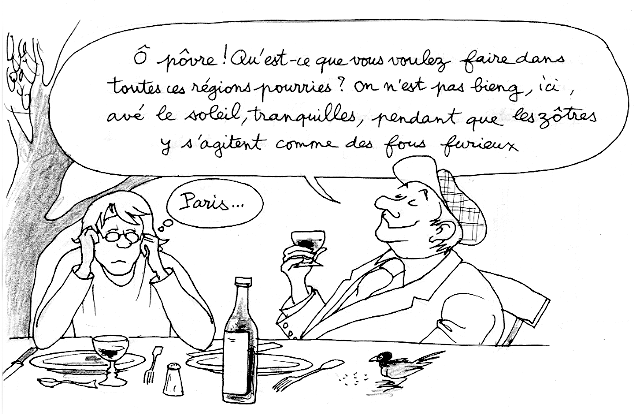
Bye-bye real retirees. The establishment of a bridgehead in the capital, even in the form of a simple maid's room, now imposes itself as an obvious fact. My decision is made and I am going to undertake without delay to resolve this problem.
Back to New Releases Back to Guide Back to Home Page
Number of connections since February 27, 2006: