Definition of styles
New JPP videos
November 3, 2015
One of the first viewers to watch these two new videos, produced by your servant, made this comment:
- After two years of hibernation, the bear comes out of its den.
My first video, directly in English:
****Jean-Pierre Petit: about interstellar travel
The image is not false. Gilles and I have spent two years accumulating scientific work, and putting it into shape. Two thousand hours of work, comfortably. We managed to place four papers in peer-reviewed journals, checked by referees. It was not easy and the fight continues, exhausting. I will soon be 79 years old.
The problem, we realize, is to be understood. We come out of thirty years during which our theoretical physicists have used their superstrings to knit super socks. Astrophysics and cosmology now develop along three themes:
-
- The cosmological inflation model* * - Dark matter* * - Dark energy. *
We take the opposite of these three elements, completely. Many of these works are not recent. Some date back 15, 20, and even 27 years. Thus, the model of a universe with variable speed of light was first published in Modern Physics Letters A in 1988, twenty-seven years ago, shortly after the discovery of the homogeneity of the primitive universe by the COBE satellite. But, very quickly, the theory of cosmological inflation, by the Russian Linde, appeared as the solution to solve the cosmological horizon paradox.
Our work, very enriched, can be found on http://www.researchgate.net in the article titled "challenging the inflation theory".
There is also a thorny point: even the most advanced scientists and mathematicians often have little or no geometric intuition. The concept of "throat sphere" connecting two space-times confuses more than one. The same happens when one moves in a five-dimensional space (which is, however, essential if one wants to approach electromagnetism).
It is a chance that we could put our work on Researchgate, this competitor of arXiv, a site where I have been blacklisted for two years. In early 2014 I had started to upload articles, which followed others, installed in the early eighties, and still in place. All these new papers were quickly, to my great surprise, put "on hold" (suspended), the explanation given being that "moderators" were examining these articles (although they were exempt from incitement to racial hatred, pornography or promotion of pedophilia or terrorism).
Finally, in early 2015, there were 17 articles blocked. The courageous "anonymous moderators" of arXiv then chose to simply delete these 17 articles, citing that they considered them "not suitable" (not appropriate for arXiv). Moreover, I was told that if I tried to resubmit them, I would lose any chance of accessing this site (...). In short, I would have been "permanently banned" by a group of fools, just like on Wikipedia more than ten years ago.
Before the summer of 2015, I uploaded a ... 18th article, which was immediately blocked, then deleted, with a response that is quite telling:
- You will only be able to put this article on arXiv if it has been previously published in a mainstream journal with referee. . .
In other words, for me, the site arXiv is no longer a structure for "preprints", but for "postprints".
One day, this will be clarified. A scientific journalist could find material for an investigation. But there is little chance that one of them in France would take this risk. By taking my side, he would end up ... blacklisted by the French scientific community and cut off from his information sources (or ... misinformation).
It doesn't matter. When the door leading to the street is locked, you have to take the door to the courtyard. Researchgate is not a publication for outsiders: more than 10,000 researchers have their work there. Curious readers can consult all our works, which have record reading numbers.
Search J.P. Petit & G. D'Agostini on Google Scholar: three pages.
The battle for publications continues, with its absurd side. But it must be understood that the system is clogged. Journals like Nature or Science receive hundreds of articles per day. Totally unmanageable. And even the journals where we managed to place papers: Astrophysics and Space Science and Modern Physics Letters A have to handle a thousand articles per year.
Among our latest misadventures, we will mention the rejection of a work that we thought would be accepted without problem, since it was only a numerical application of a model published on September 29, 2014 in Astrophysics and Space Science. Below is the way the calculation matches the 740 measurement points, regarding the acceleration of type Ia supernovae:
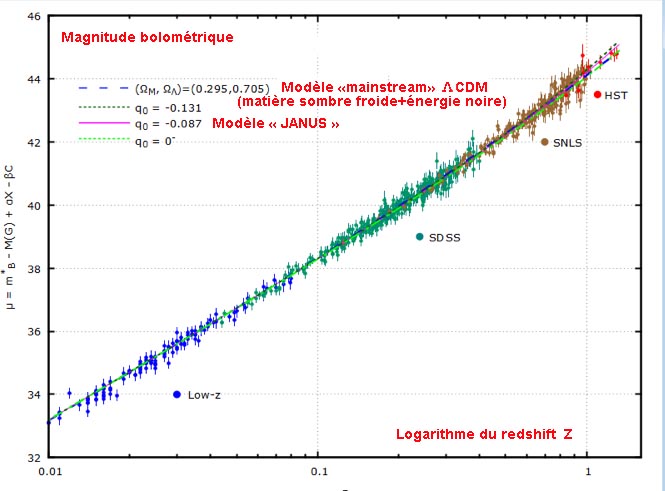
Model J.P. Petit and Gilles d'Agostini compared to observations
( pink curve )
Does it fit well? But no, a referee rejected it with an insulting letter, thinking ... that it was a solution to Einstein's equation, whereas our model is based on two coupled equations, Einstein's equation being only an approximate form of one of them. We were called "crackpots" (crazy people), authors of a "nonsense machinery" (a nonsensical theory). We politely asked for a second review. But the response was:
-
- We apologize for the insults, but we maintain the rejection. *
Another journal refused to publish an article based on the theory of dynamic groups, showing that dark matter and dark energy were only negative mass. But this time, confused by what was submitted to them, 16 referees declared themselves ... incompetent.
Why such difficulty in publishing? Because there are many areas of science that have sunk into oblivion. In cosmology, we can say that the mathematical tools, purely geometric, that we use date from the ... 1930s. Moreover, which theoretical physicist is comfortable with Dynamic Group Theory (see the book by J.M. Souriau of ... 1970, on the site that his son Jérôme and I had created). Today, referees who come across such writing are confused and wonder "where are the superstrings? What dark matter or dark energy are these people referring to? Is it a scalar field? A holographic model?".
How to have a chance of being understood, by presenting an article of a few pages, full of new concepts, to a referee who will not spend more than a few minutes on it? By thinking that there is a greater chance that this referee works in a field that our own work could completely collapse.
It's really "mission impossible". And where do these authors work? In which laboratory? None! ....
I have vainly tried to get a lab email address in France. In particular, from the Astrophysics Laboratory of Marseille, to which I belonged for more than twenty years. Immediate refusal. So, until ...