Untitled Document
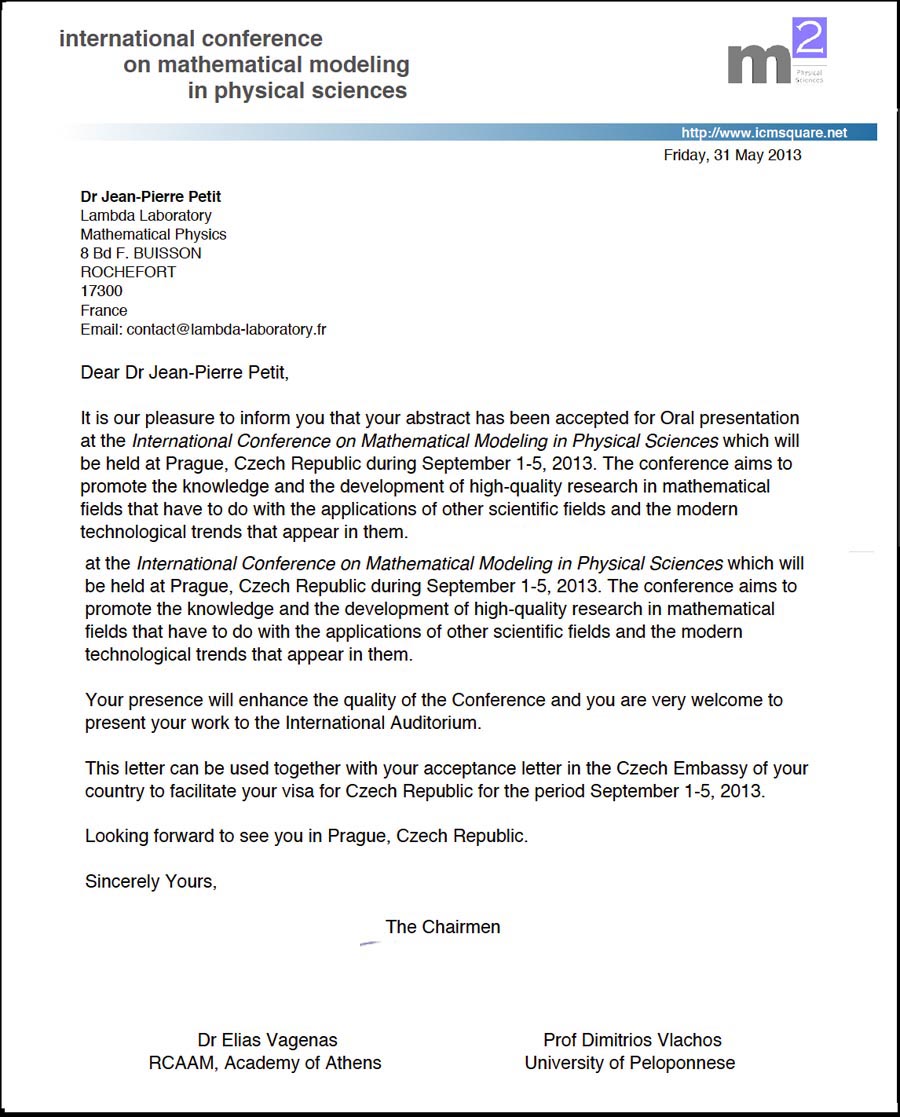
**The conference site (2-7 September 2013): **
To download the pdf of this communication
Title of the communication :
An alternative model, explaining the VLS, due to the gravitational interaction of two populations,
one composed by positive mass and the second by negative mass.
Jean-Pierre Petit Gille d’Agostini
Abstract :
Negative mass arise naturally from dynamic groups, as shown in 1972 by the french mathematician Jean-Marie Souriau. The Poincaré group acts on the movements in the Minkowski space, for which it is the isometry group. It acts also on the momentum, set of scalars, whose number is equal to the group’s dimension (ten). The elements of Poincaré’s group belong to two subsets. Souriau called the first orthochron, because it does not revert time, by acting on the movements. He calls the second one antichron, because its elements transforms a movement orientated past-to-future into a movement orientated future-to-past. In 1972 Souriau demonstrated that these movements refer indeed to negative energy-bearing particles (and negative mass, if they have one). These negative particles radiate negative-energy photons which cannot be seen by our eyes or detected by our telescopes. Further there is no theory available describing the electromagnetic interaction between particles of opposite mass and energy. Coexistence is therefore possible without mutual annihilation. Under these conditions the only possible interaction between them is gravitation. Two particules of the same sign attract each other through Newton law. Two particles of opposite signs repel each other through « anti-Newton » law. The two populations tend therefore to separate from each other as being illustrated by computer simulations. Further, if the negative mass is larger, for a given density, their Jeans’ time is shorter. This creates clusters which repel matter in the remnant space, the whole forming a stable system. Cells are like prisons for clusters, by preventing them from interaction with others clusters, and these clusters act as anchors, with respect to the positive matter structure, shaped like joint soap bubbles. In 3d we get a distribution of positive matter which explains the VLS. In additionthis model provides a new insight on the galaxies’ birth mechanism, promotingan effective radiative cooling of the positive mass matter, compressed inslates, which would enable the formation of proto-galaxies. On the opposite
negative-mass clusters could have cooling times greater than the age of the universe.
An alternative model attributing the large-scale structure of the universe to the interaction of two populations,
one composed of positive masses and the other of negative masses.
Jean-Pierre Petit Gille d’Agostini
Abstract :
Negative masses naturally emerge from dynamic groups, as shown by the French mathematician Jean-Marie Souriau in 1972. The Poincaré group acts on the movements in Minkowski space, for which it is the isometry group. It also acts on the momentum, a set of scalars whose number is equal to the group's dimension (ten). The elements of the Poincaré group are divided into two subsets. Souriau called the first orthochron, because it does not reverse time, when acting on movements. He calls the second antichron, because the action of its elements transforms a movement oriented from past to future into a movement oriented from future to past. In 1972, Souriau showed that these movements actually refer to particles with negative energy (and negative mass, if they have one). Negative-energy particles emit negative-energy photons, which cannot be seen by our eyes or detected by our telescopes. Furthermore, there is no theory available describing the electromagnetic interaction between particles of opposite mass and energy. Coexistence is therefore possible without mutual annihilation. Under these conditions, the only possible interaction between them is gravity. Particles of the same sign attract each other according to Newton's law. Particles with opposite signs repel each other according to the "anti-Newton" law. The two populations therefore tend to separate from each other, as illustrated by computer simulations. Furthermore, if the negative mass is larger, for a given density, their Jeans' time is shorter. This creates clusters that repel matter in the remaining space, forming a stable system. Cells act as prisons for clusters, preventing them from interacting with other clusters, and these clusters act as anchors with respect to the positive matter structure, shaped like joint soap bubbles. In 3D, we obtain a distribution of positive matter that explains the VLS. Moreover, this model provides a new insight into the mechanism of galaxy formation, promoting an effective radiative cooling of the positive mass matter, compressed in slabs, which would enable the formation of proto-galaxies. On the contrary, negative-mass clusters could have cooling times longer than the age of the universe.
**The communication (15-minute oral presentation on Tuesday, September 1st, in a mathematical physics session) was limited to four pages. To download this communication in pdf **
****Mathematical Physics Communication at the Prague Conference, September 2013