CNRS opinion on researcher Jean-Pierre Petit
In this file, published in its bulletin, the CNRS expresses its opinion on the astrophysics and cosmology work of Jean-Pierre Petit
March 8, 2005
| E | n
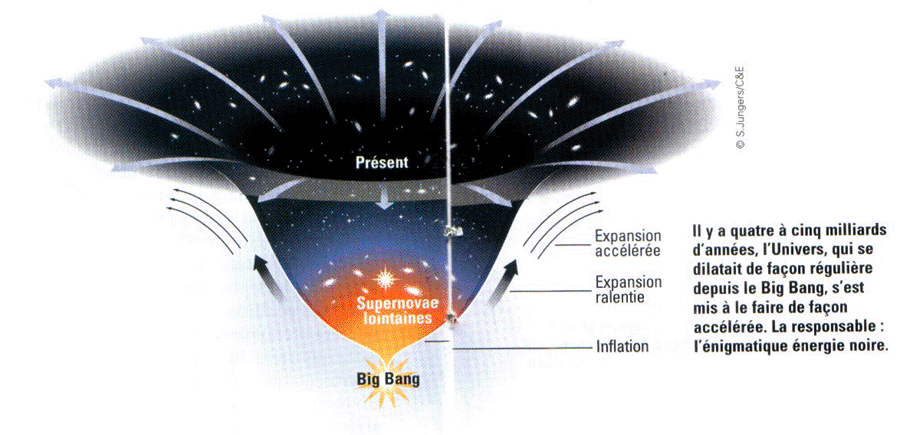
| In 1998, the earthquake happened, says Pierre Astier, from the Laboratory of Nuclear Physics and High Energies: the universe's expansion is accelerating under the influence of a mysterious | dark energy | . This would account for about 70% of the cosmos. And we know nothing about its composition. Until then, within the framework of the Big Bang theory and in the light of Albert Einstein's general relativity, it was known that the universe was expanding in a regular way under the impulse of an "initial explosion." From then on, the work of researchers consisted of cataloging the content of the cosmos in order to "weigh" it and determine if the expansion could stop under the influence | of gravity. But seven years ago, ideas were turned upside down. Two independent teams entered the scene: the Supernovae Cosmology Project and the High z Supernova search team. They observed about fifty distant star explosions (spread between 1 and 6 billion years |
|---|
light). assimilated to type la supernovae, that is, natural nuclear explosions. These rare phenomena are called "standard candles," because their absolute brightness is known and
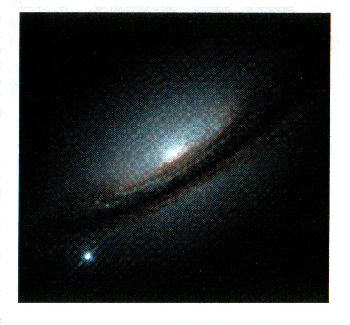
The observation of distant type 1a supernovae (here SN1994D, at the bottom left of the image) allowed astrophysicists to notice that the universe was accelerating
determine their distance by two different methods. However, during the 1998 observations, the most distant supernovae had a weaker light than expected in a universe whose expansion was solely due to matter. Therefore, a conclusion is imposed. The apparent weakness of luminosity is explained by the distance of the star. Its host galaxy is located at a greater distance than thought. Therefore, the universe must have expanded faster than expected. To explain the phenomenon, it is therefore necessary to invent a mysterious dark energy that gives a boost to the expansion. Would this discovery shake the Big Bang theory? "Not at all. It renews interest and adds spice," reassures Pierre Astier.
| D | epuis
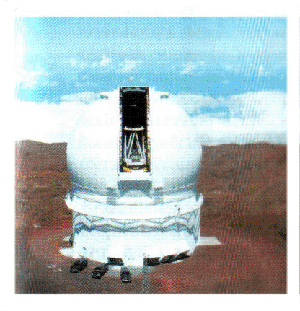
1998, two confirmations of the acceleration have also reinforced the hypothesis. And "the latest results indicate that this expansion regime has prevailed for about four to five billion years, that is, 35% of the history of the universe," says the physicist, who belongs to the research group created by Reynald Pain, the only French person who participated in the American Supernova Cosmology Project adventure. French researchers now use several telescopes, including the Canada-France-Hawaii and the European Very Large Telescope in Chile. The hunt for distant supernovae has become a major issue for these observation instruments. The ambition? "To uncover hundreds," says Pierre Astier. This is essential if one wants to estimate how the acceleration of expansion has evolved in the past. Some physicists see in this repulsive force the signature of what they call "vacuum energy."
|---|---|
Since 1998, two confirmations of the acceleration have also reinforced the hypothesis. And "the latest results indicate that this expansion regime has prevailed for about four to five billion years, that is, 35% of the history of the universe," says the physicist, who belongs to the research group created by Reynald Pain, the only French person who participated in the American Supernova Cosmology Project adventure. French researchers now use several telescopes, including the Canada-France-Hawaii and the European Very Large Telescope in Chile. The hunt for distant supernovae has become a major issue for these observation instruments. The ambition? "To uncover hundreds," says Pierre Astier. This is essential if one wants to estimate how the acceleration of expansion has evolved in the past. Some physicists see in this repulsive force the signature of what they call "vacuum energy."
it reflects the incredible quantum activity of the cosmos on a small scale. Explanations: scientists see the vacuum - "what remains when everything is removed" - as a strange medium. Absolute nothingness does not exist. Particles and antiparticles appear constantly. These objects are created and immediately destroyed. They are associated with an irreducible energy called "ground level" or, more soberly, "vacuum energy." And, according to an experiment proposed in 1948 by the Dutchman Hendrick Casimir, vacuum energy behaves like a pressure. A repulsive force. Hence the idea of identifying it with dark energy, which seems to "burst" the universe.
it reflects the incredible quantum activity of the cosmos on a small scale. Explanations: scientists see the vacuum - "what remains when everything is removed" - as a strange medium. Absolute nothingness does not exist. Particles and antiparticles appear constantly. These objects are created and immediately destroyed. They are associated with an irreducible energy called "ground level" or, more soberly, "vacuum energy." And, according to an experiment proposed in 1948 by the Dutchman Hendrick Casimir, vacuum energy behaves like a pressure. A repulsive force. Hence the idea of identifying it with dark energy, which seems to "burst" the universe.
For others, if dark energy evolves over time, it could correspond to a whole zoo of exotic objects constituting the quintessence or "fifth essence," along with the four fundamental forces (see page 28). As can be understood, the fate of the entire cosmos is at stake. It has become urgent to clarify the ambiguities. With ongoing projects, the French team plans to detect 600 new supernovae in five years. Meanwhile, the Hubble space telescope discovered sixteen supernovae in 2003. May the best one win in the quest for dark energy!
Frédéric Guérin
CONTACT
Pierre Astier, astier in2p3.fr
| D | ’une
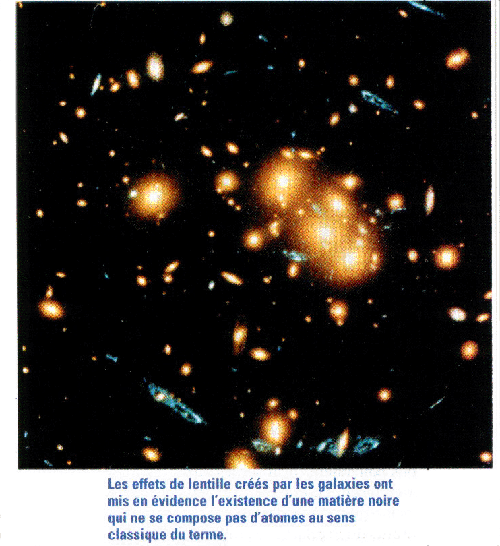
| part, the observation of galaxy rotation confirmed the presence of a halo of dark matter ten times more massive than stars. On the other hand, clusters contain a hot gas heated to millions of degrees. X-ray measurements from the Chandra satellites (Nasal and XMM (Europe)) point here to a quantity of dark matter a hundred times greater than visible matter,.. Finally, another tool has proven itself recently. Gravitational lenses, these natural mirages predicted by relativity, provide a powerful means of probing the geometry of the universe. By monitoring microlens effects, it was possible to determine that galactic dark matter does not consist of atoms in the classical sense, with nucleus O (protons and neutrons) and electrons! These enigmatic objects were named Machos (Massive Halo Compact Objects), and researchers have estimated that they account for less than 10% of the total amount of matter that haunts our galaxy. Therefore, what is the rest of the content of the cosmos composed of, which corresponds to no atomic nucleus or any known particle? No one knows, but ideas are emerging. Physicists already have a candidate in mind: the neutralino, straight from the world of supersymmetry (see p. 29), a possible extension of the "standard model of particles," whose signatures are being searched for in large accelerators. Its interaction with ordinary matter would be very weak. Today, according to the latest available data, the universe around us is composed as follows: |
|---|
-
70% of dark energy of unknown nature and composition, which accelerates the expansion but does not dilute with it - 25% of exotic dark matter (neutralinos from supersymmetry?) which dilutes with the expansion
-
4.5% of ordinary matter, of which the majority is dark and does not shine. Stars and matter visible through its radiation or light absorption account for only 0.5%. Heavy chemical elements such as carbon, nitrogen, oxygen, silicon and iron would represent 0.03%. These are the constituents of the Earth and life.
-
0.3% or less of hot dark matter in the form of neutrinos, abundant but low mass.
F.G.
one part, the observation of galaxy rotation confirmed the presence of a halo of dark matter ten times more massive than stars. On the other hand, clusters contain a hot gas heated to millions of degrees. X-ray measurements from the Chandra satellites (Nasal and XMM (Europe)) point here to a quantity of dark matter a hundred times greater than visible matter,.. Finally, another tool has proven itself recently. Gravitational lenses, these natural mirages predicted by relativity, provide a powerful means of probing the geometry of the universe. By monitoring microlens effects, it was possible to determine that galactic dark matter does not consist of atoms in the classical sense, with nucleus O (protons and neutrons) and electrons! These enigmatic objects were named Machos (Massive Halo Compact Objects), and researchers have estimated that they account for less than 10% of the total amount of matter that haunts our galaxy. Therefore, what is the rest of the content of the cosmos composed of, which corresponds to no atomic nucleus or any known particle? No one knows, but ideas are emerging. Physicists already have a candidate in mind: the neutralino, straight from the world of supersymmetry (see p. 29), a possible extension of the "standard model of particles," whose signatures are being searched for in large accelerators. Its interaction with ordinary matter would be very weak. Today, according to the latest available data, the universe around us is composed as follows:

one part, the observation of galaxy rotation confirmed the presence of a halo of dark matter ten times more massive than stars. On the other hand, clusters contain a hot gas heated to millions of degrees. X-ray measurements from the Chandra satellites (Nasal and XMM (Europe)) point here to a quantity of dark matter a hundred times greater than visible matter,.. Finally, another tool has proven itself recently. Gravitational lenses, these natural mirages predicted by relativity, provide a powerful means of probing the geometry of the universe. By monitoring microlens effects, it was possible to determine that galactic dark matter does not consist of atoms in the classical sense, with nucleus O (protons and neutrons) and electrons! These enigmatic objects were named Machos (Massive Halo Compact Objects), and researchers have estimated that they account for less than 10% of the total amount of matter that haunts our galaxy. Therefore, what is the rest of the content of the cosmos composed of, which corresponds to no atomic nucleus or any known particle? No one knows, but ideas are emerging. Physicists already have a candidate in mind: the neutralino, straight from the world of supersymmetry (see p. 29), a possible extension of the "standard model of particles," whose signatures are being searched for in large accelerators. Its interaction with ordinary matter would be very weak. Today, according to the latest available data, the universe around us is composed as follows:
Vers " Opinion du Cnrs sur les travaux de Jacques Benveniste"
Retour vers Guide Retour vers page d'Accueil
Number of views of this page since March 8, 2005 :