CHERNOBYL 2013
February 14, 2013
Part of a support building of the Chernobyl sarcophagus has collapsed
Le Monde.fr| 02.13.2013 at 10:26 a.m.• Updated on 02.13.2013 at 11:48 a.m.
By Pierre Le Hir and Cédric Pietralunga
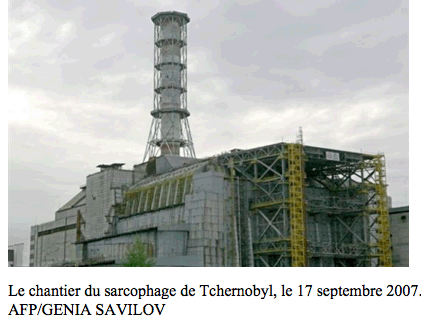
The Chernobyl sarcophagus construction site, September 17, 2007. | AFP/GENIA SAVILOV A partial destruction of the walls and roof of the containment enclosure of reactor 4 at Chernobyl (Ukraine) occurred on Tuesday, February 12, according to the power plant's press service, cited, Wednesday morning, by the newspaper La Pravda and the Ria Novosti news agency.
The damage, affecting an area of 600 m2 and caused by the accumulation of snow, affected an annex building of the reactor.
According to the power plant's press service, "the structures in question do not constitute a substantial part of the containment enclosure" and "no change in the radiological situation has been detected." The collapse reportedly caused no casualties.
Contacted by Le Monde, the Bouygues group, one of the shareholders of Novarka, the European consortium responsible for building a new containment enclosure around the reactor, acknowledges that an "incident" took place on the site on Tuesday.
"About ten meters of roofing of a building housing turbines of the former reactor number 4 collapsed, apparently because of the weight of the snow, explains a spokesperson for the builder. But it is a conventional building, which does not give off radiation in itself." (they always say)
EMPLOYEES EVACUATED
The construction site of the new arch, located only 150 meters from this building, was nevertheless immediately stopped and the employees present were evacuated, a dispersal into the atmosphere of the radioactive dust present on these structures always being possible. "Radioactivity measurements are under way and are for the moment reassuring," it is assured at Bouygues.
The site should however not resume right away. "We are waiting for the Ukrainian authorities to guarantee us that the rest of this roof does not risk collapsing in turn," explains the builder, who specifies that workers are currently clearing the snow present on the most fragile structures.
The affected building is an annex on which the concrete sarcophagus partly rests, built in the six months that followed the 1986 accident, under very difficult conditions, to confine the radioactive materials of the damaged reactor. This enclosure quickly deteriorated.
In a 2011 report on "Chernobyl, 25 years after," the Institute for Radiological Protection and Nuclear Safety (IRSN) noted that "a collapse of the sarcophagus would lead to the suspension of radioactive dust which could, again, contaminate the vicinity of the site."
Inside the sarcophagus, the melted core is still radioactive for thousands of years. (Not to say millions)
THE 1986 ACCIDENT
On April 26, 1986, at 1:24 a.m., reactor No. 4 of the Ukrainian Chernobyl nuclear power plant, in service since 1983, accidentally explodes during a technical test, causing the greatest disaster in the history of nuclear power. The blast lifts the reactor's upper slab, weighing 2,000 tons, leaving the upper part of the reactor in the open air. Several fires start in the facility, which will only be definitively extinguished on May 9.
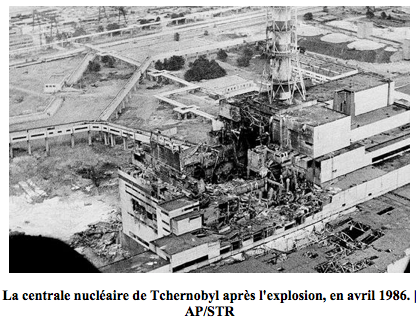
The energy released by the explosion causes an abrupt projection of the radioactive products contained in the reactor core, up to more than 1,200 meters in height. Atmospheric releases will continue until May 5. In total, nearly 12 billion billion becquerels are, in ten days, released into the environment, or 30,000 times all the atmospheric radioactive releases emitted in a year by the nuclear facilities then in operation in the world. An area of more than 100,000 km2 will be durably contaminated.
Nearly 600,000 "liquidators," civilians and soldiers, intervened on the site until the autumn of 1987 to extinguish the nuclear "fire," onto which 5,000 tons of materials (sand, boron, clay, lead...) were dumped. In the following years, they were still about 400,000.
Many of them died from diseases linked to radioactivity and the International Agency for Research on Cancer has estimated at 16,000 the number of cancer deaths attributable to the Chernobyl accident. (The International Agency for Research on Cancer is probably in the pocket of the IAEA, just like the WHO: according to Russian and Ukrainian researchers Alexey Yablokov, Vassily Nesterenko, and Alexey Nesterenko, the deaths are at least 1.5 million)
The Chernobyl nuclear power plant after the explosion, in April 1986. | AP/STR
In 1997, a program was launched to build a new containment enclosure covering the old sarcophagus, with joint funding from Ukraine and an international fund administered by the European Bank for Reconstruction and Development. Its cost: 1.5 billion euros.
The construction of the new concrete and metal arch, with a span of 250 meters and a height of 108 meters, for a weight of 18,000 tons, began in the spring of 2012.
It is led by the Novarka consortium bringing together Vinci and Bouygues. Its completion is scheduled for the autumn of 2015.
The new superstructure is intended to protect the reactor against bad weather (we see…) and to prevent any radioactive release (we also see…) into the environment, but also to allow, eventually (indefinite…), the dismantling of the first sarcophagus.
Pierre Le Hir and Cédric Pietralunga