Untitled Document
The "choice" of England
October 21, 2013
England has just made its choice, opting to build two EPR reactors on its soil.
I added the quotation marks on October 25. Indeed, an article published on Agoravox provides a different perspective on this "choice" of England to "decide" to build two EPRs on its soil. Therefore, I refer the reader to this article.
http://www.agoravox.fr/actualites/societe/article/accord-nucleaire-londres-edf-les-142527
There are some interesting details. I quote;
| In reality, since no one wants EPRs, EDF has outrightly bought British Energy at a high price (15 billion) and renamed it EDF Energy, so that it could order EPRs. Therefore, it is ultimately the French who are selling EPRs to the French, thanks to EDF's money. The trick is crude and costly. |
|---|
I return to what I had written before these details were provided:
Yet, if there is a country that could turn to other options, it is this one. I briefly diverted from the arduous task of writing cosmology works to mention this issue.
The renewable energy resources are indicated in the following figure:
It can be seen that in the south there are abundant solar resources and, on the Moroccan coast, wind resources, where the winds blow with remarkable regularity. Hence the DESERTEC project. On paper, it is magnificent, but politically, hello, when one knows the political versatility of the Arab countries. The Germans may think that after significant sums have been spent to equip these regions, the concerned countries will export this precious electricity at low prices to the European big brothers. If so, they are mistaken. After the oil shock, the "electricity shock".
October 22, 2013: Read this recent information. The Arab countries are considering recovering the DESERTEC project for their own benefit (rightly, it is their territory). The estimated cost of such a project: 400 billion euros.
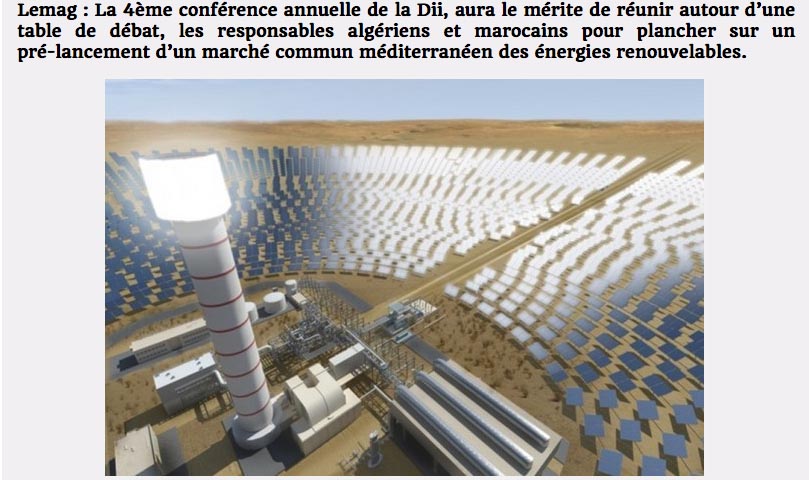
It would be enough for the rich Arab countries to put their hands in their pockets. They have the means to finance such an enterprise, instead of spending billions on buying real estate in London or Paris, or building indoor ski slopes, like in Dubai. Look at all the yellow dots on this map. This could be the future energy paradise. But this wealth would be primarily dedicated to the development of the concerned countries. Electricity could be used for desalination of seawater, thus for the development of the desert areas. By growing tomatoes under solar panels equipped with Fresnel lenses, the Emirates could become major exporters of fresh vegetables.
You should know that all the fresh water used in the United Arab Emirates is produced in a coastal desalination plant powered by oil, including the water for the lawns bordering the highways, through subterranean diffusion.
But his dream was to see the grass grow...
These countries urgently need to develop, suffering from a strong demographic pressure. The Westerners, with their comfortable lifestyles, would then be forced to concede this electricity in small quantities, in exchange for large political concessions (regarding immigration, the extension of their Islamic hegemony). It's a matter to follow.
Will these Arab countries manage to agree, for once? Everything is there. Lawrence of Arabia, in his time, suffered from their tribal disputes. These countries have often found an agreement against Israel, the only one capable of uniting their energies. Enthusiastic agreements, but which have always ended in resounding defeats.
Here, the stakes are of a different scale.
Nevertheless, these resources are unlimited. Just by equipping the entire Moroccan coastline with onshore wind power, there would be enough to supply a large part of Europe with electricity; with the remarkable consistency of the marine winds. With our EPRs, we are really the fools of history. But national independence comes first, even if it is a real suicide manual. You know the English proverb:
Right or wrong, my country
("Whether right or wrong, it's my country")
One could paraphrase it as:
Stupid or not, my country
("Whether its choices are smart or stupid, it's my country")
Parenthesis: one will note, by the way, that the USA enjoy a rather exceptional situation. They have, on their territory, vast areas (the Rockies and their desert regions), suitable for a massive development of solar and wind energy. However, for the USA, oil is the cheapest energy and a major geopolitical tool.
The English, on the other hand, are in a seemingly privileged situation. They have first of all wind and hydro resources (in the latter domain, the potential resources represent 13 to 23 terawatt-hours. (see this interesting document, here, showing the variety of possible formulas), but which would not be able to cover their needs. On the other hand, they are 1300 km away from Iceland, which could become, with appropriate investments, the Saudi Arabia of wind and geothermal energy.
The exploitation of geothermal energy is not without risk. The extraction of such energy from the ground (and it is present in many regions) is accompanied by microseisms of bad omen. This phenomenon has thus led to the stopping of such an exploitation near Basel, which had been victim of a strong earthquake in 1356.
The Basel earthquake, 1356
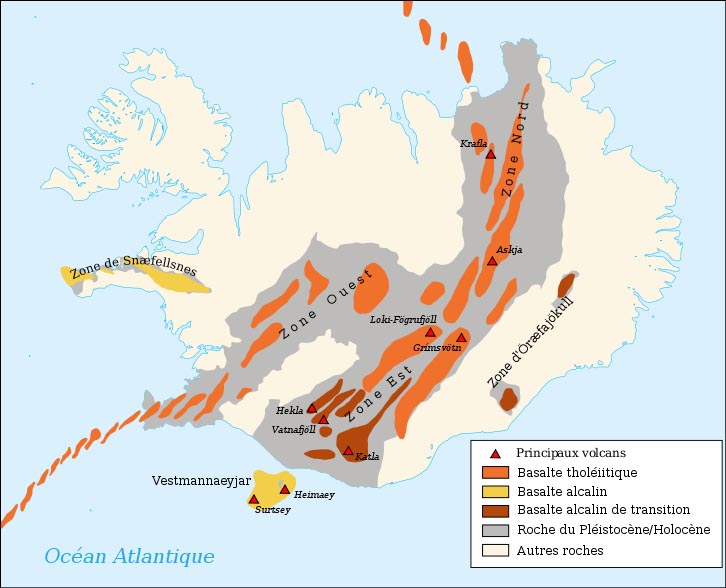
Referring to this event, the Swiss said that geothermal energy exploitation was not without risks and stopped their work. On the other hand, it would be less significant in Iceland, which is a sparsely populated island. The majority of the population is concentrated in Reykjavik, to the west. The island is crossed, from southwest to north, by a fault, which is the emerged extension of the mid-ocean ridge.
The situation in Iceland seems quite different.
The brown basaltic outcrops are the trace of the mid-ocean ridge. Reykjavik, at the end of a small bay, is to the west of this fault line. The two halves of the island continue to move away from each other, and tourists are shown places where this separation is measurable. It seems to me that large-scale geothermal energy exploitation to the east of this fault would not represent a risk for the population, which is concentrated in the capital.
This map reminds me of the memory of a visit led by the Kraft couple, who died in the flow of a pyroclastic surge in Japan in 1991. In Iceland, some geysers no longer function, simply because the temperature at the bottom is not sufficient to trigger boiling. He showed me how to revive the geysers, with dish soap. It is enough to empty a bottle through the top opening. When the product reaches depth, it lowers the boiling point of the water and the geyser revives, once. Then it shoots into the air hundreds of thousands of ... soap bubbles.
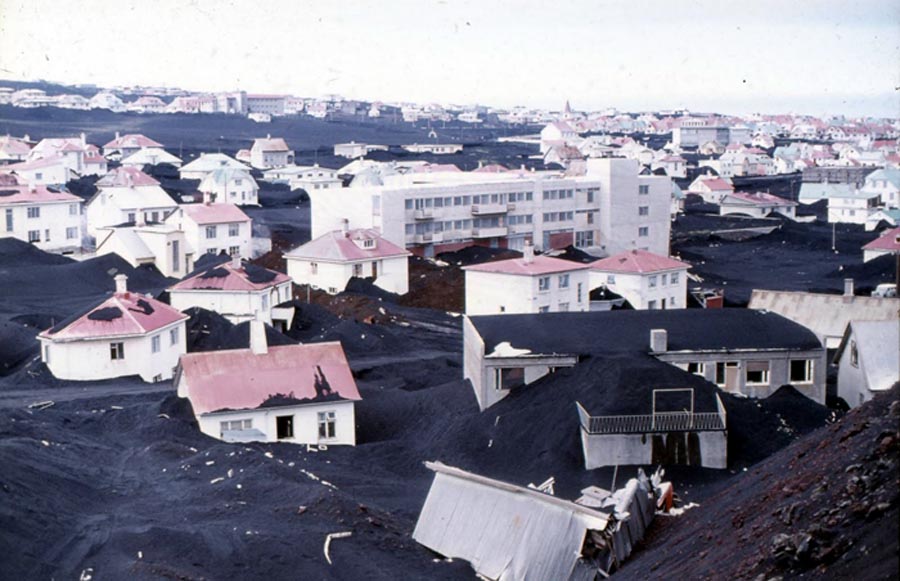
To the south of the island of Heimaey, dominated by the volcano Heldfell. Until January 1973, it was considered as the prototype of an extinct volcano, as recalled the day before, in the course of the holder of the Icelandic volcano chain (authentic). But on January 22, it awoke and buried half of the city.
**The island of Heimaey, partially covered by volcanic ash. **
A short time after, I had the opportunity to visit this region. To the southwest is the island of Surtsey, which resulted from the emergence of a submarine volcano, from 1963 to 1967. It was the geologists who gave it the name of a giant from Norse mythology.
A few years later, a new submarine volcano appeared and a smoking island emerged on the surface. This time, the Icelandic government decided that it was not the vulcanologists who should give names to the islands. This decision had to be accompanied by some political gesture. A visit was then organized by the Queen of Denmark, accompanied by one of her descendants. The Icelandic government intended to give this idea the name of this descendant. Preparations were going well and speeches were already prepared when one night, without warning, the island ... disappeared.
LEYTE**
A reader's message:
Good evening, regarding the article on energy, here is an experience report that I was told by operators of these power plants, in the Philippines, with whom I discussed. Personally, I worked with them on less revolutionary areas.
(installations of the island of ).
The island has two million inhabitants.
At first, it's quite exciting, because we inject pressurized water into the volcano, and we recover steam.
The more we inject, the more we recover... until a certain flow threshold (variable) where we recover a lot of steam for the turbine, and then suddenly, we lose control. The earth starts to tremble dangerously!!!
There are many uncontrolled parameters in geology that make this technique very delicate.
Sincerely, Luc BARANGER
Returning to the possibilities of geothermal and wind energy in Iceland, let us recall that the transport of high voltage direct current power becomes necessary once the distances (including land) exceed 1000 km. This direct current is then transported by a single conductor under very high voltage (up to 800,000 volts). Currently, there are 142 such installations in the world, carrying 100,000 megawatts. This is how the French send, and sell 5000 MW to the English, via a 70 km long line crossing the English Channel.
The Canadians also use this mode of transport to bring power produced by Hydro-Québec, in the north (hydroelectric installations, low drop, but huge flow). The current is created by alternators, the voltage is increased by transformers, then rectified. At the destination, the process is reversed with inverters and cascades of transformers.
Canadian Rectifier Unit
But the English have preferred to start re-equipping themselves with EPR reactors, operating 100% with MOX, that is, with plutonium, which means that an accident on such reactors would have ... unimaginable consequences. The reason for such a decision is twofold. First, there is the pressure from the nuclear lobbies, both French and English. Add that the third partner is China, which raises concerns. Indeed, according to my wife, who is Chinese, there are no days in China where a poorly built bridge does not collapse. And if, in addition, it is for the foreigner ...
The other reason is this obsession with independence:
Same concern in France, under the guidance of our two nuclear deputies, the deputy of the North Christian Bataille and the senator of the Haute Marne Bruno Sido. It is in his department that the CIGEO deep geological repository project of the ANDRA is located, in Bures. Bataille and Sido are concocting a plan for energy independence for the next 5000 years, with the deployment of fast neutron reactors, cooled by sodium, of which ASTRID (600 MW) is the precursor. Read this article, written for the Geneva Appeal II, you won't believe your eyes.
Old men are painting the future of French nuclear energy for the next 100 (and even 150) years.
In this madhouse that is French nuclear energy, do not forget the project of reusing the technology of nuclear submarine reactors, developed in Cadarache, the Flexblue project:
**An artist's image showing an immerseable Flexblue reactor, being transported to a coastal area. **
The same, submerged:
**The mesh is there to prevent the passage of algae and jellyfish, which could block the pumping inlets for the reactor's cooling **
There is not (yet) a project for the installation of such facilities around the French coasts, but I know from a reliable source that the CEA (which does not boast about it) has negotiated with a foreign country the installation of this excellent export product.
At Fukushima, the Japanese are still pumping, like nuclear shaddocks:
TEPCO employees
A typhoon caused the reservoirs containing the contaminated water to overflow, which flowed into the site and drained into the Pacific. The countdown has begun, regarding the recovery of the 1300 used fuel rods in the pool of reactor number four.
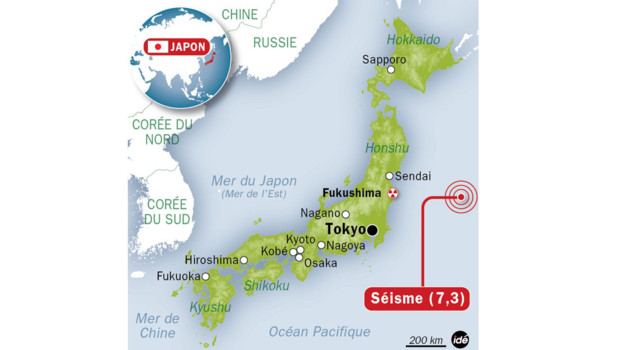
October 25: A 7.3 magnitude earthquake occurred yesterday, practically with the same epicenter as that of 2011.
**The Fukushima nuclear site has been evacuated. **
The 2011 earthquake had a magnitude of 9, but this event yesterday is there to remind us of the chronic seismicity of the region. If the epicenter of such an earthquake were located not 200 km offshore, but in the Fukushima site itself, it could cause the collapse of the pool of reactor number four, which is known to have been significantly weakened, and whose sudden drying could cause an international catastrophe. This reminds me of the theme of the conference given by a representative of Cadarache in June last year, at the Ecole des Arts et Métiers d'Aix en Provence and whose theme was "After the situation has been normalized at Fukushima, the status of the restart of the Franco-Japanese collaboration in nuclear energy ".
Back to France. Consult the two Internet pages on the Tricastin site :
AREVA : The Tricastin site: an unique industrial site in Europe
WIKIPEDIA : The Tricastin site
In the second, you will find, in the large chapter titled Pollution and incidents (latest one: 2013, a insulator explosion )
September 2008 stuck assemblies
On September 8, 2008, 2 assemblies remained stuck to the internal upper structures during a nuclear fuel renewal operation. As soon as the anomaly was noticed, the operation was immediately stopped. The 2 assemblies remained suspended under water in the vessel, while the operator carried out the evacuation of the reactor building and its isolation.
The assemblies remained stuck for more than a month.
EDF proposed technical solutions on October 14 to recover the two assemblies. The Nuclear Safety Authority evaluated them on the "mock-up" of the center for the experimentation and validation of intervention techniques on pressurized water reactor boilers (CETIC) in Chalon-sur-Saône. On October 22, the ASN gave its approval to the operation.
There was no risk due to criticality, nor due to the failure of cooling of the assemblies, during this incident.
A similar incident had already occurred in France on an assembly in 1999, at the Nogent nuclear power plant (Aube), which also ended without any particular problem. However, the situation at Tricastin was different with 2 adjacent assemblies suspended, instead of one in 1999.
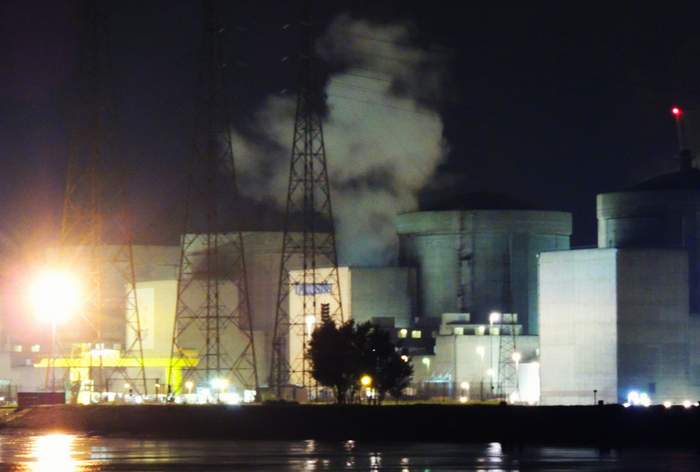
But, in the night of October 24 to 25, 2013 (yesterday, at the time I am writing these lines), one of the reactors at Tricastin, insufficiently cooled due to the condition of the fluid arriving at the pumps (a viscous sludge, a mixture of water and sediments), automatically shut down. That is to say that the control rods fell automatically, while an automatic release of the secondary circuit, also insufficiently cooled, was triggered. See the article and the photo below:
*Compare with the presentation of the site, resolutely optimistic, made by AREVA, already cited: *
The Tricastin site: an unique industrial site in Europe
Night of October 24 to 25, 2013: automatic release of steam from the secondary circuit, whose cooling is no longer ensured
*Everything is for the best in the best possible nuclear world. *
*At Fukushima there are 1300 elements to extract, at 30 meters in height. *
To review the history of Fukushima as I followed it for you in 2011