Criminal negligence during French nuclear tests
The failed Beryl test at In Ekker
(Sahara, May 1962)
The bomb released 20 kilotons, but 50. The armored doors gave way
On May 1, 1962, the French conducted an underground nuclear test at In Ecker, in the Sahara. Pierre Messmer and Gaston Palewski, ministers, were present (Messmer was then Minister of Defense). The test was conducted in a gallery carved into a mountain, in a spiral shape, sealed with reinforced concrete and metal beams. A system had been set up to allow wires leading to measuring instruments to pass through. During the explosion, the sealing system of this opening failed, and radioactive materials were ejected outside. These photos were taken moments after the detonation.
In the foreground, observers with cameras, wearing the most basic protective suits. Two had their heads uncovered. They were not equipped with masks. The wind blew the cloud back towards the people present, causing a real panic. Messmer, who had refused any equipment given the ambient temperature, fled by car, but his driver, while the car was passing through the radioactive cloud, left the air conditioning on. The two ministers were irradiated. No exact account of the accident is available, but these photos give an idea of the extent of the releases.
I hesitated to put these photos on my website, as they had been sent to me two years ago by an unknown sender. I did not know if these images could still be subject to a diffusion ban due to national defense secrecy more than forty years after the 1962 test, which could have been an excuse to close my site under the provisions of the LEN law. However, the film was later shown on France2 during an episode "Irradiated for France" in 2005. Here are these photos :
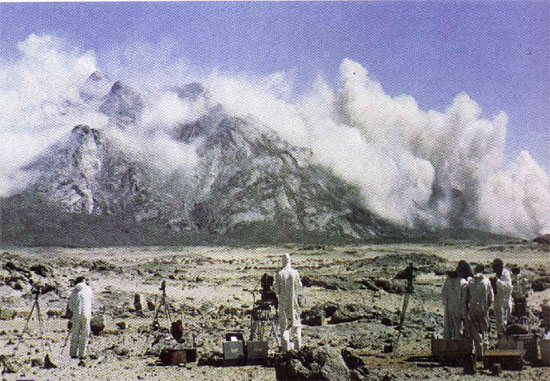
Something went wrong.....
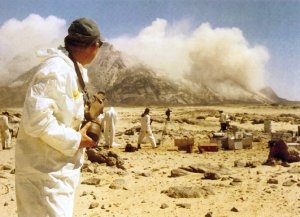
Fortunately, I was equipped....
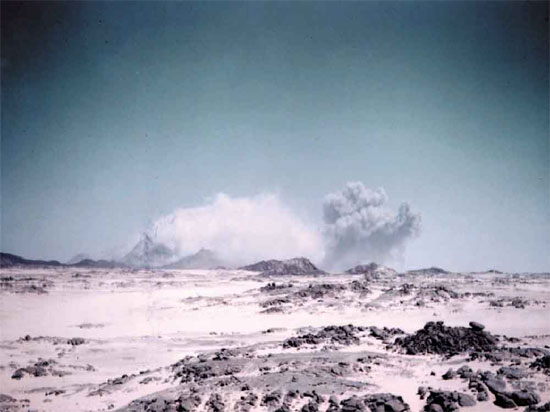
The mountain, completely hidden by the cloud of radioactive material
According to Messmer himself, a spiral-shaped tunnel had been dug into a granite mountain. More precisely, a spiral-shaped gallery ended a one-kilometer-long straight gallery, sealed with concrete. The sealing failed, and a huge mass of radioactive debris was ejected. Messmer claimed to have been irradiated, but he is still alive (he is 89 years old). Gaston Palewski died of leukemia in 1984. Messmer confirms that Palewski was always convinced that he had contracted his cancer as a result of his irradiation. The documents shown and the testimonies collected during this broadcast were eloquent. Whether it was the Sahara or Mururoa, no precautions were taken to ensure the safety of the military. This contrasted with the precautions taken by civilians working for the CEA. During the aerial explosions in the Sahara, a helicopter was sent to fly over the "zero point" a few minutes after the explosion, without it being equipped with sensors. A tank was also sent to move over the vitrified terrain from the fireball, without it being equipped with measuring devices and without its crew being provided with protective suits. As Messmer, then Minister of the Army, simply comments: "The Americans and the Russians did the same, so we did the same."
The helicopter pilot became blind. Worse still, after the underground explosion at In Ecker, ordinary soldiers were sent "to collect samples in the spiral-shaped tunnel". These soldiers did not live long. Their immune systems had been affected, and they had to be placed in a sterile atmosphere, and their families were not allowed to approach them. During the France 2 broadcast where Messmer was on the set, the widow of one of these soldiers, who had died shortly after, was also present. She mentioned, among other things, that she had not been entitled to a war widow's pension, but that her husband had been "retired at 32 years old". At the same time, a colonel had strongly insisted that the utmost secrecy be maintained regarding this matter "for national defense reasons". This poor woman, during the broadcast, simply requested that the mention "died for France" be added to her late husband's record.
At no point, regarding all these facts, did the France 2 journalist ask Messmer the question that should have been asked:
- Finally, Mr. Messmer, you were Minister of National Defense in 1962. You had been since 1960. So you were certainly aware of all these facts in 1962, weren't you?
The question was much more "mild":
- Mr. Messmer, in the face of these testimonies, what is your reaction?
The wife of the deceased soldier also "knew how to behave" (otherwise her intervention would have been cut during editing, as were all mine on television regarding the issue of underground nuclear tests). Regarding this request, the former minister responded:
- Madam, for this to appear on the death certificate, the death must have occurred during a war. It was not the case. For it to appear on your husband's service record, the law would have to be changed, which is not within my power.
A soldier who had worked at Mururoa testified:
- We were protected from nothing. One day I saw CEA employees coming to clean metal parts at the edge of the inner lagoon where we were swimming. They wore full-body suits and masks. They cleaned these parts with some kind of foam that the wind carried towards us, floating on the lagoon water. At no time did they warn us of any danger.
Nuclear tests are classified as national defense secrets. It was therefore impossible to report them before a 60-year prescription period. Chief Warrant Officer Jacques Muller, married with five children, now 67 years old, testifies. He spent thirty-three years as a helicopter pilot in the Alat, the light aviation of the Army. He was present during this failed test, conducted near the In Amguel base. He has been blind since 1987 and is convinced that this deterioration of his condition is linked to his irradiation. He has sought witnesses and eventually managed to have Pierre Messmer, former minister of the army and present at the time, heard as part of a commission rogatoire.
**Testimony of Pierre Messmer, December 5, 1995: ** I was present at In- Amguel in Algeria between April 16 and May 14, 1962, to attend nuclear tests (...) I was accompanied by Mr. Gaston Palewski, himself a minister for research. An incident occurred during an underground test (...) causing a release of gas and radioactive dust (...) Immediately, the exposed personnel were returned to the base and that evening, all the people present on the site, including the two ministers,...