Hurricane Wilma, October 2005. Solutions for hurricanes, earthquakes
Hurricane Wilma
October 19, 2005
I have a lot of work. I'm being asked from all sides. I have to work on several book projects and also battle to publish our recent research results. The GESTO report is finished since last night. All that remains is to print it.
Avian flu, various aspects of current events, scientific problems: I have files piling up. I receive two hundred emails a day, many of which represent files composed by my readers, often very well done, which would require treatment. I have to make choices. But this morning Wilma becomes a priority. It's not about sensationalism. There are things to say, urgently.
After Katrina, Rita, after the tropical storms and catastrophic floods that devastated Central America, after the earthquake that killed tens of thousands of people at the Indo-Pakistani border, here comes Hurricane Wilma, which in a few hours rose from category 4 to category 5 and apparently heads towards Central America after forming south of the island of Cuba. Category 5. Measured winds reach 285 km/h.
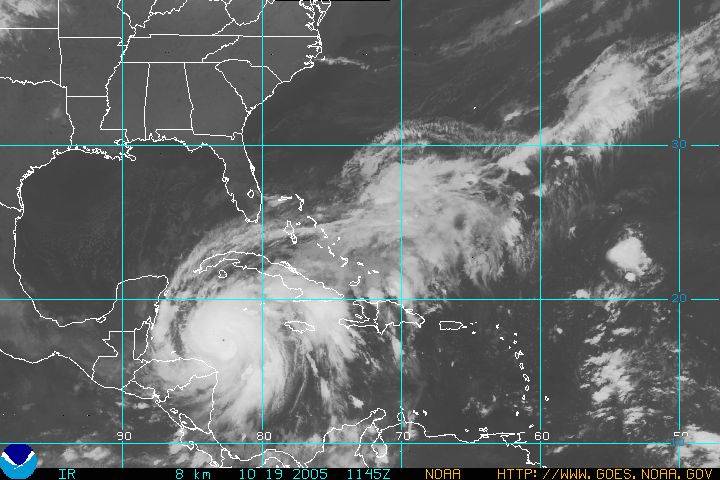
Wilma: a monster as big as the Gulf of Mexico
Those who want to contemplate this real monster just have to look at the infrared animation on the link:
http://www.ssd.noaa.gov/PS/TROP/DATA/RT/float-ir4-loop.html
This is the site http://www.ssd.noaa.gov . NOAA stands for "National Oceanic & Atmospheric Administration"
An image of Wilma in infrared, showing the extent of the disturbance. The depression at 885 millibars is the lowest ever recorded for a cyclone formed in the Atlantic.
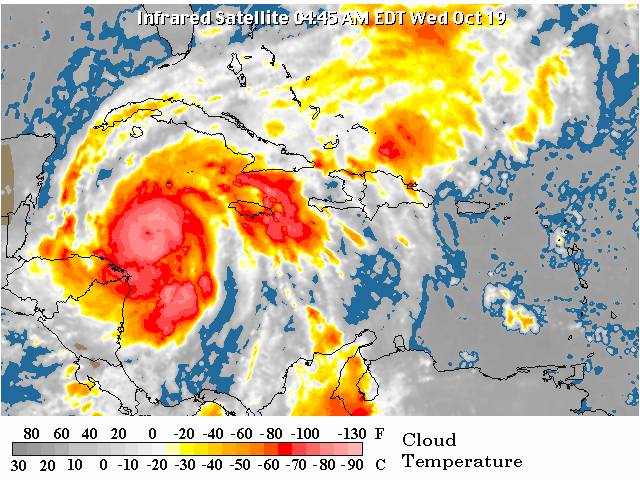
Infrared image ****
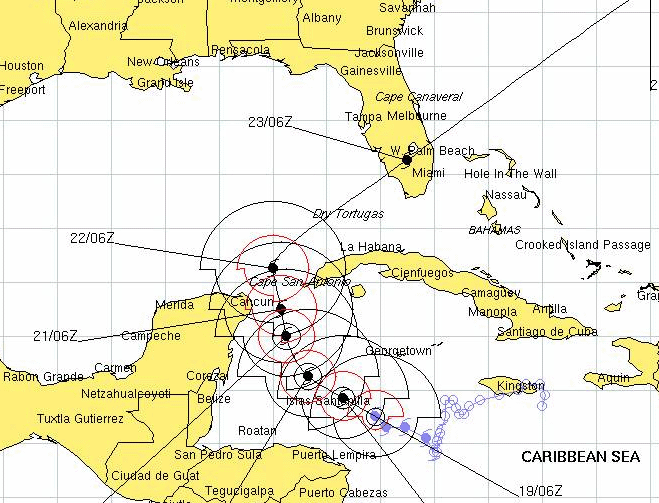
The approach trajectory of Wilma, heading north
Found on the web by Eric Dezoete an animation that shows a high-level thermal signal of strange nature.
Many human lives will disappear. Men, women, children, the elderly will be drowned in floods, buried under mudflows. Their houses will be shattered by the force of this new "Big Bad Wolf". Yet there are solutions to save many human lives in these high-risk regions. I will try to mention them for you.
****There are several types of problems. First, we need to consider homes that can withstand lateral winds of 200 to 300 km/h. Solutions have existed for a long time. For now, they correspond to manufacturing costs that are too high because these strange houses were not designed with this in mind. These are the Domespaces, invented by the Frenchman Patrick Marsilli.
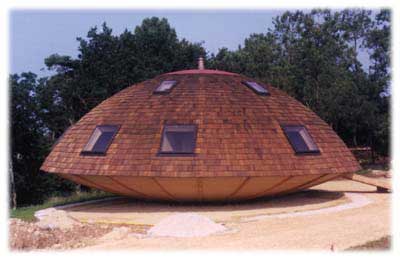
Patrick Marsilli's Domespace
Here is his website:
In the presentation, the "bio" aspect of these houses is emphasized. They are indeed rich in surprising solutions, which you discover on the site. Some models can rotate with the sun. Their habitability is astonishing. They are well protected from cold and heat by cork balls, placed between a "bardots" wood covering, like Canadian houses, and a plywood ceiling. The interior is warm, etc.
But they have qualities that should be exploited as soon as possible, through low-cost versions. For now, installing Domespaces around the world, in risk areas, would be impossible due to their price. Personally, given the human urgency, I think this system should be immediately placed in the public domain, even if a fixed compensation sum is paid to the company or if research is sponsored that it is best placed to undertake in order to develop models that can be implanted in very poor regions.
The idea is obvious. A house with vertical walls is the worst thing to face a lateral wind. The "drag" of such an object is maximum. A house has never been designed to be "streamlined." Either it resists, or it bursts like a nut.
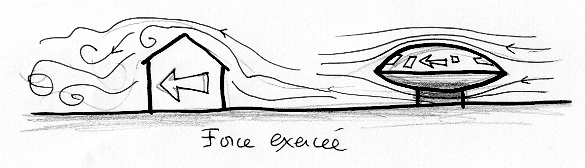
In contrast, the Domespace has minimal wind resistance. If it is only about withstanding strong winds, without the risk of flooding, the dome formula is interesting. The construction style is then as follows:
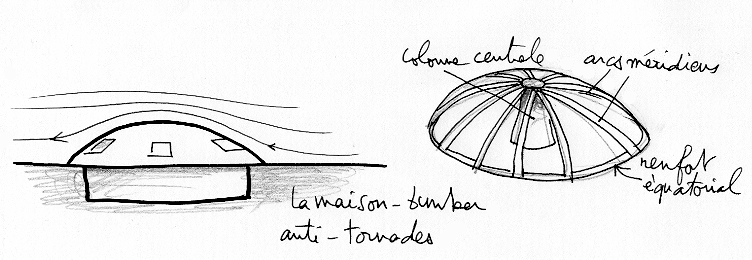
There are regions in the southern United States where winds of unprecedented violence periodically occur, reaching up to 300 km/h. All houses potentially located on the path of such tornadoes are equipped with a basement shelter, the last resort. It often happens that survivors of such a passage emerge, once the monster has passed, by opening the trapdoor of their bunker and finding only the cement base of their house, the rest having been pulverized into fragments scattered over hundreds of meters. A house in the shape of a dome would have the best chances of withstanding strong winds. When faced with such risks, aesthetic questions no longer matter; the house must be above all a bunker.
Second problem: the house is not only subject to violent lateral winds, but also to a liquid surge. This can be flooding due to rain. In these conditions, it is possible to install it on pilings or on a strong central pillar, offering low wind and liquid surge resistance.
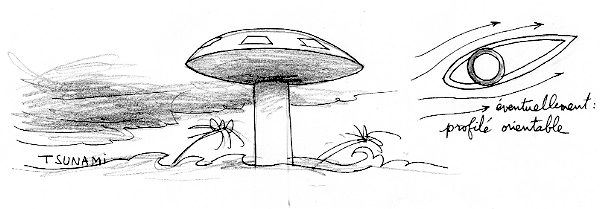
But the elements can be of a nature to carry everything away. Another, extreme, solution can then be considered. The Domespace house is an extremely resistant box, which can also be made watertight. It is then no longer a house but an ark where its inhabitants can take refuge. Light, this house can float on liquid elements. Of course, it is not possible to face all situations. A Domespace carried away by a raging current could burst if it encounters an obstacle such as a rock or a tree. But the chances of survival would at least be greatly increased, in these fixed or transforming bunkers.
Patrick Marsilli
, the designer of the Domespace, informs me that his company holds certificates attesting that its constructions have withstood winds of 240 km/h. Domespaces have endured gusts of 280 km/h during the passage of Hurricane Tim in Taiwan.
Furthermore, the Domespaces have an anti-seismic rating of 8 on the MSK scale.
He tells me he has worked on low-cost Domespaces via local production using laminated wood or "riveted" structures.
Patrick Marsilli
, the designer of the Domespace, informs me that his company holds certificates attesting that its constructions have withstood winds of 240 km/h. Domespaces have endured gusts of 280 km/h during the passage of Hurricane Tim in Taiwan.
Furthermore, the Domespaces have an anti-seismic rating of 8 on the MSK scale.
He tells me he has worked on low-cost Domespaces via local production using laminated wood or "riveted" structures.
That's how to deal with this type of risk. Now let's move on to earthquakes.
Solutions have been found for millennia. Egyptologists have them under their eyes and pass by without seeing them. In Egypt, in Central America, the constructions are under the sign of resistance to earthquakes. How? By prohibiting any binding. An earthquake represents energy that must be dissipated, anyway, one way or another. Then comes the concept of fragility, which is immediately obvious. Hit an object with a hammer. You will give it a certain amount of energy, of kinetic origin ( the energy of an earthquake is vibratory ). What will happen?
If the object is fragile ( a glass, any non-elastic material ), it will break. Now, traditional constructions, in reinforced concrete, from the point of view of material resistance are fragile. Concrete is not known for being elastic and flexible. It cracks. The steel bars break. Then ceilings fall, crushing schoolchildren. Entire buildings collapse, killing their inhabitants. All this is too fast for these buildings to be evacuated. In Pakistan in October 2005, everything happened in a few seconds.
Therefore, we need to consider solutions to dissipate this energy in another way than by cracking; the breaking of materials. In so-called anti-seismic constructions, very sophisticated systems are implemented that give buildings a certain elasticity. High-rise buildings can then undergo metric lateral movements, being placed not on pillars but on flexible blades.
Seismic waves are of several types. They can cause shear forces, horizontal or vertical. The most elaborate anti-seismic constructions are therefore able to withstand these two types of stresses with appropriate damping systems. But it is easy to imagine that all of this is very expensive, beyond the reach of poor countries.
Sometimes catastrophic earthquakes kill a large number of people in areas where the housing is modest ( and not very resistant ). Then ceilings fall, walls topple, simply crushing the inhabitants. By always opting for constructions not designed to absorb deformation energy, the catastrophic outcome is assured. One then speaks of "fate." One implores Allah, Vishnu or Christ, as one chooses, without further examining the laws of material resistance. All of this irritates me because people have already found solutions for decades, particularly a Frenchman, Fernand Ortega. I will talk about his achievements later.
Here, the principle is different. These houses are not flexible, but designed to absorb energy, like the pyramids of Giza. Because there is nothing more anti-seismic than these last homes of our dear pharaohs. The designers applied the principle of this dear Imhotep:
What is already cracked will not crack anymore
One cannot be more cracked than the pyramids, since they are piles of stones stacked on top of each other. Take a pyramid? Shake it, hard. It will slightly deform, but all the small movements of the blocks against each other will dissipate the energy, by friction, in the form of ... heat. Go see, on my site the photos of the rhombic pyramid, on the Dashour site.
**At the bottom, the red pyramid of Snefru. In the foreground, the covering of the rhombic pyramid. Note the angle of the joint planes. **
The stone layers are even inclined so that in case of horizontal tremors everything automatically realigns. Look at the special shape of the "pyramidions": the same underlying idea.
In contrast to the triangular blocks that litter the sites where the pyramids are located, but which are, as I have shown, only remnants of cutting and not elements of the covering. But this is another story.
Should we build houses in the shape of pyramids? Let's not go that far. Although, as Devos would say.....
Indeed, there is a lot to "read" in these ancient constructions, based on the "golden ratio," which is not magical but is "the least resonant of all numbers". Architects who will one day be called upon to build in seismic areas should engrave this number in their heads and introduce it into the maximum number of ratios involved in their constructions. Simply because elements related by this ratio have the least possible chance of exchanging energy by resonance. It is an experimental fact. It is ... mathematical ( property of non-resonance discovered by Kantor, when he tried to evaluate the degree of irrationality of numbers ).
What disturbs is that many ancient constructions use this property. It causes disorder.
In antiquity, they avoided the binding, even though it was already known. They preferred to be "cracked," rightly, which dissipates energy throughout the volume of the construction. If it is not the cracked, the inhomogeneous is also dissipative. An example. The Giza plateau has a structure of a thousand layers with alternating layers of limestone and clay. Very effective for attenuating horizontal seismic shocks.
Such a structure is also found, I believe, in Lisbon, where a neighborhood built on this natural substrate escaped destruction, while next to it, hello to the damage. Thinking "anti-seismic" would also mean preparing the ground deeply, which would not prevent buildings from being as resistant. The "hard" tour is not mandatory. The skyscrapers of Mexico are built on ancient swamps and their verticality is ensured by a system of jacks. Same solution, if you don't know, for the Eiffel Tower.
Seismic waves are not composed only of long-period shocks. Short-frequency waves are also destructive. Go take a look at the Colossi of Memnon ( 23 meters in height ).
They have lost all their reliefs, not because Muslims would have degraded these anthropomorphic statues, contrary to the imperatives of their religion, but simply because of resonance phenomena. An ear here, a finger there. The Sphinx has not lost its nose due to a cannon shot, but probably due to an earthquake, which had already devastated the initial shape of its head, the nose having had to be retailed smaller ( have you noticed that compared to the body it is tiny? ).
To resist earthquakes, it is necessary to avoid the creation of slip planes. Hence the apparent disorder of ancient constructions ( Egypt, Peru ) which archaeologists, in their majority, have not yet understood, who rebuild "straight." Example: look at the paws of the Sphinx.
Same thing in the reconstruction of the Kom Ombo temple, on the Nile bank, dedicated to the crocodile god Sobek. For those who have made this trip or are about to make it, upon arrival on the site, put your back to the Nile. Look at the wall under reconstruction, in the foreground, and the ancient wall, behind. Obviously the ancients "did not know how to build straight." Well, if you still have doubts about Egyptology, take a look at this photo taken at Karnak and look for the error.
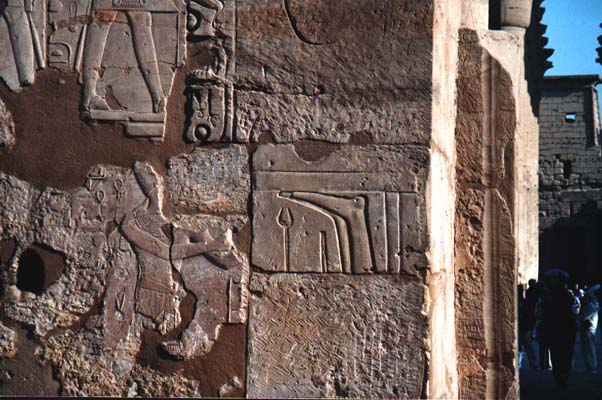
or go to my Egyptological bêtisier.
There is a Frenchman who has invented an absolutely brilliant mode of construction. His name: Fernand Ortega. It turns out ( I realized it by trying to reach him by phone ) that he is my neighbor. He lives a few kilometers from me. He does not have a website, but I will soon dedicate pages to his concepts and achievements. His ideas are brilliant, but as usual, in France, people like him have been struggling for years. As I will soon have images and maybe even some video clips, I will only give a schematic description. Ortega's houses are built without binding, without cement. He has therefore been the object of a powerful barrage from all the cement companies in the world, Bouygues at the head. The construction elements are molded. One could speak of "reconstituted stone" in the sense that Ortega creates these elements, imperishable, solid, with a zero coefficient of expansion, for example, "from the stones of the roads" or from the debris of houses, following an earthquake ( when rebuilding in a traditional way, the evacuation of such debris is immediately a problem. Ortega, on the other hand, recycles them ). These debris are agglomerated with a product of his invention. They can then take any possible shape and be equipped with tenons, male and female, so as to be assembled in the style of Legos. It's as simple as that, it's brilliant, but it remains practically unused.
In France, teams of rapid intervention have been created, ready to install on the sites of disasters hospitals in kits, emergency antennas. If I were minister, I would entrust Ortega with the task of creating teams that, transporting the trailers described above by plane, would set up elements allowing to rebuild villages and cities.
Ortega has indeed designed a trailer of about ten meters long that contains everything needed to continuously produce these "bricks." On one side, you pour in wheelbarrows full of debris from collapsed houses. In the middle, you add the "catalyst" and at the end, the Lego bricks are ready for use. The system does not require exceptional technicality. Two or three illiterate but clever maneuvers can build a house with an upper floor. The house is built on a cement base. It is "chained." There will be a complete file on the subject. I saw a complete video of its construction 15 years ago. Its advantage: it "bends and does not break." It is impossible to crack it: it is already cracked. I just spoke to Ortega on the phone, whom I will see tomorrow. His house is anti-cyclonic, it is capable of withstanding winds of 300 km/h. So, damn it, what are we waiting for, instead of continuing to build traditional things that kill people by falling on their heads!
This is my answer to this series of disasters that have been falling on the Earth for months. And I fear that this series is not about to stop. Today, October 19, it is announced that an earthquake has occurred in Greece, after it was hit, after Romania, by avian flu. The North must urgently take care of the South, the rich countries of the poor countries. Recently, demonstrators mentioned that in the world, a person dies of hunger every four seconds, while, the book by Ziegler shows, the Earth has enough to feed three times the number of people who inhabit it.
We must not only feed people, but also keep them healthy.
Can Tamiflu protect humans against the pandemic that everyone fears? Precautionary principle: better to anticipate the response.
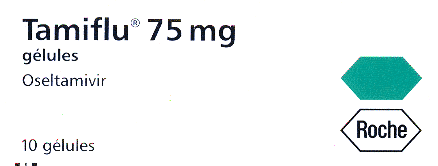
Only the Roche laboratories are supposed to be able to produce this medicine. But if the pandemic occurs, will the current stock be sufficient? One can doubt it seriously. On the other hand, large profits are to be expected for the company that would consider lowering the production conditions under license. But if hundreds of thousands of lives are threatened, this medicine, if it proves effective, could still be the object of rights?
When our public services, our spokespersons tell us "that everything has been planned and all precautions have been taken," it is precisely when we hear this that we are tempted to worry. Some remember the declarations of journalists, hammered on the television channels at the time of the first cases of AIDS. I still remember a woman who was entrusted with this mission of reassurance, repeating day after day:
*- We should not dramatize and say that only a small part of the people infected by the virus will contract the disease. *
It was nonsense, as always. We learn that poultry raised in open air are "regularly monitored by veterinary services." This being said, we have seen that in other countries, either these poultry were actually brought into buildings, or the farmers stretched nylon nets over the areas where the birds could roam, on which migratory birds or any other flying vector of the infection cannot land. But we know that it is through the droppings that the contagion occurs. We also know that migratory birds willingly land in poultry farms to peck at some food. Should we put up signs with "Have lunch, yes, but please, go take your bathroom elsewhere." Another remark: How does the epidemic spread? Some even doubt that it is due to migratory birds (...). About this, one really hears anything and its opposite these days.
A journalist explained to us that in certain farms "the poultry took their meals inside the buildings."
When sick animals are recovered, veterinary services handle them with protective clothing and rubber gloves. But the duck hunters, on the other hand, take them by hand.
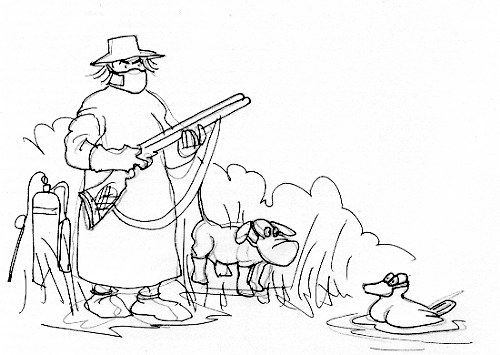
An epidemiologist told us, during a variety show where they were loudly joking about the Earth periodically experiencing influenza pandemics, according to a relatively high frequency. Is it not a first that this one affects migratory birds? That's the whole problem. Influenza is nothing. The so-called "Spanish" flu, which killed ten million people at the end of the First World War, originated in the ... United States and was very likely brought to Europe by the American Expeditionary Force. Like all influenza viruses, they are airborne, can be transported by air. The Spanish flu was a dreaded lung infection because the virus had the property of attaching itself to lung tissue and injecting its clones, which in turn parasitized cells. We know that a virus obeys only one rule:
Grow and multiply
It is a parasite that is capable of penetrating inside cells by taking control of their "assembly workshops" which then work for its benefit. Their weakness is their vulnerability to an increase in temperature, to fever. The emergence of a virus that suddenly becomes "thermoresistant," equipped with a sufficiently effective propagation vector, would rid the surface of the Earth of the human species in a few months
I only wish that these pandemic noises are just an alarm for nothing. Otherwise, poor us.
Even if I have to play the alarmist, the conspiracy theorist, I will still let out a thought, just to take note. I hope the future does not confirm this hypothesis. We have known for months ( and we knew for years ) that we are able, thanks to nanotechnology, to produce "chips" of sub-millimeter size. Six months ago, the company Gillette had considered equipping 100,000 of its next razors with chips, made by the alien technology company ( it's not a joke, go to http://www.alientechnology.com and in particular to the military applications section ). Dimensions: 100 microns, so easily injectable with simple syringes. We also know how to configure these chips so that they can fix themselves at specific points of the human body. Below is the home page of the site "Alien Technology," literally "Technologies from elsewhere" (...).

These tiny chips can be fired from rifles and their entry into the human body will then be perceived "as a simple insect bite." They can also be adapted to the end of the needles of the famous Tasers, in which case they will remain in the body of the subjects thus "treated." Another version: the introduction of such chips deep into a human brain, through a small hole made in the skull after anesthesia ( the provocation of a loss of consciousness by the action of pulsed microwaves is a perfectly developed technique ). The entry hole will heal very quickly. The chip will be undetectable and without unwanted effects until it is activated. Anything can then be considered. It can serve as a receiving antenna for orders delivered from space or from any other transmitter. It can secrete a toxin and cause death. One can use it to cause a brain tumor or to modify the behavior of large groups of human beings. In a file I had mentioned the fact that one could water large regions as part of the "war of waves" ( mentioned by journalist Robert Arnaut in his program on the waves of France Inter "Histoires possibles et impossible" as early as 2002 in an episode titled "La Guerre propre," listenable in archives, 3.5 Mo, 29 minutes. Fascinating ). Below is an illustration taken from a document from the DoD ( Department of Defense )
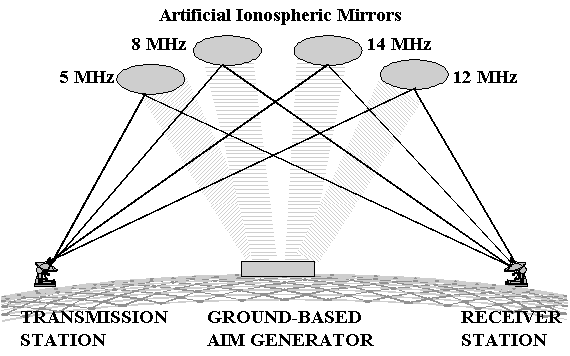
Compare with the illustration I composed in August 2002, accompanying [a With such systems it becomes possible to water entire countries. Two countries in the world currently have this technology. Coupling this modern technique of "crowd control" ( mass control ) with the idea that the subjects have a receiver implanted in their body. But, how? Through a wide vaccination campaign, proposed after a conditioning ( pandemic ). For each ethnicity, its "specific vaccine" and the possibility of finally having an "ethnic weapon," which is the dream of all great powers. Simple hypothesis.
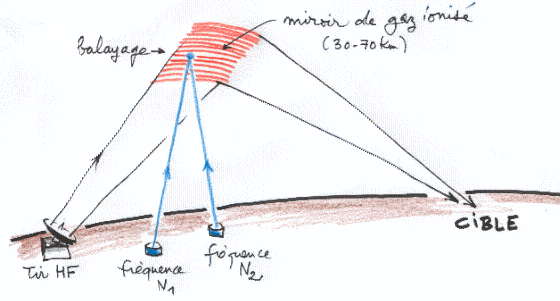
I tell you: we live in a wonderful time.
October 19, 2005:
The Garbuna volcano group (Papua New Guinea) erupted after 1700 years of inactivity.
The Garbuna volcano group, located on the island of New Britain in Papua New Guinea, erupted on Monday, October 17, 2005, after a very long period of rest of nearly 1700 years.
No surveillance equipment having been installed on this volcanic massif, the population was not able to be warned of a possible reactivation of its volcanoes.
These volcanoes - which were thought to be "extinct" - began to roar dangerously.
A plume of ash 4 km high spread from one of the craters, and the nearby village of Garu was dusted with volcanic ash.
More than 20,000 people are directly threatened by this group of volcanoes.
October 19, 2005:
The Garbuna volcano group (Papua New Guinea) erupted after 1700 years of inactivity.
The Garbuna volcano group, located on the island of New Britain in Papua New Guinea, erupted on Monday, October 17, 2005, after a very long period of rest of nearly 1700 years.
No surveillance equipment having been installed on this volcanic massif, the population was not able to be warned of a possible reactivation of its volcanoes.
These volcanoes - which were thought to be "extinct" - began to roar dangerously.
A plume of ash 4 km high spread from one of the craters, and the nearby village of Garu was dusted with volcanic ash.
More than 20,000 people are directly threatened by this group of volcanoes.
Return to Guide Return to Home Page
**Number of connections since October 19, 2005 ** :