Annihilation of shock waves
How to Annihilate Shock Waves
An idea 100% Jean-Pierre Petit, from the late 1970s
November 21, 2003
When I gave this lecture at the Toulouse School of Aeronautics in June 2003, I presented this key idea, and I was immediately understood by them and by the teachers of supersonic fluid mechanics who were present.
I realize, before resuming the presentation of this idea, that it is [present]. Suppose you have already read this file from January 2001 (and the participants of the meeting commented by Szamès should not know its content). Why is the "MHD-controlled" air intake, on aircraft traveling at supersonic speeds, like Aurora (I claim: operational since 1990), located on top?
First point: on top, these machines are as flat as a hand. Refer to the photo showing a model of the Ajax device, taken in a wind tunnel:
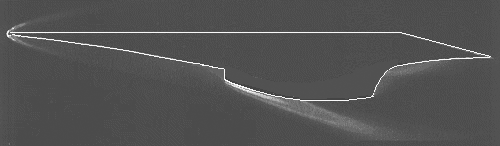
It was not me who found this photo, it was ... Szamès, in the paper he published in Air et Cosmo at the end of 2000, just before the Brighton conference, at which he participated. A simple detail: after this conference, he told me:
*- You were the only one to have spoken about MHD at this conference. Personally, I did not hear that word once. *
Our shoe salesman does not know that in conferences, the most important discussions do not take place in the room, but among specialists, away from prying ears (or simply incompetent ones). Let's take this drawing and show the characteristics and shock waves that establish around the device (a simple remark: the light phenomenon that can be seen at the extreme left of the photo, near the knife-edge leading edge of the device, does not correspond to the shock wave but to the electrical discharge that was applied to measure during this experiment focused on reducing thermal effects in this area).
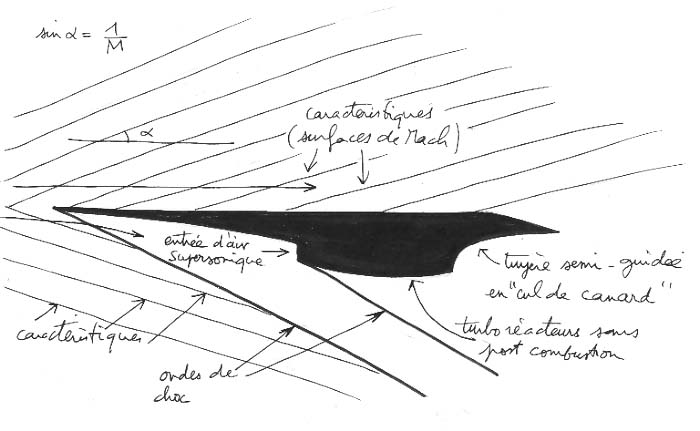
Shock waves establish at the lower part of the device, not on the top, which is "in the wind tunnel". For a shock wave to exist, there must be a change in the direction of the velocity. The bevel of the leading edge of Aurora-Ajax is designed so that its upper part is tangent to the "streamlines" in the direction of the upstream gas flow.
At the lower part, there are two shock waves, the second starting from the beveled edge of the air intake (very similar to that of the "Concorde", which leads to conventional turbojets*!
When the speed of the machine increases, the temperature jump varies roughly like the square of the Mach number. At a certain point, beyond Mach 3, the lower air intake can no longer be used, otherwise the heating of the gas would vaporize the turbine blades of the compressor. At high Mach number (ten-twelve), this temperature rise would be so high that even a scramjet air intake, cooled by the circulation of liquid fuel, would not be able to resist. The thesis of the scramjet (a supersonic combustion ramjet), promoted by the Americans in their "projects", is only a nice misinformation in which the Europeans throw themselves headfirst. The aeronautical journalist Bernard Thouanel, completely incompetent in MHD, obviously adheres to it (since ... it's on the internet).
The lower air intake will therefore be closed and the overpressure generated by the shock wave will provide lift. These devices "ride" on their lower shock wave, they are called "wave-riders". The concept dates back ... to the 1950s, check it out, when an "external combustion" was considered, under the device, behind the shock wave (but which, alas, "heated the small birds, if there were any at this altitude).
An air intake is opened on the top, whose geometry resembles the output of certain laser printers. In front of it, a long section equipped with a wall MHD generator (see my book). This MHD generator produces electrical energy, which will then be re-injected at the back of the device, in the semi-guided vein section, in a "dead end", located at the back, to increase the specific impulse of the exhaust jet. This is the "MHD bypass" system (MHD bypass), a term captured by Szamès in 2000 (but whose meaning was probably unknown to him at the time). There were masses of information in this paper composed by Alexandre Szamès, whose mention, as early as 2000, of the importance of the Hall effect (for him: from Hebrew, as for Thouanel as well). I must admit that it was the content of Szamès' article, corresponding to statements made by the Russian Fraistadt, the initiator of the Ajax project, which motivated my trip to Brighton and directed my questioning of the American specialists present there, including Thouanel, who hurriedly revealed their name to everyone.
This production of electrical energy is done at the expense of the kinetic energy of the gas, which is thus smoothly recompressed, and not through a shock wave, which must be absolutely avoided (which is not possible if you proceed on the lower part of the device, another misinformation implemented by the Americans and the Russians, during conferences, and in which the "specialists" French fall headfirst). It is here that Jean-Pierre Petit's idea is implemented: to avoid the birth of a shock wave by preventing the characteristics from crossing, since it is precisely their overlapping that causes the birth of these unwanted waves. Then a classic "expansion fan" is created, which Supaéro students know well. Here is what would happen near this MHD air intake without the "MHD decelerator-generator" coming into play:
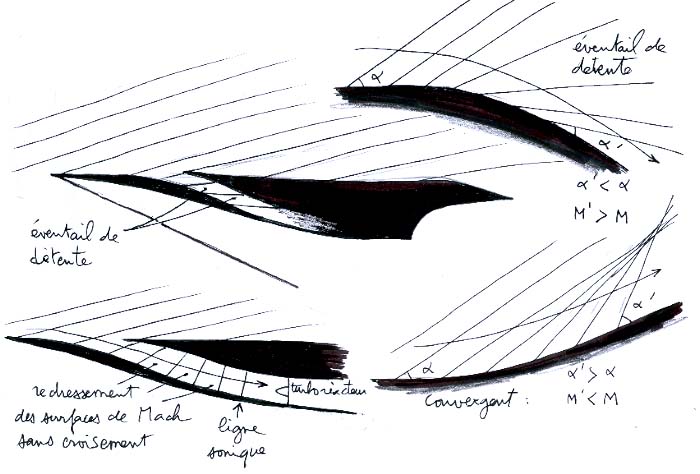
A convergent, figure at the bottom and right, straightens the characteristics, of Mach surfaces, causing their overlapping and the accumulation of these pressure disturbances. The gas is slowed down, recompressed, but a shock wave appears. The place of overlapping is where this one is created.
An "expansion fan" (figure at the top and right) accelerates the gas, increases the Mach number. The Mach lines spread out and therefore cannot cross, creating a shock wave. It is fluid mechanics before the 1939-45 war. If the MHD generator is not connected, the expansion fan of the air intake will allow the gas, coming at hypersonic speed, to enter at an even higher speed, at a higher Mach number at the compressor level: unthinkable (although these air intakes, being recessed, have the property of preventing radar waves from returning to the turbine blades and are therefore "stealthy" (see the USA drone X-47A whose photo, clumsily retouched by the modeler, is on the cover of my book.
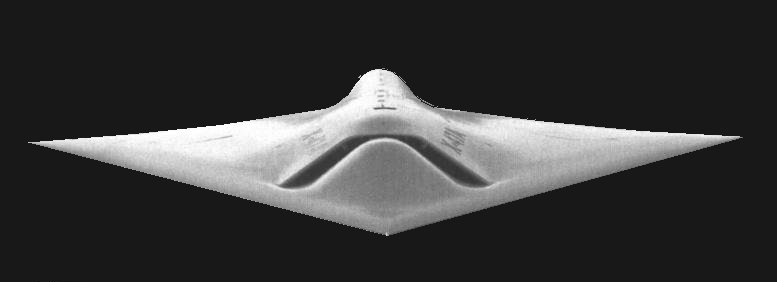
The X-47A viewed from the front
Below, the same device, a drone, from the side:
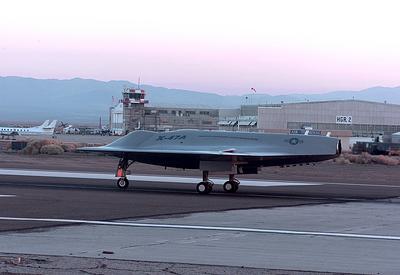
The X-47A viewed from the side
You can clearly see how the recessed placement of this air intake prevents radar waves hitting the turbine blades from returning (these are the ones that constitute the strongest obstacle regarding stealth. It should be noted that this drone is a problem in itself. How could such an air intake function at supersonic speeds? It seems apparently impossible. But then, if it is a combat drone (it is presented as such by the Americans, but without a word of precision regarding its performance), would it be, even hyper-maneuverable (although its nozzle does not seem "vectorized", that is, with a controllable jet) ..... subsonic? The B2 represents, beyond the famous B-52, key vector of the Strategic Air Command of the 1950s, the most elaborate aircraft. Yet it is presented as subsonic. Is it really? These issues are not addressed by aeronautical journalists, and Bernard Thouanel is one. Yet it would be up to them to ask these questions.
But let's get back to "decoding" the American hypersonic and the secret of their MHD-controlled air intake. In the central figure, the evolution of the Mach surfaces in the air intake is shown, without the intervention of the electromagnetic forces J x B related to the natural operation of the wall MHD generator.
If we combine this time the effect related to the presence of the expansion fan and that of the gas deceleration by the Laplace forces, we can, provided we play finely (masses of doctoral theses for physics departments that are currently in complete decline, due to lack of new ideas), straighten with the desired gradualness these characteristics, these Mach surfaces, preventing them from crossing in the vein, thus without the appearance of shock waves. When these characteristics are completely straightened, perpendicular to the fluid flow lines, it's won: you are subsonic and you can then calmly send this gas, recompressed but not heated, towards the turbine blades of the conventional jet engine of the device. It is then the same engine that serves for takeoff, supersonic flight up to Mach 3.5, and hypersonic flight at Mach 12. Great, isn't it? What is fantastic is that the energy required to slow down the gas and bring it to the appropriate pressure at the turbo entrance is provided ... by it! It is a concept that was already explicitly present in the thesis of Bertrand Lebrun, in 1986, and in the scientific publications that followed. But I am not very sure that the people from the DGA (army) or the ONERA (Office National d'Etudes et de Recherches Aéronautiques) have fully understood this concept (where "drag reduction" is timidly mentioned). On the contrary, after this thesis defense, the researcher Bernard Fontaine (former of the Institute of Fluid Mechanics where I worked from 1965 to 1972, later becoming director of the Physics Department of the Engineer at CNRS) told me by phone "that since Lebrun had worked with me, it was pointless for him to hope to find a position in any French research laboratory".
Incidentally, the strong Hall effect regime related to the operation of the generator at low density (ambient pressure: one millimeter of mercury) is accompanied by the creation of high voltages that, naturally sent to the leading edge of the device, create a protective plasma cushion (the experiment corresponding to the photo of the Ajax model in the wind tunnel). The thermal effects of the bow shock are thus reduced. But this shock does not establish permanently. Indeed, during the cruise of this hypersonic spy plane, it gains speed, bouncing towards the upper atmospheric layers, around 120 km altitude, where the air is so rarefied that the heat flux becomes negligible. Aurora thus flies by bouncing on the lower layers (everything is relative: 80 km altitude) flying like a pebble that would bounce "on the surface of the upper atmosphere". The pilots therefore go through alternating increases in their weight and moments of weightlessness, during parabolic trajectories with a period of a few tens of seconds (see the file dedicated to the Hypersoar, on my site). They are used to it, but in the civilian version of these devices, it would be necessary to have the passengers take Dramamine or carefully equip them with convenient bags.
In principle, these ideas can be understood by any student. In practice, it's another matter. Underneath are formidable problems, of which I know both the nature and the solutions, as well as my American (and Russian) counterparts. It was even one of our discussion topics at Brighton, but I did not consider it appropriate to mention it in my book. I will let the French pay the price of their foolishness by throwing themselves headfirst into these quicksand they do not even suspect the existence of. Do not expect me to indicate the solutions, which are not on any written notes and which I reserved for the Supaéro students during my seminar in June 2003 at the school.
Good luck, friends. The lesson of the affair is that, on one hand, as a certain Jesus said when leaving the synagogue of Capernaum, "no prophet is accepted in his own country". On the other hand, truly revolutionary ideas take decades to be accepted in countries where conservatism is the absolute rule (adding, in France, the aggravating impact of all research in the field being controlled by people from ... the École Polytechnique). You may remember the phrase of Poincaré:
*- If you want to destroy the military potential of Germany, create a Polytechnic School (Gilbert Payan comes from this famous "mold"). *
I turned towards astrophysics and cosmology for the next fifteen years. But I fear that even there, at least in France, I am speaking a bit too early. See "Journal of a Savanturier", in the process of being written.
My current solution, after abandoning these fields in 2001, has been to turn to Egyptology. I am currently working to publish my work in this field (which will probably not be easy), having, I think, uncovered all the secrets of Imhotep regarding the construction method of the pyramids (rest assured: it's not anti-gravity).
Last anecdote: do you know who we owe the birth of the Lanturlu series to? To Hubert Curien, who was then in charge of the CNES where Esterle and Zappoli were doing their best to try to develop my first idea of MHD (with the blessing of Payan and the army). I had asked him to intervene by saying:
*- Your people preferred to do without my services, despite their complete incompetence in this matter. There is then a big chance they will fail (which immediately happened, as will be shown). Well, if you don't intervene, I will redirect my creativity and this free time towards scientific popularization. You will find attached the first manuscripts of albums that can constitute a series. *
Curien (now deceased) never answered my letter.
**A final remark. **
With a lot of difficulty, using my 1200 dpi scanner, I tried to enlarge the figure reproduced in the VSD issue and strongly reduced by Thouanel. By squinting, I could read the text, erase it and reassemble it to make it readable. Here is this figure:
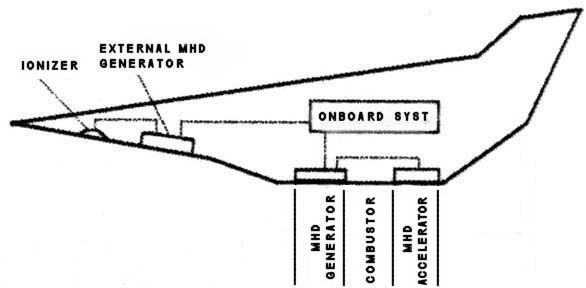
It is supposed to be the diagram of the Ajax project. If the leading edge is indeed beveled, which is not specified but appears on the artist's images, for example, on a cover of Air et Cosmos (December 2000, if I remember correctly), one should expect to see two shock waves, like this:
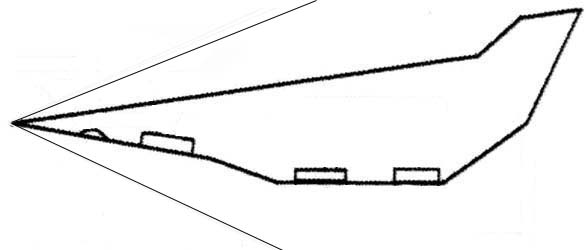
But this is precisely what we want to avoid. The diagram shows an "ionizer", that is, an ionizer system. Why there? Why not at the leading edge where it would be more appropriate to place it? There is an "external MHD generator", that is, "wall". The drawing completes it with an internal MHD generator, located in the air intake, both functioning as gas decelerators. The "MHD bypass" makes that at the nozzle exit, the designer placed an MHD accelerator. But all of this is not very clear. I think this diagram corresponds to a misinformation and that the diagram brought from the Brighton conference is the correct one and I challenge a fluid mechanic, expert in the physics of ionized gases, to prove the opposite. The fluid mechanics specialists present at my lecture at Supaéro were of my opinion.