The Implant
Lost, anatomical piece
June 9, 2006. Updated on June 13, 2006 and June 8, 2008
A few weeks ago I was examined by Dr. Landes, a surgeon at Axium clinic in Aix-en-Provence, following a umbilical hernia that had appeared earlier, during a flight.
- It's a minor incident, but I advise you to have the operation. We can sew it up without any problem. You indeed have a buttonhole above your navel. I can feel it very well. What could happen if we don't operate is that a new hernia could occur, this time strangulated. You would then have to be operated on quickly and if you were traveling in a foreign country, it could be difficult to do so under the best conditions.
- Understood. Let's go with the operation. *
The experienced eye of the practitioner immediately noticed the scar I still have, at the level of the navel, on the port side.
- What is this...?
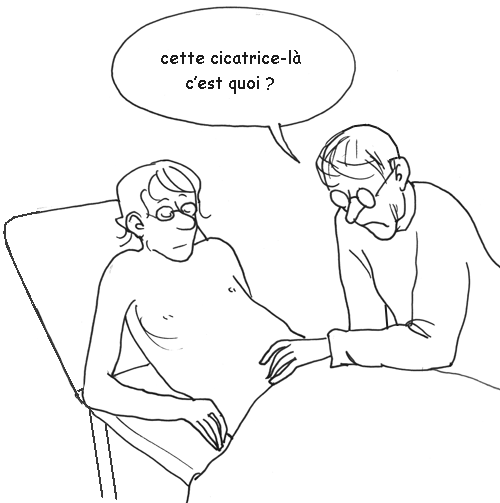
My first reaction was an awkward silence. The surgeon insisted.
- You are completely free not to answer me, but since I will have to open your abdomen, it would be preferable for me to know as much as possible about this part of your anatomy, for example if there had not been an unfortunate scalpel cut...
I chose to tell him the truth.
- Well. This happened about twenty years ago. I was taking a long nap in the living room of my house in Pertuis. When I woke up, I went to my bathroom. That's when I discovered a horizontal, long scar, flanked by two half-moon bruises. At the time, my friend Dr. Spitalier, a surgeon in Marseille, who is now deceased, had told me that after palpation he had detected an underlying scar, affecting the deep layers. *
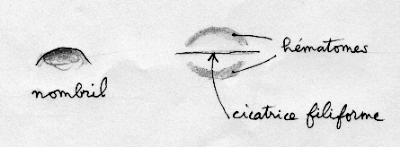
The story of this misadventure left the practitioner unmoved. But what else could I do, except tell the truth?
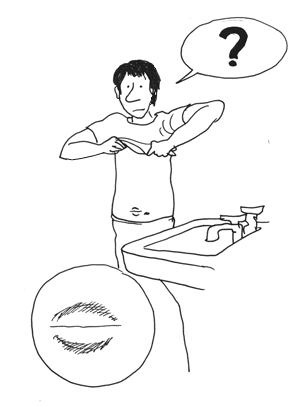
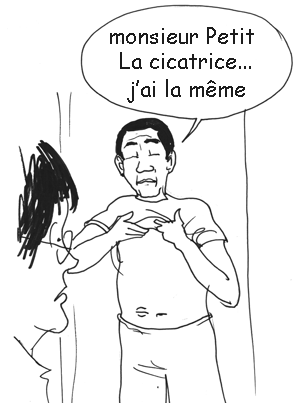
To not worsen my case, I preferred not to tell him that about ten years later my Japanese translator, Hiroji Nakajima, ended up with exactly the same scar the day after his arrival in Aix-en-Provence. The operation date was set for June 6, 2006. To maintain scientific rigor until the end, I told him, just before being anesthetized:
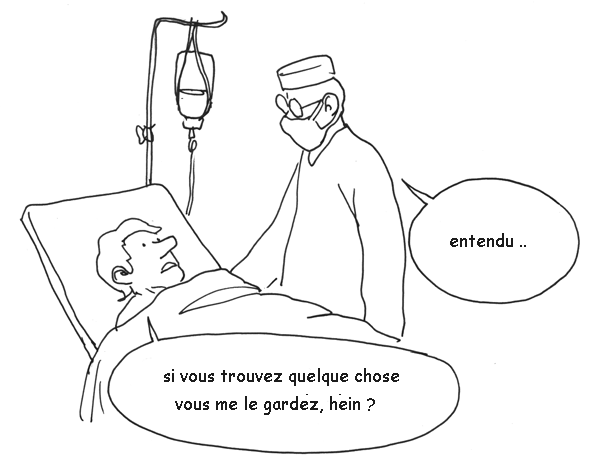
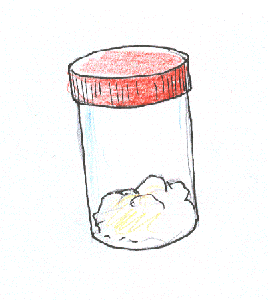
When I regained consciousness in the recovery room, someone had placed a transparent plastic bottle, closed with a red lid, in my hands. Inside I could distinguish an amorphous mass, slightly yellowish, resembling fatty tissue. I estimated its volume at just over five cubic centimeters. However, quickly, a nurse began to retrieve this anatomical piece, which, in all fairness, was my property. She insisted.
- We can't let you keep it. It's forbidden. It will be sent to the analysis laboratory.
- But...*
It's difficult to be combative when you're just emerging from general anesthesia. Already, the rolling bed was taking me toward the elevator, whose chrome doors closed on me. It is understandable that a surgeon has the duty to analyze tissues found inside a patient to determine their nature. But, on the other hand, it is also legitimate for the same patient to ask to recover what, in a legal sense, remains a part of his anatomy.
Therefore, I made a request in this sense. The next day, the surgeon gave me the following response:
- It's a lipoma. It's common for this kind of tissue to form in such parts of the body. I remind you that I found this fatty mass under the location of your hernia, just above your navel. It's common for the body to react this way in such situations and to secrete this fatty mass where there is unusual friction.
Then he went to another room.
In the following hours, I did my best, in vain, to find the trace of this part of myself. To which laboratory had this mass of cells been sent? No one could give me an answer. Today, June 9, 2006 at 9 p.m., the situation is as follows. A part of myself, probably of minor importance, is on a walk, and I have no way of knowing where it is or what will happen to this anatomical piece that I would have liked to keep, frozen, for possible future analyses.
Therefore, I am issuing a missing persons notice:
- Lost anatomical piece, appearing as a fatty mass, approximately five cubic centimeters in volume, contained in a transparent plastic cylindrical bottle, closed with a red cap. I will offer a signed comic book to anyone who would allow me to recover this part of myself.
Made in Pertuis on June 9, 2006
Jean-Pierre Petit ---
June 13, 2006: Following the placement of this page, I received messages from various doctors. A friend confirmed Dr. Landes' statements, following a consultation of a medical dictionary. It is therefore highly likely that the mass of cells extracted during the operation corresponds only to this common reaction of the organism mentioned by the practitioner. Nevertheless, given the strange nature of the story mentioned above, scientific rigor would require that this anatomical piece be kept indefinitely in case it could be subjected to other, less conventional analyses than the simple histological examination.
This story of a scar that appeared mysteriously never really bothered me. A rather spectacular twist occurred more than ten years later when my Japanese translator, Hiroji Nakajima, a professor at a Japanese university, ended up with an identical stigma (same position, same design) the very next day after his arrival in Aix-en-Provence, where he had planned to stay with his wife and child for several months during his sabbatical year.
Given his personality as a rather reserved man, the trick is to be excluded, especially since he did not gain any immediate or later advantage, whether in a media or editorial sense. We are simply in the most complete absurdity. It should be recalled that this phenomenon remains quite common. Steven Spielberg centered his series "Taken" on the theme of abductions accompanied by the placement of implants on human subjects by extraterrestrial visitors, the "little greys." In Spielberg's series, the implants appear as metallic objects, but many unusual presences in the human body appear as non-metallic objects. If simple masses of cells can correspond to a wide variety of organic dysfunctions, such as various types of cysts, one cannot rule out a priori a camouflage of a structure set up for other purposes. As I had already said and written before, I had this scar examined by a friend surgeon, Dr. Spitalier, from Marseille, who is now deceased. At that time, he...