End of Sakharov's speech
End of the Nobel Prize acceptance speech by Andrei Sakharov, read in Stockholm by Elena Bonner
4 Dec 2005
Thousands of years ago, human tribes suffered great deprivation in their struggle for existence.
At that time, it was important not only to wield a club, but to possess the ability to think intelligently, to take into account the knowledge and experience accumulated by the tribe, and to develop links that would establish the basis for cooperation with other tribes.
Today, the human race must face an analogous challenge. Several civilizations could exist in the infinite space, among which there could be societies that are wiser and more "efficient" than our own.
I support the cosmological hypothesis according to which the development of the universe repeats itself an infinite number of times on the "next" or "previous" pages of the universe's book.
Nevertheless, we must not minimize our sacred efforts in this world, where, like faint lights in the darkness, we have emerged for a moment from the darkness of unconsciousness into material existence. We must respect the demands of reason and create a life worthy of ourselves and of the goals we barely perceive.
Andrei Sakharov
Below is a photo I took in the 1980s. It is a 7 cm diameter model immersed in air under a tenth of a millimeter of mercury and powered by high frequency under a megahertz. The visible lights are high frequency arcs.
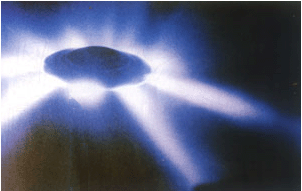
**Photo taken in my laboratory - the small room on Aude street, Aix en Provence.
When I was doing these experiments, the television screens of the neighbors were snowing. ** ---
Number of visits to this page since December 13, 2005 :