More than two billion degrees! Analysis of the paper by Malcom Haines (April 2006)
than two billion degrees!
The article by Malcom Haines
Published on February 24, 2006 in Physical Review Letters
Updated on July 16, 2006 (data at the bottom of the page on the current rise curve in the Z-machine )
****Update of March 18, 2008. Following an article published in the magazine Science et Avenir
**papier_Haines.htm#vilnius ** ****
For non-scientists
Readers ask whether these ion temperatures exceeding two billion degrees have actually been measured. The answer is yes. However, a puzzling phenomenon had been observed as early as 1998 in plasma compression experiments conducted with the Z-machine. These experiments involved various configurations. For example, when the "bird cage" imploded, a "gas puff", a "gas burst", was sent right in the center, which was then compressed. The X-ray emission allowed measuring the electronic temperature. A plasma is a "two-species" mixture: the heavy ions and the light electrons. In a "iron plasma", in "ionized iron", the nuclei of
( 56 nucleons, 26 protons ) are 100,000 times heavier than the electrons ( the nuclei are made of "nucleons" of very similar masses: protons and electrons. An electron is 1850 times lighter than a proton).
A neon tube also contains "these two species", the electrons and the neon ions ( even though in this case they have not been completely stripped of their "electron sheath" ). When the tube is operating, it contains a "bitemperature" mixture where the gas made up of atoms, the neon ions remain cold. ( you can touch the tube with your hand ), but where the "electron gas" is much hotter, reaching 10,000°. Why don't you feel this heat with your hand? Because the electrons, the poor things, are too stingy to give you energy, heat. However, they have enough energy to excite, by collisions, the fluorescent coating lining the inside of the tube. This is why they are called
fluorescent tubes
. Fluorescence is the ability to absorb radiation and re-emit it at another frequency. Thus, fluorescein absorbs solar radiation and re-emits it in green. Nylon shirts can absorb ultraviolet radiation and re-emit it in the visible ( this is the "black light" of trendy nightclubs ) etc. This white coating of the neon tube is bombarded by electrons with energies corresponding to the UV range, but when they hit the substances making up the coating, they cause re-emission in the visible. This coating is made in such a way that during re-emission its light is as close as possible to visible light. But it's not quite the case. This is why the light from neon tubes seems so "strange".
What is important to remember is that there can be "bitemperature" media. The reason for this situation is that the electric field in the tube, linked to the voltage on the electrodes, communicates energy primarily to the electrons, which then pass it on to the ions through collisions. However, since the energy transfer between the electron gas and the ion gas is inefficient, a large temperature difference can occur. This is particularly due to the fact that the medium is rarefied. If the tube leaks and the pressure increases, this "nonequilibrium" situation disappears immediately. The electron gas, strongly coupled to the ions, cools down very quickly. Then these electrons, less "agitated" ( the absolute temperature in a gas corresponds to the thermal agitation movement ) return to the atoms, which become neutral again.
The Z-machine experiment led to a very curious situation. There are two species present:
-
The electron gas
-
The ion gas ( in stainless steel, essentially iron nuclei, positively charged )
Since 1998, when people tried to account for their measurements, they had access only to the electronic temperature, by measuring the X-rays emitted. Why is the electron gas the main source of this radiation in these experiments? Because around the plasma there is a very high magnetic field. When the electrons, traveling at 40,000 km/s, enter this region with the intense magnetic field, they spiral. Then they "scream", they emit a "braking radiation". It is by measuring these X-rays that the experimenters measured the temperature of this electron gas: 35 million degrees in the experiments described in this paper.
But using formulas ( the "Bennett relation"), if they tried to estimate the temperature that the iron ions should have to counterbalance the enormous "magnetic pressure", outside the plasma, they had to admit that it must have a significantly higher value. Since 1998, regardless of the experiments carried out, this temperature difference became evident. These high values were necessary for the plasma not to be instantly crushed by the magnetic pressure. It can be seen that this suggested a nonequilibrium state ( at thermodynamic equilibrium, all the temperatures of the species composing a gaseous mixture are equal ) a bitemperature situation inverse of that of the neon tube, where this time it was the ion gas that was hotter than the electron gas.
Simple remark: what creates this "thermodynamic equilibrium"? It is the energy exchanges between particles, by collisions. Energy, for example, is the kinetic energy
. Why the index i? Because a plasma is a mixture of different species, v
is the thermal agitation velocity and the < v
is the "mean square velocity". Thus
is
the average kinetic energy
, in the species considered. This is the very definition of absolute temperature, which measures the average kinetic energy ( thermal agitation ) of a given species, according to the relation:
where k is the Boltzmann constant, which is 1.38 10
In collisions, particles exchange energy. This phenomenon tends towards energy equipartition. When it comes to purely kinetic energy, the different species tend to acquire equal thermal agitation kinetic energy. Therefore, equal
absolute temperatures
:
Let two particles of different masses m
and m
and let i be the lighter one.
The kinetic theory of gases
tells us that the rate of kinetic energy transfer in a collision will be proportional to the ratio
If the masses are very different, the
It is worth noting that at a given temperature ( sufficient to make the medium ionized, to have free electrons ) the difference in masses makes the electronic and ionic agitation velocities very different. Take the case of a hydrogen-deuterium-tritium plasma, with an average atomic mass of 2.5 ( 2 for deuterium, 3 for tritium ). Imagine that the ion gas is at 100,000,000° ( in a tokamak ). The thermal agitation velocity will be:
of the order of ( 3 k T
A proton weighs 1.6 10
kilogram
The average mass of hydrogen ions is therefore 1.6 10
2.5, or 4 10
kilogram
The average thermal agitation velocity of hydrogen ions is therefore, in a tokamak of 10
m/s or
thousand kilometers per second
. An interesting figure to remember. In a tokamak, the equilibrium state is established. The temperature of the electron gas is the same as that of the ions. But the thermal agitation velocity of the electrons is higher than that of the ions, in the inverse square root of the mass ratio.
The mass of an electron is
= 0.91 10
kilogram
In a heavy hydrogen plasma, the mass ratio is 4400, and the ratio of thermal agitation velocities is the square root of this number, or 66. The thermal agitation velocity of the electrons in a tokamak is therefore 66 times higher than that of the ions and is therefore 66,000 km/s and is 20% of the speed of light. Simple remark.
In the iron plasma of the Z-machines, the mass ratio reaches 100,000. In an iron plasma in equilibrium, the thermal velocity ratio between electrons and iron ions would be 316. But as we will see later, the iron plasma of the Z machine is very out of equilibrium. The difference with fluorescent tubes is that this time the electronic temperature is 100 times lower than that of the ions. Therefore, it is a new type of plasma
in inverse nonequilibrium state
This is a new, poorly understood medium, to be explored. In fact, a real wild west for experimenters and theorists. A Z-machine is above all a powerful electric generator:
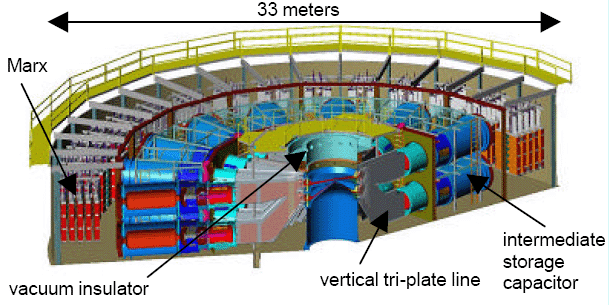
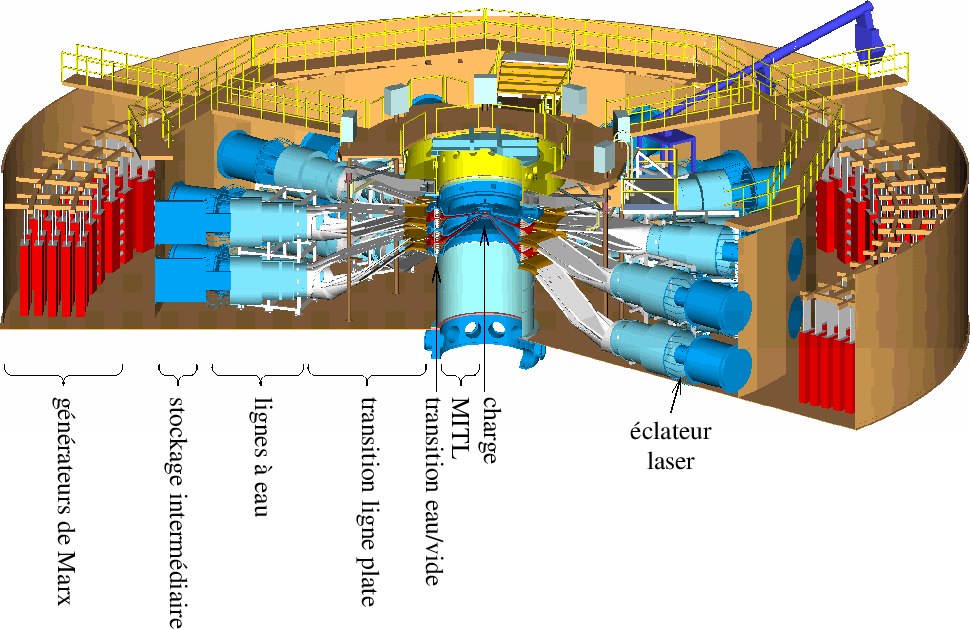
The Sandia Z-machine, before 2007
( it has since been modified and transformed into ZR, Z "refurbished" )
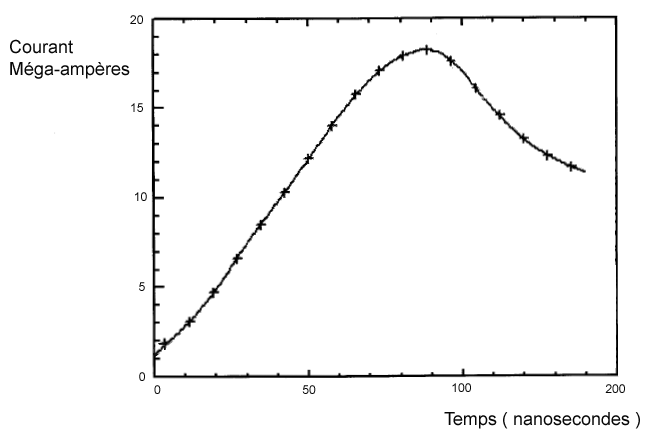
It delivers impulses of 18 million amperes, in 100 nanoseconds. A nanosecond is a billionth of a second. The electrical intensity increases linearly: Curve of the electrical intensity rise in the Z-machine ( analogous in ZR )
The ZR machine, operational since 2007, capable of reaching 26 million amperes, still in 100 nanoseconds
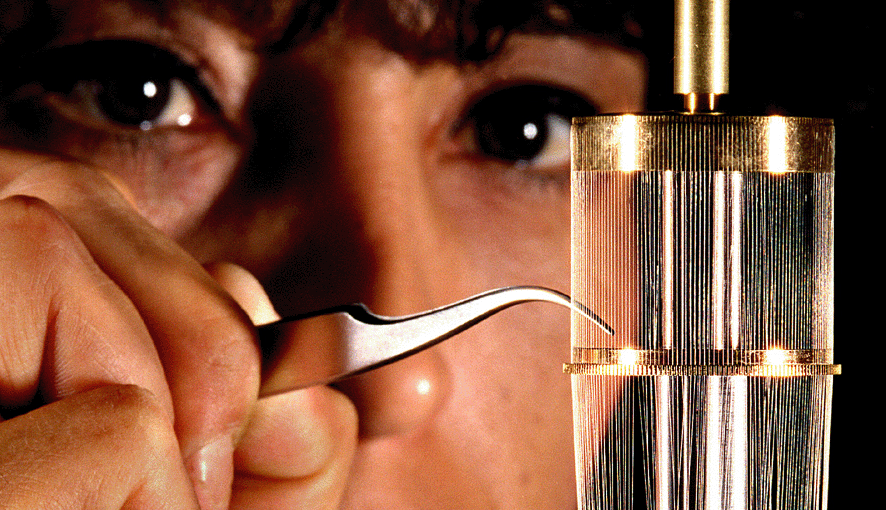
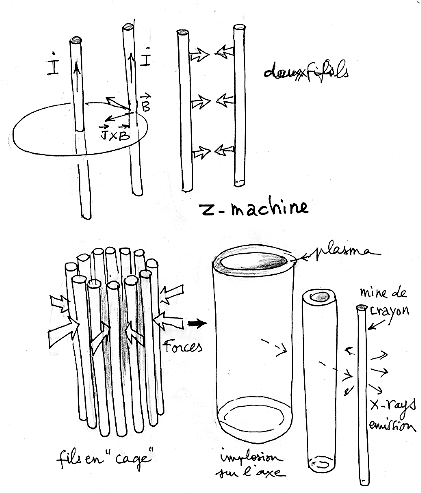
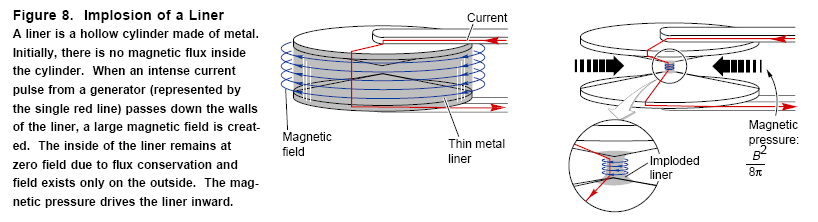
The Z-machine sends this current into a "wire liner", a kind of bird cage, 5 cm high and 8 cm in diameter, made of 240 stainless steel wires, thinner than a hair: .
Construction of the "wire liner"
Each wire therefore carries:
75,000 amperes
Each wire creates a magnetic field, which interacts with the neighboring wires according to a Laplace force I B. These forces are centripetal and tend to bring all these wires together along the axis of the system.
The Laplace forces tend to bring the wires together along the axis of the system
The drawing that had much more to Gerold Yonas, inventor of the machine
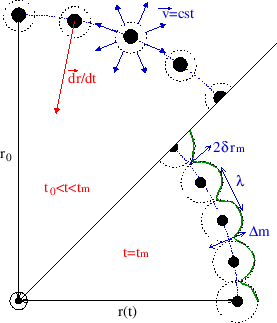
As they converge, the metal wires sublime gradually:
Formation of the plasma shell
( Mathias Bavay's thesis )
It is the structure of the wire assembly that maintains the axisymmetry and prevents MHD instabilities from appearing. Opinions are divided on the behavior of this wire liner during the implosion. The wire is surrounded by a layer of iron plasma. The experiment shows that the wires leave behind a kind of "comet tail" which represents 30% of their mass.
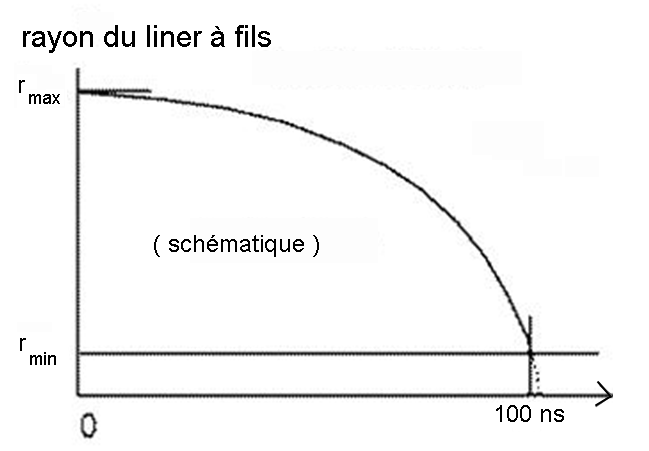
This implosion can be calculated ( see below ). The radius of this cage is 4 cm and the time is 100 nanoseconds, so the average convergence velocity is 400 km/s. There is actually an acceleration just before contact. The ion velocity before impact is between 550 and 650 km/s. The maintenance of axisymmetry means that this iron plasma becomes a 1.5 mm diameter cord at the end of the implosion.
Ions and electrons converge at the same speed towards the axis. It is not possible to separate the two populations because of the intense electrostatic forces that bind them. When these particles, iron ions and electrons, collide near the axis, there is thermalization, that is, in principle, that the kinetic energy related to the radial velocity is distributed in all directions. This is valid for both ions and electrons.
Let us forget the electrons for a moment and imagine a population of objects with a mass equal to that of iron ions that ends up near the axis at 650 km/s.
The mass of the iron ions is 9 10
kilogram
We can write:
V = 600 km/s
We obtain an ionic temperature of 925 million degrees. A simple conversion of this radial velocity into the thermal agitation velocity of the ions.
Let us perform the same calculation for the electrons, we obtain a temperature 100 times lower, around 9250 degrees. A powerful inverse nonequilibrium state. Then collisions come into play. For the ions, Malcom Haines calculated that the relaxation time ( the time for thermalization of the ion gas, the establishment of a velocity distribution function ) was 37 picoseconds, or 3.7 10
second. This time is small compared to the "stagnation time" of the plasma, in the form of a hyperdense and hyperhot cord, the size of a pencil lead.
The measurements ( X-ray emission by "braking radiation", electron-ion interaction ) give a temperature of 30 million degrees. The electron gas has therefore been heated. We will analyze this later. It is customary to express high temperatures in electron volts, according to the relation
e V = k T
with e ( unit electric charge ) = 1.6 10-19 coulomb
If we have a medium that represents a temperature, heated in "electron-volt" which is one "eV", this corresponds to a temperature
T = e / k = 11,600° K
As we reason in orders of magnitude, we often have the habit of converting electron volts into Kelvin degrees by simply
T = 10,000 V
Thus a "keV", a kilo-electron-volt corresponds to 10,000°
The measurements of the emitted radiation ( in the X-ray range ) give a temperature of 30 keV, which is rounded to 30 million degrees.
Another problem: we find that the ion gas is 3 to 4 times hotter than what would be obtained by simple thermalization. The temperature measurements give a value higher than 2 billion degrees, reaching even the maximum value of 3.7 billion degrees. Where does this energy come from? Again, we will discuss this later; .
Temperature measurements were performed using the classic method of evaluating the broadening of spectral lines by the Doppler effect. The nuclei ( like atoms, molecules ) emit radiation according to a certain spectrum which presents characteristic lines.
If the medium is relatively cold, these lines are narrow.
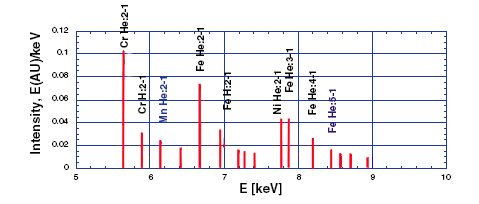
Emission spectrum of "relatively cold" stainless steel, heated to a temperature of 100,000° K
We identify the lines of chromium ( the first ones, on the left ) then those of manganese, dur iron and nickel.
In this stainless steel, carbon represents 0.15% of the mixture and its lines are not visible.
The lines correspond to electronic excitations. Around a nucleus orbit electrons, on well-defined orbits, for reasons related to quantum mechanics ( the quantization of orbits ). An energy input of any origin can cause a "transition", that is, a change in the orbit of one of the electrons. This change always occurs in the direction of the electrons moving to a more distant orbit, which represents more energy. There is no need to do elaborate calculations to evoke this idea. You know very well that to put charges of mass M on orbit, the higher the orbit, the more powerful the rocket. The energy input puts the electron on a "higher" orbit, further from the nucleus. It does not stay there for long ( there is a lifetime of these excited states ) and does not take long to fall back to a closer orbit to the nucleus in a few nanoseconds. In doing so, it loses energy which is emitted in the form of a photon whose energy is equal to the difference in energy between the two orbital levels. Hence this spectrum in "lines".
An atom like iron has 26 electrons.
They are capable of performing orbit changes, descending, not necessarily on their initial orbit. Hence a spectrum composed of a multitude of lines. Some are higher than others. What does this "height of the lines" correspond to? To the power emitted according to this frequency. A line measures the contribution of a particular transition. Some transitions are more probable than others. These are the most probable transitions, therefore frequent, which will give the main part of the radiation. By looking at the diagram above, we see that for stainless steel whose temperature would be between 58,000 ( 5 electron-volts ) and 116,000° K ( 10 electron-volts ), the strongest emission comes from a chromium line. The manganese line is "more modest". At these temperatures, the atoms are already very stripped of their electrons. But there are still some. How many? I don't have a book at hand to be able to answer you. The stripping is progressive. I don't know at what temperature it would be necessary to heat iron or chromium to obtain complete stripping, that the last electron is removed. It can be calculated, after all. It is the energy that must be provided to remove this last electron from a nucleus with 26 positive charges.
What was measured in the Sandia experiments refers to an excitation-de-excitation spectrum of the electrons that remained around the nuclei.
The broadening of the lines is related to the Doppler-Fizeau effect.
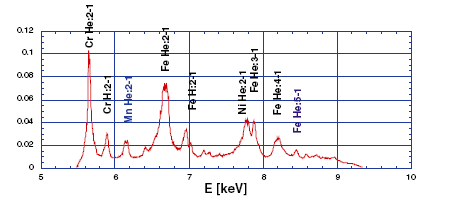
Spectrum of the same material, heated to billions of degrees. The Doppler effect has caused the lines to broaden.
The frequency corresponding to a given orbital jump ( a line ) will be higher if the atom approaches the observer and lower if it moves away ( this is then "redshift"). Thus the thermal agitation
broadens the lines
. The measurements, reliable, have been carried out and confirmed these high values of the ionic temperature, which are in the range of billions of degrees (
between 2.66 and 3.7 billion degrees
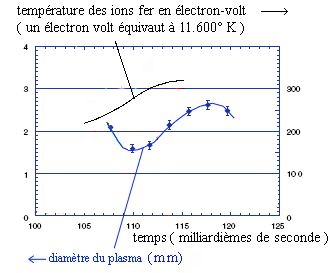
Results from May 2005 on the Sandia Z-machine.
In black, the rise of the ionic temperature. In blue, the plasma diameter.
On the x-axis: time in nanoseconds
( a nanosecond represents a billionth of a second )
The temperature jump is not an event among others. It is a major scientific discovery and it is very likely that it will have considerable consequences on our planetary society.
The ions thus become 100 times hotter than the electrons
. Until now, this was the only possible explanation, but this time it has been measured, in totally reproducible experiments. Moreover, this ionic temperature
increases over time.
Finally, the energy emitted by the electron gas, in the form of X-radiation, proved to be 3 to 4 times higher than the kinetic energy that the stainless steel rods of the "wire liner" had when they were gathered on the axis
Haines and his collaborators tried in the following paper to unravel this mystery. Where could this energy come from?
When the Z-machine is turned on, the energy is distributed in different forms. There is the thermal energy of the plasma, which corresponds to the sum of the kinetic energies of its components ( mainly the kinetic energy of the iron ions ). But there is also another energy, more difficult to understand:
the magnetic energy
which is distributed throughout the space surrounding the thin plasma cord formed on the axis. Haines therefore suggested that "MHD instabilities" could arise that would allow the plasma to recover part of this energy. As it should be in the article, this theory is very embryonic and has not led to any "simulation". The conclusion is simply "it is not impossible that this heating is due to this phenomenon". He also shows the weak collisional coupling between electrons and ions, which explains the delay in X-ray emission over time. The phenomenon first heats the ions, which then transmit part of this energy to the electron gas, which then becomes emissive ( by braking radiation ). This being the measurements ( four points )
show that the iron ion gas continues to heat
The maximum temperature is obviously not reached. However, the measured temperature of the iron ions reaches 3.7 billion degrees! thirty-seven times the temperature that Iter will never be able to exceed: 100 million degrees.
Deeney said that faced with such a result, he had repeated the experiment and the measurements many times, to be sure. It should be noted that in the title of the article it is written: "more than two billion degrees". Logically, the researchers should have mentioned the maximum value, of 3.7 billion degrees. Let's call this a move of ... timidity, in the face of the magnitude of the result obtained.
It should be remembered that with 500 million degrees, one can fuse lithium and hydrogen, obtaining helium and no neutrons. With one billion, one has a "pure fusion" second, still without radioactivity or waste ( only helium ): that of boron and hydrogen. What can be done with 3.7 billion degrees, or more? If the ion temperature continues to increase, it is logical to think that even higher ionic temperatures could be achieved.
A remark. In these experiments, the electric current intensity that the Z-machine delivers ( from 18 to 20 million amperes ) cannot be maintained indefinitely. It is a discharge: this intensity increases over time, reaches a maximum, then decreases. In the Z-machine, the pulse lasts 100 billionths of a second. Another aspect: if Haines is right, the magnetic environment of the plasma cord contains a very important energy. Therefore, if the current is maintained, this magnetic field will continue to "feed" the plasma, increasing the ionic temperature. Thus these 3.7 billion degrees do not constitute a ceiling and no one can say what temperature could be achieved with this device.
The first consequence of such experiments could be "pure non-polluting fusion", with a mixture of lithium and hydrogen ( lithium, present in seawater and brines, is found in all regions of the world. Currently, its price is 59 dollars per kilo, including taxes ). This is the Golden Age from the energy point of view ( with the bonus of a pure fusion hydrogen bomb, not expensive, for everyone ). If all this is confirmed, no country in the world could claim "to possess the planet's lithium reserves". Since lithium is present in seawater, these planetary reserves are presumably unlimited.
Since the temperature in a supernova is ten billion degrees and that this one, through fusion reactions, manages to create all the atoms of the Mendeleev table ( and their radioactive isotopes with varying lifetimes ), if a "pumped" Z-machine one day manages to achieve ten billion degrees, we will have achieved in the laboratory the highest temperatures that Nature is capable of achieving in the cosmos. This leap forward therefore represents a drastic change in nuclear physics and in our physics in general.
So far, we had only "embers". This step really represents the invention of nuclear fire
For non-scientists
Readers ask whether these ion temperatures exceeding two billion degrees have actually been measured. The answer is yes. However, a puzzling phenomenon had been observed as early as 1998 in plasma compression experiments conducted with the Z-machine. These experiments involved various configurations. For example, when the "bird cage" imploded, a "gas puff", a "gas burst", was sent right in the center, which was then compressed. The X-ray emission allowed measuring the electronic temperature. A plasma is a "two-species" mixture: the heavy ions and the light electrons. In a "iron plasma", in "ionized iron", the nuclei of
( 56 nucleons, 26 protons ) are 100,000 times heavier than the electrons ( the nuclei are made of "nucleons" of very similar masses: protons and electrons. An electron is 1850 times lighter than a proton).
A neon tube also contains "these two species", the electrons and the neon ions ( even though in this case they have not been completely stripped of their "electron sheath" ). When the tube is operating, it contains a "bitemperature" mixture where the gas made up of atoms, the neon ions remain cold. ( you can touch the tube with your hand ), but where the "electron gas" is much hotter, reaching 10,000°. Why don't you feel this heat with your hand? Because the electrons, the poor things, are too stingy to give you energy, heat. However, they have enough energy to excite, by collisions, the fluorescent coating lining the inside of the tube. This is why they are called
fluorescent tubes
. Fluorescence is the ability to absorb radiation and re-emit it at another frequency. Thus, fluorescein absorbs solar radiation and re-emits it in green. Nylon shirts can absorb ultraviolet radiation and re-emit it in the visible ( this is the "black light" of trendy nightclubs ) etc. This white coating of the neon tube is bombarded by electrons with energies corresponding to the UV range, but when they hit the substances making up the coating, they cause re-emission in the visible. This coating is made in such a way that during re-emission its light is as close as possible to visible light. But it's not quite the case. This is why the light from neon tubes seems so "strange".
What is important to remember is that there can be "bitemperature" media. The reason for this situation is that the electric field in the tube, linked to the voltage on the electrodes, communicates energy primarily to the electrons, which then pass it on to the ions through collisions. However, since the energy transfer between the electron gas and the ion gas is inefficient, a large temperature difference can occur. This is particularly due to the fact that the medium is rarefied. If the tube leaks and the pressure increases, this "nonequilibrium" situation disappears immediately. The electron gas, strongly coupled to the ions, cools down very quickly. Then these electrons, less "agitated" ( the absolute temperature in a gas corresponds to the thermal agitation movement ) return to the atoms, which become neutral again.
The Z-machine experiment led to a very curious situation. There are two species present:
-
The electron gas
-
The ion gas ( in stainless steel, essentially iron nuclei, positively charged )
Since 1998, when people tried to account for their measurements, they had access only to the electronic temperature, by measuring the X-rays emitted. Why is the electron gas the main source of this radiation in these experiments? Because around the plasma there is a very high magnetic field. When the electrons, traveling at 40,000 km/s, enter this region with the intense magnetic field, they spiral. Then they "scream", they emit a "braking radiation". It is by measuring these X-rays that the experimenters measured the temperature of this electron gas: 35 million degrees in the experiments described in this paper.
But using formulas ( the "Bennett relation"), if they tried to estimate the temperature that the iron ions should have to counterbalance the enormous "magnetic pressure", outside the plasma, they had to admit that it must have a significantly higher value. Since 1998, regardless of the experiments carried out, this temperature difference became evident. These high values were necessary for the plasma not to be instantly crushed by the magnetic pressure. It can be seen that this suggested a nonequilibrium state ( at thermodynamic equilibrium, all the temperatures of the species composing a gaseous mixture are equal ) a bitemperature situation inverse of that of the neon tube, where this time it was the ion gas that was hotter than the electron gas.
Simple remark: what creates this "thermodynamic equilibrium"? It is the energy exchanges between particles, by collisions. Energy, for example, is the kinetic energy
. Why the index i? Because a plasma is a mixture of different species, v
is the thermal agitation velocity and the < v
is the "mean square velocity". Thus
is
the average kinetic energy
, in the species considered. This is the very definition of absolute temperature, which measures the average kinetic energy ( thermal agitation ) of a given species, according to the relation:
where k is the Boltzmann constant, which is 1.38 10
In collisions, particles exchange energy. This phenomenon tends towards energy equipartition. When it comes to purely kinetic energy, the different species tend to acquire equal thermal agitation kinetic energy. Therefore, equal
absolute temperatures
:
Let two particles of different masses m
and m
and let i be the lighter one.
The kinetic theory of gases
it says that the rate of kinetic energy transfer in a collision will be proportional to the ratio
If the masses are very different, we note that at a given temperature (sufficient for the medium to be ionized, with free electrons), the difference in masses makes the electronic and ionic agitation velocities very different. Take the case of a hydrogen-deuterium-tritium plasma, with an average atomic mass of 2.5 (2 for deuterium, 3 for tritium). Imagine that the ion gas is at 100,000,000 degrees (in a tokamak). The thermal agitation velocity will be:
about (3 k T
A proton weighs 1.6 10
kilograms
The average mass of hydrogen ions is therefore 1.6 10
2.5, or 4 10
kilograms
The average thermal agitation velocity of hydrogen ions in a tokamak is therefore, 10
m/s or
thousand kilometers per second
. An interesting number to remember. In a tokamak, the thermodynamic equilibrium state is established. The temperature of the electron gas is the same as that of the ions. But the agitation velocity of the electrons is higher than that of the ions, in the inverse of the square root of the mass ratio.
The mass of an electron is
= 0.91 10
kilograms
In a heavy hydrogen plasma, the mass ratio is 4400, and the ratio of thermal agitation velocities is the square root of this number, or 66. The thermal agitation velocity of the electrons in a tokamak is therefore 66 times higher than that of the ions, and is therefore 66,000 km/s, which is 20% of the speed of light. A simple observation.
In the iron plasma of the Z-machines, the mass ratio reaches 100,000. In an iron plasma in equilibrium, the thermal velocity ratio between electrons and iron ions would be 316. But as we will see later, the iron plasma of the Z machine is very out of equilibrium. The difference with fluorescent tubes is that this time the electronic temperature is 100 times lower than that of the ions. It is therefore a new type of plasma
in an inverse out-of-equilibrium state
It is a new, poorly understood medium, to be explored. In fact, a real wild west for experimenters and theorists. A Z-machine is above all a powerful electrical generator:
The Sandia Z-machine, before 2007
(it has been modified since and turned into ZR, Z "refurbished")
It delivers impulses of 18 million amperes, in 100 nanoseconds. A nanosecond is a billionth of a second. The electrical intensity increases linearly: Current rise curve in the Z-machine (analogous in ZR)
The ZR machine, operational since 2007, capable of reaching 26 million amperes, still in 100 nanoseconds
The Z-machine sends this current into a "wire array", a kind of cage, 5 cm high and 8 cm in diameter, made of 240 stainless steel wires, thinner than a hair: .
Construction of the "wire array"
In each wire, therefore:
75,000 amperes
Each wire creates a magnetic field, which interacts with the neighboring wires according to a Laplace force I B. These forces are centripetal and tend to bring all these wires together along the axis of the system.
The Laplace forces tend to bring the wires together along the axis of the system
The drawing that had much more to Gerold Yonas, inventor of the machine
As they converge, the metal wires sublime gradually:
Formation of the plasma shell
(thesis of Mathias Bavay)
It is the structure of the wire array that maintains the axisymmetry and prevents MHD instabilities from appearing. Opinions are divided on the behavior of this wire array during the implosion. The wire is surrounded by a layer of iron plasma. The experiment shows that the wires leave behind a kind of "comet tail" that represents 30% of their mass.
The implosion scheme can be calculated (see below). The radius of this cage being 4 cm and the time 100 nanoseconds, the average convergence velocity is 400 km/s. There is actually an acceleration just before contact. The ion velocity before impact is between 550 and 650 km/s. The maintenance of the axisymmetry makes this iron plasma at the end of the implosion a cord of 1.5 mm in diameter.
Ions and electrons converge at the same velocity towards the axis. It is not possible to separate the two populations due to the intense electrostatic forces that bind them. When these particles, iron ions and electrons, collide near the axis, there is thermalization, that is, in principle, that the kinetic energy related to the radial velocity is distributed in all directions. This is valid for ions as well as for electrons.
Let us forget the electrons for a moment and imagine a population of objects with a mass equal to that of iron ions, found near the axis at 650 km/s.
The mass of iron ions is 9 10
kilograms
We can write:
V = 600 km/s
We obtain an ionic temperature of 925 million degrees. Simple conversion of this radial velocity into the thermal agitation velocity of the ions.
Let us perform the same calculation for the electrons, we obtain a temperature 100 times lower, around 9250 degrees. A powerful inverse out-of-equilibrium state. Collisions then come into play. For the ions, Malcom Haines calculated that the relaxation time (the time for thermalization of the ion gas, for establishing a velocity distribution function) was 37 picoseconds, or 3.7 10
seconds. This time is small compared to the "stagnation time" of the plasma, in the form of a hyperdense and hyperhot cord, the size of a pencil lead.
Measurements (X-ray emission by "braking radiation", electron-ion interaction) give a temperature of 30 million degrees. The electron gas has therefore been heated. We will analyze this later. It is customary to express high temperatures in electron volts, according to the relation
e V = k T
with e (unit electric charge) = 1.6 10-19 coulomb
If we have a medium that represents a temperature, heated in "electron-volt" which is one "eV", this corresponds to a temperature
T = e / k = 11,600° K
As we reason in orders of magnitude, we often have the habit of converting electron volts into degrees Kelvin by simply
T = 10,000 V
Thus a "keV", a kilo-electron-volt, corresponds to 10,000°
The measurements of the emitted radiation (in the X-ray range) give a temperature of 30 keV, which is rounded to 30 million degrees.
Another problem: we find that the ion gas is 3 to 4 times hotter than what would be obtained by simple thermalization. Temperature measurements give a value higher than 2 billion degrees, reaching even the maximum value of 3.7 billion degrees. Where does the energy come from? Again, we will discuss this later; .
Temperature measurements have been carried out using the classic method of evaluating the broadening of spectral lines by the Doppler effect. The nuclei (like atoms, molecules) emit radiation according to a certain spectrum that presents characteristic lines.
If the medium is relatively cold, these lines are thin.
Emission spectrum of "relatively cold" stainless steel, heated to a temperature of 100,000° K
We identify the lines of chromium (the first ones, on the left) then those of manganese, dur iron and nickel.
In this stainless steel, carbon represents 0.15% of the mixture and its lines are not visible.
The lines correspond to electronic excitations. Around a nucleus orbit electrons, on well-defined orbits, for reasons related to quantum mechanics (the quantization of orbits). An energy input of any origin can cause a "transition", that is, a change in the orbit of one of the electrons. This change always occurs in the direction of the electrons moving to a more distant orbit, which represents more energy. There is no need to do elaborate calculations to evoke this idea. You know very well that to put masses M on orbit, the higher the orbit, the more powerful the rocket. The energy input therefore puts the electron on a "higher" orbit, further from the nucleus. It does not stay there for long (there is a lifetime of these excited states) and quickly falls back in a few nanoseconds to an orbit closer to the nucleus. In doing so, it loses energy which is emitted in the form of a photon whose energy is equal to the difference in energy between the two orbital levels. Hence this spectrum in "lines".
An atom like iron has 26 electrons.
They are capable of performing orbit changes, descending, not necessarily to their initial orbit. Hence a spectrum composed of a multitude of lines. Some are higher than others. What does this "height of the lines" correspond to? To the power emitted according to this frequency. A line measures the contribution of a particular transition. Some transitions are more probable than others. These are the most probable transitions, therefore frequent, which will give the main part of the radiation. By looking at the diagram above, we see that for stainless steel whose temperature would be between 58,000 (5 electron volts) and 116,000° K (10 electron volts) the strongest emission comes from a chromium line. The manganese line is "more modest". At these temperatures, the atoms are already very stripped of their electrons. But there are still some. How many? I don't have a book at hand to be able to answer you. The stripping is progressive. I don't know at what temperature it will be necessary to heat iron or chromium to obtain complete stripping, that the last electron is removed. It can be calculated, after all. It is the energy that must be provided to remove this last electron from a nucleus with 26 positive charges.
What was measured in the Sandia experiments refers to an excitation-de-excitation spectrum of the electrons that remained around the nuclei.
The broadening of the lines is related to the Doppler-Fizeau effect.
Spectrum of the same material, heated to billions of degrees. The Doppler effect has caused the lines to broaden
The frequency corresponding to a given orbital jump (a line) will be higher if the atom approaches the observer and lower if it moves away (this is then "redshift"). Thus the thermal agitation
broadens the lines
. The measurements, reliable, have been carried out and confirmed these high values of the ionic temperature, which amount to billions of degrees (
between 2.66 and 3.7 billion degrees
Results of May 2005 on the Sandia Z-machine.
In black, the rise in ionic temperature. In blue, the diameter of the plasma.
On the x-axis: time in nanoseconds
( one nanosecond represents a billionth of a second )
The jump in temperature is not an event among others. It is a major scientific discovery and it is very likely that it will have considerable consequences on our planetary society.
The ions thus become 100 times hotter than the electrons
. Until now, this was the only possible explanation, but this time it has been measured, in totally reproducible experiments. Moreover, this ionic temperature
increases over time.
Finally, the energy emitted by the electron gas, in the form of X-ray radiation, has proven to be 3 to 4 times higher than the kinetic energy that the stainless steel rods of the "wire array" had when they were gathered on the axis
Haines and his collaborators tried in the following paper to unravel this mystery. Where could this energy come from?
When the Z-machine is turned on, the energy is distributed in several different forms. There is the thermal energy of the plasma, which corresponds to the sum of the kinetic energies of its components (mainly the kinetic energy of the iron ions). But there is also another energy, more difficult to understand:
the magnetic energy
which is distributed throughout the space surrounding the thin plasma cord formed on the axis. Haines therefore suggested that "MHD instabilities" could arise that would allow the plasma to recover part of this energy. As it is appropriate in the article, this theory is very embryonic and has not given rise to any "simulation". The conclusion is simply "it is not impossible that this heating is due to this phenomenon". He also shows the weak collisional coupling between electrons and ions, which explains the delay in X-ray emission over time. The phenomenon first heats the ions, which then transfer part of this energy to the electron gas, which then becomes emissive (by braking radiation). This being the measurements (four points)
show that the iron ion gas continues to heat
The maximum temperature is clearly not reached. However, the measured temperature of the iron ions reaches 3.7 billion degrees! thirty-seven times the temperature that Iter will never be able to exceed: 100 million degrees.
Deeney said that faced with such a result, he had repeated the experiment and measurements many times, to be sure. It should be noted that in the title of the article it is written: "more than two billion degrees". Logically, the researchers should have mentioned the maximum value, of 3.7 billion degrees. Let's call it a move of ... timidity, in the face of the magnitude of the result obtained.
It should be remembered that with 500 million degrees, it is possible to fuse lithium and hydrogen, obtaining helium and no neutrons. With a billion, there is a "pure fusion" second, still without radioactivity or waste (only helium): that of boron and hydrogen. What can be done with 3.7 billion degrees, or even more? If the temperature of the ions continues to increase, it is logical to think that even higher ionic temperatures could be achieved.
A remark. In these experiments, the electric current intensity that the Z-machine delivers (from 18 to 20 million amperes) cannot be maintained indefinitely. It is a discharge: this intensity increases over time, reaches a maximum, then decreases. In the Z-machine, the pulse lasts 100 billionths of a second. Another aspect: if Haines is right, the magnetic environment of the plasma cord contains a very important energy. Therefore, if the current is maintained, this magnetic field will continue to "feed" the plasma, increasing the ionic temperature. Thus these 3.7 billion degrees do not constitute a ceiling and no one can say what temperature could be achieved with this device.
The first consequence of such experiments could be "pure non-polluting fusion", with a mixture of lithium and hydrogen (lithium, present in seawater and brines, is found in all regions of the world. Its current price is 59 dollars per kilogram, taxes included). This is the Golden Age from the point of view of energy (with the bonus of a pure fusion hydrogen bomb, not expensive, for everyone). If all this is confirmed, no country in the world could claim "to possess the lithium reserves of the planet". Since lithium is present in seawater, these planetary reserves are apparently unlimited.
As the temperature in a supernova is ten billion degrees and that this one, through fusion reactions, manages to create all the atoms of the Mendeleev table (and their radioactive isotopes with varying lifetimes), if a Z-machine "inflated" one day manages to achieve ten billion degrees, we will have achieved in the laboratory the highest temperatures that Nature is capable of achieving in the cosmos. This leap forward therefore represents a drastic change in nuclear physics and our physics in general.
So far, we were content with "embers". This step really represents the invention of nuclear fire
Below is the beginning of the article by Haines, Deeney and others:
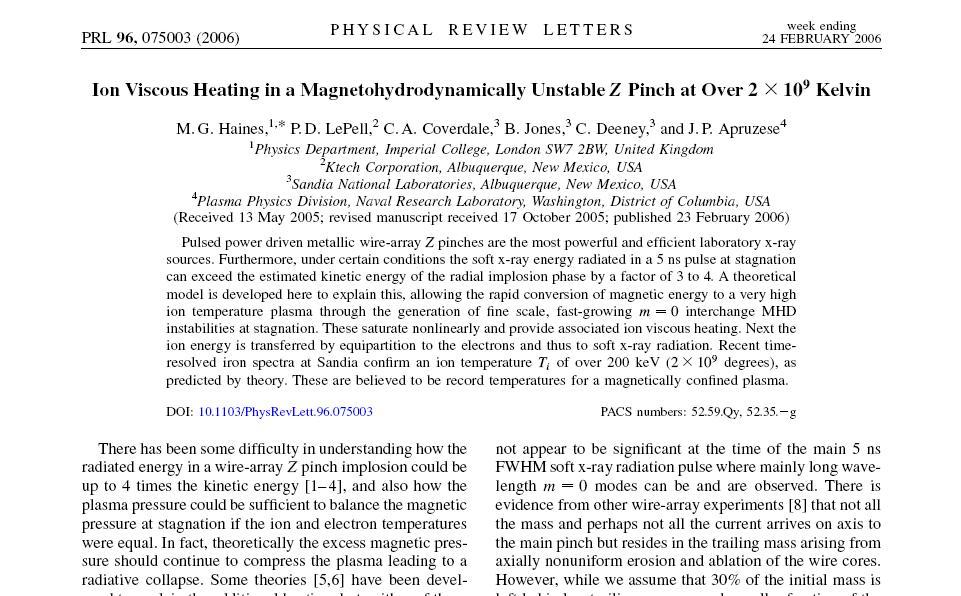
**Let's translate the title **:
**Viscous heating of ions in an unstable magnetohydrodynamic pinch, a temperature of more than 2 x 10⁹ **K
Then the abstract :
Sets made up of metal wires, strongly concentrated along the axis of symmetry of the system, are the most powerful laboratory X-ray sources to date. But in addition, under certain conditions, one can observe energy in the form of "soft" X-rays, emitted in a pulse of 5 nanoseconds, at the moment when the maximum compression is achieved (stagnation)
which corresponds to an energy exceeding the initial kinetic energy by a factor of 3 to 4
. A theoretical model is developed to explain this phenomenon by suggesting that it is due to a rapid conversion of magnetic energy, raising the ions to a very high temperature, through m = 0 type MHD instabilities, with rapid growth. There is then nonlinear saturation and viscous heating of the ion gas. This energy, first transferred to the ions, is then transmitted to the electrons by simple equipartition, ion-electron collisions, and these latter then emit soft X-rays. Recently, at Sandia, spectra were obtained, these measurements extending over time, which confirmed an ionic temperature of 200 keV ( 2
degrees ), in agreement with this theory. We then obtain a record temperature for a magnetically confined plasma.
Haines and his co-authors begin by recalling the basis of the problem. We have not been able to explain how the energy released by the plasma could reach 3 or 4 times the incident kinetic energy, that is, the sum of the 1/2 mV2 of the metal atoms launched one against the other, towards the axis, where they end their course, this kinetic energy being transformed into thermal energy. When analyzing the data, the account is not there. More energy comes out than goes in to this system and it must come from somewhere. Haines then thinks of magnetic energy. What is the situation?
If we consider a liner made of wires (240) and pass a current through them, we can calculate the azimuthal magnetic field created by the other wires. This wire experiences a Laplace force J x B. It is easy to establish that this force is the same as that which would be due to the field created by a linear conductor placed along the axis and where the entire current is passed (in the Sandia experiment: 20 million amperes).
This is also how one can calculate the value of the external field, modulo the assumption made: that one can consider this field as created by wires of infinite length, which is far from the case. This gives therefore simple orders of magnitude. This magnetic field is associated with a magnetic pressure that, if expressed in newtons per square meter, also corresponds to joules per cubic meter. The magnetic pressure is a volumetric energy density. We evaluate that which would be created by an infinite linear conductor.

Near the wire sheet, where we can approximately retain this way of calculating the field, we can calculate the magnetic energy localized between a cylinder of radius r and a cylinder of radius dr
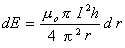
Let rmin be the minimum radius of the plasma. It obviously makes no sense to integrate this expression from this value to infinity, since it is only valid for linear conductors whose length can be considered infinite. But, by writing:

we see that the more the metal atoms are gathered near the axis of the system, the greater the energy in the form of magnetic pressure near the object. Haines sees here the source of energy that is likely to increase the temperature of the ions, who have already converted their kinetic energy into thermal agitation energy. If V is the radial velocity of the ions at the moment of impact, of the "stagnation", we can evaluate this thermal agitation velocity by simply:

The use of this formula implies that "the iron ion gas" is "thermally equilibrated", that it has acquired a Maxwell-Boltzmann velocity distribution. But as Haines will show later, the relaxation time in this medium is very short.
tii, relaxation time in the ionic medium: 37 picoseconds (Haines)
Add that the energy coupling with the electron gas is also weak. Moreover, the redistributed energy can only be done in the form of kinetic energy (thermal agitation energy of the ions and electrons). This formula, very simple, is therefore valid. Finally, insofar as we assume that the ion gas is not fed by another energy source, and we will see later that this is the case.
With a velocity of 1000 km/s, we would indeed obtain 2 billion degrees. When does the system go from the "separate wires" configuration to the "plasma ring" configuration? The paper does not say. With a 4 cm radius liner and an implosion time of 100 nanoseconds, we obtain an average radial velocity of 400 km/s, minimal. The iron atom weighs 9 10-26 kilograms but if it is the velocity of the ions at the moment of impact, we still get 348 million degrees. It is only an average velocity. When writing the differential equation of motion, we have a spectacular acceleration at the end. We also have to take into account the fact that the discharge is not at constant current. I increases over time. We have:
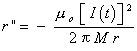
M represents the mass of the liner, per meter. We see that at the end of the discharge and at the end of the run, the acceleration increases. The velocity takes off. Haines writes:
There has been some difficulty in understanding how the radiated energy in a wire-array Z pinch implosion could be up to 4 times the kinetic energy [1– 4], and also how the plasma pressure could be sufficient to balance the magnetic pressure at stagnation if the ion and electron temperatures were equal. In fact, theoretically the excess magnetic pressure should continue to compress the plasma leading to a radiative collapse. Some theories [5,6] have been developed to explain the additional heating, but neither of these have addressed the pressure imbalance.
A difficulty has arisen in explaining how the radiated energy in a wire-array Z pinch implosion could reach up to 4 times the kinetic energy (1 , 4 ) and how the plasma pressure could be sufficient to balance the magnetic pressure at stagnation if the ion and electron temperatures were equal. In fact, theoretically, the excess magnetic pressure should continue to compress the plasma leading to a radiative collapse. Some theories ( 5 , 6 ) have been developed to try to explain this additional heating, but none have been able to account for this pressure imbalance
There has been some difficulty in understanding how the radiated energy in a wire-array Z pinch implosion could be up to 4 times the kinetic energy [1– 4], and also how the plasma pressure could be sufficient to balance the magnetic pressure at stagnation if the ion and electron temperatures were equal. In fact, theoretically the excess magnetic pressure should continue to compress the plasma leading to a radiative collapse. Some theories [5,6] have been developed to explain the additional heating, but neither of these have addressed the pressure imbalance.
A difficulty has arisen in explaining how the radiated energy in a wire-array Z pinch implosion could reach up to 4 times the kinetic energy (1 , 4 ) and how the plasma pressure could be sufficient to balance the magnetic pressure at stagnation if the ion and electron temperatures were equal. In fact, theoretically, the excess magnetic pressure should continue to compress the plasma leading to a radiative collapse. Some theories ( 5 , 6 ) have been developed to try to explain this additional heating, but none have been able to account for this pressure imbalance
There has been some difficulty in understanding how the radiated energy in a wire-array Z pinch implosion could be up to 4 times the kinetic energy [1– 4], and also how the plasma pressure could be sufficient to balance the magnetic pressure at stagnation if the ion and electron temperatures were equal. In fact, theoretically the excess magnetic pressure should continue to compress the plasma leading to a radiative collapse. Some theories [5,6] have been developed to explain the additional heating, but neither of these have addressed the pressure imbalance.
A difficulty has arisen in explaining how the radiated energy in a wire-array Z pinch implosion could reach up to 4 times the kinetic energy (1 , 4 ) and how the plasma pressure could be sufficient to balance the magnetic pressure at stagnation if the ion and electron temperatures were equal. In fact, theoretically, the excess magnetic pressure should continue to compress the plasma leading to a radiative collapse. Some theories ( 5 , 6 ) have been developed to try to explain this additional heating, but none have been able to account for this pressure imbalance
Looking at the cited references:
[1] C. Deeney et al., Phys. Rev. E 56, 5945 (1997).
[2] C. Deeney et al., Phys. Plasmas 6, 3576 (1999).
[3] J. P. Apruzese et al., Phys. Plasmas 8, 3799 (2001).
[4] C. A. Coverdale et al., Phys. Rev. Lett. 88, 065001
(2002).
[5] L. I. Rudakov and R. N. Sudan, Phys. Rep. 283, 253
(1997).
[6] A. L. Velikovich, J. Davis, J.W. Thornhill, J. L. Giuliani,
The reference (1) dates back to 1997. So, even at that time, this unexplained phenomenon was already observed. Deeney is the director of the Z-machine experiments. I have not read these articles. If people could send me the pdfs, I could read them and give additional comments.
Jump directly to the conclusions of the paper:
**
| In conclusion, it appears that short wavelength
| m = 0 MHD instabilities at stagnation in low mass implosions provide fast viscous heating of ions to record temperatures of over 200 keV. Such temperatures have been measured, the energy coming from conversion of magnetic energy on a 5 ns time scale. The ions heat the electrons which immediately radiate the energy. Furthermore, the broadened spectral lines arising from the high ion temperature will permit a greater radiative power to occur due to decreased opacities. The proposed mechanism provides a plausible explanation of several phenomena of fundamental importance to Z pinch dynamics including pressure balance at stagnation, the absence of radiative collapse, the significant excess of x-ray radiation | In conclusion it appears that short wavelength m = 0 MHD instabilities occurring at stagnation in low mass implosions provide fast viscous heating of ions to record temperatures of over 200 keV. Such temperatures have been | measured | , the energy coming from the conversion of magnetic energy on a 5 ns time scale. Furthermore, the broadened spectral lines arising from the high ion temperature will allow a greater radiative power to occur due to decreased opacities. The proposed mechanism provides a plausible explanation of several phenomena of fundamental importance to Z pinch dynamics, including pressure balance at stagnation, the absence of radiative collapse, and the significant excess of X-ray radiation. |
|---|
In conclusion, it appears that short wavelength m = 0 MHD instabilities at stagnation in low mass implosions provide fast viscous heating of ions to record temperatures of over 200 keV. Such temperatures have been measured, the energy coming from conversion of magnetic energy on a 5 ns time scale. The ions heat the electrons which immediately radiate the energy. Furthermore, the broadened spectral lines arising from the high ion temperature will permit a greater radiative power to occur due to decreased opacities. The proposed mechanism provides a plausible explanation of several phenomena of fundamental importance to Z pinch dynamics including pressure balance at stagnation, the absence of radiative collapse, the significant excess of x-ray radiation
In conclusion, it appears that short wavelength m = 0 MHD instabilities occurring at stagnation in low mass implosions provide fast viscous heating of ions to record temperatures of over 200 keV. Such temperatures have been
measured
, the energy coming from the conversion of magnetic energy on a 5 ns time scale. Furthermore, the broadened spectral lines arising from the high ion temperature will allow a greater radiative power to occur due to decreased opacities. The proposed mechanism provides a plausible explanation of several phenomena of fundamental importance to Z pinch dynamics, including pressure balance at stagnation, the absence of radiative collapse, and the significant excess of X-ray radiation.
In conclusion, it appears that short wavelength m = 0 MHD instabilities at stagnation in low mass implosions provide fast viscous heating of ions to record temperatures of over 200 keV. Such temperatures have been measured, the energy coming from conversion of magnetic energy on a 5 ns time scale. The ions heat the electrons which immediately radiate the energy. Furthermore, the broadened spectral lines arising from the high ion temperature will permit a greater radiative power to occur due to decreased opacities. The proposed mechanism provides a plausible explanation of several phenomena of fundamental importance to Z pinch dynamics including pressure balance at stagnation, the absence of radiative collapse, the significant excess of x-ray radiation
In conclusion, it appears that short wavelength m = 0 MHD instabilities occurring under stagnation conditions, involving small amounts of matter, produce rapid viscous heating of ions to a record temperature of 200 keV (two billion degrees). Such temperatures have been measured, with conversion of magnetic energy into kinetic energy occurring on a 5 nanosecond time scale. Moreover, the phenomenon of line broadening, related to the high ion temperature, allows for greater radiation emission due to decreased opacity. The proposed mechanism provides a plausible explanation of several phenomena of fundamental importance to Z pinch dynamics, including pressure balance at stagnation, the absence of radiative collapse, and the significant excess of x-ray radiation.
Equation (1) of the paper is cited as "Bennett's relation", dating from 1934 (referred to as presented in reference (1)). It can be restored without too much difficulty. It simply expresses that the magnetic pressure equals the pressure in the plasma. The magnetic pressure is given above. The total pressure in the plasma is given as the sum of the partial pressures contributing
-
of the electron gas ne k Te
-
and of the ion gas ni k Ti
where k is the Boltzmann constant.
If Z is the ionization degree
ne = Z ni
If these absolute temperatures are expressed in electron volts and not in Kelvin, with
k T = e V
then the pressure in the plasma is written:
ni e ( Ti + Z Te )
We see the second member of the "Bennett's relation" appear. It was previously established that:
r is then the minimal radius of the plasma column confined along the axis. Bennett then introduces a number of ions per meter of liner Ni.
Which gives (Bennett, 1934)
This expression is remarkable because the minimal radius of the plasma column does not appear. Why?
When the plasma column pinches, the magnetic pressure acting on it increases as the inverse of the square of its radius. But the ion density also increases in the same way. This compensates for that. What is curious, indeed, is that the large difference between the ionic and electronic temperatures does not depend on the final radius of the plasma column, which could be as small as desired. We have a differential equation that gives the evolution of the radius r of the plasma as a function of time:
We can calculate the shape of the curves (provided we have the current rise law I(t), which is an "input" of the problem. In principle, in Z machines this rise is practically linear, unless there is an error). The decrease of r intensifies. I mean that the implosion velocity increases as r decreases. If r became zero, this implosion velocity would become infinite. But by writing this equation we have forgotten something: the pressure force opposing the implosion. It should be taken into account. This being the case, the problem is less simple than it appears. This pressure opposing the implosion depends on the ionic temperature. However, we cannot model it since, according to Haines, its growth depends on a phenomenon we do not know how to account for: plasma heating by micro-MHD instabilities.
Moral: it is necessary to know when to stop modeling and stop considering all the parameters. We have the formula:
but we do not know the velocity V of the ions at the end of the implosion. Introducing an average velocity (radius of the liner over the implosion time) has little meaning since the velocity increases at the end of the implosion.
Haines then refers to a particular experiment on the Z-machine, Z1141, where the mass of the liner per meter was 450 milligrams of stainless steel wires (4.5 10-5 kg/m), arranged in two concentric rings, the first one, with a diameter of 55 mm, having double the mass of the other, with a diameter of 27.5 mm.
A little further, Haines will use a value of Ni (number of ions per meter) of 3.41 1020. The mass of an iron atom is 9 10-26 kg, if I divide 4.5 10-5 kg/m by this mass I get 5 1020. However, he specifies that during the implosion 30% of the mass "is lost along the way." Therefore, we roughly get his figure.
He indicates that the measured electronic temperature gives 3 keV at the moment of stagnation, that is, 35 million degrees. He specifies that the current is raised to 18 megaamperes in 100 nanoseconds. He estimates that 30% of the matter "was lost along the way," but that 70% arrived safely. Indeed, this is what comes out of all these studies with wire liners (Bavay's thesis). During the collapse, these wires "evaporate" like comets outgassing. They leave "in their wake" a trail of plasma, whose mass can represent 30 to 50% of the mass of the wires.
With Ni = 3.41 1020 ions per meter and Z = 26 (iron), applying Bennett's relation with the unit electric charge e = 1.6 10-19 (Coulomb)
mo = 4 p 10-7 MKSA
Calculate (Ti + Z Te):
which corresponds to 3.44 billion degrees. When the diameter of the plasma column passes through a minimum, the measured ionic temperature is 270 keV, that is, 3.12 billion degrees. Considering the error range, this agreement is simply remarkable.


June 26, 2006
How to evaluate the ionic temperature in a setup (J.P.Petit June 27, 2006)
Let's go back to the details of the establishment of the differential equation giving the dynamics of an element of the liner subjected to the radial electromagnetic force. Let's go back to all of this. It is easy to establish that the magnetic field created by a curtain of wires arranged along a cylinder is equivalent to that which would be created by a single wire arranged along the axis and through which all the current would pass. So:
There are n wires. In each wire, the current I/n passes. This is subject to the Laplace force, per unit length:
Let M be the mass per unit length of the liner. As long as the wire is not vaporized, the differential equation is obtained by writing:
where I depends on time, by the way. But it is a data of the equation.
Now replace the wire with a metal vapor. More precisely, replace the entire system of wires with a plasma cylinder, a "pinch". This is still traversed by the current I. On the surface we can calculate the field B, always by the same formula. But we can also introduce a pressure force, which tends to stop this implosion. This pressure is the ionic pressure
We are not in control of it, since it depends on the energy given to the ions in an as yet unexplained way, thanks to MHD instabilities, according to Haines. We have the Laplace force acting on each "wire" or each sector of the plasma that corresponded to the sector 2 / n it occupied. The pressure force acting on this sector per unit length is:
I can obtain the equation of motion by writing:
We have:
by introducing into the equation:
Since we do not know how to give the evolution of the ionic temperature over time, since it depends on this external energy input, we can hardly go further, except by trying to evaluate the value of the ionic temperature when the acceleration is zero, in "stagnation condition", when the acceleration is zero, that r" = 0. We then obtain:
We see that this ionic temperature (it is an order of magnitude in a rough calculation), corresponding to a "stagnation condition", depends on the square of the total electric current I and increases when the number of ions per meter is reduced. Therefore, for the same mass and the same liner geometry, it would be better to use heavier atoms, such as gold, as suggested by an old employee of the DAM (military applications division), for example, which is ductile, easy to work with, four times heavier than stainless steel. With the configuration of the Sandia Z-machine, one could hope to reach, with gold wire, a temperature of ten billion degrees.
But it would still be necessary that all parameters are mastered, that is, that we know "why it worked". The sublimation speed of the material can play a key role. The lower it is, the longer the liner will remain in the form of individual wires, maintaining the axisymmetry. If that of gold is too high, replacing stainless steel with this material could instead give worse results. But in any case, it is necessary to try. And of course, try with increased intensities. What will the Americans get with ZR, which will develop 28 million amperes instead of 20? Logically, the ionic temperature should then reach higher values. Perhaps five billion degrees.
If we rely on this expression, which gives the tendency of the experiment, the way the parameters should affect the ionic temperature at the end of compression, it would indicate that with a setup identical to that of the Sandia Z-machine, the Gramat generator would not be able to exceed 50 million degrees. But other setups can be considered. See further.
June 26, 2006
How to evaluate the ionic temperature in a setup (J.P.Petit June 27, 2006)
Let's go back to the details of the establishment of the differential equation giving the dynamics of an element of the liner subjected to the radial electromagnetic force. Let's go back to all of this. It is easy to establish that the magnetic field created by a curtain of wires arranged along a cylinder is equivalent to that which would be created by a single wire arranged along the axis and through which all the current would pass. So:
There are n wires. In each wire, the current I/n passes. This is subject to the Laplace force, per unit length:
Let M be the mass per unit length of the liner. As long as the wire is not vaporized, the differential equation is obtained by writing:
where I depends on time, by the way. But it is a data of the equation.
Now replace the wire with a metal vapor. More precisely, replace the entire system of wires with a plasma cylinder, a "pinch". This is still traversed by the current I. On the surface we can calculate the field B, always by the same formula. But we can also introduce a pressure force, which tends to stop this implosion. This pressure is the ionic pressure
p
i
= n
i
k T
i
We are not in control of it, since it depends on the energy given to the ions in an as yet unexplained way, thanks to MHD instabilities, according to Haines. We have the Laplace force acting on each "wire" or each sector of the plasma that corresponded to the sector 2
p
/ n it occupied. The pressure force acting on this sector per unit length is:
I can obtain the equation of motion by writing:
We have:
by introducing into the equation:
Since we do not know how to give the evolution of the ionic temperature over time, since it depends on this external energy input, we can hardly go further, except by trying to evaluate the value of the ionic temperature when the acceleration is zero, in "stagnation condition", when the acceleration is zero, that r" = 0. We then obtain:
We see that this ionic temperature (it is an order of magnitude in a rough calculation), corresponding to a "stagnation condition", depends on the square of the total electric current I and increases when the number of ions per meter is reduced. Therefore, for the same mass and the same liner geometry, it would be better to use heavier atoms, such as gold, as suggested by an old employee of the DAM (military applications division), for example, which is ductile, easy to work with, four times heavier than stainless steel. With the configuration of the Sandia Z-machine, one could hope to reach, with gold wire, a temperature of ten billion degrees.
But it would still be necessary that all parameters are mastered, that is, that we know "why it worked". The sublimation speed of the material can play a key role. The lower it is, the longer the liner will remain in the form of individual wires, maintaining the axisymmetry. If that of gold is too high, replacing stainless steel with this material could instead give worse results. But in any case, it is necessary to try. And of course, try with increased intensities. What will the Americans get with ZR, which will develop 28 million amperes instead of 20? Logically, the ionic temperature should then reach higher values. Perhaps five billion degrees.
If we rely on this expression, which gives the tendency of the experiment, the way the parameters should affect the ionic temperature at the end of compression, it would indicate that with a setup identical to that of the Sandia Z-machine, the Gramat generator would not be able to exceed 50 million degrees. But other setups can be considered. See further.

Back to Bennett's formula. In the Sandia experiment, the measured electronic temperature Te (according to X-ray emission) is 3 keV. With Z = 26 we have:
Z Te = 78
Therefore, the pressure is not due to the electron gas! There remains to balance the magnetic pressure (Bennett's relation) the pressure of the ions. But they would have to be at a temperature of 219 keV, that is, ... 2.54 billion degrees! Indeed, it must be that:
Ti + 78 (measured) = 296
But that's not all. Before these experiments, Sandia had operated with "gas puff" "gas puffs" sent to the center of the system and compressed using the wire liner.
However, the same pressure balance discrepancy arises in gas puff Z pinch implosions [9] in which the density and temperature profiles have actually been measured at stagnation, but which also have a hitherto unexplained high measured ion temperature of 36 keV.
Regardless, the same pressure balance discrepancy has been found in gas puff Z pinch experiments [9] in which the density and temperature profiles have also been measured at stagnation, but also with an ion temperature of 36 keV (3 million degrees) that remains unexplained.
However, the same pressure balance discrepancy arises in gas puff Z pinch implosions [9] in which the density and temperature profiles have actually been measured at stagnation, but which also have a hitherto unexplained high measured ion temperature of 36 keV.
Regardless, the same pressure balance discrepancy has been found in gas puff Z pinch experiments [9] in which the density and temperature profiles have also been measured at stagnation, but also with an ion temperature of 36 keV (3 million degrees) that remains unexplained.
However, the same pressure balance discrepancy arises in gas puff Z pinch implosions [9] in which the density and temperature profiles have actually been measured at stagnation, but which also have a hitherto unexplained high measured ion temperature of 36 keV.
Regardless, the same pressure balance discrepancy has been found in gas puff Z pinch experiments [9] in which the density and temperature profiles have also been measured at stagnation, but also with an ion temperature of 36 keV (3 million degrees) that remains unexplained.
[9] K. L. Wong et al., Phys. Rev. Lett. 80, 2334 (1998).
Again, if a reader could send me the pdf of reference (9), I would examine it more closely.
Haines excludes resistive heating, the simple Joule effect that Yonas had turned to. For example, he indicates that to heat a 2 mm diameter pinch to 3 keV (3 million degrees only) it takes 8 microseconds!
He only sees the surrounding magnetic field as a possible energy source. He then proposes to invoke ion heating via short wavelength MHD instabilities, which are followed by equipartition, ion-electron collision heating, and finally this results in energy emission from these same electrons (by the classic bremsstrahlung, or braking radiation, that is, by interaction with the magnetic field).
What follows discusses the nature of these MHD instabilities mentioned. It leads to an energy equation written:
k is the Boltzmann constant and neq the collision frequency. CA is the Halfven velocity, Cs the sound velocity, a is the minimum plasma diameter. But Haines writes this equation differently by putting the temperatures in electron volts and replacing this collision frequency with its inverse, the mean free path time teq.
Compared to out-of-equilibrium plasmas like, for example, the neon tube in your kitchen, you will note that this time it is the ionic temperature that is higher than that of the electrons (while in the tube it is the opposite: electron gas is hot, neon is cold). Below is the equation for an out-of-equilibrium medium like a simple neon tube.
The first member represents the heating of the electron gas by the Joule effect. J is the current density vector and s the electrical conductivity. The right-hand term, from the previous equation, is read as follows. We have at the denominator the mean free path of the electron in neon, whose inverse is a collision frequency. When electrons transfer energy to ions, they do so with difficulty and a mass ratio coefficient appears in the equation.
But when an ion hits an electron, the energy transfer efficiency is unity. Therefore, this mass ratio coefficient disappears, or rather it is ... unity. Haines then produces the classical formula for calculating the ion-electron collision frequency. We are in the "Coulomb regime". We find in the expression the ion-electron collision cross-section. Those who know kinetic gas theory will recognize this classic expression.
The part concerning the birth of MHD instabilities remains quite brief, in particular because the Hall parameter of the ions is greater than one.
This parameter involves the ion-ion collision frequency.
Yonas wrote me that "Haines' theory explains this out-of-equilibrium state" but I am only half convinced. Let's say that "Haines' explanation" remains very embryonic and is summarized in a few lines. He assumes that these instabilities affect the ions and cause viscous heating within this medium.
The reader might wonder what these instabilities look like and how they appear. The Joule dissipation per unit volume is:
The instabilities considered create current density turbulence. The current lines tighten, spread out, tighten again, according to long wavelengths that Haines gives in microns or tens of microns. These are micro-instabilities. If locally the current density increases, this is accompanied by an increase in the magnetic field, and vice versa. It is therefore an electromagnetic turbulence, typical of pinches. We find such turbulence in ... lightning. A lightning bolt does not last long, but the photos we can take of a lightning bolt as it dissipates show plasma droplets, one after another. In this case, the gas (air) is not completely ionized. When the discharge pinch occurs, the current density increases, as does the electronic temperature. The lightning discharge is an electric arc. The mechanisms that take place are complex. The increase in electric current causes an increase in Joule heating. The plasma filament expands, etc...
The micro-instabilities suggested by Haines are "cousins" of these instabilities. Micro-pinches occur. The local current density increases, which subsequently increases the magnetic field and the magnetic pressure around it. This increase tends to intensify the pinch. This is the basis of the plasma's self-instability, of this electromagnetic turbulence. It can then happen ... a lot of things that only calculation would allow to theorize, which Haines has not done. The least we can say is that the medium is complex. Let's suppose, before the instabilities start to heat the plasma ions, that the two temperatures, electronic and ionic, are equal, for example, at 20 million degrees. A pinch occurs. This results in an increase in the electronic temperature. Does this create new electron escapes? It depends on the "ionization characteristic time". Again, data, calculation. But, unlike the Vélikhov instability, this instability affects the ion gas, by "viscosity". Physically, these pinches "shake" the ions radially.
I specify that in these plasmas the electric current is an electronic current and is not due to an ion current. This plasma is connected to metal electrodes. When the pinch occurs, the magnetic field and the Laplace force are reinforced, which are mainly experienced by the electrons, who transmit this impulse to the ions through collisions. This striction of the electron current lines creates a radial electric field that acts on the ions, pulling them in turn. In this instability, there is a phenomenon of micro-turbulence that affects the electron gas, which in turn transmits these "shocks" to the ion gas. The characteristic time of thermalization in the ion gas is very short (37 picoseconds).
He then writes the energy equation, concerning the ion gas, including in the first member the contribution related to the viscous heating by the instabilities;
The characteristic time that appears in the denominator of the second member is a mean free path time of the ions under the effect of collisions with the electrons. It is therefore "the equipartition time", the characteristic time of equalization of the two temperatures, ionic and electronic. Haines gives it as "approximately 5 ns".
Note that this equipartition time involves the ratio (mi / me). The longer it is, the less the ion gas and the electron gas will be coupled. For iron ions, this ratio is:
It was obviously possible to ask whether, during this process, one could consider the velocity distribution function in the ion medium as Maxwellian. Haines justifies this by producing the value of the thermalization relaxation time tii in this medium, which he gives as 37 picoseconds. Since this time is short compared to the equipartition time, Haines concludes that the ion gas is thermalized, Maxwellian. He then uses the above formula with the values he chooses, which leads him to wavelengths of these MHD micro-instabilities ranging from a hundredth to a tenth of a millimeter.
In this expression A is the atomic mass of iron (55.8), a is the minimum diameter of the pinch, I is the electric current passing through the plasma column (we no longer speak of wire liner: those have transformed into plasma).
The key sentence is:
Thus for stagnated Z pinches where
is significantly longer than a / c
the ion temperature will greatly exceed the electron temperature.
Thus, for Z pinches in stagnation condition, if the equipartition time
is significantly longer than the ratio a / c
of the pinch diameter to the Alfvén velocity, the ion temperature can be significantly higher than the electron temperature.
Returning to the experiment taken as a reference, Haines adopts a plasma column diameter of 3.6 mm. With these values, he obtains "a result that is consistent with the value of 219 keV for the ionic temperature (2.5 billion Kelvin degrees). He recalls that in the Saturn experiment (reference 3), this same factor of 3 to 4 was found for the ratio between the ionic thermal energy and the pinch kinetic energy, but that at that time ionic temperature measurements had not been performed. The only difference is that today, the experimenters have such measurements, which will be detailed further.
This being said:
Indeed, without this artificial fix no codes have been able to model these large array diameter experiments. 2D and 3D simulations of wire-array implosions in general [9] require, as input parameters, the wavelength and initial amplitude of modes and a value of the resistivity of the 'vacuum,' defined as where the plasma density falls below a given value. In addition, no simulation currently includes ion viscosity (let alone the full stress tensor) or a fine enough mesh to model the short wavelength instabilities proposed here. Often an ad hoc procedure is used to prevent radiative collapse.
Indeed, without this somewhat artificial way of defining the parameters, computer programs have not been able to model these experiments on devices of such large diameters. 2D and 3D simulations of wire-array implosions in general [9] require, as input parameters, the wavelength and initial amplitude of the modes and a value of the resistivity of the "vacuum," defined as where the plasma density falls below a given value. In addition, no simulation currently includes ion viscosity (let alone the full stress tensor) or a fine enough mesh to model the short wavelength instabilities proposed here. Often an ad hoc procedure is used to prevent the radial collapse of the plasma.
These statements relativize this explanation of ionic heating by interaction with the surrounding magnetic field.
Ionic temperature measurements by line broadening, due to the Doppler effect, have been performed, as well as over time and using a LiF crystal spectrometer located 6.64 meters from the pinch. See the paper for the technical details regarding this spectrometer. Below is the emission spectrum:
We find in this stainless steel used in this Z1141 test, in addition to the lines of chromium and iron which dominate, those of manganese and nickel. The temperature evaluation was based on the line at 8.49 keV for iron and the line at 6.18 keV for manganese. The measurements on these lines, although weaker, are less likely to be affected by opacity.
Subsequently, the paper justifies the reliability of these temperature measurements, the deviation was estimated at 35 keV. Below is the evolution of the temperature, the radiated power, and the pinch diameter over time.
We note that the error bars associated with the (three) ionic temperature measurements for iron are not shown on the graph. However, in the paper it is written:
An error of 35 keV is assigned to the temperature measurements based on uncertainty in measuring linewidths.
A systematic error of 35 keV is associated with the temperature measurements, due to the uncertainty regarding the evaluation of line widths.
The authors simply forgot to include them. One must not forget that there are six of them. Either one person is in charge of the writing and the others co-sign, or each one contributes their part, and the article then has a somewhat patchwork aspect. It's up to the reader to decide. We will therefore add these error bars.
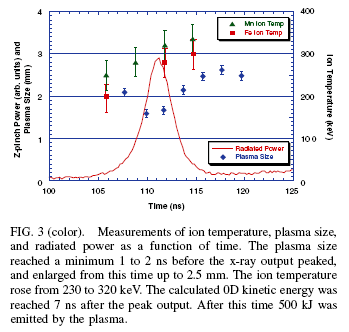
It can be seen that the measurement points for iron ions are within the error bar of the manganese ions, and vice versa. In the graph, the temperature measurement for iron ions increases from 200 to 300 keV, but as these measurements are mixed, not considering a temperature difference (of 35 keV) between the iron and manganese ion populations (probably rightly so), the authors give intermediate values ranging from 230 keV (2.66 billion degrees Kelvin) to 320 keV (3.7 billion degrees). We are indeed "over 2 x 10⁹ Kelvin", "beyond two billion degrees" and not just a little, since the maximum value reaches 3.7 billion degrees. Moreover, given the shape of the curve, it is not impossible that a higher value could be measured, if, in repeating this experiment identically, the four available images had been taken 5 ns later. And if this temperature rise, linked to this ion heating that Haines tries to justify, had been maintained, it wouldn't be two billion degrees we could consider, but... four (we recall that in supernovae, the temperature reaches ten billion degrees).
Logically, given the reliability of the temperature measurements, the authors should have titled "A temperature of 3.7 billion degrees was achieved," indicating "the record value," but they only said "beyond two billion degrees." Why this... timidity? Furthermore, note that:
-
With 500 million degrees, bingo for (non-polluting) lithium-hydrogen fusion
-
With one billion degrees, bingo for (non-polluting) boron-hydrogen fission
-
With four billion, what? (Let the nuclear specialists answer)
-
If one day we reach ten billion, then all the nuclear synthesis reactions leading to the atoms of the Mendeleev table become possible. That is, the whole range of Genesis.
Call me God...
The same graph, plotting the time evolution, in black the average curve, retained in the paper.
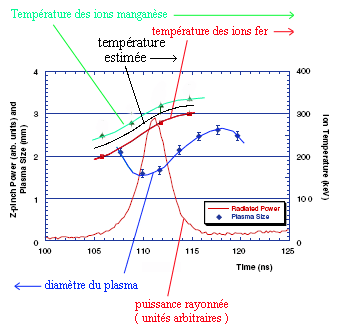
It can be seen that the plasma diameter reaches a minimum just before t = 110 ns. There is an X-ray emission over a duration of about 5 ns. Note the maximum temperature values recorded. 300 keV (3.48 billion degrees) for iron ions and 340 keV (3.94 billion degrees) for manganese ions.
NB: The Bennet formula:
mo I2 = 8 p Ni ( Ti + Z Te )
gives (see above) 2.5 billion degrees for iron. This calculation refers to the Z1141 test (18 million Amperes. 450 mg liner), as well as Figure 1. However, the analyses and data presented in this article refer to three tests (Z1141, Z1137 and Z 1386).
My comment:
Return to the title of Haines' paper: " over 2 x 10⁹ Kelvin ", which means " beyond two billion degrees ". Whereas in previous years these systems reached a million and a half, two million degrees and more, suddenly the machine is accelerating. Readers might be surprised by the absence of carbon emission. But (wikipedia) austenitic stainless steel contains very little carbon (less than 0.15%). See the box.
Austenitic stainless steels comprise over 70% of total stainless steel production. They contain a maximum of 0.15% carbon, a minimum of 16% chromium and sufficient nickel and/or manganese to retain an austenitic structure at all temperatures from the cryogenic region to the melting point of the alloy.
Austenitic stainless steels (a particular crystalline structure) represent 70% of production. They contain a maximum of 0.15% carbon (...), a minimum of 16% chromium and sufficient nickel and/or manganese to maintain the austenitic structure at all temperatures, from the very low, cryogenic temperatures up to the melting point of the alloy.
Austenitic stainless steels comprise over 70% of total stainless steel production. They contain a maximum of 0.15% carbon, a minimum of 16% chromium and sufficient nickel and/or manganese to retain an austenitic structure at all temperatures from the cryogenic region to the melting point of the alloy.
Austenitic stainless steels (a particular crystalline structure) represent 70% of production. They contain a maximum of 0.15% carbon (...), a minimum of 16% chromium and sufficient nickel and/or manganese to maintain the austenitic structure at all temperatures, from the very low, cryogenic temperatures up to the melting point of the alloy.
Austenitic stainless steels comprise over 70% of total stainless steel production. They contain a maximum of 0.15% carbon, a minimum of 16% chromium and sufficient nickel and/or manganese to retain an austenitic structure at all temperatures from the cryogenic region to the melting point of the alloy.
Austenitic stainless steels (a particular crystalline structure) represent 70% of production. They contain a maximum of 0.15% carbon (...), a minimum of 16% chromium and sufficient nickel and/or manganese to maintain the austenitic structure at all temperatures, from the very low, cryogenic temperatures up to the melting point of the alloy.
The two temperature curves for the iron ion gas and the manganese ion gas are shown, which seem different. However, on one hand, the error range indicated for manganese allows us to consider that these two temperatures may actually be very close. On the other hand, the manganese ion, which has practically the same charge as the iron ion (25 vs. 26), is twice as light (30 vs. 58). It is therefore not impossible that, subjected to an MHD instability, these two gases, closely linked, present between them a (slight: 12%) imbalance effect and have different temperatures.
Haines: The plasma diameter reaches its minimum value of 1.5 mm 2 nanoseconds before the maximum X-ray emission. He estimates that at the moment this maximum is reached, the density and "equipartition" must be at their maximum (I tend to read "the tendency toward equipartition").
Let's try to "make these different curves speak." What happens?
We have four temperature measurement points. One is eliminated, for iron, the second, due to a measurement problem. This low number corresponds to everything the recording system can capture. It's already extraordinary, not only to have temperature measurements, but also to have an idea of their evolution over time. However, we don't have access to values before t = 105 ns and after t = 115 ns.
The text says that at the moment of "stagnation" (stagnation) of the plasma, the electron temperature has reached 3 keV, that is, 35 million degrees. This means that at the moment this temperature is maximum, it will not exceed a hundredth of the value reached by the maximum ion temperature. Since the power emitted rises in a strong "pulse," we must assume that before t = 105 ns it was much lower. It seems that this temperature collapses by a factor of 9, towards 115 ns. But the Stefan law indicates that the radiated power varies as the fourth power of the temperature. Therefore, the decrease is actually in the ratio of the fourth root of 9, that is, 1.73. This brings Te to 3 to 1.68 keV. I draw the curve, roughly:
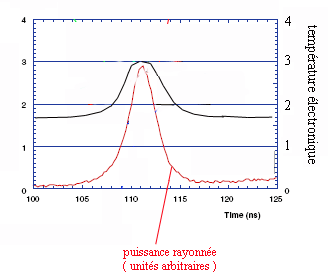
In black, the variation of the electron temperature. In red, the variation of the radiated power (Stefan law).
At t = 105 ns, the ions are already hot (T of the order of 200 keV). Therefore, this heating mechanism, to be clarified, occurs before the plasma reaches its minimum radius, which occurs at t = 110 ns.
Schematically: the plasma implodes. Without this additional energy input, to be clarified, but that Haines thinks comes from the conversion of magnetic energy into heat, this plasma would implode completely, if the ion temperature were equal to the electron temperature (less than twenty million degrees before t = 105 seconds).
But the ions are fed by this input. The ion temperature increases. The coupling between the ion gas and the electron gas occurs in the "characteristic time of equipartition" teq that Haine estimated at 5 ns. The rise time of the electron temperature therefore corresponds to this figure (from 107 to 112 ns).
Haines says that this ion gas heating phenomenon is sufficient to counterbalance the magnetic pressure and that the "stagnation conditions" are actually achieved because the characteristic speed with which the plasma radius varies is only 15% of the ion thermal speed. We can evaluate the thermal speed of the iron ions between the minimal and maximal values of the measured temperature.
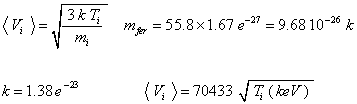
- For the minimum temperature, 230 keV or 2.66 billion degrees: < Vi > = 1066 km/s - For the maximum temperature, 320 keV or 3.7 billion degrees: < Vi > = 1258 km/s
Haines compares these values to the "expansion speed" of the plasma and says that it represents 15% of this value. No matter how you evaluate it by taking points on the curve, it remains lower than the thermal speed, which seems to indeed indicate that the pressure in the plasma has balanced the magnetic pressure.
After that, the plasma diameter starts to increase again. Why? Because the ion heating continues. We could try to calculate this expansion.
There is one thing I don't understand for now: why does the electron temperature decrease, since the electron gas should continue to be supplied with energy by the ion gas, which, in turn, continues to heat up, at least within the time frame we have access to.
Clarification: what is the thermal speed in the electron gas heated to 3 keV (35 million degrees).

Assume we manage to pass 18 million amperes through a 1.5 mm diameter plasma cord. What is the value of the magnetic field at the plasma interface and the corresponding magnetic pressure value? (modulo the assumption that we consider the conductor as infinite, obviously).


June 27, 2006: In France, an interesting idea.
In another article dedicated to magnetocumulation machines, inspired by the Russian machines of the 1950s, we saw the principle of the MK-1 machine. Later, people experimented with non-cylindrical liners, but conical ones. We obtained a "hollow charge effect." The mass of the liner, gathering on the axis, gives rise to a dart projected at high speed. I believe that speeds of 80 km/s were obtained. To be verified. Still, as Violent pointed out to me, we could consider Z-machines with non-cylindrical, but conical wire liners. We could then hope to obtain the same hollow charge effect. Different configurations can be imagined. MHD is the preferred field for the most imaginative solutions. Below is a setup made up of two cones with a common base. If the two plasma darts form and collide, we could obtain higher temperatures, even with a machine like Gramat's.
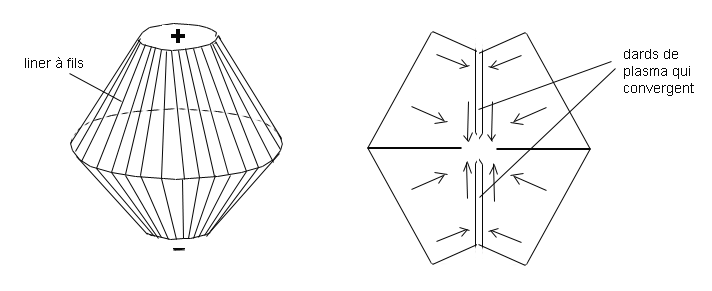
We can't do much else than this drawing. Simulations could be considered and, of course, experiments.
Another idea is emerging: sliding the liner on a bicone. The idea is not new. Here is the drawing, corresponding to a continuous liner:

It's enough to transpose it with a wire liner. ---
July 16, 2006. What is the Hall parameter bi = Wi tii for the ions?
Haines, in his paper, says it is greater than one. This parameter is the ratio of the gyrofrequency to the collision frequency. According to Haines, this ionic collision frequency is essentially an ion-ion collision frequency. Its inverse, the relaxation time tii, is given as 37 picoseconds. This gives a collision frequency:
nii = 3 1010
The gyrofrequency is:

This gives the value bi = 0.258 Z for the Hall parameter of the ions, Z being the ionic charge (maximum 26 if the ion is completely stripped). So, as Haines says, the Hall parameter is greater than one. A lot of work for us theorists.

An additional data (source: http://www.sandia.gov/pulsedpower/prog_cap/pub_papers/023862p.pdf)
The characteristic current discharge profile in the Z machine:
It is the brevity of this current rise (100 nanoseconds) that allowed these results on the Sandia machine. Indeed, it turned out that the sublimation of the wires was slower than expected. Thus, this "wire liner" structure could last during the implosion, preserving the axisymmetry, which disappears immediately when the object, transformed into a plasma curtain, starts to twist under the effect of MHD instabilities. When trying to implode a liner made of a metal cylinder, you get about what would happen if you tried to crush a paper cylinder in your hand. I think the French ( the Sphinx machine, paper presented in September 21006 at the Tomsk colloquium, Siberia, minimal rise time: 800 nanoseconds) did not fully grasp that this aspect was crucial, which Yonas had immediately told me by email in 2006.
February 17, 2008: A clarification on the parasitic reactions related to the formula B11 + H1
Boron has 5 electric charges, hydrogen has one. Carbon has 6 and nitrogen has 7.
The radiative cooling of the plasma occurs by braking radiation. The emitted power varies as the square of the electric charge. The power emitted in X-rays by an electron spiraling around a boron atom is therefore 25 times higher than that lost by spiraling around a hydrogen atom (light or heavy, it's the charge that counts).
B11 + H1 gives C11 + n + 2.8 MeV
Lifetime of carbon C11: 20 minutes. You can open the chamber safely 10 hours after shutdown.
B11 + He4 gives N11 + n + 157 keV
Protection: 20 cm of B10 or 1 meter of water.
Induced radioactivity in the beryllium electrode: 5 microcuries per year (data: Lerner's condensation)
According to Lerner, in this pulsed fusion we use the MHD instabilities. His description of the mechanisms is as follows. The "umbrella" electrical discharge first tends to give plasma condensations similar to "the whales of the same umbrella." Then these filaments wrap around the axis to give a plasma cord. This cord, by Kink instability, configures "like a spiral telephone cord." Then, in this same structure, "self-confined plasmoïdes" form, small hot spots of an infinitesimal volume, less than a cubic micron. In these plasmoïdes, the magnetic field has a toroidal topology. New pinch along the axis of this plasmoïde-droplet. And it is then, according to Lerner, that the fusion reactions occur.
March 18, 2008: Comment following the publication of an article in the magazine Science et Avenir.
The journalist David Larousserie published an article titled "The feats of the Z-machine" in the March 2008 issue of the magazine he works for: Science et Avenir. He called me asking where I had read that Sandia's experiments in 2005-2006 had exceeded, not two billion degrees, but three. I referred him to Haines' article, from February 24, 2006, figure 3, where it is explicitly mentioned that the ion temperature rose from 230 to 320 keV. Now, unless I'm mistaken, 320 keV corresponds to a temperature of 3.68 billion degrees.
He does not address in his article the possibility of a neutron-free fusion of boron and hydrogen, contenting himself with evoking the holraum technique. In general, this temperature breakthrough is very poorly received in circles related, directly or indirectly, to the ITER project, where they prefer to keep this perspective under wraps, hearing to confine the Z-machine to essentially military applications. Indeed, if one day it turns out that the future of fusion goes through these very high temperatures (a billion degrees), the Tokamak technology could absolutely not keep up.
In his article, Larousserie reports what he could remember of conversations with Alexander Chuvatin, from the Laboratory of Plasma Physics and Technology (LPTP) at the Ecole Polytechnique. He reports these words, which we quote:
- We shouldn't get carried away about these temperatures. They only exist for too short a time and are located in unstable areas. This makes fusion impossible, which requires both a high matter density, a sufficiently long confinement time and a high energy.
According to Larousserie, Chuvatin said he had proposed an explanation for the anomaly reported by Haines at the beginning of his article. I quote what Haines emphasizes:
There has been some difficulty in understanding the radiated energy in a wire-array Z pinch implosion could be up to 4 times the kinetic energy [1,4] (the dates of the cited references: 1997 to 2002, show that this problem is not a novelty), and also how the plasma pressure could be sufficient to balance the magnetic pressure at stagnation if the ion and ion temperatures were equal. In fact, theoretically the excess magnetic pressure should continue to compress the plasma leading to a radiative collapse. Some theories have been developped to explain the additional heating, but neither of these have adressed the pressure imbalance.
I confess I don't really understand Chuvatin's remark. What's important is what comes out of the Bennet formula, which simply states that the plasma pressure balances the magnetic pressure. It is given in Haines' paper and I have detailed the way (ultra-clear) to establish it:
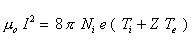
Haines clearly states that for the plasma not to be crushed, the temperature must be 296 eV. What is new, finally, in the 2006 paper, is that this ion temperature, previously derived by this formula, is measured by line broadening and confirmed. Haines' article is very clear on this point.
What Chuvatin's comment suggests is that these very high temperatures "might only interest very small, and very unstable regions." One then thinks of the "hot spots" of Lerner's experiments, related to self-confined micrometric plasmoïdes. If that was the idea, it would mean that only very small volumes would be affected by such high temperatures. But one must not forget that a temperature is also an energy density, in joules per cubic meter. If this temperature only concerned very small fractions of the plasma, in volume and mass, then the pressure would have to be deduced from an evaluation of the average energy density. And the Bennet formula would no longer be satisfied.
It seems simpler, given that the temperature measurement by spectroscopy is in excellent agreement with the Bennet formula, to conclude that this temperature increase is likely to affect the entire mass of the plasma cord and not just small hot spots.
As for the feasibility of fusion: we are certainly not there yet, although D-T fusion is already being considered in the USA. But it is undeniable that Z-pinches like the Z-machine represent an extremely interesting path, compared to heavy and problematic approaches like ITER or MEGAJOULE, while being two orders of magnitude cheaper and remarkably flexible. It is regrettable that two years have passed since the publication of Haines' paper without any reaction in France, except for the continuation of the experiments on the Sphinx setup, which we do not consider to be up to the importance of the issue: an aneutronic fusion!
February 16, 2009: After multiple exchanges with plasma physicists and people who have worked on Z-pinches, the following conclusions emerge:
These environments remain poorly understood. In general, these plasmas would be extremely turbulent, possibly the site of micro-turbulence. It is indeed necessary to explain where the energy emitted in the form of X-rays comes from, which is something tangible, measured, and exceeds by a factor of 3 to 5 the kinetic energy collected by the metallic ions during their run towards the axis of the system. As we have seen, Malcolm Haines invokes MHD instabilities, without describing them. Then the word spheromaks is invoked, self-confined elements that would form as a result of this instability, and involving the closure of magnetic field lines on themselves, according to a toroidal geometry. Dimensions of these objects: conjectural. People like Lerner (Focus experiments) use the word "hot spots." The measurements carried out have not shown sufficient spatial and temporal resolution to highlight these phenomena.
Haines has evaluated the Joule heating and concluded that it was insufficient to justify the measured temperature increase. But how to understand this mysterious energy exchange between the plasma cord and what surrounds it, where a magnetic pressure of 90 megabars, corresponding to a magnetic field of 4800 teslas, is at play? When Haines calculates the Joule dissipation, he assumes a homogeneous plasma. The electric field moves the charges. The progression of these charges is hindered by collisions with anything in the plasma that can be an obstacle. In Haines' calculation, it is ions of different species present, their collision cross-section increasing as the square of their electric charge.
Turbulence makes the medium inhomogeneous, at different scales. In fluid mechanics, turbulent diffusion is more dissipative than laminar dissipation. Take the example of an airplane wing profile. When turbulence is triggered, the frictional drag at the wall increases. The boundary layer sees its thickness increase. Within it, dissipative phenomena generate more heat. And all this happens through micro-turbulence phenomena, not visible to the naked eye.
There is an analogy when thinking about plasma. The electric current flow, assumed in Haines' evaluation to be homogeneous (a simple working hypothesis!), ceases to be laminar. The zones of micro-MHD instabilities become obstacles to the current's progression. There is an increase in impedance initially noted by Christian Nazet. Moreover, the formation of such spheromaks would be accompanied by a chaotic distribution of the temperature field. This is Lerner's idea. In a plasma whose temperature is globally lower than the critical fusion temperature and where the Lawson conditions are not established (at a macroscopic level), these conditions could appear briefly in these small objects, whose lifespan is unknown in advance.
It turns out that I spent an entire day, by boat, about thirty years ago, with the astrophysicist Fritz Zwicky, the inventor of the concept of supernova in 1931. I suddenly remember his hypothesis of "nuclear sprites," spheromaks before the letter, which he imagined forming in the heart of the sun, by MHD instabilities, and which he told me about during that sea trip.
Back to Z-pinches. We must extract the energy from somewhere. Available to us is the magnetic energy present around the plasma cord. Let's recall that a pressure (in this case, the magnetic pressure) is an energy density per unit volume. If there is a transfer of this energy to the plasma cord, it will be at the expense of this ambient electromagnetic energy. There is no "magic" here. The micro-instabilities that arise in the plasma increase its resistivity, create additional dissipation, and, by reducing the current intensity, also reduce the value of the magnetic field outside the cord. Communicating vessels.
I know well the electrothermal instability (Vélikhov). It is a type of bitemperature plasma turbulence that manifests itself by significant fluctuations in the electron temperature. On one side, by structuring the plasma like a thousand-layer cake, with alternating zones of strongly and weakly ionized, it destroys the performance of MHD generators. But on the other side, it shows how an MHD instability can create locally (here in flat layers) hotter, more ionized zones (the phenomenon is violently nonlinear). The hypothesis of the formation of hot spots evokes another model of the birth of micro-instabilities, this time in 3D. In such highly nonlinear phenomena, the excursions in temperature and density could be significant. Hence, possible "micro-fusion" reactions.
It is therefore premature to conclude that with systems like the Z-machine we are "very far from being able to achieve fusion." If we reason with a homogeneous plasma: yes.
Let's move on to the question of temperature measurement. First, what is temperature? In kinetic theory of gases, it is the measurement of the average kinetic energy, for a given species. A medium can be composed of several different species, each having its own temperature. These temperatures can differ greatly. In a fluorescent tube, it is the electron temperature that is much higher than the temperature of the ions and neutrals. We then speak of non-thermal ionization (where the energy is provided by the electric field that accelerates the electrons. If this field is cut off, the electrons lose their energy through collisions: the electron gas cools down and the ionization disappears.
We must then calculate an electron-gas collision frequency. Its inverse becomes a relaxation time. Indeed, if we leave a bitemperature medium to itself, equipartition occurs at the rate of collisions.
Complete thermodynamic equilibrium is the equalization of all temperatures to a common value, and the fact that the velocity distributions of each species take the form of a Maxwell-Boltzmann distribution (Gaussian curve). The plasma of the Z-machine is in a state of inverse non-equilibrium, in the sense that the electron gas is colder than the ion gas. If we disregard the energy input related to MHD instabilities to model (the plasma's micro-turbulence), the energy to be taken into account is of a kinetic nature. The Laplace force acts on the stainless steel wires, precipitating them against each other, finally at 400 km/s. This force acts on the electrons. The current flowing in the wires is of electronic nature, not ionic. The electrons carry the ions with them. We cannot separate these populations, like well-matched spouses, from a distance exceeding the Debye length. The result is that the ions and electrons gather near the axis of symmetry at the same speed. But their kinetic energies are different. The lighter particles carry less.
Haines then evaluates different relaxation times, related to the different types of possible collisions.
- There are electron-electron collisions
- Ion-ion collisions
- Electron-ion collisions
The energy transfer between two particles of different masses is proportional to the ratio of the mass of the lighter one, divided by that of the heavier one. Within the same species, these energy exchanges are maximal, since this ratio is equal to one. Haines estimates the relaxation time to be 37 picoseconds. The curves give a plasma confinement time of a few nanoseconds (about five). I don't know what the time of the temperature measurement by line broadening is. It must be mentioned somewhere in Haines' paper. If we compare the relaxation time within the same species (electrons-electrons or ions-ions), this time is more than one order of magnitude higher than the relaxation time. This is sufficient to assert that the ionic species can be described by a Maxwell-Boltzmann function.
The measurement by average line broadening averages the Doppler-Fizeau effect according to the "line of sight" as astronomers say, that is, according to a radial distribution. And here is yet another way to deviate from thermodynamic equilibrium: anisotropy. But, you might say, could a gaseous medium present a different "thermal appearance" depending on the angle from which it is observed? This is what happens behind a strong shock wave, a real "hammer blow" that imparts an initial perpendicular impulse to the atoms with the wave, then quickly "thermalizes," this gain in agitation speed being redistributed in all directions within a few collisions. Again, we can consider a relaxation time. From a rough estimate, I would say that this anisotropy should be negligible. But again, any conclusion is based on assumptions about the nature of the studied medium, at a microscopic scale. It also adds the magnetic field and its local and temporal fluctuations, hello!
What reliability can be attributed to these temperature measurements by line broadening? Are we not measuring the temperature of a subset: those... hot spots? We know that the radiated power follows the Stefan law, which increases as the fourth power of the source temperature. Dilemma.
This is where we need to turn to the Bennet equation, the non-implosion of the plasma cord. Its radius passes through a minimum. At this precise moment, the ionic pressure must balance the magnetic pressure, which supports a temperature of 300 keV. Take a pressure capsule. It provides a value of the pressure, integrating a very large number of particle collisions against its surface. There is no longer any question of the Stefan law. The pressure in a mixture is the sum of the partial pressures. And pressure is also an energy density per unit volume. If the Bennet equation provides 300 keV, this gives an average value of the particle energy. And this corresponds to more than three billion degrees Kelvin, hot spots or not.
I know that all of this is quite confusing. Take the example of a fluorescent tube. Cold gas, hot electrons. Perform a temperature measurement by spectroscopy (in a fluorescent tube, the light is emitted not by the gas but by the fluorescent coating lining the inside of the enclosure). The gas emission is in the UV. Will we conclude that this gas is 10,000°? No, it is the electron gas that is at this temperature. If there were no Bennet equation, we could be tempted to think that our temperature measurement by line broadening is biased.
All of this leads us to conclude that there is much to be done. I have recommended (vox clamat in deserto) the development of a European Z-pinch project. If the LMJ does not give the expected results, we will have to quickly resort to something else, in this case, something less expensive.
A final remark.
When I was at the conference on High Power Pulsed Systems in Vilnius, Lithuania, in September 2008 (where I presented three communications, see http://www.mhdprospects.com), I found myself, from the first day, face to face with the Americans Matzen and Mac Kee, the first being the head of the ZR experiment at Sandia and the second his assistant. I was very surprised to see them smile immediately when I asked them about ZR and they immediately said:
- "The Haines paper from 2006? He was wrong, the temperatures were lower by at least an order of magnitude!" - "But, there are still these strong line broadening..." - "An Israeli, Yitziak Maron, has re-examined all this and concluded that Haines had misinterpreted these spectrograms." - "Has this been published?" - "No, we did not do it, to not hurt this good Malcolm's feelings" (...)
In the evening, as I insisted, Mac Kee went to a console and said to me:
- "I will send a mail to Maron, in front of you, and tomorrow we will have his explanations."
The next day, I met Mac Kee:
- "So, Maron's explanations?" - "Hmmm... we prefer not to publish this for the moment;" - "But you will at least let me read his mail....." - "It's that... he replied by phone" (....)
Followed by confusing and unconvincing explanations.
Two days later, Matzen presented, on the stage, the progress of ZR, focusing on the simple aspects of big technology, with magnificent photos to support it. It was there that I learned that the experiments to obtain VII ice had not been obtained by implosive compression but by explosive compression, with another experimental scheme, where the current loops like an "umbrella", that is, with a massive axial pillar and return through a wire liner, in contact with which the medium to be compressed is placed, outside. Nothing to do with previous experiments. At the end of his presentation, I asked for the microphone and said:
- "We had, in the previous days, a discussion where you questioned Haines' analysis of the temperature measurements made on the Z-machine, by spectroscopy and published in 2006 in Physical Review D. According to you, the ion temperature would have been at least an order of magnitude lower. You told me that Yitziak Maron, from the Weisman Institute in Jerusalem, had reached this conclusion. Since this matter is important, could you enlighten us?"
Matzen:
- "Hmmm.... this is a good question"
Then a minute of silence, which was broken by the session chairman.
Back in Brussels, I sent an email to the Israeli Maron, who gave me a confused response, without answering my questions, saying the highest praise for Haines. He said he was going to join Sandia in the following days.
I sent another email to Gerold Yonas, the scientific director of Sandia, who immediately gave me a very concise response.
- "Yes, it's also a mystery for me. I will ask Matzen to clarify this story."
Since the end of October 2008, complete radio silence.
February 18, 2008: On Aneutronic Fusion
In a fusion reaction, two nuclei must be brought close enough for a nuclear reaction to occur. Nuclear physics is similar to the world of chemistry in this respect. Radioactivity, natural or induced, simply means that nuclei are unstable. Fission is a spontaneous dissociation reaction that gives nuclei of smaller masses than the one from which they are derived. In the spontaneous dissociations of Uranium 235 or Plutonium 239, the products of this decomposition have masses close to half that of the initial nucleus.
There is emission of neutrons, which can, upon colliding with other U235 or Pu239 nuclei, trigger new dissociations, fissions induced by these collisions. One can then speak of an auto-catalyzed dissociation. Nuclei have a cross-section for capture. Knowing this, it is then possible to calculate the critical mass. It is the mass of a sphere whose radius is roughly equal to the mean free path of a neutron, with respect to its collision with a fissile nucleus.
One can reduce this critical mass by increasing the density of the nuclei, by compression, which is ensured in bombs by a chemical explosive.
Let us consider a gas at absolute temperature T. If this medium is strongly collisional (i.e., if the medium is in a state very close to thermodynamic equilibrium with a Maxwell-Boltzmann statistics), the average value of the thermal agitation velocity of these elements will be given by the formula below. The few drawings and formulas allow to understand, in a schematic way, the concept of collision cross-section (leading here to a nuclear reaction) and collision frequency (of the considered nuclear reaction). Here we reduce the velocity of the ions of mass m to the average value . We consider that everything swept in the passage in a "net" made by the cross-section leads to a reaction probability equal to one, and that for what is outside, this probability is then zero.
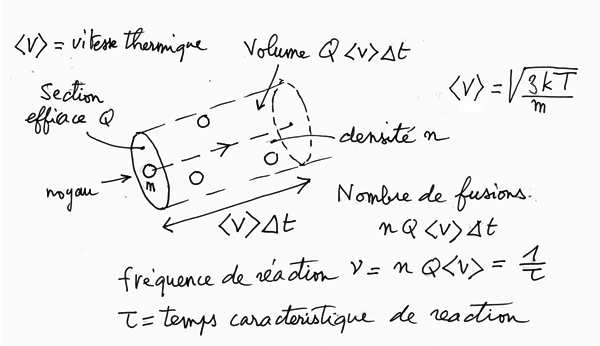
Collision frequency, characteristic reaction time (of fusion)
But it is not enough that the collision frequency is sufficient, that the characteristic reaction time is less than the confinement time. It is also necessary that the ion temperature is high enough for these ions, moving at a velocity centered on the average velocity , to overcome the Coulomb barrier, repulsive, which opposes the approach of two positively charged ions. This leads, for a deuterium-tritium (D-T) mixture, to a temperature between 100 and 200 million degrees, a temperature that physicists often evaluate in kilo-electron-volts, keV, according to the formula
e V = k T
e is the electric charge of the electron, 1.6 10-19 coulombs
k is the Boltzmann constant = 1.38 10-23
Thus, one electron volt corresponds to (e/k) degrees Kelvin, i.e., 11,600 ° K
As we reason in terms of orders of magnitude, we equate one eV, one electron-volt, to a temperature of 10,000°K. Therefore, this ionic temperature must be between 10 and 20 keV.
For fusion reactions to start, the Lawson conditions must be met.
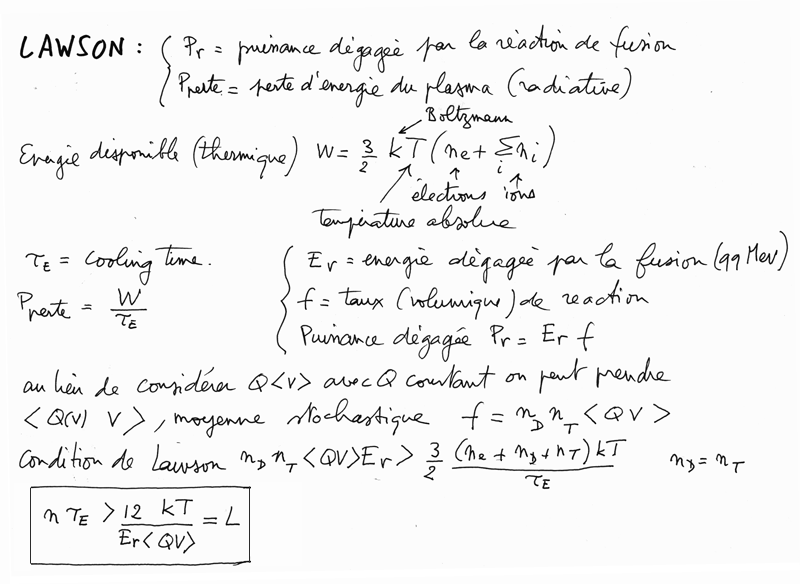
This function L depends on the plasma temperature. The effective cross-section Q(V) depends on the relative velocity of the nuclei and therefore on the average velocity , hence on the ion temperature.
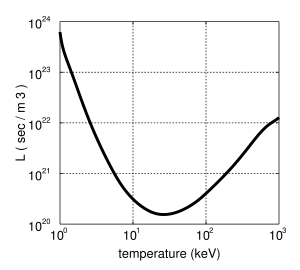
Lawson curve
The deuterium-tritium reaction is neutronic. Reactions that are not have been known for a long time. See Aneutronic fusion.
Only a reduced number of fusion reactions occur without neutron emission. Here are those that have the highest cross-section.
2D + 3He → 4He (3.6 MeV) + p+ (14.7 MeV)
2D + 6Li → 2 4He + 22.4 MeV
p+ + 6Li → 4He (1.7 MeV) + 3He (2.3 MeV)
3He + 6Li → 2 4He + p+ + 16.9 MeV
3He + 3He → 4He + 2 p+ + 12.86 MeV
p+ + 7Li → 2 4He + 17.2 MeV
p+ + 11B → 3 4He + 8.7 MeV
The first two use deuterium as fuel, but some secondary 2D-2D reactions produce some neutrons. Although the fraction of energy carried by the neutrons can be limited by the choice of reaction parameters, this fraction will probably remain above 1%. It is therefore difficult to consider these reactions as aneutronic.
It is on the last reaction that efforts are concentrated. If the mentioned reaction does not produce neutrons, secondary reactions are, however, neutronic. If we base ourselves on the relaxation times calculated by Haines, if there is a temperature difference of a factor of 100 between the electron gas and the ion gas (this one was in a state "out of inverse equilibrium", hotter), we can still consider that the ionic population is in a state close to thermodynamic equilibrium, around its own temperature, that it is a thermal plasma. We then have the following neutronic reactions:
11B + alpha → 14N + n0 + 157 keV (exothermic)
11B + p+ → 11C + n0 - 2.8 MeV (exothermic)
This carbon isotope has a half-life of 20 minutes.
Some have estimated the energy released by these reactions to be 0.1% of the total.
There is also a reaction producing gamma rays:
11B + p+ → 12C + n0 + γ 16 MeV
This reaction has a probability of 10-4 compared to the reaction producing alpha particles.
Finally, there are neutronic boron-deuterium or deuterium-deuterium reactions:
11B + 2D → 12C + n0 + 13.7 MeV
2D + 2D → 3He + n0 + 3.27 MeV
, which can be eliminated by using isotopically pure fuel.
The main component of the shielding would be water to slow down the fast neutrons, boron to absorb them, and metal to absorb the X radiation with a total thickness of about one meter;
The temperature required for the boron-hydrogen reactions to start is ten times higher than that of the deuterium-tritium mixture. There is also a question of optimal reactivity. For this last mixture, it is around 66 keV (730 million degrees). That of the boron-hydrogen takes us to 600 keV (6 billion degrees). However, we have seen that obtaining very high temperatures is possible with a Z-machine, noting that the maximum temperature reached increases as the square of the current intensity. According to this logic, the temperature that ZR could reach would be 9 billion degrees.
No information available on the performance of this machine since it went into operation
At this stage, it is best not to go too far in either direction. The hot plasma of the Z-machine is not that of a Tokamak. Let us add that this hypothesis of "hot spots" is currently beyond any theoretical description. My personal opinion is that instead of arguing endlessly, it would be better to let Nature speak, that is, to experiment. It should be noted that the cost of a Z-machine is two orders of magnitude less than that of a fusion giant like ITER. Moreover, the device has a flexibility that the latter does not have. In early 2008, I met at the Ministry of Research and Industry, Edouard de Pirey, a young normalien, scientific advisor to Valérie Pécresse. When I met him, he confessed at once that he had not had time to read the report, although it was concise and clear, that I had sent him. I gave him a copy of the letter that Smirnov had proposed to send, provided that there was a recipient's name. I therefore asked de Pirey to approach his boss to see if she would accept to have her name on this letter as the recipient.
This initiative remained unanswered. The same for a request for funding for my participation in the international conference in Vilnius, Lithuania, on High Power Pulsed Systems, where I had to go at my own expense in September 2008.
It should be noted that the Z-pinch approach is not on the recently published roadmap by the minister. I leave the reader to formulate his own hypotheses regarding the failure of my initiative.
I think the Europeans should quickly form a research group, collaborating closely with the Russians, experts in this field. It would be appropriate, and even urgent, to put some money on the table and build a machine with a civilian purpose, accessible to all, installed in some "neutral" country (in the technical-scientific sense, of course). The French Z-machine, the Sphinx device, installed in Gramat, in the Lot, is not improvable. With discharge times of 800 nanoseconds, this machine is too slow. I also think that it would be a major mistake to place this project under the supervision of defense secrecy, for various reasons. Of course, through such an approach, the emergence of pure fusion bombs becomes "non-impossible". The Russians are masters in the manipulation of High Power Pulsed, when the initial energy is an explosive. Periodically, the West discovers, often with surprise, some new idea born beyond the Urals, which completely changes the game, like those of disk generators.
The production of very strong currents is done by compressing, using an explosive, a cavity where a strong magnetic field has been created. But chemical explosives induce limited implosion speeds. If we divide the characteristic dimension of the chamber by this speed, we get times that can hardly go below a few microseconds. This is far too slow for a formula inspired by the Z-machine, where this time cannot exceed 100 nanoseconds. In a classical system, the discharge power increases with the cavity volume. The Russians have bypassed the problem by simply giving it the shape of a ... accordion. Imagine an accordion whose outside is embedded in an explosive, cast right next to its chamber. The total volume can be significant, while the thickness to be crushed remains, in each of these cells, quite small. This aspect is mentioned in the English version of Wikipedia.
Military authorities fear the "proliferation" aspects of such a technology, where the initiation of fusion reactions no longer passes through the, technologically heavy, stage of isotopic enrichment. But what can be done? Nothing? Our planet is on the brink of collapse, due to a lack of energy resources. Go tell the Chinese and the Indians they must save!
The choice is political, on a planetary scale. A final remark regarding ITER and Megajoule:
Gilles de Gennes, before his death, was one of those who had pointed out the numerous arguments making the ITER project problematic, unless it is considered a social plan or a way, for thousands of researchers, engineers, and technicians, to have a complete career in one of the most beautiful regions of the world, the best located. De Gennes was very skeptical about whether the superconducting magnet of ITER, located closest to the plasma torus, could withstand a strong neutron bombardment for a long time. He pointed out that no prior study had been done on this, which would have been easy, on the scale of models placed in a neutron flux. But the result might have had the conclusion of an immediate stop to the construction of this real cathedral for engineers.
Second point: fusion plasmas are collisional, they are thermal plasmas, close to thermodynamic equilibrium. The velocity distribution of ions is therefore of the Maxwell-Boltzmann type, with a Boltzmann distribution tail, populated by fast ions:
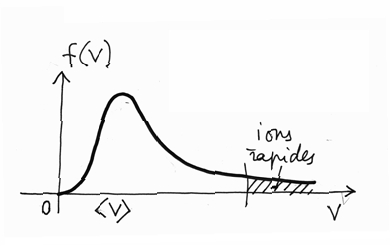
Fast ions in a Boltzmann distribution tail
These ions will inevitably overcome the magnetic confinement field. Upon hitting the walls and the various objects constituting the chamber, they will detach heavy atoms.
Pollution of the fusion plasma of a tokamak, due to the detachment of heavy ions from the wall
These, immediately ionizing, and acquiring a charge Z, and also undergoing the effects of the magnetic pressure gradient, will join the core of the plasma, polluting it. Now, the radiative losses due to the interaction between the plasma electrons and the ions (bremsstrahlung or braking radiation) increase as the square of the electric charge of the ions Z.
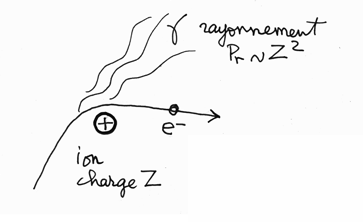
Radiative losses by electron-ion interaction (bremsstrahlung)
No one sees how to prevent this pollution of the plasma by these heavy ions, nor how to clean it. The increase in radiative losses will lower the temperature and the steam engine of the third millennium will suffocate. When I raised this question during public meetings with the people from ITER, their only reaction was:
- "This is a good question....."
If one asks whether the machine ITER will allow fusion reactions to occur at a significant and sustained rate, it is possible that the answer is positive, on short time scales. But if the question is "will this type of machine eventually lead to an operational reactor and solve the energy needs of humanity?" I think the answer must then be negative.
I will make another remark, regarding this pulsed fusion. It lends itself to a direct conversion. The fusion plasma expands. If this happens in a magnetic field, as the magnetic Reynolds number is very high, there is "flux compression" and induced current. Efficiency: 70%. No moving parts. Why complicate life with a heat exchanger, a steam turbine. Why not a propeller, while we are at it? I believe in the "two-stroke fusion", in the long term. There are other solutions than Z-pinches for this pulsed fusion. We have only touched the question.
There are natural systems that perform pulsed fusions. These are the quasars. I do not think the energy comes "from the accretion by a giant black hole". Joint fluctuations of the metrics of the two twin universes create a centripetal shock wave, in the interstellar gas of a galaxy. I had already described this in "We have lost half the universe", published in 1997 by Albin Michel. Strictly no media echo. The gas is compressed on its passage, destabilized. Young stars form which, spitting in the UV, ionize this interstellar gas. The magnetic Reynolds number increases and the gas wave then carries the galaxy's field lines (frozen in), like a farmer gathers wheat stalks. The collapse ends in a small plasma ball on the scale of a galaxy, where the Lawson conditions are achieved in the mass and not in the core, as in a star. Hence these objects that "as small as stars, emit as much as a galaxy". The plasma is then ejected in two lobes, following the direction of the dipole magnetic field. The magnetic field gradient accelerates charged particles over a distance of hundred thousand light years. Thus, the "cosmic rays" are formed in these large natural particle accelerators.
When the joint fluctuations of the metrics result in a weakening of the confinement, the galaxy ... explodes. These are the "irregular galaxies", about which the famous English astrophysicist sir James Jeans (discoverer of the instability to which he attached his name, as well as the equation that describes it) said:
- "The often incredibly tortured forms of some galaxies make one think that they are the seat of colossal forces, of which we know nothing."
As for the LMJ (Laser Megajoule), it has never been said anywhere, outside of the usual refrains ("the sun in a test tube", "a field of research for astrophysicists"), that this tool for military engineers is part of an attempt to solve the problem of the planet's energy needs.
Return to Guide Return to Home Page