Paranormal Artifacts Psychic Experimentation
Paranormal versus Artifacts
October 14, 2002
Seventh Part
Forced Choice Method
A few years ago, a friend—sincerely well-intentioned—had built a sort of "psychic wave cannon." With others, he experimented using this device. One version involved two coaxial solenoids, nested one inside the other, carrying opposing currents and thus producing a "zero field." All of this went along with a theory I admittedly didn't fully grasp. One day, enthusiastic and confident, he invited me to become the subject of an experiment. Pointing the cannon at my forehead from a few meters away, he claimed it would "activate my third eye."
- Do you feel anything? ...
- Well... I don't know...
Apparently, a medium who had undergone these tests just days earlier had rolled on the floor, finding the signal unbearable. After a while, I said to my friend:
- Let's see whether I perceive something or nothing at all. Take a coin. Call one side "1" and the other "2." Using this simple device, we'll create a sequence of pairs:
1 - 1 - 2 - 1 - 1 - 2 - 1 - 2 - 2 - 2 - 1 - 2 etc...
- What's the point of this?
- Instead of presenting the stimulus once and asking me whether I perceived it, we'll implement a "forced choice" system. You'll announce a "pair of trials" according to the following procedure:
First trial......... (wait a few seconds)
Second trial.... (wait another few seconds)
Following the sequence generated by "heads or tails," you'll apply the stimulus in the first trial and nothing in the second when the number is 1, and reverse the assignment when it's 2. After sending each pair of trials, you won't ask me whether I felt anything, but rather: in which of the two trials was the stimulus present? This way, I'll be in a situation of forced choice. I won't be able to avoid answering. And if I feel nothing in either trial, you'll still require a response—any response.
- And then?
- Afterwards, you'll tally the correct answers. If I truly perceive something clearly, the percentage will be high.
- And if I perceive nothing, will it be zero?
- No, it will be 50%. Depending on the stimulus intensity, the percentage of correct responses will increase only if the subject perceives anything at all. In experimental psychology, this is a standard method for detecting subliminal phenomena—visual, auditory, tactile. For vision, a subject is placed in a completely dark room, then a very faint light signal is presented. Each time, the subject must respond. The same protocol applies in a soundproof room with a faint auditory signal. What's amusing is that one can achieve a response rate significantly above 50% (mathematical methods exist to assess the "significance" of a positive response), even though one has the impression of perceiving nothing at all and merely guessing at random for each pair of trials.
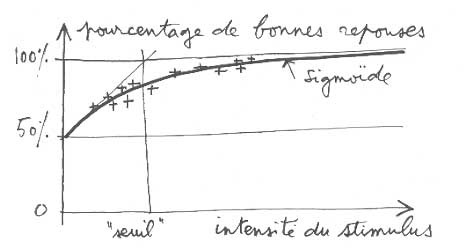
All of this corresponds to what is known as "signal detection theory." Assuming that the failure to perceive a signal is due to it being masked by "gaussian background noise," the theoretical curve above takes the shape of a sigmoid (a simple exercise for the mathematically inclined).
We proceeded exactly as I suggested, and my percentage of correct responses was 52%. This was not statistically significant. Therefore, my third eye was completely insensitive to these psychic waves. The situation became more complicated when my friend himself became the subject, and his performance turned out to be comparable to mine. Since this psychic wave cannon had cost quite a few millions in old currency, I quietly left... on tiptoe. I won't count the times when simply introducing a bit of methodology into an experiment ended in disaster.
Final note: To eliminate all artifacts, the experiment should be run by a computer (which would then control timing and display messages on a screen) rather than a human. Indeed, it's far too easy for the operator to signal the stimulus position to the subject by subtly changing tone or volume of voice, body gestures (if visible), or simply by varying the duration of the two procedures. Moreover, one must consider that between an experimenter and their subject, an unconscious complicity can develop, quite sincerely—after all, as the saying goes, hell is paved with good intentions.
Back to News Back to Guide Number of views since October 14, 2002: