Paranormal Artifact and Domespace Radioactivity
Paranormal vs. Artifacts
October 14, 2002
Eighth Part
We have drawn upon the world of magic to illustrate the concept of an artifact. While the trick performed by the Mexican medium was relatively crude and easy to expose, we have seen that others—such as this one based on unsuspected and poorly known topological properties—can be genuinely deceptive. Imagine that, in an experiment where the medium must reach a key seemingly out of reach, he tells you, "I can only dematerialize in total darkness." A thorough inspection of the equipment would yield absolutely nothing. You could probe the foundations, check the holes, verify the strength of the restraints—transformed in this case into steel cables. You could search the medium, even undress him if necessary, and perform a full-body X-ray to check whether, like Houdini, he might be hiding tools in his esophagus or anus to unlock the handcuffs. You could ensure no assistant could help him. Yet all these checks would lead to no result, and you would eventually have to admit the truth: Dematerialization would be the only possible explanation. Simply because, according to our paradigmatic understanding of the situation, the medium cannot bring the ring close to the key. Only a specialist in knot theory could tell you, "Your medium is not irrevocably fixed to his starting position." Admit it—if I hadn’t given you the solution, you would never have looked for it!
There are extremely insidious artifacts. I was once called to Brittany by a man named Patrick Marsilli, inventor and builder of remarkable homes: the Domespaces. See the website http://www.domespace.com
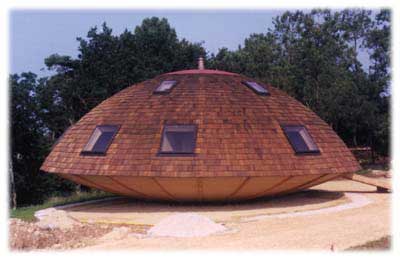
These homes are extraordinary. Built entirely of wood, they are extremely welcoming and pleasant to live in. Moreover, they can rotate on their own axis because they rest on a circular track with ball bearings. One day, Marsilli called me and invited me to witness a stunning phenomenon firsthand: inside these buildings, natural radioactivity is reduced by 40%. It was certainly worth the trip. I went there with some engineer friends, bringing our own equipment—Geiger counters. First step: a careful measurement of natural radioactivity in the surrounding terrain. This proved remarkably constant. Then came a major surprise: as soon as we crossed the threshold of the dwelling, radioactivity began to drop, reaching a minimum at the center, with an actual reduction of thirty to forty percent. We repeated the measurements again and again.
Could the material have unsuspected properties? Marsilli had built a conventional garage near this "dome," constructed with exactly the same components: laminated wood, cork pellets for insulation, and Canadian red cedar cladding. Yet there was no reduction in radioactivity there. So that was a dead end.
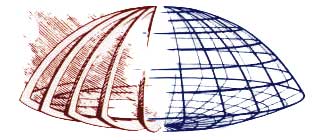
We conducted measurements on several similar structures. Same result. Marsilli even claimed this reduction in radioactivity had already been observed in a building under construction, even before its floors and cladding had been installed—while it existed only as a skeleton. In the diagram below, taken from Marsilli’s website, you can see the laminated wood arches forming the basic frame.
Another highly disconcerting phenomenon. Many Domespaces rest on cylindrical concrete pillars. The rolling track is located precisely at the junction between this pillar and the house itself. In the diagram below, the components are clearly visible. The Domespace’s frame is bolted onto a cylindrical metal turret, which rests on the concrete base via its rolling track. The inhabitants move on a floor. Between this floor and the lower spherical dome, there is a kind of "cave" accessible via a trapdoor. We entered and took new measurements. At the junction between the dome and the cylindrical support, the shell is interrupted. There is a circular opening several meters in diameter, opening into the interior of the concrete pillar. And there, a major surprise: when we moved the Geiger counter probe, we observed a significant increase in radiation levels over just ten or twenty centimeters. The gradient was striking. The rise occurred precisely when the probe passed through a kind of "virtual surface" that effectively completes the lower spherical dome.
Could the shape of the Domespace be affecting radioactivity? Were we facing a reproducible, extra-paradigmatic phenomenon? We remained puzzled for a long time. What could possibly create such a phenomenon?
Initially, we considered radon—a radioactive gas continuously emitted by the Breton soil. Being heavy, radon tends to accumulate near the ground. It is well known that Breton cellars must be ventilated, or else radioactivity increases as the gas rises to the surface. But you’ve seen that Domespaces are all systematically elevated. Their floors are not at ground level, so they are not in the layer near the soil where radon accumulates. Now, consider the measurements taken inside a Domespace mounted on its concrete pedestal. Inside, there is only packed earth. So radon emitted by the soil rises and fills this cylindrical space completely. It then overflows through the rolling track. This means the cylinder is entirely filled with radon up to the brim, and that’s why we observed such a dramatic change in readings.
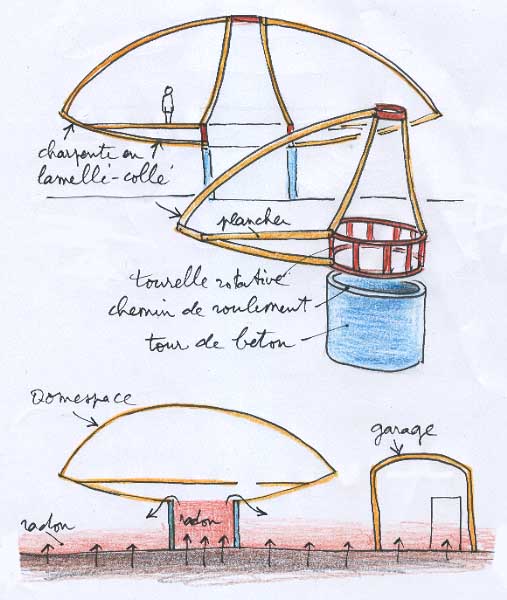
Why would Marsilli have observed a reduction in radioactivity in Domespaces during their construction, even before the cladding was installed? Perhaps simply because these homes were already elevated on their concrete bases, and no one had thought to take control measurements at a certain distance from the ground (I must admit that at the time, none of us had even considered the possibility of an artifact linked to radon accumulation near the soil). This is just a hypothesis. Marsilli will need to verify it.
Brittany is far away. Unfortunately, I haven’t had the chance to return, but I’ve pointed this out to Marsilli. He’s also quite busy. I hope he’ll be able to confirm my analysis of this phenomenon.
Was Marsilli a magician, a fraud? Not at all. He observed this phenomenon in good faith. When we went there, not one of us thought to climb a ladder and take radiation measurements in the open field, simply moving away from the ground. It’s a formidable trap for people of the purest good faith—and an excellent way to appear foolish by drawing hasty conclusions about the undeniable effects of "form waves" on physical phenomena.