Paranormal artifacts, experiences, methodology
Paranormal versus artifacts
October 14, 2002
Ninth part
All this may seem rather depressing. Scientists appear to be killing dreams by relentlessly pursuing a process of demystification. These examples were merely given to remind us of caution and a certain methodological strategy. Personally, I believe that the "paranormal" presents us with a genuine challenge, and we will have the opportunity to discuss it again later. One of the major difficulties lies in:
- The non-reproducibility of these phenomena — and
- The possible interaction between the observer and the phenomenon he or she wishes to observe.
We cannot rule out the second point, otherwise we would be adopting an a priori attitude rooted in belief. And that is precisely what we want to avoid. So, what can we do?
Let’s offer a few ideas. Everyone knows the classic "spiritualist experiment." Arrange letters and numbers flat on a smooth table in a circle. Then place, for example, an inverted glass on the table. People seated around the table place their fingers on the glass. It is said that the glass then moves, providing answers in the form of a sequence of letters, which are recorded and interpreted as responses to questions posed.
- Spirit, are you there?
- O
- What is your name?
- GIGO
- If you are the spirit of a deceased person, in which era did you live?
- 13S
- Where did you reside at that time?
- SALERNO
- What was your role at that time?
- DOCTOR
And so on...
But the problem is that if the participants can see the letters, it is extremely easy for them to move the object themselves toward the desired letters. We end up with an undecidable situation, even if those present make a conscious effort not to impart any impulse to the object. They may do so unconsciously. How can we create experimental conditions where such fraudulent or unconscious contributions could be systematically eliminated?
IKEA sells wooden lazy Susans, where the top rotates very easily due to ball bearings. Buy one. Cut small squares of paper, on which you write the 16 letters of the alphabet, plus numbers, plus any other symbols you wish to include. Leave, for example, one blank square representing "no answer." Place these squares in a bag. Draw them one by one and arrange the forty symbols in a circle as evenly as possible, then glue them onto the lazy Susan. Once this is done, cut an equal number of covers from black cardstock, folding them along one edge as shown, so that the moving object can bump into them. Secure them with tape so that after each contact with one of these covers, you can lift it up and see which letter it conceals.
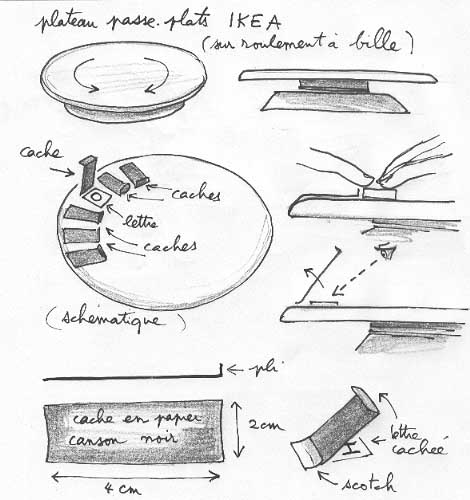
The fact that the platform is rotatable means that, like a roulette wheel, you can spin it between each letter. If your setup is carefully assembled, it will be impossible for a participant to detect the positions of the letters. If you want to go even further, you could cover the platform with several layers of white varnish to conceal any wood grain that might serve as reference points.
Begin your experiment.
- Spirit, are you there?
If the object (glass, mineral water bottle cap, or plexiglass disc, depending on your choice) moves and points, for example, to the letter "Z," we could consider the experiment a failure. Two conclusions: either spiritualism is a hoax, or no one in the group possesses sufficient mediumistic abilities to allow the phenomenon to manifest. On the other hand, if the response is "O" or "Yes," and you have included a square with such a response, then you must note that the probability of such a response occurring by chance is 1 in 40.
If, by good fortune, you have passed this threshold, remove the moving object, spin the platform, and repeat the process for each letter. If you obtain a sequence of n letters forming a meaningful sequence, the probability that this result arose purely by chance would be 1 in 40^n. Suppose this "machine" produced the 22-letter sequence mentioned above; the probability that this sequence resulted from chance alone would be:
1 in 40^22, or 5 × 10^-36
Previous page Back to table of contents
Back to News Back to Guide Number of views since October 14, 2002: