Mitterrand in the gardens of the Observatory
The Observatory affair.
References: « Le Crapouillot », no. 20 New Series, March-April 1972; no. 59 New Series, Summer 1981; no. 2 Special Issue, June 1994.
Reported by Y. Langard
Mitterrand's version
On the night of October 15 to 16, 1959, François Mitterrand, senator, former Minister of the Interior and Justice under the Fourth Republic, filed a complaint with the police: he claimed to have been the victim of an assassination attempt.
As he recounts it, when he was leaving the Lipp café on the Boulevard Saint-Germain around half past twelve, and returning to his home at 4 Rue Guynemer, near the Luxembourg Gardens, in his blue Peugeot 404 (*), a Renault Dauphine followed him. Concerned (the climate was tense with attacks linked to the Algerian War), he altered his route and, upon reaching the Senate, turned left toward the Boulevard Saint-Michel instead of right toward his home. But the suspicious car followed him, so he eventually turned right into Rue Auguste-Comte, abandoned his vehicle, and jumped over the hedge of the Observatory gardens just in time to avoid a machine-gun barrage—seven bullets fired at his car by his pursuers.
Judge Braunschweig opened an investigation “against X” for attempted murder and entrusted the case to Commissioner Clot, head of the criminal investigation unit of the judicial police, who launched intensive searches over several days.
(*) Possibly a typographical error. The 404 did not exist at that time, unless mistaken. I believe it was actually a "403." According to this source, the 404 was "symbolically launched with the advent of the 1960s."
http://www.caradisiac.com/php/collection/voitures_legende/francaises/peugeot_404.php
September 6, 2005. It was indeed a 403:
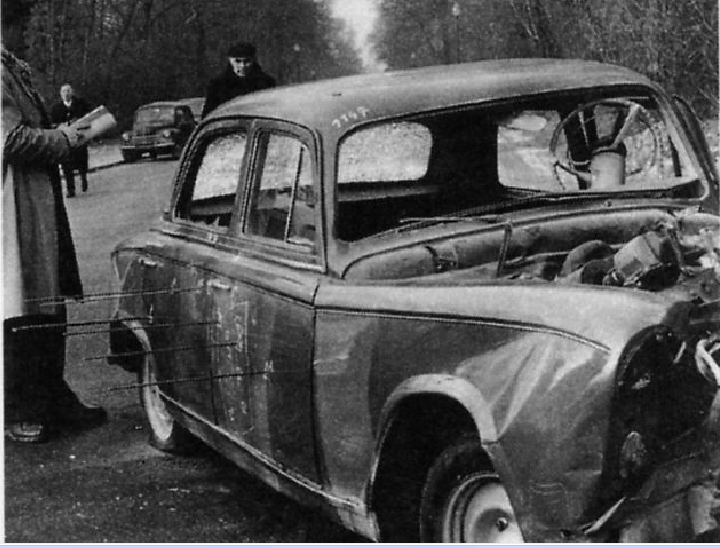
Mitterrand's vehicle after the "attack" (photo from press agency)
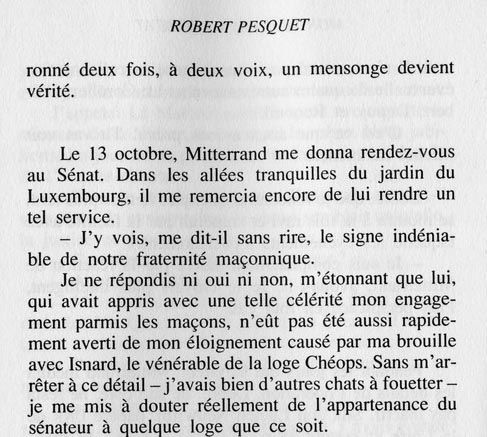
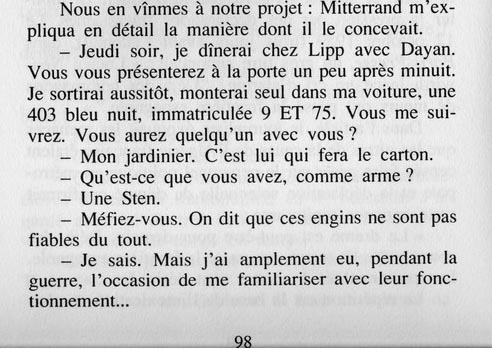
My comment: The metal rods are there to indicate bullet impacts and trajectories. These are located at the level of the driver's seat. Six impacts are visible. The Sten submachine gun's magazine holds 20 rounds; if we assume the shooter emptied it, this would explain the shattered windows. Since Mitterrand is said to have jumped out of the car, the vehicle must have crashed into something, accounting for the body damage. However, as Bernard D. points out in sending me this photo, why is the steering column completely twisted, if the driver is supposed to have exited the vehicle at the moment of impact? Below is an excerpt from Pesquet's book.
The scandal breaks
Six days later, on October 22, 1959, the right-wing weekly Rivarol claimed that Mitterrand was not the victim of an attack, but the orchestrator of a fake assassination attempt against himself, carried out with a accomplice, former Poujadist (right-wing) deputy Robert Pesquet, defeated in the 1968 elections.
Pesquet's version
On the same day, Pesquet appeared before the judge. He claimed that Mitterrand, whom he met on Wednesday, October 7, at the Palais de Justice, had offered to "rescue him from mediocrity" if he agreed to perform certain dangerous missions for him; this proposal was renewed on October 14 and confirmed on October 15, the day he was assigned the mission of staging an assassination attempt against Mitterrand, in order to restore the latter's lost popularity since de Gaulle had come to power. All operational details—times, routes—were supposedly finalized that day by the two men, according to Pesquet.
He revealed that the following car, a Dauphine, was driven by himself, Pesquet, while the submachine gun was held by Abel Dahuron, his gamekeeper. Both had waited, as agreed, until Mitterrand was safely hidden in the shrubbery before firing at his empty car.
Mitterrand's second version
Mitterrand filed a dual complaint: for attempted murder and for defamation. According to him, Pesquet, whom he barely knew, had "intoxicated" him by "revealing" that a real assassination was planned against him by his opponents, supporters of French Algeria; that Pesquet was supposed to carry it out, but had instead chosen to warn his future victim to spare him, and instead suggested a failed attack. Mitterrand claimed he accepted this proposal out of fear that other "friends" of Pesquet would actually kill him if Pesquet informed them he was backing out.
The judge's reaction
The judge charged Pesquet and Dahuron with illegal possession of war weapons, as they held no firearms permits; furthermore, they had fired in a public street.
He also charged a third accomplice, André Péquignot, who had provided the submachine gun (a "souvenir" from the Resistance), though he had no idea of its intended use.
Finally, since this former Minister of Justice had misled the police and the judiciary by failing to mention Pesquet and their relationship when filing his complaint after the alleged attack—causing a futile investigation by the judicial police for several days—the judge expressed a desire to charge Mitterrand with contempt of court.
But Mitterrand was a senator, thus protected by parliamentary immunity. The judge therefore requested the Senate to lift Mitterrand's immunity, which was done on November 25, 1959, by 175 votes against 27. Thus, there were now four accused individuals.
Aftermath
Apart from a minor incident in which Pesquet was briefly imprisoned for another matter and went on a hunger strike, the Observatory affair dragged on for another seven years.
By the end of 1965, de Gaulle ran for re-election. Two of his most determined political opponents stood against him: Mitterrand and Tixier-Vignancour, a far-right candidate and former lawyer for Pesquet. Yet the Gaullists did not even mention the fake attack at the Observatory, likely fearing that Mitterrand, a former Minister of Justice, might possess his own files against them (particularly against Michel Debré regarding the bazooka attack in Algiers in January 1957, which Debré was accused of having orchestrated).
De Gaulle re-elected in January 1966, a law of amnesty was issued in June, as is customary after a presidential election. This law erased Pesquet and Dahuron’s offense of illegal firearm possession. But for the first time in history, it also extended to the offense of contempt of court: Mitterrand was thus cleared as well, and it became forbidden to even mention his indictment. This "gift" from de Gaulle to his fiercest opponent seems to confirm that the Gaullists feared Mitterrand might bring out his "files."
Epilogue
On August 8, 1966, two months after the amnesty, Judge Sablayrolle, who had replaced Judge Braunschweig, issued a dual ruling concerning Pesquet and Dahuron: referral to the correctional court (purely formal, since the case was already...