The crash rate of São Paulo
The failed crash in São Paulo
July 24, 2007 - Update from July 4, 2007
On July 24, 2007, viewers were able to watch a video and numerous photographs showing the consequences of a loss of control of a civil aircraft carrying 186 passengers, which left the runway and crashed into a building located to the left of the emergency stopway of the takeoff runway.
All of this is obviously very sad, and our thoughts are with the families of the victims. We have read many things, for example, that this runway, located in the middle of a city, was quite short (1,900 meters) and lacked a grooving system to drain rainwater. We have read that in the preceding days, other aircraft had experienced braking problems. We have read that the right thrust reverser of this Airbus aircraft had been out of service for several days. This reverser allows for very effective braking in rainy conditions. See http://siteaero.free.fr/reverser.htm. And under these conditions, where the aircraft can only hydroplane, it is even the only usable braking device. Of course, if the right reverser is broken and the pilot makes the mistake of activating the left one, it will immediately cause the aircraft to turn, and visibly, this is what happened. In this regard, aviation regulations lack precision. It must be specified to pilots that when one reverser is out of order, they must not use the other one (for a twin-engine aircraft). The pilot should have thought of this.

Thrust reverser

This is a device that, by deflecting flaps, redirects the gas flow forward.
Below is the general operating principle of "cascade reversers." According to information provided to me, these Airbus A320s are equipped with secondary flow reversers, cascade type, IAE V/2500 model.


The cowling is moved backward, uncovering the grids that deflect the gases forward.
Cynics would say that aircraft with a faulty thrust reversal system should be immediately grounded and sent for maintenance. Indeed, using an aircraft where one of the two thrust reversers is out of service is equivalent to driving a car whose brakes only work on one side. But these people do not measure the revenue losses that such a measure would entail. Thus, according to the Brazilian airline operating the route, the French company Airbus had prescribed in its maintenance manual that aircraft could continue to fly with only one reverser functioning for 10 days. This gives the airline using the aircraft time to put crew members on leave, arrange for the replacement of the plane, reserve a maintenance hangar, etc. Of course, there remains the risk that such an aircraft will have to land in rainy weather on a fairly short runway. But let us recall that zero risk does not exist. Taking a plane is always more risky than staying safely at home. These 186 deaths, plus those who were in the vicinity and perished, are the price to pay for the aviation machine to keep running. This is called the ransom of progress. Furthermore, victim compensation is there to take over.
As an aviation specialist, I can only make a few remarks regarding the photographs of the crash, comparing them to the impact of the Boeing on the Pentagon in 2001, after its hijacking by Al-Qaeda terrorists. Numerous differences are immediately apparent. It is said, for example, regarding the impact of the Brazilian plane, that the kerosene, whose strong odor witnesses smelled in the area, ignited upon impact. Note that the aircraft that landed in Brazil had almost empty tanks, as it was at the end of its flight and not taking off. Conversely, the Boeing hijacked in 2001 had full tanks as it had been configured for a transcontinental flight. Despite this, the impact on the Pentagon presents undeniable, interesting ecological aspects. For example: the lawn located in front of the building was not damaged.

The grass, intact after the impact of the hijacked plane on the Pentagon.
Conversely, the São Paulo accident can be considered the model of a failed crash, and we can wonder what caused things to turn out this way.

During the crash, the kerosene ignited within seconds.
If there had been a lawn in front, it would have been irretrievably lost. In the foreground is the vertical tail of the aircraft.
First remark: if there had been a lawn in front of the building into which the aircraft crashed in São Paulo, it would have been completely ruined. Fortunately, there was none.
Over time, people are becoming increasingly sensitive to pollution issues. Now, look at the aftermath of the São Paulo accident. The too-low temperature of the kerosene leads to very polluting combustion, with thick black smoke.

São Paulo: heavy pollution linked to the incomplete combustion of kerosene, which takes time to burn.
Conversely, the crash on the Pentagon is exemplary in terms of pollution. Note the absence of black smoke. The combustion of the kerosene is complete and rapid, almost instantaneous, one might say. It is practically an explosion, according to witnesses.

Pentagon, September 11, 2001. This is the clean crash par excellence, respecting the environment.
Let us put ourselves in the place of the pilot of the Brazilian plane. He has left the runway, he is speeding towards the buildings. He knows that his life and that of his passengers are irretrievably lost. Under these conditions, he should only think about the people living nearby. And in this case, the instruction that should be written in the manuals, regarding the procedure in case of a crash, should stipulate that pilots must do their best to keep the aircraft straight, so that it can penetrate the building while causing the minimum of damage in the neighborhood and loss of life for residents. The crash on the Pentagon showed that when an aircraft approaches straight, the fuselage penetrates completely into the building and the wings can fold back, taking with them the engines and the fuel reserve.
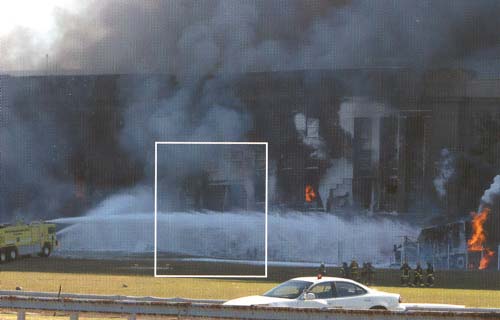
On the Pentagon, knowing that everything is relative, we are facing a crash with virtually "zero damage".
In the square is the opening through which the aircraft entered, after folding its wings, engines, and tail. If there had not subsequently been an unfortunate fire caused by the materials contained in the building, which led to a collapse, the damage would have been, all things considered, minimal, thanks to this mastery of the crash.
Thus, it only catches fire with a delay. There is no projection of kerosene everywhere and, if there is a lawn in front, it is not affected. I know this may seem trivial, but when the tragedy is inevitable, one might as well save what can be saved, even if it is a lawn. That is always a gain. Note the modest scale of the fire during the crash on the Pentagon, whereas the plane had a full tank of fuel.
The aircraft, penetrating well on axis, leaves very few debris.

The crash on the Pentagon, very clean. Grass intact a few meters away. Very few debris.
An exemplary crash from an ecological point of view. Very little damage to the environment.
And above all, as the fuel ignites with a delay, the temperature reached vaporizes the bodies of the passengers, which avoids the heartbreaking sight offered to the victims' families of burned and horribly mutilated bodies. Subsequent DNA analyses will always suffice, as in 2001, to identify the victims.

São Paulo crash. Removal of bodies.
During the crash on the Pentagon, the high temperature, by vaporizing the bodies, spared rescuers this painful task; they only collected DNA with a spoon from the walls for the identification of the victims.
The aircraft debris, practically vaporized at the same time, is also less significant, which facilitates clearing. Conversely, the temperature being too low in São Paulo left numerous and bulky debris.
  
The too-low temperature of the fire in São Paulo left numerous and significant debris.
If the aftermath of the impact of the Brazilian Airbus on the building was so damaging to the environment, and if a witness, Dr. Douglas, who arrived immediately at the scene, "was able to see about twenty bodies around the plane," it is because the aircraft hit the facade while advancing "crab-like," in a full skid, the pilot proving incapable of controlling his crash.

The uncontrolled end of the aircraft's trajectory in São Paulo; the plane hits the facade at an angle.
Seeing that the impact was inevitable, the pilot should have had the reflex to retract the left thrust reverser while striving to control his final trajectory with the brakes, to better negotiate the aircraft's penetration into the building, straight on axis. The photos of the impact on the Pentagon showed this: even approaching at a much higher speed, an aircraft of comparable size (also twin-engine, with an equivalent number of passengers) was able to penetrate through a three-meter by three-meter hole, taking with it its wings, which fold automatically, as does the tail and landing gear. The perfection of the crash on the Pentagon can be seen in the fact that the windows of the upper floors were not even broken. Last July 24, because of this poorly handled crash, the accident created a dozen "collateral victims," dead or seriously injured, which could have been avoided with a better-controlled crash in the final phase.
When the irreparable has happened and there is nothing left but to mourn the dead, one might as well try to draw positive aspects as a summary. This boils down to this sentence, which should appear in all pilot manuals in red letters, in the chapter "crash control":
If impact with a building is inevitable, stay straight on axis; you will at least save the lives of the neighbors, if not your own, and you will cause less material damage ---


The French press ---
Jean-Claude Boetsch, retired journalist, survivor of the 1988 Airbus A320 crash at Habsheim, which killed 3 people and injured 100 out of 135 passengers, has created a website where he closely follows the São Paulo crash.
http://www.crashdehabsheim.net/autre%20crash%20TAM.htm
This is the page dedicated to this Airbus A320 crash. We encourage readers to consult the account of a whole list of crashes, with the analyses and mysteries surrounding these disasters. It is ... impressive.
****http://www.crashdehabsheim.net/autres%20crash%20liste.htm
Saturday, July 28, 2008
. Email from Jean-Claude Boetsch, reproduced with his permission.
Dear Sir,
The crash I escaped was the one at Habsheim in 1988. An A320 whose innovative technology, put into service too quickly, betrayed the pilot and the 135 passengers. There were 3 deaths and about a hundred injuries. Several years later, when I learned to master computing, I created a first website, then others, so that the desire to forget this crash by Air France, Airbus, and the Administration could not succeed.
You may have noticed that in statistics during news of a plane crash, the count starts in 1990 or beyond 10 victims, in such a way as to "erase" the existence of this first Airbus A320 accident. Furthermore, you also mention the attitude of the press, which is "beneath contempt." As a journalist myself for more than 30 years and a recent retiree, I agree with you entirely. But it is first the system and the organization of the media structure, before the men and women themselves, that allow certain affairs to be ignored or suppressed.
On the human side, there is also, of course, the fear of being wrong or making a fool of oneself by being the first to reveal certain events, which leads to real voluntary censorship. The vast majority of journalists are always on the lookout for what their colleague will say or write. I have known so many who did not hesitate to change the orientation of their articles to align with the general direction of their colleagues and... the AFP dispatches. The subject deserves debate at a time when journalists are increasingly discredited in the public eye, while the power of the press is still theoretically one of the pillars of democracy.
Sincerely,
Jean-Claude Boetsch
When you took a plane, you noticed that when the aircraft lands, it deploys high-lift devices, which has the effect of increasing its lift, wing surface area, and the "camber" of its profile. Without high-lift devices, airliners simply could not land on sufficiently short runways. Once the aircraft has made contact with the ground, you see flaps rising on the wings. They are called "spoilers" (in English, to spoil means "to damage").

High-lift devices and spoilers.
They act as braking flaps, but their main role is to completely disrupt the airflow near the high-lift devices, whose contribution to lift becomes abruptly zero. These flaps provide only an increase in drag. This loss of lift has the effect of pressing the plane onto the ground, which allows its wheel brakes to become effective. Otherwise ... they have none! No journalist took the trouble to inquire about these different points, including ... aviation journalists, but for another reason. Touching the interests of a major company is like triggering a ... very sensitive ejection seat.
You will read in crash reports that everything has been seen, including this absence of spoiler deployment. Did they work during the São Paulo crash? If the answer is no, the aircraft, on such a short runway, practically had no brakes left, except for the thrust reversers, and since the right one was out of service, the swerve was guaranteed. But, as a pilot pointed out to me, even if both reversers had worked, if the spoilers did not deploy, hydroplaning was guaranteed, and the reversers alone would have been insufficiently effective to stop the aircraft's run. And at the end of the runway, see on the linked site, the terrain ends with a slope down towards the city!
The press published a few lines purported to reproduce the last words of the crew. It is something like:
- Brake!
- I can't!
Did the crew have the possibility to check if the spoilers were deployed or not? I don't think so. The cockpit windows are at the front and the wings are in the middle of the fuselage. As far as I know, airliners are not equipped with rearview mirrors, and I have trouble imagining the captain saying to a flight attendant:
- Please, could you go look through a window in the middle of the cabin to see if the spoilers are deployed? Come back to the cockpit and tell us.

On this photo of an aircraft of the same type, you can see the spoilers deployed.
The crew only has their indicators, their nice color screen, and a few seconds to react. A piloting error? Who would make the right decision on a 1,900-meter runway that ends with a nice slope leading towards the city?

The São Paulo runway, squeezed in the middle of the city. After the crash, planes landed on the right runway (1,400 meters versus 1,900 for the left one).
A pilot told me:
- With an airliner, if you hit something at 50 knots (90 km/h), it's over.
In a recent interview, a pilot said:
- If the brakes don't work, it's a runway excursion.
With more or less damage. In São Paulo, a runway excursion is simply unthinkable.

And at the end:

The end of the runway. Below are two solid concrete pillars ... to stop the planes!
How to increase flight safety regarding this type of accident? In the mentioned file, you will see that runway excursions and braking system malfunctions are not rare. Put a braking parachute at the tail of the aircraft? This is done for military aircraft.

This is not a Rafale but an "Eurofighter" (its competitor, manufactured by GD, Italy, and Spain) using its braking parachute.


July 4, 2007 Hello Mr. Petit, It's me again to give you two photos of the Concorde tests with a parachute and arrestor barrier to demonstrate that a commercial aircraft can use this kind of accessory to stop safely. Currently, all air bases in France and ... Navarre are equipped with arrestor cables to stop aircraft with failed brakes, whatever they are, fighters or transport planes. The hypothesis of equipping civil airports with short runways with an equivalent system is absolutely not inappropriate, but at what cost? As for the braking parachute mounted on aircraft, it weighs only a few kilos. Air Force mechanics carry the containers with the parachute under their arm to replace it on aircraft that used it during their last landing (this is not systematic).
Finally, you speak of a "Mirage 2000" with its parachute, whereas it is an "Eurofighter," a multinational fighter built by Germany, the UK, Italy, and Spain in competition with the French "Rafale."
With all courtesy, JCBoetsch. August 5, 2007: From a reader, Mr. Gilles Pinon:
During my military service in Istres in 1981, I had to weed the landing strip. It is the longest in Europe (5 km if my memory serves me right) and the only one that can accommodate the space shuttle in case of trouble; it is nevertheless equipped with an arrestor barrier that is normally retracted flat and rises when needed.
If I remember correctly, it is triggered by photoelectric cells that trigger its raising if approached at more than 60 km/h.
Gilles Pinon
A better solution would be to equip the emergency stopways of airports with nets analogous in every way to those equipped on aircraft carrier landing points, which can be raised. If there is one place where landing is delicate, it is certainly on the short landing strip of an aircraft carrier. Aircraft must catch one of the braking cables with a tailhook. If they miss this maneuver: immediate go-around. But there can be intermediate situations, where the aircraft has become too slow to take off again but its speed is too high for it to have a chance of stopping at the end of the runway. Raising a safety barrier, controlled from the tower, is a solution. Otherwise, pilot ejection and loss of the aircraft.

Emergency arrestor barrier on the aircraft carrier Foch.

This is an F-14 Tomcat passing 50 cm above the deck of an American aircraft carrier.
Thirty days of suspension is mandatory.

Here is a Tomcat using the emergency stopway. Its right landing gear leg is not down.
A 150-ton airliner, speeding at 170 knots (like Concorde, for example) can be stopped in 275 meters without major damage other than a good scare for the passengers. On aircraft carriers, braking is much more brutal, the "emergency stopway" being much shorter. One hundred and seventy knots is very fast. That is 300 km/h. An airliner that had braking problems, already landed, for example with spoilers that do not deploy, would be much slower and would be stopped without difficulty.
In the lowered position, they do not hinder a low-level takeoff.
I would recommend the installation of this system, which is not ruinous, as a priority, for São Paulo airport (and for many others).
Here are links leading to descriptions of arrestor barriers. A reader, a pilot, specifies to me that these arrestor barriers exist at Mehrabad aerodrome (Tehran) and ... Toulon. Information welcome. It is curious that the São Paulo aerodrome lacks one given the enormous risk linked to the airport's location in the middle of the city.
Emergency arrestor barriers: http://aviation-fr.info/avion/IA4.php http://aeronavale.free.fr/appontage1.htm
My interlocutor confirmed what has already happened to me. He has flown long distances with obvious incidents. After his arrival, faced with any request for explanation from the airline (for me it was a San Francisco-Paris flight on an Air France 747), he encountered, like me, the official line.
- Our company ensures the transport of its passengers under the best safety conditions.
In terms of aviation safety, financial interests are often at the source of disasters, more so than piloting errors, which are immediately invoked. But there are, of course, many disasters attributable to purely human errors. You will find in the file an air disaster due to the fact that the captain had installed his 16-year-old son at the controls, and the latter, after untimely disconnecting the autopilot, engaged the aircraft in swerves of 4.5 g such that the pilots could not regain control of the aircraft. The greatest disaster of all time (collision on the runways of two 747s: 580 deaths) is attributable to a misunderstanding of an English phrase by one of the pilots, concerning the runway to use! There is also, nowadays, another aspect that complicates things: the introduction of computing in piloting, going as far as controlling flight actions. You will easily find in this file a case, which did not end in disaster because the plane was flying high enough, where "the system" responded to a request for climb in ... six seconds, which the inertia of the engine rotor cannot explain.
The manufacturers' argument is to improve passenger safety by entrusting a large part of flight management to the computer. This has already led to the disappearance of the third man: the flight engineer. The programs are supposed to control how pilots fly their aircraft by refusing to obey orders that would make them "exit their flight envelope," for example by causing a stall. This implies that pilots do not have the leisure, easily, to disconnect computer control, otherwise they would not hesitate to do so. But if this system is supposed to compensate for human errors, who compensates for the errors of ... the computer?

You have all had computer bugs. You have all known sudden slowness in your machine's reaction. The marriage of computing with aircraft piloting does not happen without friction and without a significant human cost. The ... price of progress.

****Help Georges