Interview with Donald Rumsfeld on September 11, 2001
Interview given by Donald Rumsfeld
on October 12, 2001, by the American daily Parade
Posted online on September 27, 2005
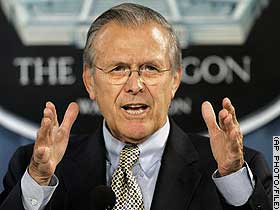
It is known that there is an interview given by Donald Rumsfeld, one month after the events of September 11, 2001, in which he explicitly mentions a missile. To jump directly to this passage. Otherwise, here is the full interview, translated by Mr. Makaligooa.
To consult the original Pentagon document, in English. 500 K in pdf. The key passage is highlighted in yellow. As an indication, no media wanted to relay this information, reported by several readers to written press organs. The US commission report on 9/11 also does not mention it.
This document is still online, by the way :
http://www.defenselink.mil/transcripts/2001/t11182001_t1012pm.html
*but for four years no journalist has paid attention to its content!
http://www.defenselink.mil/transcripts/2001/t11182001_t1012pm.html
******
| Q | :
Let me start by asking you, most of us are programmed
to leave a building with smoke. What made you go towards
the fire here a little over a month ago, and what was
going through your mind? | Rumsfeld | :
Well, I was sitting here and the building was struck,
and you could feel the impact of it very clearly, and
I don't know what made me do anything I did, to be honest
with you. I just do it instinctive. I looked out the window,
saw nothing here, and then went down the hall until the
smoke was too bad, then to a stairwell down and went outside
and saw what had happened. Asked a person who'd seen it,
and he told me that a plane had flown into it. I had been
aware of a plane going into the World Trade Center, and
I saw people on the grass, and we just, we tried to put
them in stretchers and then move them out across the grass
towards the road and lifted them over a jersey wall so
the people on that side could stick them into the ambulances.
I was out there for a while, and then people started gathering,
and we were able to get other people to do that, to hold
IVs for people. There were people lying on the grass with
clothes blown off and burns all over them. Then at some
moment I decided I should be in here figuring out what
to do, because your brain begins to connect things, and
there were enough people there to worry about that. I
came back in here, came into this office. There was smoke
in here by then. We made a judgment about where people
should be. The chairman was out of town, so he was separate.
The vice chairman was with me. We had my deputy go out
to another site. At a certain point it got too bad and
we went into a room about 30 yards away here inthis building,
in the same general area but back that way that is sealable.
But as it turns out it wasn't sealable for smoke and so
forth. We worked in there, and we kept being told the
building had to be evacuated completely except for the
people that were in that group that were assisting me,
and they kept saying you should get out of here because
these people have to stay if you're here, as I recall.
I said fine, we'll do that at the appropriate time. They
were able to get enough of the fire out and then move
some air out that the increasing smoke stopped. It did
not disappear, but it stopped. We were in there throughout
the day, and never did go to (inaudible). The advantage
for me was I could be here near where the problems were
and I had full communications from the area -- to the
president and the vice president, the secretary of state.
I guess he was out of the country, wasn't he? It was the
deputy. | Q: In the interest
of time I'm going to move you along. I'm sorry if I seem
rude - | Rumsfeld: Not
at all. | Q: This is a question
that's been asked by many Americans, but especially by
the widows of September 11th. How were we so asleep at
the switch? How did a war targeting civilians arrive on
our homeland with seemingly no warning? | Rumsfeld: There
were lots of warnings. The intelligence information that
we get, it sometimes runs into the hundreds of alerts
or pieces of intelligence a week. One looks at the worldwide,
it's thousands. And the task is to sort through it and
see what youcan find. And as you find things, the law
enforcement officials who have the responsibility to deal
with that type of thing -- the FBI at the federal level,
and although it is not, it's an investigative service
as opposed to a police force, it's not a federal police
force, as you know. But the state and local law enforcement
officials have the responsibility for dealing with those
kinds of issues. They [find a lot] and any number of terrorist
efforts have been dissuaded, deterred or stopped by good
intelligence gathering and good preventive work. It is
a truth that a terrorist can attack any time, any place,
using any technique and it's physically impossible to
defend at every time and every place against every conceivable
technique. Here we're talking about plastic knives and
using an American Airlines flight filed with our citizens,
and the missile to damage this building and similar (inaudible)
that damaged the World Trade Center. The only way to deal
with this problem is by taking the battle to the terrorists,
wherever they are, and dealing with them. | Q: Please briefly
explain to our readers why it's not enough just to get
bin Laden and al Qaeda. Why this threat ought to extend
beyond that. | Rumsfeld: Well,
because they have trained any number of people that are
spread all across the globe, but there are a number of
terrorist networks in a number of countries that have
harbored terrorists, and to deal with one and ignore the
rest would be to misunderstand the nature of the problem.
There is a correlation, really, between the countries
that sponsor terrorism, and the countries that have been
weaponizing chemical and biological, and they're working
diligently to develop nuclear capability for the most
part. Not in each case. But that nexus is something that
ought to be of concern to people. Were that connection
to occur, obviously you're talking not about thousands
of people, but hundreds of thousands. | Q: What it sounds
like you're saying too in this process then is that we're
going to need to address Iraq's weapons of mass destruction,
particularly in the light of even the evidence that with
inspectors Saddam continued to build his arsenal through
the 1990s and now we don't know what exactly has happened.
Is that going to be a top priority as well? | Rumsfeld: Those
are decisions for the president, but he has been very
clear that he is deeply concerned about the problem of
terrorism. He is going to find terrorists and keep them
out and root them out, and he's going to create an environment
that suggests to countries that are harboring them that
they ought to stop. | Q: Unlike some
of our previous conflicts abroad, a lot of our efforts
at the moment are concentrated in a part of the world
where portions of the population are hostile to us, both
allies and enemies. A Washington Post editorial spoke
pretty eloquently to this subject yesterday. | Can you talk a little bit about your thoughts about the
balance we have to strike between the politics of the
reason, even some of the propaganda that exists in the
region, and our own security interests? | Rumsfeld: We have
to look at our sec...