Crash at the Pentagon
The Pentagon Gate
Page 2
October 6, 2003
Thierry Meyssan's book "The Pentagon Gate," plate VI, provides photos taken between 9:10 and 10:10. Firefighters were already on the scene. The text says, "a secondary fire had broken out, a truck parked in front of the Pentagon having caught fire. The smoke coming out is that of a hydrocarbon fire" (black, in contrast to the "urban fire" smoldering behind, which emits gray smoke.
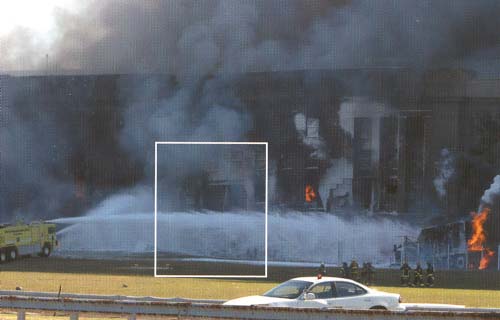
**1 - A fire truck is spraying a fire that broke out in another truck parked in front of the Pentagon (on the right). The place where the object that hit the Pentagon struck the facade is indicated in the white rectangle. **
On the following photo, an enlargement of this hole presented as the point of impact. It is a very intriguing photo. Indeed, the opening seems to be rectangular in shape. The windows above and on the sides can be seen. The upper part seems to be part of a floor. The hole spans the space of two windows and is said to be 5 to 6 meters wide. This would correspond to a wall that had been battered. In front of it, the water jet from the fire truck. We do not exactly know what appears in the middle of the hole. Is it a wall seen from the side or a fragment of a beam hanging down?
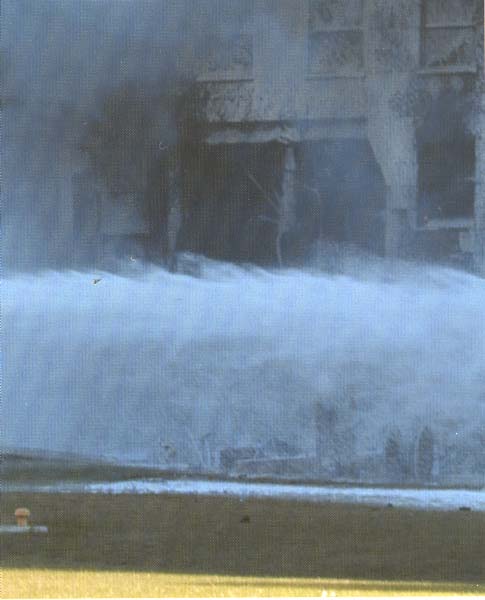
2 - The entrance hole, enlarged
It should be noted that opposite this entrance hole, the lawn is ... intact, whereas it should normally be flooded with burning kerosene, if it were the impact of a commercial airplane. It is also noted that there are no debris, no trace of the impact of the vertical stabilizer on the facade wall. When the landing gear is not extended, a Boeing 757-200 is twelve meters high.
It should also be noted something, unless I'm completely mistaken: The windows located just above the largest opening and the one on the right, as well as others, seem to be stained with something that looks like dry ice. Whatever the exact nature of this substance, the glass is intact, whereas the plane was apparently completely pulverized. Can someone explain how a commercial airplane could hit a facade, completely disintegrate, and yet have windows located so close to the impact remain intact?! There are no visible bodies, no landing gear debris, practically nothing except pieces of aluminum. So where is the rest? We are told it is inside. But through which opening? Through which hole did this huge fuselage, with its cargo of human beings (sixty passengers), their suitcases, the cockpit electronics, the landing gear struts, etc., etc. (there are many things in a 757) enter? It cannot have been through a tiny hole. Therefore, we must consider the largest hole. If it is the largest square hole, then the tail would have hit the facade on the immediately upper part. Go back to the previous image: the windows are intact! We fall back on the general idea linked to the official theory: the plane hits the facade and "folds like a bassan folds its wings (and tail) to manage to slip inside. Reenactment, please! An airplane wing is not made "only of pieces of aluminum. There is a strong longeron, which takes the stresses. This longeron must have hit the facade at 450 km/h. Where is the mark of the impact?
If, as noted by Milanini, there are several impacts, several holes, and if these correspond to the penetration of the engine blocks into the building, then where did the fuselage hit and where is the mark of the tail's impact? Please explain......
The engine blocks are compact structures (see my drawing further on, where they are represented in red). The engine axes take all the thrust of the plane. They are not light alloy assemblies, susceptible to being pulverized. In all crashes, at least one identifiable engine has been found. If nothing was found outside, it is because these engines are inside. How? If they had hit the outside and not penetrated, we should have found identifiable elements, not just "simple pieces of aluminum." If they penetrated inside and "had a wild run," how did these debris vanish, when, according to Milanini, they would have passed through three building sections where there does not seem to have been a heat so intense as to vaporize everything. Look at the hole shown on the cover of Meyssan's book. Something must have hit this wall at the end of its course? The fuselage? Not compact enough. Then, an engine? But then, in this courtyard, at the foot of the firefighter, there should be identifiable debris. There hasn't been "a heat of a furnace that vaporizes everything," since above the hole there are simply broken windows.
When there is a major fire glass melts. In 1959 I was in a Dauphine driven by a young engineer, a military officer, who later became a general: Gildas Rouvillois. His somewhat impulsive driving made us leave the road (in a straight line, simply trying to overtake a truck, nothing coming the other way) with several flips. By miracle we came out without injury. But immediately the fuel tank caught fire. It was full: 40 liters of gasoline. All the windows melted. They were found the next day as blocks of glass in the car's body. Has anyone found blocks of melted glass in the debris of the Pentagon?
In fact, nothing was found because nothing was preserved or because "the elements of the investigation were considered to be of defense secret." Not only did the plane vanish, along with its passengers (and, as Mr. Milanini points out, their seats!), but if there were any remains, they have ... done the same. There is room for a re-examination of the investigation, don't you think? But in the USA, asking the question "was something wrong" is considered impious. How come the French press simply refused to even consider the question, contenting itself with scandalized comments on this "primitive anti-Americanism." This confirms more and more what I am beginning to think: our journalists don't think, don't reflect, they repeat what they hear here and there like parrots. Unless someone firmly asks them not to be interested in the subject. Last hypothesis, perhaps not the farthest from reality: indifference and absence of professional conscience.
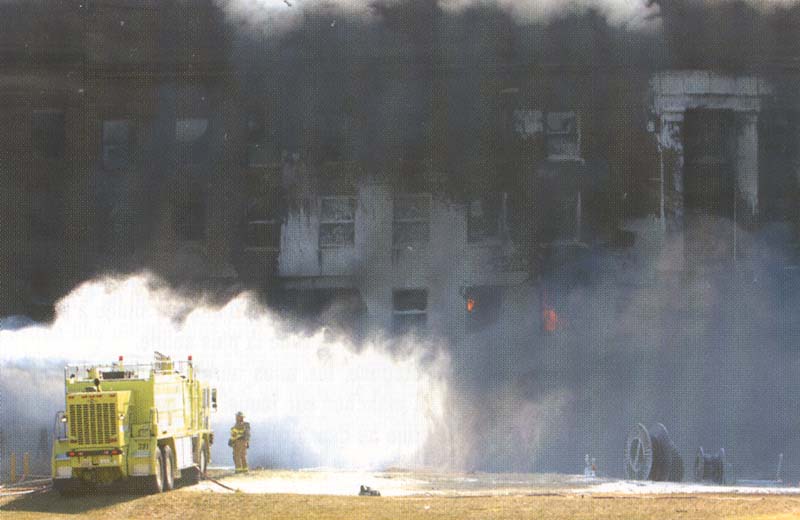
3 - Another view of the entrance hole, now open.
This image is interesting. The entrance hole, roughly rectangular in shape, appears open this time. The firefighter in the foreground gives the scale. Inside, one can see flames from a fire that is just starting. One can then wonder what could have made this hole. To find out, let's look at how a commercial airplane like the Boeing 757-200 is constructed. I mention in passing that I graduated from the École Nationale Supérieure de l'Aéronautique in Paris, 1961.
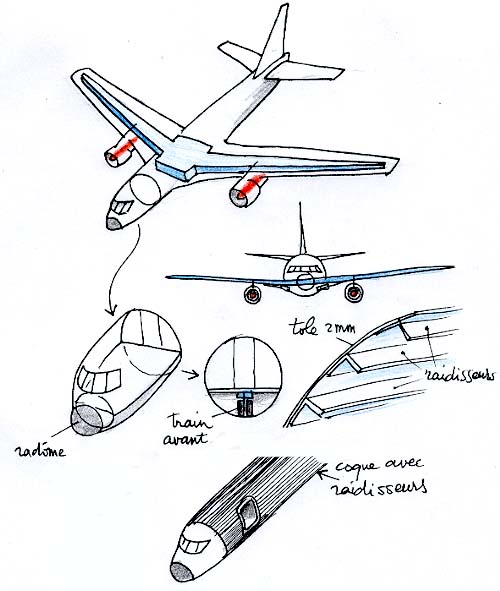
4 - Typical structure of an a...