Collision between a commercial airplane and a simple noise barrier
Can an airplane fuselage pierce a concrete wall?
November 25, 2007
The question is not as straightforward as it might first appear. At the beginning of the century, people amused themselves by demonstrating that one could pierce a wooden door using... a candle, provided the candle was fired from a hunting rifle, thus endowing it with kinetic energy.
Taking this reasoning much further, a reader named Jean-Sylvain Delroux developed a theory based on experimentation. By forcefully projecting a straw into a potato, he managed to drive the potato into its target and concluded that an airplane fuselage could be likened to a "large straw" and the Pentagon building to a "large potato." Thus was born "Delroux's Effect" (May 2004).
Recently, a commercial aircraft made a minor error and collided at low speed with a noise barrier at a French airport. Here are the photographs:
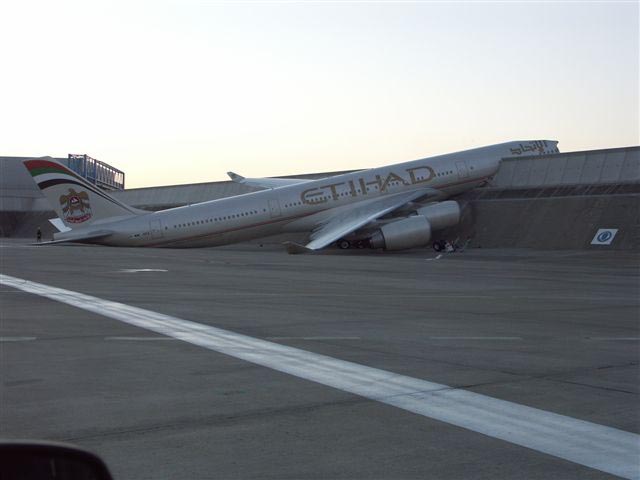
The aircraft, moving at taxi speed, first climbs over the noise barrier's support structure.
The front part of the aircraft then hits the 10-centimeter-thick noise barrier. The results of the impact are visible in the two photos below. They reveal the fragility of a commercial airliner's cabin, which resembles... chocolate wrapper:
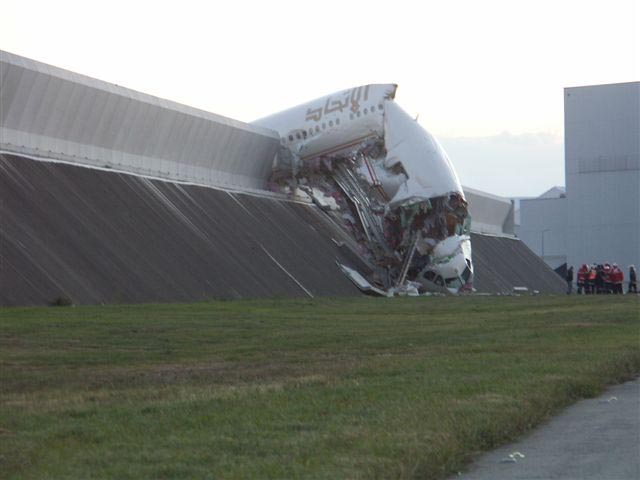
It was only the aircraft’s own weight that caused the entire front section to collapse and buckle.
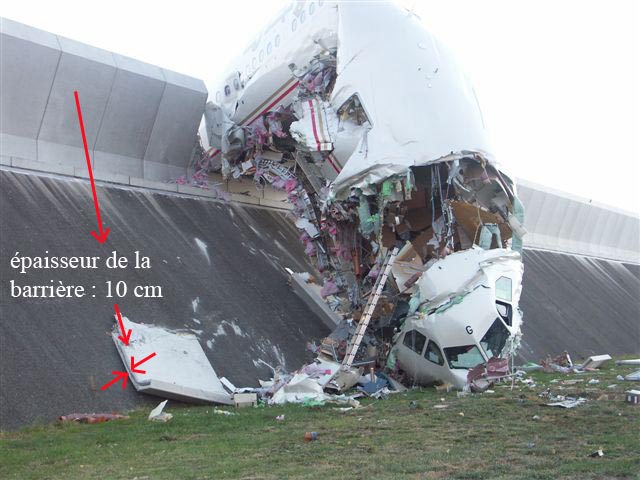
In this third photo, the fragment of the interior wall that damaged the entire front of the aircraft is visible in the foreground.
Can we trust the various videos corresponding to the numerical simulations carried out, particularly at Purdue University in the United States? Returning to the only test that could lend credibility to the official thesis regarding the "crash of Flight 77 into the Pentagon": a proper reconstruction, using a building wing rebuilt exactly as it was, at least structurally. And a 767 carrying the same amount of fuel, remotely controlled, approaching at 60 cm above the ground, at the same speed, with not corpses, but at least animals, luggage, and everything that could constitute the contents of such a commercial aircraft.
If the aftermath of the impact matches the photographs, then we would have no choice but to accept it. This would mean that a jet traveling at 600 km/h could penetrate such a building through a 3-meter by 3-meter hole, folding its wings and bringing fuel inside. Its kinetic energy would be so great that it could pierce several walls and finally create the well-known exit hole in an inner courtyard—despite the fact that the object achieving this feat was never found or displayed.
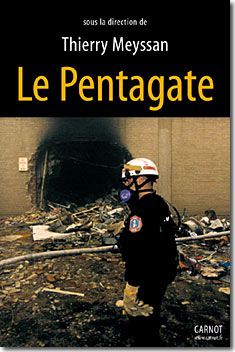
Pentagon: the exit hole
One might remain equally skeptical when viewing the simulations carried out by the same laboratory, this time concerning the impact of aircraft on the World Trade Center towers. Was the kinetic energy of the planes sufficient to enable such penetration into the buildings, or was the entry facilitated by a missile strike from extremely close range, as seems indicated by an unusual light captured by three different video cameras from three different angles, precisely at the point of impact? The aircraft involved were, moreover, quite strange—especially one that appeared to carry a large container, a "pod," beneath its belly, an accessory typical of military aircraft, not civilian airliners.
Once again, only a simulation using actual structures would provide a credible answer.
This is one of the many aspects that cast doubt on the entire official version.
This entire story is utterly monstrous from beginning to end. In passing, we can add a clarification provided by a reader of one of the numerous studies published online. The Americans, Russians, and other major powers possess incapacitating gases with extremely rapid action. These gases were, for example, used during the famous hostage-taking by Chechen activists at a Moscow theater. Speed was essential, as the bomb carriers—“human bombs”—could trigger their detonators with a quick hand movement. These gases (a webpage listed their nature and composition) are quite heavy and fall on their targets like real gas caps. Loss of consciousness occurs in mere tenths of a second, after a single breath. The target then has no chance to activate any device. Some of these gases are simply lethal. Others (it is said) can be countered by an antidote, such as those used in the Moscow theater incident.
Anyone who has questioned the true nature of the aircraft involved in the "hijackings and attacks of September 11, 2001" has asked: "What happened to these planes and passengers?"
This is a question that demands an answer. First, note that both civilian and military air surveillance systems were remarkably non-operational that day, all military aircraft having been drawn away from the area for "maneuvers."
In another dossier, you have seen the sudden change in direction of Flight 77 and its redirection toward the Pentagon (in just a few minutes), based on data from a black box provided years later by military authorities. Did things really happen this way? In the following opinions expressed at http://www.patriotsquestion911.com and their French translation, you will see how many high-ranking military officials remain skeptical. But if the Pentagon was struck by a missile, what became of the aircraft and its passengers?
Pilots and passengers could have been killed very quickly by the release of a lethal gas in a specially prepared aircraft transformed into a "gas chamber." Pilots have a button they can press in a fraction of a second to signal that they have been hijacked. Did they have time to do so? More simply: was this button active or disabled?
It was then extraordinarily easy to remotely take control of the aircraft and either land it at some military sanctuary where all traces of the plane and its passengers would disappear, or detonate the plane over the Atlantic, some distance from the coast.
Aircraft have already been destroyed mid-flight by explosives placed in a suitcase or a small object. Significant fragments were then recovered and submerged. But if the aircraft was configured for a "controlled demolition," practically nothing would remain. It all comes down to the amount of explosive carried onboard.
Whether the aircraft was destroyed in flight or on the ground, this rules out the possibility of...