Cinema Angela Luc Besson Jamel Debbouze
Thank you, Mr. Besson
January 1st, 2006
I went to see Luc Besson's film Angela twice. The second time, I brought a friend along. But already, at the large Cézanne cinema center in Aix, the film had been moved to screening room 4. During the Christmas holidays, no lines, half-empty auditorium. I don’t get the sense that the public connected with it the way they had with Jean-Pierre Jeunet’s film Amélie Poulain. That film was funny, quirky—people need to laugh.
Besson’s film is different. I rediscovered the breath of black-and-white films from the 1950s, like Green Pastures or Miracle in Milan. I don’t have the memory of a cinephile—others will recall the directors behind such films.
I’ll reveal the theme of the film. Too bad. Maybe it’ll make you want to go see it. Jamel Debbouze delivers a complete, full-bodied performance as an actor. He’s not funny here—he’s deeply moving. Perhaps that’s what audiences don’t understand. People love to label things. Delon, who’s always been an excellent actor, never escaped being typecast in police films because of that. Jamel has the label of a comic. But here, he’s a great actor who breaks through the screen.
At the beginning of the film, Jamel-André is a complete mess.
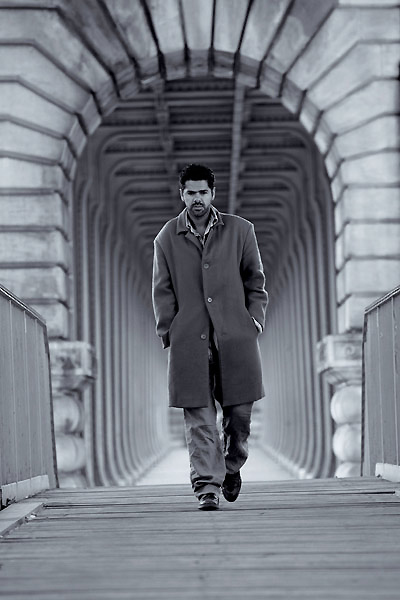
A bad businessman, a bit of a con, who’s borrowed money from dangerous people and now faces threats of being killed if he doesn’t repay them. At the end of the day, having found no solution, he tries to get himself arrested at a police station “just so things can calm down.” A large cop listens to him, distractedly. Jamel tries to move him:
- I’m at my wit’s end. Don’t you understand?
And the cop replies:
- Is this for a hidden camera prank?
Jamel ends up on the parapet of a Paris bridge, determined to end his life. He looks up at the sky and says to God:
- Is this what you want?
But to his left, he sees a tall blonde woman, standing on high heels, facing the muddy waters of the Seine. She looks like she’s been crying a lot. André calls out:
- Hey, what are you doing here? Why are you standing like this?
- You can see for yourself. Same reason as you.
And she jumps.
Without thinking, little Jamel leaps too—his left arm, malformed and always hidden in a too-big shirt sleeve—swims, and saves her life. Now they’re both on the riverbank, face to face. The girl is a head and a half taller than him. She has a charming accent, messy straight blonde hair, and her makeup has completely run. We don’t know where this actress came from, where Besson found her. Her name is Rie Rasmussen. A Nordic name. Swedish? I can’t remember. In Journey to the Center of the Earth, Jules Verne’s heroes followed the trail of Aarne Saknudsen. It’s similar. I remember Jean-Christophe and I went there when he was ten, searching for the entrance leading to the Earth’s core. One day I’ll tell you about it. I’ll scan our travel journal. I’ve kept them all. While others stayed on the edge, we descended into the steaming craters, all the way to the bottom, searching for the entrance.
This blonde actress is excellent in every way. She has fantastic presence. And that’s no small feat, facing a little genius like Jamel, who seems to ooze talent from every pore of his skin. But perhaps that’s Besson’s genius—this great director. When you watch his scenes, you feel they’re perfect. I think this film is a masterpiece, and maybe people just don’t realize it. The plot, the dialogue, the performances of the two actors: I was completely carried along from beginning to end. I even ran.
People may need to laugh. Jeunet’s film was funny, surreal from start to finish, of course. I remember Rufus receiving yet another postcard showing his garden gnome traveling around the world, repeating:
- I don’t understand...
With Angela, Besson takes it a step further. He takes every risk, including the biggest one: speaking directly to the hearts of the audience, disturbing them in an unapologetic way—no sex scenes, no violence, no exploding or burning cars, no machine-gun fire, no dozens of deaths—yet those are the ingredients that work today. Besson, who can command an army of extras, creates an intimate, auteur film. Maybe that’s where he reveals himself? Laughter lets us forget, even briefly, the anxiety of our fleeting lives. What Besson offers us is the unfolding of a miracle. Jamel-André is utterly desperate, and heaven sends an angel across his path. For this woman truly is an angel, and she quickly reveals it to him. She’s on a mission—to help this little André, who doesn’t love himself, who only makes mistakes in life. To help him finally see himself as he truly is: beautiful inside, tender, touching, warm.
There are several actors in this film, but we only see the two leads, only hear their dialogue, without a single pause. Both are equally matched. Jamel is already famous. Maybe the real magician is Besson—the man who knows how to create miracles. He reminds me of Knoum, the potter.
I’m spoiling the story, but it’s so you’ll go see the film, so you can savor it to the very end. Angela’s role is to help Jamel-André finally become himself, to speak the truth, to finally be real—instead of just spouting nonsense and getting himself into endless trouble that always comes back to bite him.
There’s a key scene in the film. Angela and André are in the restroom of a restaurant. She takes him by the shoulders and leads him to look into a mirror. Slowly, Besson’s camera passes through the wall and ends up facing them. Angela tells André that no one has ever told him they love him. And to show him how simple it is, she says:
- I love you, André.
And Jamel-André replies:
- I love you, Angela.
The film is in black and white throughout, and it must be. Color would be inappropriate, because this film isn’t from our time. It feels like something from René Clair. Hats off to you, Mr. Besson, the magician.
From that moment on, everything shifts. The lightning strike takes hold. It’s not just something that happens in novels or films—though many people never experience it, as if they were naturally protected by a lightning rod. The lightning strike is an irrational phenomenon that pierces you.
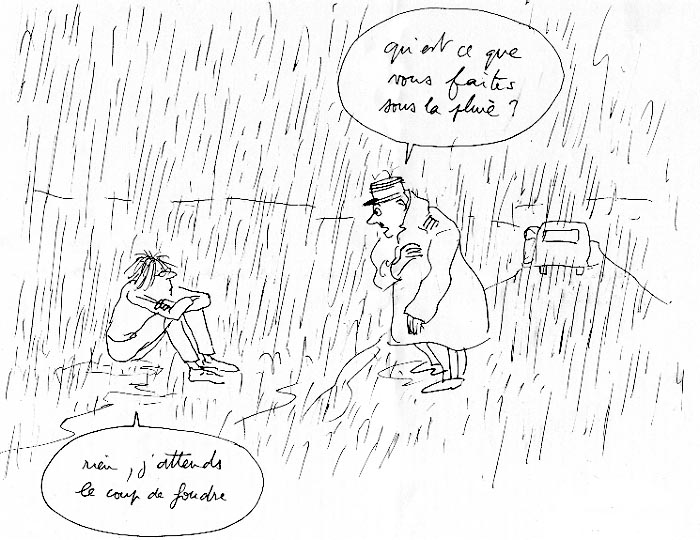
The mechanism kicks in, and Besson masterfully sets the gears in motion. What happens next wasn’t on the schedule. This little Jamel is so charming, so sincere that Angela falls in love with him. Along the way, we learn who angels are. They don’t remember their past. It’s “top secret,” she says. They’re sent on missions. It’s “the schedule” that decides. When their mission is complete, their wings unfold and they fly away. Their powers are vast—they can levitate ashtrays, knock tough guys to the ground with a single punch, predict the results of every horse race, which helps them pay their hotel bills.
Angel...