The Antonov 225, the largest airplane in the world
April 15, 2010
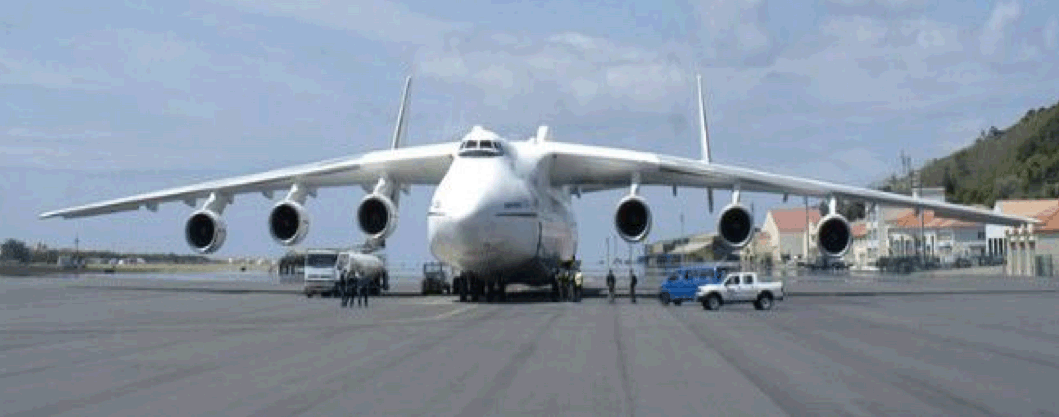
The giant, on the ground
Span: 85 meters, eight more than the Airbus 380. Length: 90 meters, ten more than the French giant. It is capable of carrying 250 tons of cargo. The diameter of its air intakes, its "blowers," is such that one could park a large truck inside. The wings are flexible. On the ground, they give it a pronounced negative dihedral. During takeoff, these enormous feathers, whose surface area is about 1,000 square meters, gradually rise upward. The protrusions visible on its upper part allow it to secure heavy and bulky loads such as a 65-ton space shuttle:

The Antonov 225 taking off with a 65-ton space shuttle on its back. Its main landing gear consists of 32 identical wheels.
Russian philosophy has not changed: "It's rugged, it's heavy, but it works. Ornamentation, design: no! Petty bourgeois decadence."
This image reminds me of a visit I made to a huge hall where, in Moscow, the achievements of the Soviet Union in space technology were once displayed. These were not models, but operational vehicles. The "furniture" of the space capsule was made of varnished plywood. On the photo above, note the "formica" style table from the 1950s, the defect in the plastic trim of an armrest. In the Russian space capsules of the 1960s, the windows could be covered with a piece of printed fabric, hastily sewn.
In those same 1960s, my colleagues and I were amazed to find oscilloscopes with hand-painted casings. But their performance was the same as that of their sleek American counterparts. Let's approach the control panel:

The yellow arrow points to an external stiffening angle, made of light alloy, fastened with three round head screws, whose sharp edges have been "tapered with a file." Red arrows: the paint flakes off on any relief and on the rudder pedals. The components of this control panel are fastened with screws that fit into crosshead screwdrivers.
But all of this flies, very well, even. Attention is paid to the essential, not to the accessory. Zoom back camera:

Near the front windows, two sturdy fans. On the left, the crank used to open the window (at rest).

For the seat covers, a non-staining material was chosen. On the tray, a coffee filter.

The rest area: deliciously kitsch.
Traditionally, in airplanes, Russian passengers take off their shoes to be more comfortable.
A mobile crane capable of carrying five tons. Normal: the trap can carry 250!

On both sides, solidly braced, spare wheels.
And, to conclude the series:
Now: the Antonov 225 and the Airbus 380 in flight:

http://www.youtube.com/watch?v=1dp9JjuJbZ0&feature=fvw
News
Guide
Home