The Warriors of the Future
February 16, 2005
May 12, 2005:
Replicants
A new company is about to make headlines. Its name: SWORD (in English, "sword").
Special Weapons Observation Reconnaissance Detection Systems
This time, it's a ground-based drone—the first of a long lineage. Evolution is inevitable. A soldier is expensive. He must be fed, cared for, given a pension and retirement benefits. He has emotions, moral qualms. Ground robots had already been tested in Bosnia and Afghanistan, where they completed over 20,000 missions. They were, like the future Sword robots guided by soldiers comfortably seated in front of screens—more accurately, wearing helmets with 360-degree vision. When the human turns his head, the robot, miles away, does the same—left, right, up, down. Cost of one Sword: $230,000.
In passing, to learn more about robotics, read "What Do Robots Dream Of?"—out of print in bookstores, available on the Lanturlu 1 CD.
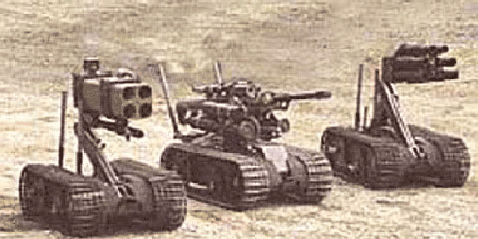
The drawback of ground robots is their difficulty navigating varied terrain. Let's take a look at the robot developed by the company Sword:
The Sword combat robot.
This robot was inspired by research conducted by demining companies. It performs well in open terrain, but becomes confused by stairs or tree trunks. Yes, humans remain an extraordinary machine for navigating the most diverse terrains—though unfortunately, they are also vulnerable. So what will the combat robot of the future look like? Hard to say. A kind of "Terminator," a steel infantryman? I'd tend to think that the flying drone has an advantage over humans. It can do things humans cannot. Advances in nanotechnology mean it can be undetectable, as small as...
an insect,
whose flight it can mimic. There could also be larger drone carriers. A drone-insect could slip through a window, even navigate inside a building following a precise flight plan. There are a thousand ways to kill. The machines shown above are heavy, crude. They can fire 60 mm missiles and 50 caliber shells. Mini-drones can explode upon contact with their target. A few grams of explosive are enough to kill a human. Anyway, in Iraq and elsewhere, drones will soon be going on the offensive.
Americans blindly believe in their technology. To them, it appears to be the solution to all their problems. It's a strange psychology—as if they viewed human beings as... insects.
May 7, 2005:
A four-meter-tall robot capable of stopping a car?
A reader, who did not give his name, directed me to the site:
http://www.r50rd.co.uk/research/internal/v2i/engin/
which contained various videos. The inventor of this robot was supposedly an English engineer in retirement, Colin Mayhew:
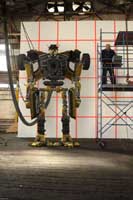
And here is his machine:
Among the videos presented, this one:
http://www.r50rd.co.uk/research/internal/v2i/engin/videos/stop_test.htm
The inventor drives his 4x4 toward the back of the hangar. The robot then takes position, kneeling on one knee, and stops the car with its left hand while pressing its right hand against the roof to immobilize it. Mayhew admitted, "I still had my foot above the brake pedal, not entirely sure my robot would actually stop my vehicle."

Fortunately, when I'm the target of a hoax, I have a whole network of readers who step in immediately. Arnaud Riess investigated. Within an hour of the video being posted, the truth was uncovered. The incident remains instructive, showing how difficult it is today to distinguish between fiction and reality due to the high quality of computer-generated imagery. In fact, this hoax was a promotional video for BMW, since at the end the inventor said that among the various companies that contacted him, BMW seemed best equipped for collaboration.
Thank you, Arnaud
May 12, 2005, from yahonews:
Thursday, May 12, 2005, 9:35 AM
Replicant Robots: When Science Dreams of Matching Fiction
LONDON (Reuters) – Replicant robots are no longer confined to science fiction, now that American researchers have created models capable of assembling structures similar to themselves.
Each robot consists of an identical arrangement of 10 cm cubes, electromagnets that attach and detach, and a replication software designed by scientists at Cornell University in Ithaca, New York.
The robots can lean over to pick up cubes and stack them.
"Although the machines we've created are still simple compared to biological self-replication, this demonstrates that self-replication is possible in mechanical systems and is not exclusive to biology," says Hod Lipson in an article published Wednesday in the scientific journal Nature.
His team and he believe the principle could be applied to design long-duration robots capable of repairing themselves or each other in dangerous situations or during space missions.
Powered by contact with the table on which they operate, these experimental robots—doing nothing other than replicating—exchange data through the faces of their cubes. The machines lean over to place their top cube on the table. Then they lean again to pick up another cube and place it on top of the first, repeating the process. As the new robot begins to take shape, it participates in its own construction.
"Four-module robots can build a replica in 2 minutes and 30 seconds," adds Lipson.
Back to the Arms dossier---