American Robots Tested in Iraq
March 25, 2005
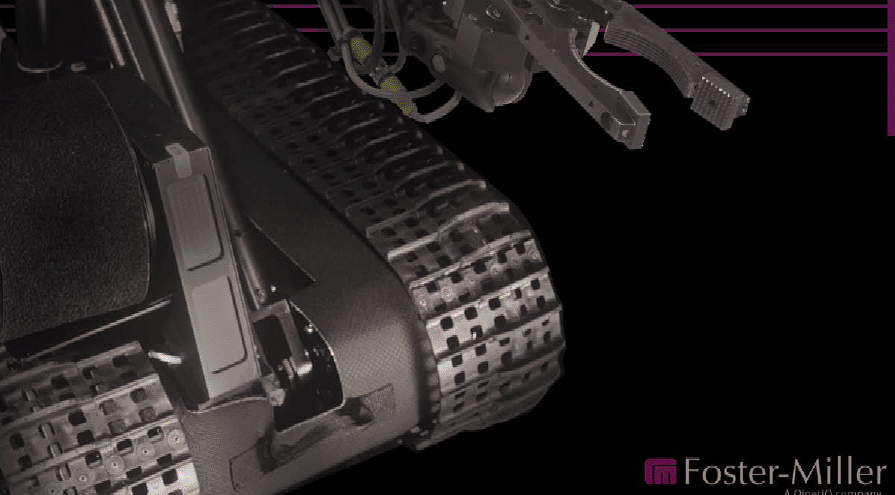
The Americans have tested many things in Iraq, including this multi-purpose robot, light enough to be carried by a single person. It is produced by Foster Miller Inc. Here, a close-up of the mini-robot's gripping claw, named "Talon."
Source:
http://www.foster-miller.com/lemming.htm
Below is a description of the device, whose motorized platform can accommodate various equipment.
On the left, the watertight case containing its joystick control and piloting system.
Here are the specifications of the vehicle:
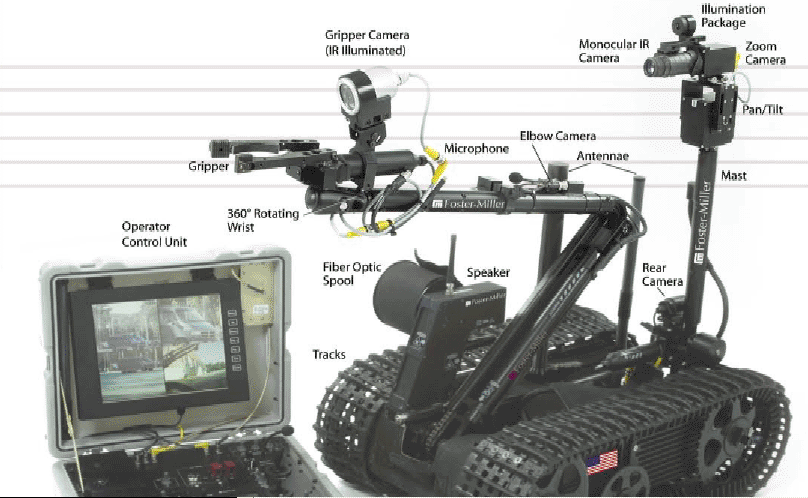
Height: 30 cm (this is the base platform with its arm folded. When extended upward, it reaches 1.5 m)
Width: 57 cm
Length: 86 cm
Ground clearance: 7 cm
Weight: between 34 and 54 kg (man-portable)
Speed: approximately 8 km/h (walking pace)
Joystick control
Capable of climbing stairs with a 45° incline or moving across terrain with a 56° slope
Payload capacity: 45 kg
Can generate a pulling force of 90 kg
Power supply: rechargeable lead-acid battery (2 hours at full speed) or lithium battery (4 hours at full speed)
Communication and remote control: designed for a range of 800 m; with a high-gain antenna, up to 1,200 m
Four color cameras
All systems can withstand immersion up to 27 meters deep. Equipment is designed for operation under all temperature and climatic conditions, including deserts, etc.
Audio communication (for speaker and communication with troops)
Optional: all types of sensors
Optional: X-ray analyzer, cannon
The manipulator arm with its gripper can lift between 9 and 11 kg
The robot can be equipped with GPS guidance
A long list of optional equipment: infrared vision system, spotlights, barbed wire cutter
User training: 2.5 days
Parts guaranteed for one year
Talon robot in Iraq.
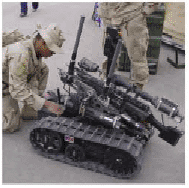
A soldier carrying a Talon on his back, with its manipulator arm folded (34 kg)
The Talon robot can operate in relatively rough terrain.
Talons equipped with various gear: rockets, cannon, rocket launcher.
Firing systems can be elevated "at arm's length."
Close-up of the gripping claw during night vision operations.
These small robots have already been used in Iraq. Their durability has become legendary. One of them, having detached from the roof of a vehicle, fell into a river. Soldiers managed to recover it by remotely maneuvering it underwater. We can consider these mini-robots just the beginning of a much more impressive arsenal already in development. Let’s say that in laboratories, machines far more sophisticated undoubtedly exist. Indeed, what represents an absolute advantage in these new weapons is not so much their caliber or the array of gadgets they can deploy, but rather
a far more serious threat looming ahead—the emergence of "adaptive robotics," in other words, artificial intelligence (the ability granted to machines to reprogram themselves).
I explored this theme in fiction in my book "The Year of Contact" (Albin Michel, 2004).
See on my homepage
Few echoes, no media coverage, low sales.
Yet, a book containing the essential elements of this artificial intelligence, which, unfortunately, when it emerges, will become an instrument of absolute domination in the hands of humanity’s worst kind.
Back to the Weapons dossier---