Basic Instinct
Basic Instinct
March 29, 2006
Yesterday I opened the newspaper "Le Monde." I first came across a long interview with footballer Lilian Thuram. The text hit me straight in the heart. This young man didn’t stumble; he spoke precisely, even citing the foolish remarks of a French intellectual, Alain Finkielkraut.
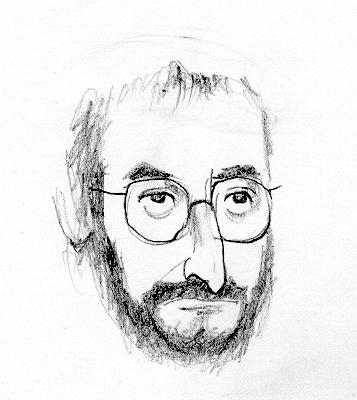
Alain Finkielkraut
But when you have a lot on your mind, it's easy to say foolish things. It all depends on how you use them. Summing it up in a single, concise sentence, I’d say that it often happens that an "intellectual," or someone claiming to be one, is simply an idiot who has studied. In fact, the proportion of idiots is the same everywhere—among whites, blacks, the rich, the poor, intellectuals, non-intellectuals, journalists, academics, philosophers, astronomers, butchers, gays, straights, the famous, the unknown, priests, etc. A few years ago, in the chaotic mess that is my website, I created a dossier announcing that "we had discovered that the CNRS had the same proportion of idiots as the rest of the population." If you type "idiots" into the site’s internal search engine, you’ll find this dossier. (By the way, I’m currently compiling a list of keywords that, when entered into my site’s internal search, lead to specific folders. If readers could send me a list of such keywords via email, I’d be happy to add them. There are probably several thousand.)
Let’s close this parenthesis: there are idiots among intellectuals, as Thuram’s text demonstrates—though we might have suspected as much already. So what is intelligence? Perhaps it’s above all something that comes from the heart, and in our footballer, it’s precisely that organ speaking. On the other hand, I’m not sure that people like de Villepin or Jacques Chirac, or so many others, possess one—except perhaps a vague pump. At the very least, if they do have hearts, they lack brains. Or else they’re not saying what they truly think. If they’re thinking at all—which would require proof.
I don’t know if you’ve read Victor Hugo’s "Notre-Dame de Paris." A film was once made with the delightful Gina Lollobrigida. At the end of the book (or the film), the poor emerge from the "Court of Miracles" and flood the streets. Today, replace the phrase "Court of Miracles" with "suburbs." In his book, Hugo describes this Parisian place—a space of lawlessness where all the city’s outcasts gathered, and where the royal guard never dared enter. In short, at the end of the book, this population invades the streets, unleashing their anger, smashing, burning. Then, the king of the time, Louis XI, says:
- When the common people overrun the streets, they must be repressed, crushed.
Indeed, at the end, the troops, the soldiers in helmets and armor, corner this "common people" in narrow alleys and cut them down with sword and thrust until they retreat back into their ghetto—the "Court of Miracles." The sword replaces the Karsher. For in Louis XI’s time, ghettos already existed. Our modern ghettos aren’t for Jews or Blacks; they’re for the poor, for those with no future, whose numbers grow daily despite successive "reforms." You’ll find the reason behind this rise in precariousness in this dossier—simply. The problem is global. Marxism produced monstrous outcomes. This wretched liberalism is leading us straight to catastrophe.
If you didn’t know, France has Black people in its population. Not only Black people as black as ink, like him, but also yellow people like quinces, café au lait, curly-haired, straight-haired, all kinds.
It also includes the rich and the poor, those with a future and those without, those with knowledge and those without. We are a colorful country, full of variety. Thuram questions, seeks solutions. In the end, he suggests one: launching a large-scale plan to educate these "people from the ghettos." We fully agree with him. Especially since knowledge today has become free. It’s easier than ever to distribute. We don’t even need paper and ink. Machines are everywhere. ADSL is reaching the suburbs. A simple USB key costing just a few euros holds more than a vast library.
We’ve only recently launched a race against ignorance. Check out Savoir-sans-Frontières. If you’d like to support this movement, send a few euros to our bank account—details are on the homepage. It’s a beautiful idea. In just three months, a flood of translators arrived, charging 150 euros per album. We created the association, opened a bank account with La Banque Postale. We can finally start paying these people. What we hadn’t anticipated was that this amount, for many of them, represents several months’ salary (for Croats, Greeks, Arabs, etc.). In just a few months, translations into 25 languages! There are translations into Lao, Arabic. Most recently, the Economicon in Rwandan.
This aligns perfectly with what Thuram said in his Le Monde interview. Currently, I’m trying to find time to create new albums focused on teaching science (all who know my albums understand that they’re not just popular science books, but actual teaching materials, somewhat unusual, in the style of "laugh, we’ll take care of the rest"). These albums will be accessible to "12-year-olds"—that is, the general public and people "without basic scientific literacy." Logically, the Ministry of National Education should support such an initiative. Logically, they should print these books—now completely free, having fallen into the public domain—and distribute them by the hundreds of thousands in high schools, middle schools, and... suburbs. Production cost:
One euro per copy
I need to produce ten to twenty new albums quickly. I already have them in mind, but alas, days only have twenty-four hours.
I keep repeating this to public and private educational institutions, to libraries: everything is free! I’ve reclaimed the rights. Belin editions used to sell these albums (poorly) for 13 euros each by mail, plus shipping fees. That time is over: I’ve reclaimed the rights. Use them, download them, copy them onto CDs, install the files on your internal computer networks. To those who doubt me, I can provide written proof.
When these children's comics are ready—ideally at least one—I’ll try to knock on the door of UNESCO, the UN (with its hand-cranked computer developed at MIT, expected to produce 100 million units, they say). The fact that the albums are translated into African languages—Rwandan, Wolof, Swahili—might even interest Kofi Annan, who knows?

The hand-cranked computer (MIT - UN)
By the way, why did I give this page the title "Basic Instinct"? Because in the same issue of Le Monde where Thuram…